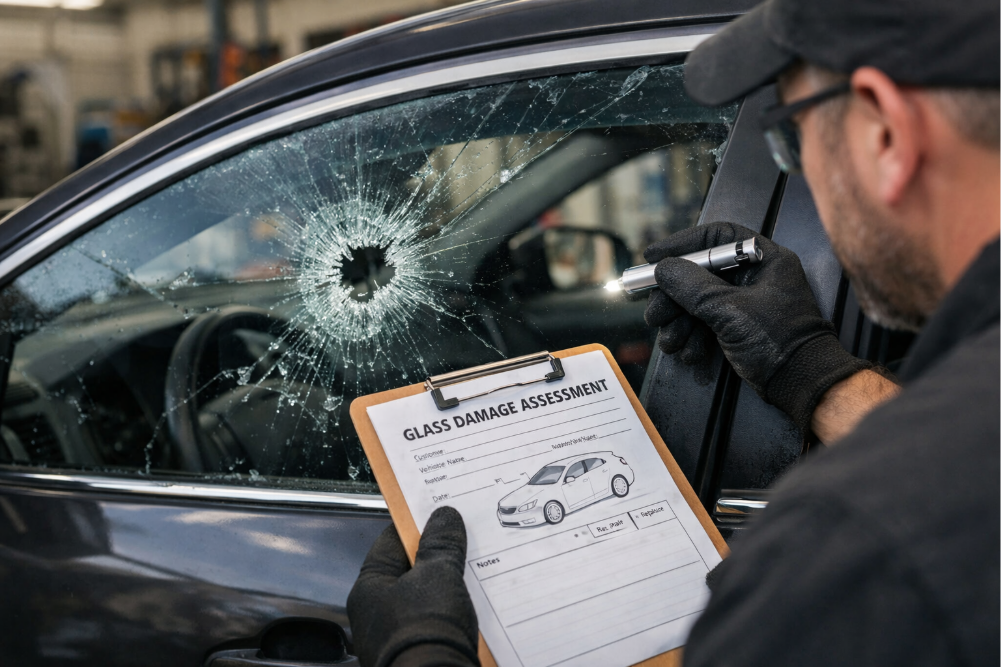
Side Window Glass Replacement Damage Assessment
Before you know how rapidly it might jeopardize the safety and structural integrity of your car, a crack in your side window may seem like a little annoyance. Damaged side window glass needs immediate maintenance and thorough inspection, regardless of whether it was brought on by a stray pebble, an attempted break-in, or temperature changes. You may save time, money, and potentially safety hazards by knowing when repair is feasible vs when replacement is required. This guide helps you make well-informed choices regarding the necessary repairs for your car by guiding you through the side window glass damage assessment procedure.
Get An Auto Glass Replacement Quote Now 866.278.7417

Windshield Replacement & Repair
Our competitors push you into going to their shop to get your glass fixed-making it cheaper for them. We make it easier for YOU to get back on the road by offering free mobile repairs at your home or work. With our free mobile services servicing the entire Orange County & Los Angeles area, we can often handle your windscreen replacement the same day! So the next time you need a windshield replacement, give us a call.
Talk to a Windshield Replacement Specialist Now 866.278.7417

Calibration
Calibration is the process of returning a vehicle’s ADAS to OEM specifications. Calibration is necessary after a new glass installation, particularly a windshield with a camera mounted to it, to ensure that the ADAS features continue to function properly despite having been moved during installation. If a car’s ADAS is not properly calibrated, the system may not function safely. A misaligned camera could jeopardize the functionality of the system and lead to dangerous driving or accidents, so it is crucial that the cameras are aligned perfectly, which is what windshield calibration ensures.
Talk to a Calibration Specialist Now 866.278.7417

Fleet Auto Glass Repair
We provide expert auto glass repair and windshield replacement services for commercial fleets of all sizes. We are experienced with all manufacturers and machine types of domestic or foreign cars, trucks, vans, or commercial vehicles, including heavy equipment. Our same day mobile auto glass and windshield repair service will enable you to get back on the road faster and start saving you time and money instantly. Give us a call today! We are here to help!
Talk to a Fleet Auto Glass Specialist Now 866.278.7417
Comprehending the Glass Construction of Side Windows
In terms of design and use, side windows are quite different from windshields. Tempered glass, which is used in the majority of side windows, is made to break into tiny, comparatively innocuous fragments when struck. In addition to protecting passengers in crashes, this safety element often necessitates total replacement rather than repair for even minor damage.
In contrast, windshields are made of laminated glass, which has two panes of glass with a plastic coating between them. Small chips and cracks may be repaired thanks to its structure. Because side windows don’t have this intermediate layer, repairs are usually very impossible.
In your car, the vent windows, quarter glass, and door glass all have distinct functions. While vent windows and quarter glass (the tiny triangle windows) improve vision and the appearance of the car, door glass offers access and ventilation. Depending on its usage and location, each kind may experience varying patterns of deterioration.
Common Types of Side Window Damage: Impact Damage: When things hit the glass hard enough, impact damage occurs. Small impact points may be produced by hail damage, rock chips from highway traffic, or debris from storms.
These could begin tiny, but because of the tempered glass composition, they usually spread. More serious impact damage is caused by vandalism and attempted break-ins.
Because side windows are simpler to smash than windshields, thieves often target them. Usually, these accidents cause total breakage, necessitating replacement right away.
Stress Cracks: Glass expands and contracts in response to temperature changes. Stress fractures may be produced by drastic shifts, such as blasting hot air on frozen windows or parking in the sun after using air conditioning. Usually, these fractures begin at the perimeter of the window and work their way inside.
Stress fractures may also result from accident-related frame damage. Glass is subjected to unequal pressure as the door frame bends or moves, which may cause breaking even in the absence of direct collision.
Damage to the Edge: Side windows’ edges are especially susceptible. Weak spots where fractures start might be created by installation flaws such poor sealing or missized glass. The rubber moldings and seals may deteriorate with age, leaving the edges vulnerable to moisture and temperature fluctuations.
Although little edge chips may not appear critical, they jeopardize the integrity of the whole pane. Because tempered glass is made as one piece, any damage to one component impacts the whole piece.
Determining the Severity of Damage
Surface-Level Inspection: Look at the damage first in a well-lit area. Check for any chips, cracks, or scratches, noting their size and placement. Take pictures of what you discover from various perspectives to assist you and the repair experts analyze your alternatives.
Make sure the damage doesn’t block your vision while you’re driving. Particularly at night or in direct sunshine, even little disruption to your field of vision might result in hazardous blind patches or distracting reflections.
Tests for Structural Integrity: Apply little pressure to the glass around any broken areas. Unusual movement, flexing, or noises are signs of impaired structural integrity. Never use too much force since weaker glass might break suddenly.
When driving over bumps or opening and shutting the window, listen for any strange or rattling noises. These sounds often indicate internal damage or that the glass has come loose from its fastening.
Safety considerations: Water leaks around the window may indicate that the glass is damaged along with the seal. Mold development, electrical system damage, and interior degradation may result from moisture entry.
Replacement is usually required for any damage greater than a quarter. Even little damage to tempered glass may spread on its own as a result of vibrations, temperature changes, or vehicle movement.
When Replacement Is Required: Tempered Glass Restrictions: Side windows, in contrast to windshields, cannot be fixed after they are broken. The internal tension produced during the tempered glass production process keeps the glass together. This tension is broken by any surface break, rendering the whole pane unstable.
Tempered glass cannot be repaired by do-it-yourself methods using materials used for windshields. Side windows don’t have the laminated structure that these items have.
Insurance Coverage Factors: Glass damage is covered by the majority of comprehensive vehicle insurance plans, which often include deductibles for glass replacement that are lowered or eliminated. To learn about your coverage and out-of-pocket expenses, see your policy.
Because glass claims are normally seen as no-fault accidents, filing a claim for the replacement of a side window usually has no effect on your insurance premiums. Before moving further, however, make sure of this with your insurance company.
Legal and Safety Requirements: State regulations pertaining to vehicle safety equipment may be broken by driving with damaged side windows. If damage reduces visibility or poses a safety risk, law enforcement may issue tickets.
The security of your car is jeopardized by damaged windows. They are simpler to break entirely, which makes your car a desirable target for thieves. Your safety and your possessions are safeguarded by prompt replacement.
Do you have a Question?
Get An Auto Glass Replacement Quote Now 866.278.7417
The Process of Replacement
Expert Evaluation: Skilled auto glass specialists precisely analyze damage using sophisticated equipment. In addition to the glass, they will also examine the seal quality, door frame alignment, and window regulator.
If any related components exhibit wear, the technician is likely to suggest replacing them. In addition to shattered glass, window regulators, weatherstripping, and mounting clips often need to be replaced, particularly in older cars.
Quality Considerations: Original Equipment Manufacturer (OEM) glass precisely complies with the original requirements of your car. Aftermarket glass might differ in fit, hue, and thickness. To make an educated decision, talk about these choices with your technician.
Expertise and specific equipment are needed for proper installation. Inadequate installation may result in water leaks, wind noise, or even broken glass. Select a trustworthy installation who is covered by warranty and has manufacturer qualifications.
Timeline and Costs: Depending on the vehicle and degree of damage, replacing a side window typically takes one to three hours. It might take longer for complicated cars with sophisticated systems like heating or rain sensors.
Depending on the kind of glass, the make and model of the car, and local labor rates, prices might vary significantly. Repairing luxury cars and cars with unique glass elements usually costs extra. When feasible, get many bids, but give quality a higher priority than price.
Avoiding More Damage
Precautions: Parking in covered spaces shields your windows from falling objects, hail, and very high or low temperatures. Use vehicle coverings for prolonged periods of time if covered parking is not available.
On roads, keep a safe following distance to decrease the chance of rock chips. Whenever possible, steer clear of vehicles transporting building materials or gravel.
Regular Maintenance: When doing standard auto maintenance, check the window seals and weatherstripping. To stop water entry and lessen the strain on the glass, replace damaged seals as soon as possible.
Maintain lubricated and clean window tracks. The glass may bind or shift incorrectly as a result of debris in the tracks, increasing stress and damage risk.
Resolving Minor Issues Quickly: Professional examination is necessary for even little chips within windows. A seemingly little issue might soon turn into a safety risk. Planning for replacement before emergencies occur is made possible by early evaluation.
Keep a close eye on any harm that has already occurred. Stop driving the car and make arrangements for a replacement right away if you see expanding cracks or increasing flexing.
Choosing the Best Option for Your Car: Side window damage need immediate care and expert evaluation. Because of the tempered glass structure, replacement is the only safe way to preserve the integrity of your car and your safety while driving. Repair is not an option.
Don’t put off fixing broken side windows. A little fracture may soon jeopardize the structural integrity, weather protection, and security of your car. For a comprehensive evaluation and high-quality replacement that returns your car to its original state, get in touch with a qualified auto glass specialist.
How Professionals Evaluate Damage to Side Windows
You see a little crack forming across the side glass of your automobile while you’re running late for work. Is it better to disregard it? Make a repair appointment? Or is a complete replacement necessary?
Not every fracture is made equally. While some are simple and safe to fix, others jeopardize the structural integrity of your car and need to be replaced right away. Most of the time, the discrepancy is due to variables that most drivers are unaware of.
You may save money, stay secure, and make wise choices regarding your car by being aware of how experts assess side window damage. Here are some factors that professionals look at while deciding whether to replace your side window.
The anatomy of car side windows: It’s useful to know what you’re working with before beginning to evaluate cracks. The construction and purpose of side windows are quite different from those of windshields.
Tempered glass, a form of safety glass that has been heat-treated to be four to five times stronger than ordinary glass, is used to make the majority of side windows. Instead of shattering into hazardous shards, it breaks into tiny, comparatively innocuous fragments.
Windshields, which employ laminated glass with a plastic layer positioned between two sheets of glass, are essentially different from this. Because of this, side windows usually cannot be fixed when they shatter, while windshields can.
Most important are size and position: A professional looks at two important aspects of your cracked side window first: the extent of the damage and its location.
The length of the crack is crucial. It is almost always necessary to repair any crack that is more than six inches long. These lengthier fractures will continue to expand because of the tempered glass structure, particularly when the temperature changes and the car vibrates.
Less than three-inch fractures may seem to be manageable, but placement is crucial. It is more troublesome to have a crack close to the window’s edge than one in the middle. Because edge damage weakens the seal between the glass and the door frame, it impairs the window’s overall structural integrity.
Moisture may enter via cracks that extend to the door seal or window frame, causing corrosion and electrical problems with power window systems. These must constantly be replaced.
The Effect of Spider Webs
A tiny impact point with several fractures extending outward like a spider web is something you have undoubtedly seen. This damage is referred to as “bullseye” or “star break” by technicians.
This pattern indicates a large amount of force focused in one place, often from an impact or rock hit. Energy has been absorbed by the tempered glass, causing internal tension that erodes the pane as a whole. The underlying structural damage is significant, despite the spider web design seeming to be modest.
Unpredictably, windows with spider web fractures will break. A little impact might cause them to break entirely or hold for days. For this kind of damage, replacement is always advised by professionals.
A contrasting tale is told by temperature stress cracks, which do not always result from collisions. Stress fractures caused by temperature usually begin at the border of the window and extend horizontally in rather straight lines across the glass.
These happen when there is a sudden change in temperature, such as when you use a defroster on a frozen window or park in the sun after using air conditioning. Stress fractures are caused by the glass’s unequal expansion and contraction.
Stress fractures are a sign that the window was previously weakened, either by small damage or manufacturing flaws. The only way to deal with them is to replace them once they arise. With every change in temperature, these fissures will keep expanding.
Do you have a Question?
Get An Auto Glass Replacement Quote Now 866.278.7417
Safety and Visibility Issues
Experts assess how the break impacts your line of sight in addition to structural problems. Even small fractures might cause glare, distort vision, or block off crucial viewing angles.
Side windows provide a vital view for evaluating blind areas, merging, and changing lanes. Regardless of its size or location, a fracture that obstructs essential functions poses an urgent safety risk.
Technicians also think about how safety features can be impacted by the damage. Sensors for driver assistance, automatic dimming, and rain sensing are often included into the side windows of contemporary cars. These technologies may become inoperable due to cracks, necessitating replacement in order to fully work again.
The moisture test: Here’s an expert tip: to look for leaks, technicians often mist the affected area with water. Replacement is not negotiable if water seeps through or around the fracture.
A series of issues arise as a result of moisture intrusion. Water corrodes electrical components, degrades upholstery on door panels, encourages the development of mildew, and freezes in cold weather, which exacerbates the breach.
One of a window’s key purposes has already been compromised if it is unable to maintain a weather-tight seal. The inside of your car will continue to deteriorate despite any temporary remedies.
Why side window repairs are seldom successful: You may be wondering why side windows aren’t as repairable as windshields. The composition and production technique of glass hold the key to the solution.
In order to fix and connect the fracture, resin is injected into laminated glass layers during windshield repair. This layered construction is absent from tempered side windows. The internal stress patterns cannot be fixed or reversed once they have been shattered.
For side windows, several businesses provide “crack filling” treatments, although these are only short-term cosmetic solutions. In addition to not restoring structural integrity, they often make replacement more difficult by leaving residue on the glass.
What Takes Place When You Wait
It seldom saves money to put off replacing a side window; in fact, it usually costs more. This is what usually occurs:
Road vibrations and temperature changes cause small fractures to widen. In a few days, a three-inch fissure may develop across the whole window. Damaged windows are more likely to break altogether, sometimes even while you’re driving. Driving conditions become hazardous when glass pieces, wind, rain, and road debris unexpectedly enter your car.
The security risk is another. Because a shattered glass is simpler to smash, thieves will find your car more appealing. Because of this, some insurance companies may refuse to cover things that were taken via windows that were already destroyed.
Knowing what to anticipate when a replacement is required can help you and your technician collaborate more efficiently. The first step is to gently remove the broken glass and give the window channel a thorough cleaning. To check for damage from the first hit, technicians examine the door frame. It will also be necessary to fix any impacted door seals or window regulators.
Brand-new tempered glass is expertly cut to fit the specs of your car. When it comes to quality, OEM (Original Equipment Manufacturer) glass adheres to the precise standards of your vehicle, but aftermarket alternatives could differ slightly in thickness or color.
Proper alignment and sealing are part of a professional installation. The window must function properly, without binding or gaps, and sit flat in its channel. Depending on the type and model of your car, this usually takes one to two hours.
Selecting the Best Option for Your Car
Damage to side windows seldom gets better on its own. A slight discomfort might soon turn into a costly repair issue or a safety threat.
As soon as you discover a fracture, get it examined by a specialist. The majority of vehicle glass businesses can give thorough evaluations of the damage and provide free inspections. What they perceive and why replacement is—or isn’t—necessary will be explained in detail.
You can do more with your side windows than just block the weather. They are essential to the general dependability, safety features, and structural integrity of your car. Both your investment and your driving safety are safeguarded by taking damage seriously and responding promptly.
Mobile Safe Auto Glass
14241 E Firestone blvd suite 400,
La Mirada, CA 90638
Phone: (562) 608-1154
Toll Free: 1 866 278 7417
Mail: sales@mobilesafeautoglass.com
Get a FREE QUOTE today! You can get a free quote and schedule 24/7 using this free quote wizard.
Mon – Fri 8am – 5pm
Saturday 8am – 1pm
Sunday Closed