Car Side Window Glass Replacement Alignment Issues
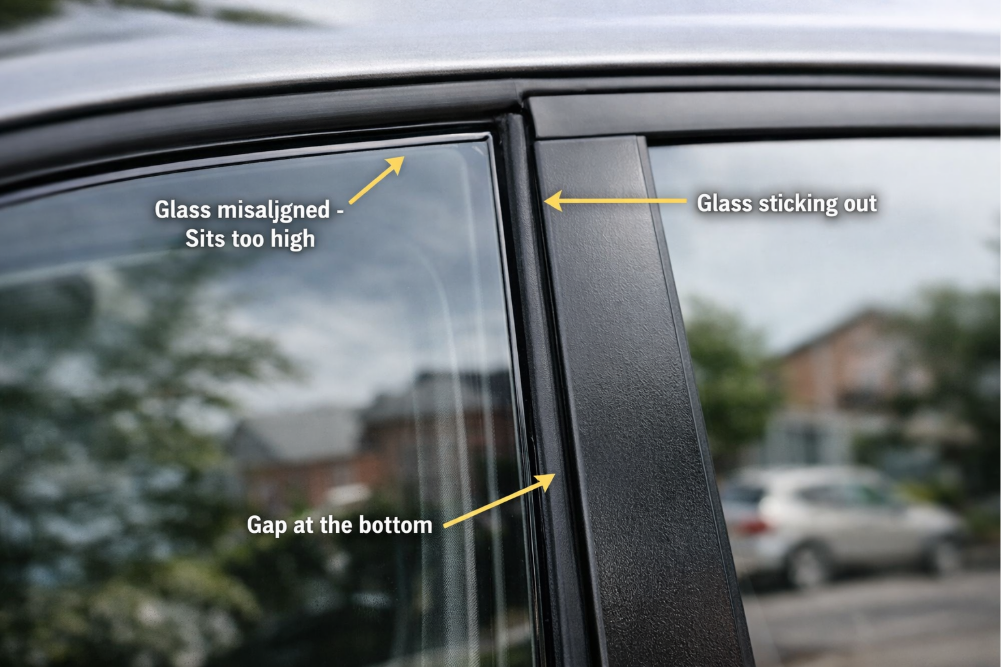
Something is wrong when you press the button to roll up the side window of your car. It may tilt at a strange angle, become caught in the middle, or fail to seal correctly against the door frame. In addition to being inconvenient, these alignment problems may result in water leaks, wind noise, and even security threats. Usually, loose mounting brackets, worn regulators, or damaged tracks are the cause of side window glass alignment issues. The good news? This tutorial explains the typical reasons why side window alignment problems occur, how to spot the issue, and how to fix it step-by-step so that your window functions properly once more.
Get An Auto Glass Replacement Quote Now 866.278.7417

Windshield Replacement & Repair
Our competitors push you into going to their shop to get your glass fixed-making it cheaper for them. We make it easier for YOU to get back on the road by offering free mobile repairs at your home or work. With our free mobile services servicing the entire Orange County & Los Angeles area, we can often handle your windscreen replacement the same day! So the next time you need a windshield replacement, give us a call.
Talk to a Windshield Replacement Specialist Now 866.278.7417

Calibration
Calibration is the process of returning a vehicle’s ADAS to OEM specifications. Calibration is necessary after a new glass installation, particularly a windshield with a camera mounted to it, to ensure that the ADAS features continue to function properly despite having been moved during installation. If a car’s ADAS is not properly calibrated, the system may not function safely. A misaligned camera could jeopardize the functionality of the system and lead to dangerous driving or accidents, so it is crucial that the cameras are aligned perfectly, which is what windshield calibration ensures.
Talk to a Calibration Specialist Now 866.278.7417

Fleet Auto Glass Repair
We provide expert auto glass repair and windshield replacement services for commercial fleets of all sizes. We are experienced with all manufacturers and machine types of domestic or foreign cars, trucks, vans, or commercial vehicles, including heavy equipment. Our same day mobile auto glass and windshield repair service will enable you to get back on the road faster and start saving you time and money instantly. Give us a call today! We are here to help!
Talk to a Fleet Auto Glass Specialist Now 866.278.7417
The Reasons Behind Issues with Side Window Alignment
You must identify the cause of a misaligned window before you can correct it. To maintain your window moving smoothly along its track, a number of parts cooperate.
Worn Window Regulator: The device that raises and lowers your glass is called the window regulator. The window may travel unevenly or become stuck as a result of the internal gears and wires wearing out over time. A malfunctioning regulator is most likely the cause if you hear grinding sounds or see the window tilting as it moves.
Broken or Unclean Window Tracks: The glass moves up and down in what are known as window tracks. These tracks may accumulate dirt, debris, or rust, which would hinder smooth motion. Additionally, the rails may get bent due to physical damage from accidents or forcing a trapped window.
Loose Mounting Brackets: These brackets are used to secure the window glass to the regulator. The glass may move and go out of alignment with the door frame if these brackets come away or the bolts holding them loosen.
Broken Window Clips: The glass inside the door is guided by tiny plastic clips. The glass may wobble or tilt as it travels because these clips may break from age or temperature fluctuations.
How to Determine the Cause of Window Alignment Problems
Finding the precise issue will assist you in choosing the best solution. Here’s how to identify the issue with your window.
Visual Inspection: Watch how the window moves as you roll it up and down. Does it have a sideways tilt? Is one edge moving more slowly than the other? You can identify the trouble spot with the help of these visual clues.
Examine the window for any gaps between the glass and the weatherstripping surrounding the door frame after it has been completely closed. Uneven gaps are a sign of misalignment that may allow air or water to enter.
Listen for Odd Noises: Noises that grind, click, or scrape frequently indicate debris in the tracks or a regulator issue. One loud pop could be a sign of a bracket or clip breaking.
Check for Resistance: Is the window difficult to move or does it stop halfway? This can indicate that the regulator motor is malfunctioning or that something is obstructing the tracks.
Step-by-Step: Resolving Window Alignment Issues: After determining the issue, you can proceed with the necessary fix. The majority of alignment problems may be fixed with simple equipment and a little perseverance.
Clean the Window Tracks: Begin with the most straightforward method. Debris and dirt in the tracks can hinder smooth travel and cause alignment issues.
Fully roll down the window. The tracks can be cleared of loose dirt by using a vacuum attachment that is narrow. Apply a lubricant with a silicone basis to the tracks.
Using a fresh cloth, remove any extra lubrication. For the lubrication to be distributed, roll the window up and down multiple times. Steer clear of petroleum-based compounds like WD-40, as they have the potential to accumulate more grime over time.
Do you have a Question?
Get An Auto Glass Replacement Quote Now 866.278.7417
Adjust Loose Mounting Brackets
It might be necessary to tighten the mounting brackets if the glass tilts or wobbles. To reach the window mechanism, remove the door panel (for further procedures, refer to your vehicle’s handbook).
Find the mounting brackets that connect the regulator and glass. Use the proper socket wrench to tighten the bolts after making sure they are not loose. You might need to fix the threads or use slightly bigger bolts if the bolt holes are stripped. Before putting the door panel back together, check the window’s movement.
Replace Broken Window Clips: Replacing broken guide clips is reasonably simple and reasonably priced. Take off the door panel. Find the broken clips, which are often found along the glass’s front and back edges.
Sliding the old clips out of their slots or unscrewing them will remove them. Put fresh clips in the same places.
Make sure the window tilts-free and moves smoothly by testing it. Replacement clips are available from online merchants or auto parts stores. Be careful to purchase the appropriate clips for the make and model of your car.
Straighten Bent Window Tracks: You might be able to straighten bent window tracks if they are not badly damaged.
Take off the door panel. Determine which part of the track is bent. Carefully bend the track back into alignment with pliers or a tiny pry bar.
Take your time and monitor your progress often; bending too much can exacerbate the issue. Clean and lubricate the track after it has been straightened. Replacement is the preferred choice for tracks that are seriously damaged.
Replace a Defective Window Regulator: It is necessary to replace a broken regulator. Even though this fix is more complicated than others, do-it-yourself mechanics can nonetheless handle it. Take off the door panel and anything else that is obstructing the regulator’s access.
Utilize tape or blocks to hold the window glass upright. Unplug the regulator from the mounting brackets made of glass. Unplug the power windows electrical connector.
The fasteners holding the regulator to the door frame should be removed. In opposite sequence, install the new regulator. Prior to restoring the door panel, test the window’s functionality. Window regulators are available online, at dealerships, and at auto parts stores. Depending on your car, the part should cost between $50 and $200.
When to Get Expert Assistance
Professional assistance is necessary for certain window alignment problems. Think about getting your vehicle fixed by a mechanic if:
The glass of the window is broken or fractured.
The actual door frame is distorted or broken due to an accident.
You’ve tried fixes, yet the issue still exists.
The window entirely collapses into the door. Depending on the extent of the problem and the make and model of your car, professional repairs usually cost $200 to $500.
Avoiding Future Alignment Issues: Window alignment problems can be avoided with routine maintenance. To avoid dirt accumulation and lower friction, lubricate the tracks twice a year with a silicone-based lubricant.
To avoid jarring the mechanism and gradually loosening the brackets, do not slam the door when the window is open. Deal with issues as soon as possible. Unusual sounds or somewhat sticky movement are examples of minor difficulties that frequently signal the emergence of larger ones.
Early repair avoids later, more costly repairs. To stop water from getting into the door hollow and corroding metal parts, keep the door seals clean.
Get Your Window Back on Track: Problems with side window alignment can range from small irritations to major concerns that compromise the comfort and security of your car. You may get your window back in working order by knowing the typical causes and doing the repairs listed here.
Before proceeding to more intricate repairs, start with the easiest fixes, such as lubricating and cleaning the tracks. With simple tools and replacement parts, many alignment issues can be fixed in a single afternoon.
Do not hesitate to seek expert assistance if you feel uneasy doing these repairs yourself or if the issue appears to be too complex for a do-it-yourself solution. In addition to performing better, a correctly oriented window preserves the value of your car and safeguards the inside.
Why Calibration Matters for Side Window Glass Replacement
Windshields are the first thing that most drivers consider when considering auto glass replacement. That makes sense because many of your car’s sophisticated safety features are located on the windshield, which is also essential for visibility. However, replacing the glass in side windows should receive more attention than it usually does, particularly in terms of calibration.
Numerous sensors and cameras are included into the structure of modern cars, and many of these systems depend on exact placement to work properly. Replacing a side window involves more than just changing out damaged glass.
Every time you drive, you may have an impact on how safety elements that protect you and your passengers align and function. You can make well-informed decisions about the upkeep of your car and make sure your safety systems continue to function as intended by knowing how calibration pertains to side window replacement.
Vehicle Calibration: What Is It?The process of aligning and modifying your car’s electronic safety systems to make sure they operate in accordance with manufacturer requirements is known as vehicle calibration.
Advanced driving assistance systems (ADAS) such as parking assistance, blind spot monitoring, and lane departure warning are among these systems. The computer systems in your car use information from cameras, radar sensors, and other detecting devices placed all over the vehicle.
The safety measures that these parts support may not function correctly when they are even slightly out of alignment, or worse, they may issue false alerts that could cause mishaps. Calibration guarantees that all of these systems interact with one another precisely and react to actual driving situations.
Positioning of the Sensors and Side Windows
You may be wondering why calibration would be necessary while changing a side window. The location of safety sensors by manufacturers holds the key to the solution.
Sensors are installed in or near side windows, especially the rear quarter windows, of many contemporary cars. These sensors are compatible with features such as:
Systems that monitor your blind spots and notify you when cars approach
When backing up, the rear cross-traffic alarm alerts you to oncoming traffic.
Parking sensors that make navigating confined places easier
Systems with surround-view cameras that give you an aerial perspective of your car
These sensors must be disconnected and reconnected by technicians when they remove and replace side window glass. System accuracy may be impacted by even slight variations in sensor location or angle.
How Side Window Replacement Impacts Calibration: Accuracy is the key to the relationship between side window replacement and calibration. Extremely tight tolerances, frequently expressed in millimeters or fractions of degrees, govern how modern safety systems function.
Several factors can affect sensor alignment when replacing a side window: Even if the new glass satisfies manufacturer specifications, it may sit slightly differently in the frame than the original.
Subtle changes in location could be caused by adhesives and mounting points. Sensor brackets or mounting locations may be moved during the removal and reinstallation procedure.
These minor adjustments may not seem like much, but they might interfere with the calculations your car’s computer systems do to keep an eye on your environment. Just a few degrees off, a blind spot sensor may not pick up on a car in the next lane or may send out misleading signals that teach you to dismiss real cautions.
Do you have a Question?
Get An Auto Glass Replacement Quote Now 866.278.7417
Types of Side Window Sensor Calibration
When replacing your side window with sensors, technicians might have to undertake one or both of the following calibrations:
Static Calibration: A controlled shop setting is used for static calibration. Technicians utilize specified targets or patterns that sensors must detect, and they place the car in accordance with exacting requirements.
While the calibration apparatus interacts with onboard computers to modify sensor characteristics, the vehicle stays still. For sensors that must set baseline references or measurement sites independent of vehicle movement, this approach performs admirably.
Dynamic Calibration: In order for sensors to gather real-world data, dynamic calibration necessitates operating the vehicle under particular circumstances. Usually, technicians travel preset routes with different speeds, curves, and traffic conditions.
This driving data is used by the car’s systems to optimize sensor performance. After replacing their side windows, some cars just need dynamic calibration, while others require both static and dynamic processes to fully calibrate their systems.
Signs Your Car Needs Recalibration: After replacing your side windows, keep an eye out for these signs that your safety systems might require adjustment:
Driver assistance function warning lights on the dashboard turn on and remain lit. When there are no cars around, your blind spot monitoring system sounds an alert; if there are, it doesn’t notify you. Even when there are no adjacent barriers, parking sensors continue to honk. When lane keeping assist fails to keep you centered or pulls your car abruptly.
Calibration-required notifications appear on the maintenance computer or owner’s manual for your car. Don’t disregard these cautions. They show that your safety systems aren’t working properly, which increases your risk when driving.
Selecting a Skilled Technician
Not every auto glass company has the tools or expertise required to carry out accurate calibration following side window replacement. Ask the following questions while choosing a repair facility:
Do they offer calibration tools made specifically for the make and model of your car? Do their specialists have the necessary certifications to calibrate ADAS? Will the impacted systems be recalibrated as part of the replacement service, or will there be an extra fee for that? Can they offer proof that the calibration was carried out in accordance with the manufacturer’s instructions?
By working with skilled experts, you can make sure that replacing your side window won’t affect your car’s safety features. Even though calibration-capable establishments might cost more, the investment shields you from future mishaps and system failures.
The Cost Factor: Although calibration raises the overall cost of replacing a side window, it is an essential safety precaution and not an extravagance. The following factors affect calibration costs:
how many sensors are impacted by changing the window. whether either dynamic, static, or both kinds of calibration are needed. The year, make, and model of your car (newer and fancier cars tend to have more sophisticated systems).
regional prices for labor and equipment. Before assuming you’ll have to pay out of yourself, find out if your insurance covers calibration fees related to glass replacement.
Avoiding Calibration Problems in the Future
You can take the following actions to preserve system accuracy after your side window has been correctly replaced and calibrated: Steer clear of aftermarket changes that alter sensor placement or vehicle ride height.
Keep the surfaces of the sensors clear of debris, ice, and dirt. Take immediate action to repair any collision damage, even little, ostensibly cosmetic affects. Sensor angles may be impacted by suspension modifications, so get your car’s alignment checked frequently. In between service visits, routine maintenance enables your calibrated systems to continue operating as intended.
The Bottom Line on Side Windows and Calibration Replacing the glass in side windows is more than just repairing the damaged part. Proper calibration of sensors guarantees that your car’s safety features continue to keep you and your passengers safe.
Avoid taking short cuts by selecting the least expensive replacement option without making sure calibration is included. The risk of blind spot monitoring or parking assistance breaking down when you need it most is not worth the money you save up front.
Insist on paperwork demonstrating that your systems were calibrated in accordance with manufacturer requirements, collaborate with skilled personnel, and ask questions. It is essential to your safety.
Mobile Safe Auto Glass
14241 E Firestone blvd suite 400,
La Mirada, CA 90638
Phone: (562) 608-1154
Toll Free: 1 866 278 7417
Mail: sales@mobilesafeautoglass.com
Get a FREE QUOTE today! You can get a free quote and schedule 24/7 using this free quote wizard.
Mon – Fri 8am – 5pm
Saturday 8am – 1pm
Sunday Closed