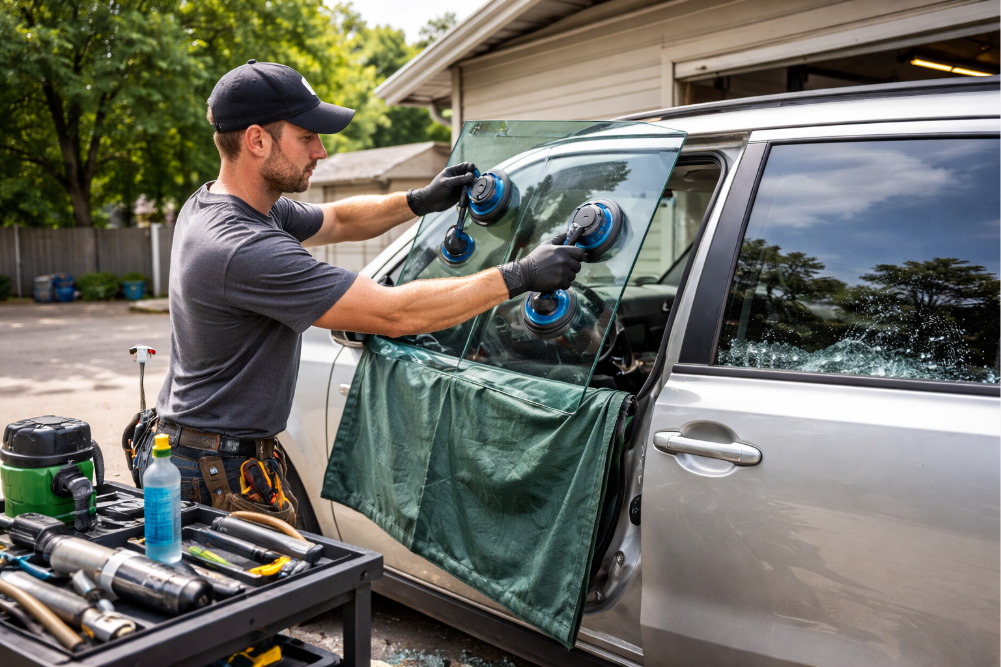
Side Window Glass Replacement Safety Guide
In addition to being unpleasant, a broken or cracked side window poses a security and perhaps safety issue. Replacing the side window glass on your automobile requires careful attention to detail and appropriate safety precautions, regardless of whether it was damaged in an accident, vandalized, or just worn out. Everything you need to know about replacing side window glass is covered in this article, from determining when replacement is required to the safety measures you should take while doing it. By the end, you’ll know precisely what to anticipate when hiring a professional or be able to undertake this work with confidence.
Get An Auto Glass Replacement Quote Now 866.278.7417

Windshield Replacement & Repair
Our competitors push you into going to their shop to get your glass fixed-making it cheaper for them. We make it easier for YOU to get back on the road by offering free mobile repairs at your home or work. With our free mobile services servicing the entire Orange County & Los Angeles area, we can often handle your windscreen replacement the same day! So the next time you need a windshield replacement, give us a call.
Talk to a Windshield Replacement Specialist Now 866.278.7417

Calibration
Calibration is the process of returning a vehicle’s ADAS to OEM specifications. Calibration is necessary after a new glass installation, particularly a windshield with a camera mounted to it, to ensure that the ADAS features continue to function properly despite having been moved during installation. If a car’s ADAS is not properly calibrated, the system may not function safely. A misaligned camera could jeopardize the functionality of the system and lead to dangerous driving or accidents, so it is crucial that the cameras are aligned perfectly, which is what windshield calibration ensures.
Talk to a Calibration Specialist Now 866.278.7417

Fleet Auto Glass Repair
We provide expert auto glass repair and windshield replacement services for commercial fleets of all sizes. We are experienced with all manufacturers and machine types of domestic or foreign cars, trucks, vans, or commercial vehicles, including heavy equipment. Our same day mobile auto glass and windshield repair service will enable you to get back on the road faster and start saving you time and money instantly. Give us a call today! We are here to help!
Talk to a Fleet Auto Glass Specialist Now 866.278.7417
When Does Side Window Glass Need Replacement
A complete window replacement is not necessary for every chip or blemish. However, replacement is inevitable due to certain sorts of damage.
Visibility and structural integrity are compromised by extensive fractures that extend across the window. Small chips may be fixable, but as cracks grow more than a few inches, they must be replaced.
You are forced to replace the whole window if the glass is shattered by impact or abrupt temperature changes. The window is risky due to the damaged frame, even if the glass hasn’t fallen out entirely.
Replacement is also necessary for deep scratches that damage the glass or restrict your vision. Deep gouges generate weak spots that might cause an abrupt failure, whereas little surface scratches can sometimes be rubbed away.
Glass may sometimes sustain damage while operating due to malfunctioning window systems. You’ll probably require both mechanical repairs and glass replacement if your window won’t roll up or down correctly and the glass is chipped or cracked.
Recognizing Side Window Glass Types Side windows are not the same as windshields in terms of design or purpose. Tempered glass, which is used in the majority of side windows, breaks into tiny, comparatively innocuous fragments. In the event of a collision, passenger safety is given first priority in this design.
Laminated side windows are a characteristic of several cars, especially those with rear doors. Like windshields, these windows have a plastic covering sandwiched between two panes of glass. Additional protection against break-ins is provided by laminated glass, which remains unbroken even after breaking.
You can get the right replacement and comprehend the installation procedure if you know which kind your car utilizes. If you’re not sure, check the handbook for your car or get advice from an expert.
Crucial Safety Measures
Glass replacement for side windows requires hefty materials and sharp edges. Adopting the right safety precautions guarantees a good installation and keeps you safe.
Protective Gear: Wear thick, cut-resistant work gloves at all times. Invest in high-quality hand protection since glass shards may readily cut through thin fabrics. Safety glasses protect your eyes from flying glass pieces during installation or removal.
Your skin is further protected by long sleeves and trousers. Wear clothes that you don’t mind throwing away after work since glass particles may become embedded in fabric.
Workspace Preparation: Remove any obstructions from the vicinity of your car. There must be space for you to move around and place tools without creating a trip hazard. To capture glass fragments during removal, place a tarp or thick piece of cardboard down.
Work in a place with good lighting, ideally during the day. Having good sight makes it easier to position the new window correctly and identify any residual glass fragments. Stay away from windy areas where debris might be blown into your eyes or workstation.
Do you have a Question?
Get An Auto Glass Replacement Quote Now 866.278.7417
Methods for Handling Glass
Even with gloves on, you should never hold glass by the edges with your bare hands. To equally distribute weight, support heavy parts from beneath with your hands and forearms.
When taking out shattered glass, begin at the top and work your way down. Larger pieces won’t fall suddenly using this method. To remove any last bits from the door frame, use a little brush and a vacuum.
Until you’re ready to install the new window, keep it in its original packing. Store it somewhere safe from being trodden on or pushed over.
DIY vs. Professional Replacement: A number of criteria determine whether you should replace the window yourself or employ a professional.
The level of skill is important. Side windows might be challenging if you’ve never worked on vehicle glass before. In most cases, the door panel must be removed, and the glass must be precisely aligned with the window track and seals during installation.
Certain adhesives, primers, and sometimes specialist tools for removing door panels are among the equipment and supplies required for the task. Buying these things might be as expensive as paying a professional to conduct a single repair if you don’t already have them.
Professional installation may be covered by insurance with little or no deductible. Glass replacement is covered by comprehensive insurance, so hiring a professional is the most cost-effective option.
For someone with rudimentary mechanical understanding, a do-it-yourself replacement usually takes two to four hours. Experts guarantee their service and do the same task in about one hour.
Detailed Safety Procedure for Do-It-Yourself Window Replacement: Take careful note of these procedures if you have made the decision to replace the window yourself.
Remove the Door Panel
Get the battery disconnected before doing any electrical repair. Find the screws and clips that are holding the door panel in place, then take them out. Many cars conceal screws within door handles or beneath trim elements.
Utilizing a plastic trim removal tool, carefully peel the panel away from the door frame. Metal tools may break plastic parts or damage paint. Unplug any electrical connections that provide power to speakers, locks, or windows.
Remove the Broken Glass: If the mechanism is still working, lower the window regulator to its lowest setting. You can reach the glass mounting locations as easily as possible this way.
Any bolts or retaining clips that secure the glass to the regulator should be removed. Some cars employ glue, which has to be cut with a wire or specialized instrument. Gently remove the glass by lifting it out through the door frame’s top.
To ensure that all glass particles are gone, vacuum the door cavity completely. Tiny fragments might cause rattling sounds or clog the window mechanism.
To be ready for installation, use isopropyl alcohol to clean the mounting surfaces of any grease, dirt, or leftover glue. The new glass will attach properly if the surface is properly prepared.
Following the drying time recommendations provided by the manufacturer, apply primer to the areas that will be covered with adhesive. By doing this, further leaks are avoided and adhesive strength is increased.
Put the New Glass in Place
Align the mounting points with the new window as you place it in the door frame. As you connect the glass to the regulator from the inside, have someone hold it up from the outside.
Reinstall retaining clips or apply the proper glue in accordance with your car’s instructions. Take your time; accurate alignment guarantees smooth operation and avoids rattling.
Before putting the door panel back in place, test the window mechanism. There should be no binding or strange sounds as the glass moves up and down.
Reassemble the door by reconnecting all electrical parts and making sure they are working properly. Make sure all the clips fit correctly before snapping the door panel back into place.
Take care not to overtighten and break plastic parts while reinstalling screws and trim pieces. Test every door function and reattach the battery.
Post-Replacement Care: Before you can use a newly installed window regularly, it must cure. The majority of adhesives need 24 to 48 hours to fully solidify.
Even in pleasant weather, keep the window closed during this period. Premature opening may cause the adhesive seal to fail, necessitating reinstallation.
After installation, stay away from vehicle washes for at least 72 hours. Uncured seals may be forced past by high-pressure water, which might loosen the glass or harm internal components.
Using a gentle cloth and a light soap solution, clean the new glass. Tinting or protective coatings on fresh glass may be harmed by harsh chemicals or abrasive materials.
Common Errors to Avoid: Breaking plastic parts that are costly to repair might occur when obstinate clips or bolts are forced. Rather than using too much power, apply penetrating oil and wait.
Ignoring the priming stage might result in leaks or loose glass since it weakens adhesive connections. Always adhere to the full directions provided by the adhesive’s manufacturer.
Reusing old weatherstripping may appear cost-effective, but it often results in water leaks and wind noise. For best results, new glass needs new seals.
The most frequent error is probably not paying enough attention to the curing time. Being patient in those first days will save you from having to redo the whole project.
All Set for a Clear View
It is important to respect the material and the procedure while replacing the glass in side windows. This work is more complicated than it first seems because of the sharp edges and exact fit requirements.
If you decide to do it yourself, be sure you have all the equipment and supplies you’ll need. Prioritize safety, take your time, and don’t be afraid to refer to your car’s service handbook for detailed instructions.
Professional installation provides knowledge and guarantees, which provide peace of mind. Professional glass replacement is really handy since many mobile glass businesses come to you. Regardless of the route you take, fixing broken side window glass as soon as possible ensures both your safety and the security of your car.
How to replace a side window in your car safely and securely: Although replacing a side window may appear simple, taking short cuts might put your safety and security at danger. A badly placed window may weaken the structural integrity of your vehicle, make you more susceptible to burglaries, and even fail when you need it most—during an accident.
Getting the correct replacement is important, regardless of whether your window was broken in a break-in, damaged in an accident, or just worn out over time. This book helps you learn what to look for in a professional service and what warning signs to watch out for as it guides you through the fundamental best practices for replacing the glass in a side window in a safe manner.
Why it’s important to install side windows correctly The side windows on your automobile do more than just block out the wind and rain. They are essential to the entire safety system of your car.
Side windows that are fitted correctly contribute to the roof’s structural integrity in the event of a rollover accident. To further safeguard passengers, they cooperate with airbags.
Incorrect side window installation may lead to a number of issues. If the glass doesn’t seal correctly, water may seep into your car and could harm electrical systems.
More significantly, an incorrectly bonded glass may come out in an accident, jeopardizing the safety your car is supposed to provide. Another big worry is security.
It is easy for thieves to identify improperly placed windows. Easy entrance opportunities for burglars include gaps in the seal or loose-fitting glass. Your window will rest flat and securely with a skilled installation, discouraging any possible theft.
Select the Appropriate Kind of Glass Replacement
Glass for cars is not all made equal. Tempered glass, which is often used for side windows, is made to break into tiny, comparatively innocuous fragments. In the event of a collision, this shields passengers from severe cuts.
Similar to windshields, some contemporary cars include side windows made of laminated glass. This kind of glass provides increased security and protection since it remains intact even after breaking. To find out what kind of glass your automobile needs, check the specs.
Demand OEM (Original Equipment Manufacturer) glass or glass of a comparable quality at all times. Glass from aftermarket sources that don’t adhere to OEM specifications could not fit well or provide the same degree of security. Even while it could be less expensive up front, subpar glass might cause costly issues later.
Check the credentials of your technician: The quality and safety of your window replacement are directly impacted by the installation technician’s expertise. Seek for technicians that have earned certification from the Auto Glass Safety Council (AGSC) or the National Glass Association (NGA).
Inquire about prospective service providers’ familiarity with the make and model of your particular car. Rain sensors, antennae, and defrosting components are just a few of the increasingly intricate electrical systems that are incorporated into the windows of modern automobiles. A skilled technician will understand the correct way to handle these parts.
Before choosing a provider, ask for references or check internet reviews. Take note of comments on customer service, job quality, and if prior clients had any problems after installation.
Do you have a Question?
Get An Auto Glass Replacement Quote Now 866.278.7417
Make Sure the Surface Is Prepared Correctly
The technician must carefully clean and prepare the window frame before replacing the glass. The replacement glass may not adhere properly if there is any glue, grime, or debris left behind.
It is necessary to check the metal frame for damage or rust. Before installation can begin, any rust must be addressed. To guarantee that the new window has a strong base, damaged portions may need to be repaired.
The bonding region must also be primed as part of proper surface preparation. This primer strengthens the adhesion between the glass and the frame and aids in the proper curing of the adhesive. Ignoring or hurrying through this phase is a serious warning sign.
Use high-quality glue and give it enough time to cure: The adhesive that is used to attach your side window ought to be on par with or better than the requirements set by the automotive industry. Strong bonding that can resist the pressures your window will experience—from temperature changes to vibrations and impacts—are provided by premium urethane adhesives.
For safety, cure time is essential. Some adhesives set rapidly, but it takes longer for them to attain their maximum strength. Since a complete cure takes at least 24 hours, most manufacturers advise waiting at least an hour before driving your car.
After installation, never allow a technician to push you to drive your vehicle right away. Look for a different service provider if you are instructed to leave immediately. Allowing the glue to fully bind is essential for your safety.
Check for Correct Fit and Seal
Examine the window’s fit closely after installation. There should be no obvious spaces or irregularities between the glass and the surrounding body panels. Feel for any imperfections by running your fingers along the edges.
Examine the seal on the exterior of your car as well as the interior. A good seal has no gaps, bubbles, or extra glue and is consistent around the glass. Small flaws in the seal that worsen over time are often the first signs of a water leak.
If the window is made to open and shut, test its movement. It should function without binding or producing odd sounds. Power window controls and other electronic parts need to operate as intended.
Recognize warranty coverage: Reputable glass repair companies provide extensive warranties to back up their work. Look for coverage that covers both the glass and the labor involved in installation, at the very least.
Carefully read the warranty conditions. Recognize what is covered, how long it lasts, and what might cause the warranty to expire. Certain warranties are prorated, which means that as time goes by, the coverage diminishes.
Save all of your window replacement paperwork, such as invoices, warranty documents, and any before-and-after pictures. If you need to file a warranty claim, this documentation will be necessary.
Keep an eye out for these warning indicators: Be mindful of warning indications that point to subpar materials or bad craftsmanship. Exceptionally cheap costs often indicate that some compromises are being made. A quotation is most likely false if it seems too nice to be real.
A lack of professionalism is implied by pressure to decide or begin work immediately. You will have time to think over your selections and ask inquiries from legitimate service suppliers.
Concerns should be raised by evasive responses on the kind of glass being used, adhesive brands, or cure timeframes. Expert technicians will be open and honest about their supplies and procedures.
Take Care of Your New Window
Don’t wash your automobile for at least 48 hours after installation. Before the seal is completely sealed, high-pressure water might jeopardize it. In the same way, don’t drive on bumpy roads or smash doors during this first phase.
Use a soft cloth and automotive glass cleaner to keep your window clean. Over time, abrasive materials or harsh chemicals may erode the seal or harm the glass.
Check the seal occasionally for indications of deterioration, such as gaps, peeling, or cracking. Early detection enables fixes to be made before these problems worsen.
Making the best decision for your safety: Replacing the glass in your side windows securely is more important than convenience or appearance. It’s an important safety precaution that keeps you and your passengers safe. You can make sure your car keeps its security and structural integrity by adhering to these best practices and selecting trained experts.
Spend some time researching service providers, making sure that the necessary processes are being followed, and asking the right questions. The effort is worthwhile for both your car and your safety. When replacing the glass in your car, don’t skimp on quality.
Mobile Safe Auto Glass
14241 E Firestone blvd suite 400,
La Mirada, CA 90638
Phone: (562) 608-1154
Toll Free: 1 866 278 7417
Mail: sales@mobilesafeautoglass.com
Get a FREE QUOTE today! You can get a free quote and schedule 24/7 using this free quote wizard.
Mon – Fri 8am – 5pm
Saturday 8am – 1pm
Sunday Closed