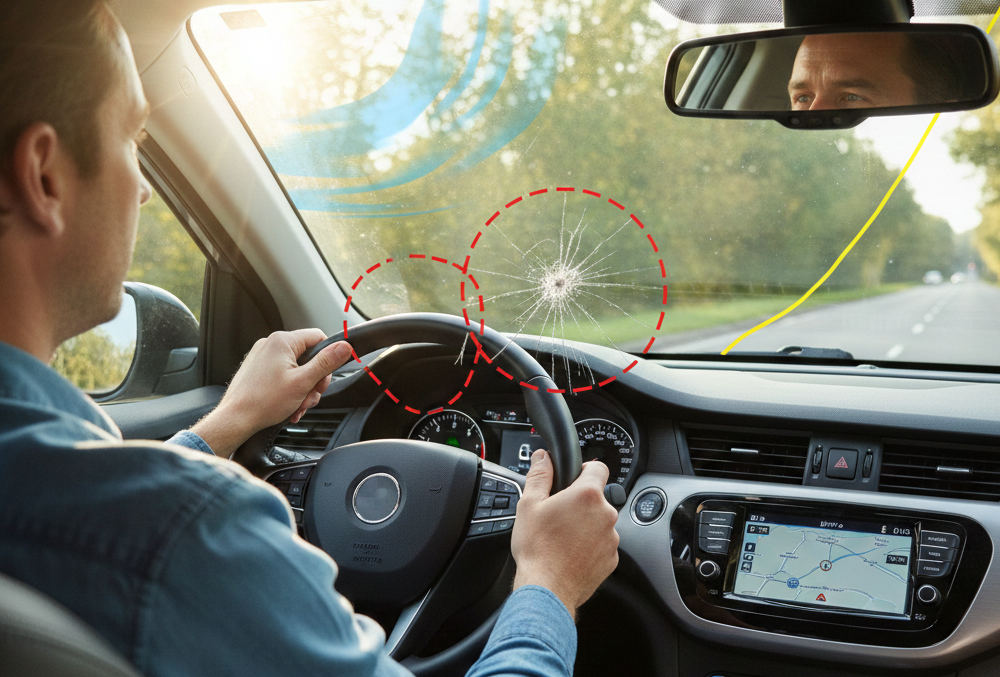
Front Window Repair Warning Signs Drivers Often Ignore
Your car’s front window, also known as the windshield, performs much more than just keeping insects out of your teeth. It is an essential structural part of your car that guarantees the proper deployment of your airbags and supports the roof during rollovers. However, many drivers tend to overlook their windshield, only taking notice when a large crack obstructs their view. Ignoring minor concerns with your front glass might lead to serious safety hazards and expensive replacements down the line. On the highway, a hardly noticeable chip might rapidly develop into a serious shatter risk. Understanding the early warning signs of windshield damage can save you time, money, and ultimately your life. These are the main signs that your front window needs expert repair right away rather than a “wait and see” strategy.
Get An Auto Glass Replacement Quote Now 866.278.7417

Windshield Replacement & Repair
Our competitors push you into going to their shop to get your glass fixed-making it cheaper for them. We make it easier for YOU to get back on the road by offering free mobile repairs at your home or work. With our free mobile services servicing the entire Orange County & Los Angeles area, we can often handle your windscreen replacement the same day! So the next time you need a windshield replacement, give us a call.
Talk to a Windshield Replacement Specialist Now 866.278.7417

Calibration
Calibration is the process of returning a vehicle’s ADAS to OEM specifications. Calibration is necessary after a new glass installation, particularly a windshield with a camera mounted to it, to ensure that the ADAS features continue to function properly despite having been moved during installation. If a car’s ADAS is not properly calibrated, the system may not function safely. A misaligned camera could jeopardize the functionality of the system and lead to dangerous driving or accidents, so it is crucial that the cameras are aligned perfectly, which is what windshield calibration ensures.
Talk to a Calibration Specialist Now 866.278.7417

Fleet Auto Glass Repair
We provide expert auto glass repair and windshield replacement services for commercial fleets of all sizes. We are experienced with all manufacturers and machine types of domestic or foreign cars, trucks, vans, or commercial vehicles, including heavy equipment. Our same day mobile auto glass and windshield repair service will enable you to get back on the road faster and start saving you time and money instantly. Give us a call today! We are here to help!
Talk to a Fleet Auto Glass Specialist Now 866.278.7417
Small Chips and Pits Right in Your Line of Sight
Suddenly, a pebble from the truck’s tire ahead of you hits the glass, causing a tiny dent in its surface. It might seem insignificant, especially if it doesn’t immediately spread. However, chips immediately in the driver’s line of sight are dangerous distractions.
Even a little pit can capture sunlight or headlight glare, causing a dazzling flash that momentarily obscures your vision. This split-second blindness is all it takes to trigger an accident. Furthermore, these little chips are weak areas.
If you hit a pothole or slam your door too hard, that tiny chip might suddenly become a huge break. Generally speaking, a repair specialist will be able to fix the hole if the damage is less than a quarter in size. If you wait too long, a complete replacement may be necessary.
White Haze Around the Edges: Have you noticed a milky white haze creeping in around the corners of your windshield? This is not merely grime that cannot be removed by washing. It is a symptom that the Polyvinyl Butyral (PVB) layer—the special plastic safety layer sandwiched between two sheets of glass—is separating from the glass itself.
This condition, known as delamination, compromises the structural integrity of the windshield. The PVB layer is what keeps the glass from fracturing into sharp fragments upon impact. Your windshield is much weaker and might not adequately protect you in an accident if this layer is deteriorating. Delamination cannot be corrected; it requires a full windshield replacement.
The “Stress Crack” Mystery
A crack can occasionally arise out of nowhere. There was no rock, no debris, and no collision. We refer to these as stress cracks. Usually, they begin near the windshield’s edge and move inward.
Stress cracks can occur owing to significant temperature fluctuations—like pouring hot water on a frozen windshield—or structural weakness in the car’s frame. If you see a crack appearing without an impact point (a “bullseye” or pit), you need to get it evaluated quickly. It signifies that the glass is under severe tension and could fail unexpectedly.
Swirling Scratches and “Pitting”: Your windshield is inundated with grit, sand, and other road debris after years of driving. This causes thousands of microscopic pits and scrapes on the surface. When the sky is cloudy, it is difficult to see them, but when you are driving in the direction of the sun or when you are facing incoming headlights at night, they are apparent.
The light refracts through these micro-scratches, generating a dazzling halo effect that makes it difficult to see the road. This is often called “pitting.” While some minor scratches can be rubbed away, significant pitting usually damages the optical quality of the glass permanently. If the sun consistently reveals a persistent layer of glitter on your windshield, it’s time for a replacement.
Rattling or Wind Noise: You should have a silent windshield. The seal surrounding the glass may be deteriorating if you begin to hear a high-pitched whistling sound at fast speeds or a rattling sound when you encounter obstacles.
The windshield is held securely in place against the frame of the vehicle by the urethane seal. The windshield may move if this seal deteriorates or comes free. In a worst-case scenario—such as a collision—a loose windshield can detach altogether, allowing the roof to collapse or the passenger airbag to push the glass out rather than cushioning the passenger. Never overlook new noises coming from your front window.
Do you have a Question?
Get An Auto Glass Replacement Quote Now 866.278.7417
When to Repair vs. When to Replace
Knowing the warning signs is step one. Comprehending the solution is the second step. Typically, the industry follows a few standard rules:
Repair: A resin injection repair is typically possible if the chip or crack is smaller than a dollar bill, if it is not in the driver’s direct line of sight, and if it is not at the edge of the glass.
Replace: If the crack is longer than six inches, approaches the edge of the glass, is deep enough to enter the inner layer, or involves delamination, replacement is the only safe alternative.
Don’t Gamble with Your Safety: Your windshield is crucial safety equipment. In most cases, ignoring these warning signs does not cause problems to disappear; rather, it causes them to deteriorate until they become emergencies that cannot be avoided and are associated with high costs.
Regularly examining your glass for these five symptoms takes less than a minute. See a qualified vehicle glass specialist if you notice anything suspicious. Addressing a little chip today is far cheaper and safer than dealing with a smashed windshield tomorrow.
Small chips can quietly develop into significant visibility issues. With music playing and a clean length of road ahead, you are speeding down the highway. A stinging thwack abruptly interrupts your drive.
You scan the windshield and find it: a little, inconsequential blemish right near the wipers. It looks superficial, possibly the size of a dime. You check your mirrors, shrug it off, and keep driving. It’s only a minor imperfection, after all.
This situation plays out for thousands of drivers every day. To have a tendency to disregard minor harm is a natural and understandable behavior. Life is busy, and scheduling a repair for something that slightly obstructs your view feels like a low priority.
However, that little chip usually moves. It is like a ticking clock on your dashboard, waiting to develop into a web of fissures that can cover the whole width of your car when the proper conditions of temperature, pressure, and time are met.
A damaged windshield poses significant safety dangers that many drivers overlook, in addition to the aesthetic nuisance. The glass in your vehicle does far more than keep the bugs out of your teeth; it is a key structural component designed to protect you in a crash. Ignoring a chip isn’t just about risking a greater repair price later—it is about compromising the safety of everyone in the car.
This tutorial explores the mechanics of windshield deterioration, why those tiny chips spread, and the significant visibility and structural hazards they generate if left unchecked.
The Anatomy of Your Windshield
To understand why a chip is hazardous, you first need to comprehend what you are looking through. Automobile windshields are composed of laminated safety glass, rather than the glass in your home windows, which breaks into sharp fragments upon impact.
This structure is made up of two layers of glass that are sandwiched between two layers of polyvinyl butyral (PVB) plastic. When your windshield is hit by a rock, the exterior layer of glass will normally be fractured, but the plastic and the internal layer will remain intact. This system is a deliberate design. It stops glass from flying into the cabin after an accident and helps keep occupants within the vehicle.
On the other hand, if a chip were to disturb that outer layer, it would completely change the tension throughout the entire surface. We manufacture the windshield under stress to ensure its strength. A chip creates a weak spot in the surface tension. The weakness in the armor is what encourages more failure.
Why Small Chips Don’t Stay Small: Although glass appears solid and unchanging, it is always growing and contracting. Drivers often endure a chip for weeks without issue, only to wake up one morning to find a foot-long crack. Several environmental factors fuel this rapid expansion.
Thermal Stress: Variations in temperature are detrimental to broken glass. If your automobile has been sitting in the blazing sun all day, the glass stretches. If you climb in and immediately blast the air conditioning, the sudden cooling causes the glass to contract.
In a spotless windshield, this expansion and contraction happen uniformly. When a chip cracks the surface, the stress focuses on that weak area. Glass can be instantly broken by the conflicting pressures of the cold air within and the hot sun outside, transforming a chip that can be fixed into a crack that needs to be replaced entirely. It is the same concept that applies throughout the winter, when defrosters are used to counteract temperatures that are below freezing.
Physical Stress and Road Vibrations
Driving is usually a bumpy experience. Potholes, speed bumps, and even the natural vibration of the engine pass through the vehicle’s frame and into the windshield.
The windshield, being a structural component of the vehicle, absorbs a significant portion of this kinetic energy. Weakened windshields are unable to adequately transfer this energy. Every bump in the road acts like a hammer tapping on a chisel, slowly (or sometimes fast) forcing the crack deeper across the glass.
Moisture Intrusion: The PVB layer between the glass sheets is susceptible to moisture. Rain, car washes, and washer fluid can leak into the laminate when a chip breaks through the top layer.
In the event that temperatures fall below freezing, the water that is trapped will expand and turn into ice. The force of expanding ice, strong enough to fracture pavement, easily breaks windshield glass. Moisture, even in the absence of freezing, can lead to the delamination or fogging of the laminate, resulting in persistent white patches that hinder visibility.
The Visibility Hazard: Refraction and Distraction. The impact on the driver’s vision is the most direct risk associated with a chipped windshield. A chip in the corner of the passenger side might seem inconsequential, but damage in the driver’s “critical vision area” (the space directly in front of the steering wheel) is a significant concern.
The Prism Effect
Glass chips are irregular. They feature rough edges and variable depths. When light strikes these abnormalities, it doesn’t pass through smoothly. Instead, it refracts and scatters.
During the day, sunlight hitting a chip can cause a blinding glare, momentarily whiting out your view of the road. The issue gets worse at night. Streetlights or the headlights of oncoming traffic may catch the chip, producing a “starburst” or halo of light.
This optical distortion attracts attention, taking your focus away from the road and potential risks, like pedestrians or braking cars.
Distraction of the Mind: Human brains are wired to spot irregularities. The presence of a flaw in your field of view provides you with a low-level distraction that is persistent. Even if you aren’t actively glancing at the chip, your brain registers it as an impediment.
This dual concentration enhances reaction times. In emergency driving scenarios where milliseconds count, the mental processing capacity necessary to look “past” a windshield imperfection could be the difference between a near miss and a collision.
The Compromise of Structural Safety
There is a great deal more peril than you presently perceive. When it comes to contemporary automobiles, the windshield is an essential component of the safety restraint system (SRS).
Deployment of Airbags: When a passenger-side airbag deploys, it does so with explosive force—roughly 200 miles per hour. It is supposed to bounce off the windshield and cushion the passenger. If the windshield is weakened by a crack or a large chip, the force of the airbag can shatter the glass or push it completely out of the frame.
Without the backstop of the windshield, the airbag may deploy wrongly, affording zero protection to the passenger.
Roof Crush Protection: In the horrific case of a rollover accident, the windshield offers essential vertical support to the roof. In the event of a front-end collision, automotive safety experts believe that the windshield contributes up to forty-five percent of the structural integrity of the cabin, and in the event of a rollover, it contributes up to sixty percent.
A compromised windshield is substantially weaker. If the glass fails during a rollover, the roof is far more likely to collapse inward, dramatically increasing the risk of severe head and neck injuries for the occupants. That tiny stone chip produces a fault line that compromises the safety cage of the entire car.
Do you have a Question?
Get An Auto Glass Replacement Quote Now 866.278.7417
The ADAS Complication
Advanced Driver Assistance Systems, sometimes known as ADAS, give an additional layer of complexity to automobiles that are more recent. Cameras and sensors that are mounted directly behind the windshield are typically responsible for the operation of features such as lane departure warning, automatic emergency braking, and rain-sensing wipers.
These cameras are set up to see through flawless glass. A chip, crack, or even the distortion from a poor-quality repair in the camera’s line of sight can blind the system or lead it to miscalculate distances.
If a chip turns into a crack and you need a windshield replacement, you aren’t just paying for glass anymore. You must also pay to have the ADAS cameras recalibrated to ensure safety features work appropriately. Such an expense might increase or treble the cost of the service. Catching a chip early and fixing it minimizes the need for replacement, sparing your wallet from the expensive calibration process.
Frequently Asked Questions: Is it possible to fix every scratch in a windshield? Not all chips are candidates for repair. Resin can usually be used to fill in damage that is less than a quarter, or about one inch in diameter. However, if the chip is directly in the driver’s line of sight, most experts would recommend a full replacement because the repair process can leave a slight blur that hinders vision.
I need to know how much time I have until a chip becomes disseminated. A time frame has not been decided upon in advance. A chip might remain stable for years or spread over the glass in hours. Variables including temperature changes, road conditions, and the severity of the hit all have a role. It is best to assume that the chip will spread quickly and take immediate action.
If I file a claim for fixing my windshield, would my insurance premiums go up? The majority of the time, the answer is no. Because it is much less expensive for insurance companies, they would rather you fix a chip than replace a windshield. Many comprehensive policies include chip repair with a zero deductible, meaning it is free for you and often does not count as a claim that affects your rate.
Is a DIY repair kit as effective as a professional repair? DIY kits can improve the appearance of a chip and prevent spreading if used correctly, but they rarely approach the quality of a professional repair. Experts employ high-quality epoxy that cures under UV light and vacuum pumps to remove air from the crack. If you botch a DIY repair, you usually cannot undo it, leading to a needed windshield replacement.
Don’t Gamble with Your Glass
It’s simple to ignore a windshield chip. It’s a cosmetic flaw that doesn’t hinder the car from running or the music from playing. Yet, considering it as purely superficial is a perilous gamble.
A typical drive can become hazardous in an instant when a small chip develops into a large break. Between the loss of structural integrity, the interference with safety airbags, and the probable failure of driver aid systems, the stakes are quite high.
The answer is straightforward: move quickly. Windshield repair is rapid, effective, and often free depending on your insurance coverage. By addressing the damage at its earliest stage, you can preserve the factory seal of your original windshield, guarantee the proper operation of your safety systems, and maintain a clear view of the road. It would be advisable to address the chip now instead of waiting for a crack to develop.
Mobile Safe Auto Glass
14241 E Firestone blvd suite 400,
La Mirada, CA 90638
Phone: (562) 608-1154
Toll Free: 1 866 278 7417
Mail: sales@mobilesafeautoglass.com
Get a FREE QUOTE today! You can get a free quote and schedule 24/7 using this free quote wizard.
Mon – Fri 8am – 5pm
Saturday 8am – 1pm
Sunday Closed