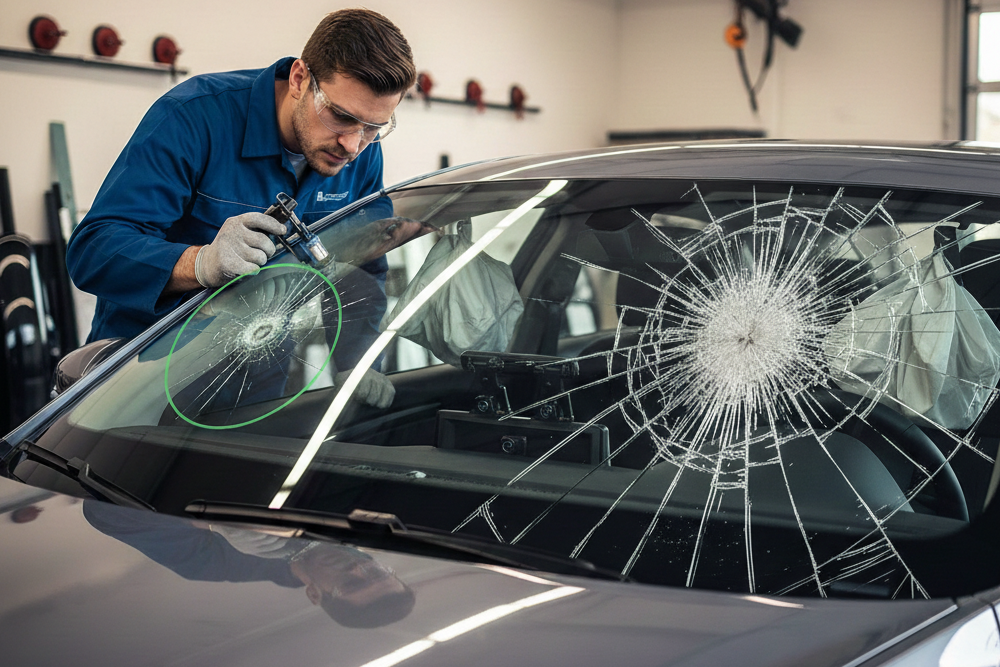
Windshield Crack vs Chip Risk Differences Explained
It is the characteristic pop that you hear while you are driving down the highway. Someone has hit your windshield with a wayward pebble. As soon as you see the devastation, your heart begins to sink. The question is, however, whether the damage is a little chip that can be filled in quickly or a crack that poses a risk to the structural integrity of your vehicle. Every driver should make it a priority to develop an understanding of the distinction between a chip and a crack in the windshield. At first glance, both may appear to be small cosmetic annoyances; however, they are actually quite different in terms of the risks they pose and the methods of healing that are required.
Get An Auto Glass Replacement Quote Now 866.278.7417

Windshield Replacement & Repair
Our competitors push you into going to their shop to get your glass fixed-making it cheaper for them. We make it easier for YOU to get back on the road by offering free mobile repairs at your home or work. With our free mobile services servicing the entire Orange County & Los Angeles area, we can often handle your windscreen replacement the same day! So the next time you need a windshield replacement, give us a call.
Talk to a Windshield Replacement Specialist Now 866.278.7417

Calibration
Calibration is the process of returning a vehicle’s ADAS to OEM specifications. Calibration is necessary after a new glass installation, particularly a windshield with a camera mounted to it, to ensure that the ADAS features continue to function properly despite having been moved during installation. If a car’s ADAS is not properly calibrated, the system may not function safely. A misaligned camera could jeopardize the functionality of the system and lead to dangerous driving or accidents, so it is crucial that the cameras are aligned perfectly, which is what windshield calibration ensures.
Talk to a Calibration Specialist Now 866.278.7417

Fleet Auto Glass Repair
We provide expert auto glass repair and windshield replacement services for commercial fleets of all sizes. We are experienced with all manufacturers and machine types of domestic or foreign cars, trucks, vans, or commercial vehicles, including heavy equipment. Our same day mobile auto glass and windshield repair service will enable you to get back on the road faster and start saving you time and money instantly. Give us a call today! We are here to help!
Talk to a Fleet Auto Glass Specialist Now 866.278.7417
Explain The Definition Of A Windshield Chip
A windshield chip is exactly what it sounds like: a little piece of glass that has been “chipped” away from the windshield. This is the definition of a windshield chip. The majority of the time, this type of chip occurs when a piece of material, like a pebble or gravel, strikes the glass at a rapid rate of speed.
Generally speaking, chips are classified according to their shape. The following are examples of common types:
“Bullseye” describes a circular breach in the outer layer of glass, characterized by a split cone.
Star: A break that causes many cracks to radiate outward from the point of contact, giving the appearance of a star.In the vicinity of the site of impact, a half-moon is a semicircle-shaped separation.
Risks Involved with a Chip: Chips, although they are typically less severe than extensive cracks, are not in themselves harmless. The most significant danger associated with a chip is that it will not remain one for an extended period of time. There is a possibility that moisture will seep into the damaged region.
Temperatures that are either extremely cold or extremely hot might cause the water to expand or contract, which puts stress on the glass. Because of this tension, the chip will frequently “run,” which will immediately result in the formation of a crack.
Capacity for Repair
The good news is that chips are generally capable of being repaired. In most cases, a technician is able to inject a specialized resin into the chip if the damage is less than a quarter in diameter (approximately one inch in diameter) and is not immediately in the line of sight of the driver. This resin will cure and harden, thus restoring the structural integrity of the glass and rendering the imperfection almost undetectable until it is removed.
Could you please clarify what constitutes a crack in the windshield? The term “crack” refers to a distinct line that divides the glass into two separate pieces. It may begin as a crack as a result of an impact or develop as a chip that has not been addressed. The length of cracks on your windshield might range from less than an inch to completely across its width.
Potential Dangers of a Crack: Instead of chipping, cracks provide a more immediate and severe threat to the structure.
Structural Integrity: Your windshield does more than just block the wind; it also makes a substantial contribution to the structural strength of the cabin of your vehicle. In the case that the car is struck by an accident that causes it to roll over, the windshield plays a role in keeping the roof from collapsing. A cracked windshield may compromise its ability to provide essential support.
To ensure that the passenger-side airbag deploys properly, many automobiles have a mechanism that allows it to bounce off the windshield. In the event that the glass is broken, there is a risk that the force of the airbag could completely destroy it. As a consequence of this, the airbag would not deploy as it should, leaving the passenger without any form of protection.
Cracks reflect light, which can generate blinding glare from sunshine or oncoming headlights, significantly limiting your ability to see the road. Cracks can also cause glare from lights that are coming from behind you.
Do you have a Question?
Get An Auto Glass Replacement Quote Now 866.278.7417
Ability to Repair
It is more difficult to repair a fracture than it is to repair a chip. If a crack is less than three inches in length, which is roughly equivalent to the length of a dollar bill, then it is possible that it can be repaired using the resin approach. It is important to note that the success of this procedure is dependent not only on the size of the crack but also on its location.
When the crack is greater than three inches, when it contacts the edge of the windshield, or when it is located directly in the driver’s line of sight, a replacement is nearly always the only solution that is considered safe. When a crack reaches the glass’s edge, it weakens the seal, necessitating glass replacement.
An Analysis of When It Is Better to Repair or Replace: Size, depth, and position are the three most important considerations that should be taken into account when deciding whether to do a rapid repair or a complete replacement.
Size Is Important: Two simple methods for determining the extent of the damage are the “Quarter Rule” and the “Dollar Bill Rule.” In the event that a chip is small enough to go under a quarter or a crack is shorter than a dollar bill, fix it. In the event that the damage surpasses these dimensions, replace it.
The Crucial Role of Location: It is possible that even minor chips will necessitate the replacement of the entire windshield, depending on where they land.
Repairs frequently result in a little distortion in the glass, which obscures the driver’s line of sight. Because of liability and safety concerns, the majority of repair shops will not fix the vehicle if the damage is located directly where you intend to drive.
The Edges: The most concentrated stress occurs around the edges of your windshield. The glass must be replaced if there is damage within two inches of the frame, as this weakens the bond between the glass and the vehicle body.
Modern automobiles typically install Advanced Driver Assistance Systems (ADAS) behind the windshield. These systems typically include sensors and cameras. The presence of damage near these sensors can cause lane departure warnings or automatic braking to malfunction. It is frequently necessary to replace the glass and recalibrate the system with new settings.
Percentage of Damage: Windshields have two glass layers with vinyl in between. When the damage extends through the outer layer and the vinyl and the inner layer of the glass, the windshield is in such a compromised state that it cannot be repaired with a straightforward resin.
Avoid Putting Things Off Until It Is Too Late
In the event that your windshield is damaged, the most important thing to keep in mind is the need of having a sense of urgency. A minor crack in your car poses a significant structural vulnerability, and even a small chip poses a potential threat.
If the damage is ignored, a relatively modest $100 repair can quickly become a $500+ replacement. It is possible for a little chip to soon become a spiderweb of cracks due to variations in temperature, vibrations on the road, and the stress of driving on a daily basis. The result can compromise both visibility and safety.
Before you schedule any repairs, it is essential to check the coverage that your auto insurance policy provides. There are numerous comprehensive insurance plans that cover small chip repairs with a deductible that is minimal to nonexistent.
Insurance companies typically prefer to pay a small repair cost now rather than a much higher windshield replacement cost later. You may save both time and money by having a thorough understanding of your coverage, which will enable you to take prompt and decisive action.
Both your own personal safety and the structural integrity of your vehicle should be your top priorities. A windshield is more than just glass; it is an essential component of the protection system of your vehicle, ensuring that the roof is strong, that the airbags deploy correctly, and that modern safety sensors are functioning properly.
To prevent the chip from growing larger, you should have it filled as soon as you discover it. This will prevent the chip from expanding. It is imperative that you schedule an appointment for a professional inspection as soon as possible when you find a fracture in the surface.
Not only does keeping the glass in good condition and free of any damage guarantee a clear line of sight, but it also makes driving a more secure and dependable experience. If you want to safeguard yourself, your passengers, and your vehicle, you need to take immediate action. Every moment that you delay increases the risk.
If You Have A Crack In Your Windshield
Every one of us has been through that experience. During your commute or weekend road trip, you are traveling down the highway when all of a sudden, a rock that has become loose from the rear of a truck blows all over the place.
The pop. This unmistakable sound causes you to shudder in response. You take a quick look at your windshield and spot a tiny chip. Yes, it is frustrating, but the situation appears to be harmless enough.
You think it’s not a big deal, that it’s out of the way, and that you’ll fix it eventually. It has been a week. Then take a month. Even as life becomes hectic, the chip continues to be there, seemingly unmoving.
On a chilly morning, you decide to stroll out to your car, but you end up freezing. This tiny chip has grown into a huge spiderweb of cracks that are stretching directly across your line of sight so that you can see through it.
Suddenly, a relatively insignificant inconvenience has escalated into a significant risk that jeopardizes your car’s visibility and structural integrity. Addressing this little flaw can protect the safety systems, the strength of the roof, and the airbag performance in a collision.
At what point does a purely aesthetic nuisance escalate into a serious threat to one’s safety? The reality is that the transition from a minor issue to a serious threat can occur suddenly and without warning.
For example, variations in temperature, vibrations from the road, and even tiny collisions can hasten the spread of cracks, which can turn a chip that might be repaired into a costly replacement of the entire windshield.
For the sake of safeguarding not only your investment but also the lives of everyone who is inside your vehicle, it is necessary to have a thorough grasp of the severity of the damage to your windshield, although it may be tempting to put off repairs.
How can you tell if your windshield damage has gone from minor to dangerous? The key to ensuring your car remains safe, structurally sound, and ready to defend you in any circumstance is to recognize the warning signals, be aware of the size and location of cracks and chips, and obtain a professional examination as soon as possible. Taking prompt action can result in cost savings, the prevention of future damage, and most importantly, the maintenance of personal safety for your passengers.
Your Windshield’s Role in the Structure of Your Vehicle
You must first have a solid understanding of what your windshield truly functions as to have a complete comprehension of why windshield damage is significant. It is not only a barrier against insects, wind, or rain, but also a vital safety feature that protects the car’s occupants.
In contemporary automobile design, the windshield is regarded as an essential structural component of the vehicle’s interior, being responsible for providing support for both passive and active safety systems.
In today’s world, the majority of windshields are constructed out of laminated glass, which is manufactured by bonding two layers of glass together and sandwiching a layer of polyvinyl butyral (PVB) in between them. This design is meant to prevent the glass from shattering into sharp and deadly shards upon impact.
This design not only preserves the car’s overall integrity but also safeguards passengers from potential injuries. During a collision, the PVB layer is also responsible for absorbing some of the energy, which in turn reduces the forces that are transmitted to the occupants.
The windshield not only works as a shock absorber, but it also offers a considerable amount of structural support to the car. Due to the fact that it provides up to forty-five percent of the structural integrity of the cabin in the event of a front-end collision, it helps to maintain the rigidity of the frame and assures the safety of the occupants.
In rollover accidents, its function becomes even more crucial, contributing up to sixty percent of the roof’s strength. When the windshield is damaged in any way, whether it be through cracks, chips, or faulty installation, the roof is significantly more likely to collapse under the pressure of a rollover. The result significantly raises the danger of serious injury or being ejected from the car.
It is important to note that a damaged windshield is not only a cosmetic problem; rather, it has a direct impact on the safety of everyone who is within the vehicle. When its integrity is maintained by prompt repairs or replacements, it ensures that the cabin of the vehicle continues to be a robust and protective cocoon in the event of an accident and that all related safety systems, ranging from airbags to advanced driver-assistance systems, continue to function as they were intended to.
Indications That Your Windshield Is in Dangerous Condition
Chips vary in their characteristics. While others require an immediate replacement, some may be fixed in twenty minutes, while others require a complete replacement. These are the warning signals that suggest that your windshield is risking your safety and should be avoided at all costs.
The damage obscures your field of vision: Currently, this is the most pressing threat. A “bullseye” is a crack, chip, or other damage that is directly in the line of sight of the driver. This terminology refers to an area that is approximately the size of a piece of paper and is located in front of the steering wheel.
Even the smallest defects can produce a blinding glare by capturing the light from the sun or the headlights of approaching vehicles. In the event that you need to move your head in order to see the road clearly, it is imperative that you replace the windshield.
This fracture is getting wider as a result of the expansion and contraction of glass, which is a feature that is dependent on temperature. A little chip can rapidly explode into a long crack if you blast the defroster on a chilly morning or the air conditioner on a hot afternoon. Both of these situations are extreme.
The integrity of the glass’s structural integrity is compromised when a crack is longer than approximately six inches, which is roughly equivalent to the length of a dollar note. When a crack of this size is present, it is normally impossible to repair it and instead requires a complete replacement.
The damage is nearing the top of the windshield: Chips or cracks within two inches of the edge of the windshield create an especially dangerous situation. The vehicle’s motion places the largest strain on this portion of the glass. It is possible for the connection between the glass and the metal frame of the vehicle to become more fragile if this area is damaged.
Damage along its edges increases the likelihood of a windshield completely detaching in a serious collision. This will render the passenger airbag ineffective, as the airbag frequently requires the glass as a backstop to deploy effectively.
There is a crack in the innermost layer of glass: Windscreens, as was previously said, consist of two layers of glass. If you feel a snag when you run your fingernail over the damage on the inside of the car, or if the crack has penetrated the protective layer, the windshield is no longer strong. The scenario in question is one of immediate replacement.
Do you have a Question?
Get An Auto Glass Replacement Quote Now 866.278.7417
The Legal Consequences of Broken Windows
A cracked windshield can have financial and legal repercussions that go well beyond the expense of repairs, in addition to the safety risks that are associated with driving with a cracked windshield. In a number of states and nations around the world, law prohibits operating a vehicle with a windshield that obstructs the driver’s view or interferes with the proper functioning of the windshield wipers.
Even anything that appears to be a little chip or crack can quickly become a liability if it impairs visibility, particularly in settings where visibility is impaired, such as when driving in strong sunshine, rain, or at night.
Officers of the law are trained to recognize damaged windshields, and they have the authority to issue citations or “fix-it” penalties that require quick repairs to be made. When this happens, the vehicle owner usually has to pay a fine along with the repair expenses.
Additionally, scheduling the repair under a deadline can exacerbate the stress and time lost. Due to this, putting off or disregarding the repair presents a danger that is both legal and financial in nature.
Dealing with the repair in a proactive manner is typically the more intelligent strategy. You can avoid fines, avoid potential legal trouble, and save yourself the additional stress of dealing with an urgent remedy under a ticket deadline if you treat chips and cracks as soon as they appear.
Fixing your windshield early keeps it intact and your safety systems working, and it saves you from the extra costs of waiting. Taking action sooner rather than later is simply the choice that is safer, more practical, and more cost-effective.
In what way do you determine which service you require? If the chip is smaller than a quarter, if it is outside the driver’s direct line of sight, and if it is away from the edge of the glass, then it is generally possible to repair the problem. For the purpose of bonding the glass and preventing it from spreading, a resin is injected into the chip. Replacement is required if the crack is longer than six inches, if it penetrates both layers of glass, if it is located at the edge, or if it obstructs the driver’s view.
It Is Not Worth Waiting Until It Breaks
By ignoring damage to the windshield, you are essentially taking a bet with the returns being progressively less. At first glance, a small chip might not seem like much of a problem, but even relatively slight damage can worsen extremely quickly under normal circumstances.
If it is not addressed, a repair that initially costs fifty dollars might quickly balloon into a replacement that costs four hundred dollars or even more. Cracks spread due to temperature changes, road vibrations, and exposure to the elements, making a manageable problem costly and time-consuming to fix.
More importantly, a damaged windshield is not merely a matter of worry from a purely aesthetic standpoint; rather, it is an essential component of the safety system of your car. The windshield is responsible for contributing to the strength of the roof, ensuring that sophisticated driver assistance systems function correctly, and supporting the appropriate deployment of airbags by providing support.
When it is compromised, it has the potential to fail under stress, which puts you and your passengers in a highly precarious position in the event of an accident. To prevent the chip from growing over time, you should have it sealed as soon as possible if you notice even a little chip.
In the event that the glass has significant cracks or damage that compromises its structural integrity, it is imperative that you quickly arrange an examination with a qualified auto glass expert. The strength of your windshield may be preserved by timely action, which also helps maintain the safety of your car and can save you a significant amount of time and money along the way. The lives of those inside and the vehicle’s structural integrity depend on that one sheet of glass remaining intact.
Mobile Safe Auto Glass
14241 E Firestone blvd suite 400,
La Mirada, CA 90638
Phone: (562) 608-1154
Toll Free: 1 866 278 7417
Mail: sales@mobilesafeautoglass.com
Get a FREE QUOTE today! You can get a free quote and schedule 24/7 using this free quote wizard.
Mon – Fri 8am – 5pm
Saturday 8am – 1pm
Sunday Closed