Windshield Crack Behavior in Extreme Temperatures
At that moment, you are traveling down the highway when a rock comes flying out of the tire of the vehicle that is in front of you. You will hear a loud thud as it collides with your windshield. Upon inspecting the glass, you see a very little chip that is just about the size of a cent. It appears to be of little consequence, so you choose to disregard it for the time being. A few weeks have passed since then. Suddenly, that little chip has morphed into a jagged line that is extending across your line of sight. This happens when the seasons change.heir most critical transparent components.
Get An Auto Glass Replacement Quote Now 866.278.7417

Windshield Replacement & Repair
Our competitors push you into going to their shop to get your glass fixed-making it cheaper for them. We make it easier for YOU to get back on the road by offering free mobile repairs at your home or work. With our free mobile services servicing the entire Orange County & Los Angeles area, we can often handle your windscreen replacement the same day! So the next time you need a windshield replacement, give us a call.
Talk to a Windshield Replacement Specialist Now 866.278.7417

Calibration
Calibration is the process of returning a vehicle’s ADAS to OEM specifications. Calibration is necessary after a new glass installation, particularly a windshield with a camera mounted to it, to ensure that the ADAS features continue to function properly despite having been moved during installation. If a car’s ADAS is not properly calibrated, the system may not function safely. A misaligned camera could jeopardize the functionality of the system and lead to dangerous driving or accidents, so it is crucial that the cameras are aligned perfectly, which is what windshield calibration ensures.
Talk to a Calibration Specialist Now 866.278.7417

Fleet Auto Glass Repair
We provide expert auto glass repair and windshield replacement services for commercial fleets of all sizes. We are experienced with all manufacturers and machine types of domestic or foreign cars, trucks, vans, or commercial vehicles, including heavy equipment. Our same day mobile auto glass and windshield repair service will enable you to get back on the road faster and start saving you time and money instantly. Give us a call today! We are here to help!
Talk to a Fleet Auto Glass Specialist Now 866.278.7417
How Stress and Glass Are Related to Science
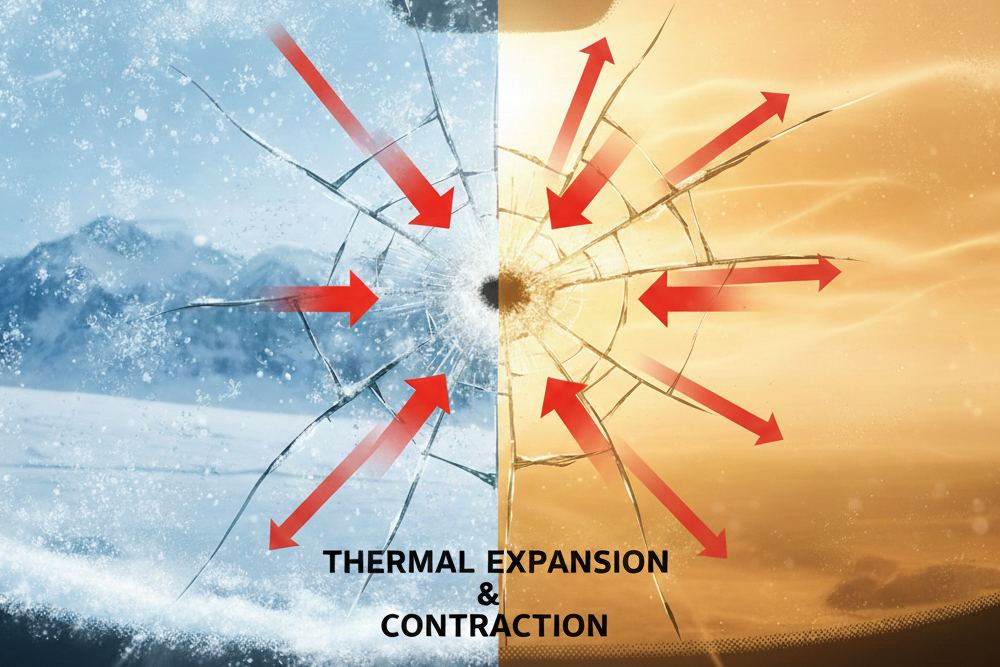
In order to comprehend the reason behind the propagation of cracks, it is necessary to examine the manner in which materials respond to temperature. The vast majority of materials, including the safety glass that is utilized in automobiles, expand when they are heated and contract when they are cooled.
In your vehicle, the windshield is not only a sheet of glass floating in the air; rather, it is securely attached to the metal frame of your vehicle. Glass and metal differ in their ability to conduct heat. Different rates of expansion and contraction are experienced by the metal frame and the glass in response to changes in temperature.
The majority of the time, automobile glass is strong enough to withstand the force of this push and pull. On the other hand, the structural integrity of the windshield is negatively impacted when it has a chip or fracture. This generates a point of weakness. This tension finds the route of least resistance whenever the glass expands or contracts; thus, it moves in that direction. As a consequence, a fracture appears that extends in a direction away from the place of initial contact.
The Damage That Cold Weather Causes to Your Windshield
The winter season is particularly harsh on automobile windshields. The likelihood of a chip spreading is substantially higher in temperatures below freezing than it is in temperatures above freezing, according to research conducted by the industry. Moisture and temperature shock are the two primary factors that are responsible for this harm caused by winter.
A distinctive trait of water is that it expands when it freezes, which is referred to as the freeze-thaw cycle. In the event that it rains or snows, moisture has the potential to penetrate the minute cracks that are present in a windshield chip. In the event that the temperature falls below freezing, the water that is trapped will transform into ice and expand.
The layers of glass are forced apart as a result of this expansion, which functions like a wedge. It is not uncommon for the pressure to be sufficient to rapidly expand a minor fracture. Over the course of many days, the damage will gradually become more severe as the ice melts and then refreezes.
Defroster Danger: The second risk that we face throughout the winter is the way in which we attempt to combat the cold. The first thing that comes to mind when you wake up to find your windshield iced is to turn the defroster on to its highest setting. A phenomenon called thermal shock is produced as a result of this.
There is a phenomenon known as thermal shock that takes place when several sections of the glass suffer significant temperature variations at the same time. If you blast the interior of the glass with air that is 150 degrees Fahrenheit and the exterior of the glass is 20 degrees Fahrenheit, the glass will rapidly expand on the inside while remaining constricted on the outside. The enormous amount of force that is being applied causes a “snap,” which results in chips running into large cracks in the blink of an eye.
How the Summer Heat Affects Things
The heat of summer is just as harmful as the cold climate, which has a negative image. Glass is weakened by high temperatures, and the form of the windshield is distorted as a result. This makes any damage that already exists far more volatile.
When you leave your automobile parked in the sun, the interior of the vehicle will behave in a manner similar to that of a greenhouse. When compared to the air outside, the temperatures inside might skyrocket to much greater levels. The middle of the windshield is transparent, but the edges, which are typically painted black and are referred to as the frit, are able to absorb heat more quickly.
A temperature gradient is produced across the glass as a result of this. When compared to the blazing hot edges, the core holds a somewhat moderate temperature. Tensile tension is applied to the glass as a result of the uneven baking process. When there is a chip that is situated in that high-stress zone, it is quite likely that the heat will cause it to spread.
The shock caused by air conditioning: In the same way that the defroster may induce heat shock in the winter, your air conditioner can do the same thing in the summer. In the event that your vehicle has been sitting in a parking lot for a length of time, the glass will be heated and swollen. When ice-cold air is blasted directly into the windshield, the inner layer of glass undergoes a fast contraction, while the outside layer of glass continues to expand. As a result of this abrupt contraction, the glass is pulled apart, resulting in chips becoming fissures.
Threats to One’s Safety When Ignoring a Crack
If you have a crack in your windshield, it may seem like a little irritation, but in reality, it poses a significant risk to your safety. More than just a windscreen, your windshield is an essential structural component of your car. Its primary function is to block the wind.
Up to sixty percent of the structural integrity of the cabin roof is provided by the windshield in the case of an accident that causes the vehicle to roll over. When there is a significant break in the glass, the roof is more likely to collapse than it would otherwise be. For more information, the correct deployment of the passenger-side airbag is dependent on the windshield serving as a backstop. It is possible for a windshield that has been weakened to shatter when the airbag is deployed, leaving the safety device worthless.
Do you have a Question?
Get An Auto Glass Replacement Quote Now 866.278.7417
Safeguarding the Glass of Your Automobile
In the event that you have a chip and are unable to go to a repair shop right away, you should try to reduce the amount of stress that the glass is under. The following are some of the methods that you may use to prevent the damage from spreading: Park your vehicle in the shade or in a garage. This will keep the temperature of the windshield more constant and will prevent it from being exposed to the extremes of direct sunshine or freezing overnight.
Make gentle adjustments to the temperature; under no circumstances should you turn on the air conditioner or the defroster. Take your time to warm up or cool down the vehicle in order to prevent thermal shock. Maintain a clean environment: it is important to keep the windshield wipers clean so that they do not drag debris over the chip, which can make the repair more difficult in the future. It is important to refrain from slamming doors because the vibration that is caused by slamming a car door might be sufficient to cause a crack extension in glass that is already under thermal stress.
Avoid putting things off until it is too late. Weather is the enemy of glass that has been damaged. For any reason, whether it be the growth of ice in January or the blistering heat in July, the elements will ultimately convert a chip that can be repaired into a windshield that is completely broken.
Repairing a chip as soon as it appears is the most efficient approach to deal with it. The structural integrity of the glass can be restored with the use of resin injections, which are both rapid and inexpensive. There is a high probability that you will lose money if you wait for the weather to change. If you find a chip, you should make an appointment for a repair before the thermometer falls or spikes.
Your automobile’s glass can be destroyed by extreme temperatures, including fire and ice. Initially, it is a very slight flaw that is scarcely noticeable, such as a small stone chip from a gravel truck or a modest hole caused by debris from the roadway. At first, you might not even notice it, or you could rationalize it away by telling yourself that you will deal with it later. The seasons thereafter undergo a transformation.
While you are blasting the air conditioning on a particularly hot afternoon, all of a sudden, that little chip causes a jagged line to appear across your dashboard. Another possibility is that it is a frigid morning, and the instant your defroster starts working, the glass suddenly breaks.
Despite the fact that pebbles and dirt are typically the first things to cause damage to a windshield, temperature is the unseen killer that ultimately brings the work to a successful conclusion. Glass for automobiles is long-lasting, although it is not indestructible. The capacity of your vehicle’s windows to maintain their structural integrity is significantly impacted by the physical phenomena of heat expansion and contraction. It is possible to avoid the abrupt shock of a broken view and the expense of a complete replacement by gaining an understanding of how heat and cold exert their influence on your windshield.
How Stress and Glass Are Related to Science
You need to examine the behavior of materials in order to comprehend the reason behind the cracking of your windshield when subjected to temperature pressure. When material is heated, it expands, and when it is cooled, it contracts significantly. The glass itself, as well as the rubber seals and the metal frame of your vehicle, is included in this category.
The difficulty occurs due to the fact that these materials do not expand and contract at the same rate simultaneously. When metal is heated, it expands more quickly than glass does. The metal frame of your vehicle rubs against the edges of the glass when it is parked in the direction of the sun. Under typical conditions, the safety glass used in automobiles is designed to withstand this kind of pressure. Nevertheless, once the structural integrity is damaged by a chip or scratch, that strain requires a location to release in order to be effectively released. The chip, which is the weak spot, becomes the starting line by which a fracture begins.
Tension is concentrated around the fault rather than being distributed evenly throughout the surface as a result of this occurrence, which engineers refer to as “stress risers.” If you combine the mixture with changes in temperature that are extremely high or low, you are creating a formula for disaster.
How the Heat of Summer Can Destroy Windshields
Winter weather is typically thought of as the culprit when it comes to windshield cracks, but summer weather may be just as devastating. Both the exterior ambient temperature and the interior thermal shock are the two separate methods in which the heat affects the glass of your automobile.
When you park your automobile in direct sunshine on a day with a temperature of 90 degrees Fahrenheit (32 degrees Celsius), the inside temperature does not remain at 90 degrees Fahrenheit. Solar radiation is absorbed by the dashboard and the glass, which results in the temperature of the windshield itself skyrocketing to an incredible level. At temperatures of 150 degrees Fahrenheit or above, it is not unusual for windshield glass to reach those temperatures.
When heated at these temperatures, the glass undergoes a substantial expansion. In the event that there is a bullseye chip or a minuscule crack, the molecules come into contact with each other with an incredible amount of force. Given that the growing glass has nowhere to go, the chip breaks open in order to release the strain that it is under.
Thermal Shock of Air Conditioning: Human mistake is the second reason for failure during the summer, and it is possibly the most prevalent cause. The first thing that comes to mind when you get into a vehicle that has the sensation of being in an oven is to turn the air conditioning up to its highest setting and direct the vents toward your face as well as the windshield.
The outer surface of the glass, which may be 150 degrees Fahrenheit, and the internal surface, which is being blasted with air at 40 degrees Fahrenheit, are both subjected to a significant temperature differential as a result of this. While the inner layer makes an effort to swiftly compress, the outside layer continues to display its enlarged state. Thermal shock is the name given to this push-pull dynamic mechanism. As a result of the fact that glass is a poor conductor of heat, it takes some time for the temperature to become uniform across the pane’s thickness. It is the stress that causes the glass to shatter if the transition occurs too quickly.
The Way That The Winter Cold Breaks Glass
For automobile glass, winter poses a new set of issues, some of which may be considered more aggressive. Expansion and contraction are the mechanisms that are comparable to those that occur during the summer, but there is also the presence of moisture.
In the same way that the air conditioner is the leading source of heat shock during the summer, the defroster is the primary offender during the winter. It is quite likely that the temperature of the glass on your windshield is below freezing when it is covered with frost or ice.
You are putting the glass through a tremendous amount of localized heating if you start your vehicle and then immediately blast high heat into the windshield in an effort to melt the ice quickly. The region that is affected by the vent experiences fast expansion, whilst the glass in the surrounding area continues to freeze and constrict. Tensile stress is significantly increased as a result of this unequal expansion. It is possible for a horizontal fracture to appear nearly immediately across the bottom of the windshield if there is a chip that has already been present.
The ice wedge effect occurs when precipitation in the form of snow, sleet, and rain occurs during the winter season. If your windshield has a minor hole or chip, water will surely leak into that fissure. This is an unavoidable consequence.
During the night, the temperature decreases, which causes the water that was trapped to freeze. The expansion of water is around nine percent when it freezes. The ice is transformed into a minuscule wedge as a result of this expansion, which causes the sides of the fracture to separate. Throughout the course of winter, this cycle, which is also known as the freeze-thaw cycle, occurs on multiple occasions. Each time the water freezes, it causes the crack to expand slightly further, which in turn causes the glass to become more fragile until it eventually breaks completely.
Brittleness is increased: Glass, like many other materials, becomes more brittle when exposed to extremely cold temperatures. The degree of its adaptability is diminished. When hit by the same pebble in temperatures below zero, a windshield that is able to withstand a small pebble impact on a mild spring day is more likely to crack or shatter than when used in warmer spring weather. Because of the cold, the glass is already under tension, which makes it less capable of absorbing the energy that is brought about by an impact.
The Reasons Why Chips Are Like Time Bombs
A windshield that has not been damaged is extremely durable. It is intended to fulfill the role of a structural component of the vehicle, making a contribution to the rigidity of the cabin and providing support for the roof in the event that the vehicle rolls over. On the other hand, a chip completely alters the physical laws. Imagine a piece of fabric in your mind. You are able to exert a great deal of force on it, and it will not tear. However, if you make a very small cut with scissors and then pull with the same amount of force, it will tear very easily. The thin cut is referred to as a stone chip.
Studies that were carried out by the Motor Industry Research Association (MIRA) demonstrated that chips have a high probability of developing into cracks when temperatures reach lower levels. According to their findings, more than eighty percent of chips will spread when heated to fourteen degrees Fahrenheit (ten degrees Celsius). Even at a temperature of 0 degrees Celsius (32 degrees Fahrenheit), nearly sixty percent of chips are likely to develop cracks.
If you do not repair a chip, you are essentially gambling with the meteorological conditions. It is possible that you will remain fortunate for a few weeks, but in the end, a hot afternoon or a cold morning will find the weak spot in your defenses.
Do you have a Question?
Get An Auto Glass Replacement Quote Now 866.278.7417
How to Preserve the Glass of Your Automobile
However, you have the ability to control how you treat your vehicle, even though you cannot control the weather. Listed below are a few different approaches that can be taken to reduce the likelihood of thermal stress and glass failure. The best way to protect yourself from thermal shock is to exercise patience and gradually increase the temperature. Roll down the windows during the summer months to allow the hot air to escape before turning on the air conditioner fully. In the event that you do turn it on, you should not immediately direct the vents in the direction of the windshield. Please allow the cabin to gradually cool down.
When the weather is cold, you should let the car warm up gradually. In the beginning, you should use the defroster on a lower setting. Before you hit the glass with hot air that is forced into it, it is best to let the car idle for a few minutes so that the glass can warm up slightly from the heat that is generated by the engine from the surrounding environment.
You should park your vehicle in a garage or a shaded area whenever it is possible to do so. This shields the glass from the intense heat of direct sunlight and maintains its temperature during the nighttime hours when it is below freezing. If you do not have access to a garage, you might want to think about using a windshield sunshade during the summer months in order to lower the temperature of the glass’s surface. During the winter months, a car cover can prevent snow and ice from adhering to the glass, thereby necessitating less vigorous defrosting.
Immediately repair any chips that have been made. The most efficient method for preventing cracks is to remove the initial point of contact. Repair technology for windshields has come a long way in recent years. It is possible for a technician to inject a specialized resin into a chip and then cure it with ultraviolet light in order to rebond the glass component.
By restoring the structural integrity of the windshield, this process also prevents moisture from entering the crack that was previously present. In most cases, it takes less than half an hour to complete, and it is significantly less expensive than a complete replacement.
When trying to de-ice a windshield, you should never use boiling water under any circumstances. The magnitude of the temperature difference is so great that it will almost certainly cause the glass to shatter. To remove ice, you should use a plastic scraper rather than a metal one and de-icing fluid.
Questions That Are Frequently Asked:
Is it safe to drive with a windshield that has a visible crack? Yes, in most cases. The presence of a crack can make it difficult to see, particularly if it reflects sunlight or the glare of headlights. Additionally, the windshield contributes up to thirty percent of the structural strength of the vehicle for the vehicle. A windshield that has been compromised may not be able to support the roof in the event of a rollover or permit the passenger airbag to deploy in the correct manner.
I have a crack; is it possible to repair it, or do I need to replace it? Size and location are two factors that determine this. Generally speaking, it is possible to repair chips that are smaller than a quarter. It is typically necessary to perform a complete replacement if the crack is more than a few inches in length or if it is directly in the line of sight of the driver.
Is windshield repair covered by some insurance policies? There are numerous comprehensive insurance policies that cover chip repair without a deductible. This is due to the fact that insurance companies would rather pay for a minor repair now rather than a complete replacement in the future. In order to be certain, check with your provider.
Why does the crack seem to grow overnight? This is usually due to the temperature drop. As the air cools, the glass contracts, pulling the crack apart. If moisture was trapped inside, it likely froze and expanded, wedging the crack open further.
Avoid Giving in to the Influence of the Weather
Your windshield endures a lot—highway debris, rain, snow, and the constant expansion and contraction caused by the elements. Despite the fact that you are unable to stop the thermometer from fluctuating, you are able to prevent a minor issue from developing into a significant headache.
Handle the glass on your vehicle with caution. It is important to avoid shocking it with sudden blasts of hot or cold air, and more importantly, you should not ignore those small stone chips. It is much preferable to have a broken view tomorrow than to have a quick repair done today. Before the next heatwave or cold front arrives, you should make arrangements to have any damage repaired if you find any.
Mobile Safe Auto Glass
14241 E Firestone blvd suite 400,
La Mirada, CA 90638
Phone: (562) 608-1154
Toll Free: 1 866 278 7417
Mail: sales@mobilesafeautoglass.com
Get a FREE QUOTE today! You can get a free quote and schedule 24/7 using this free quote wizard.
Mon – Fri 8am – 5pm
Saturday 8am – 1pm
Sunday Closed