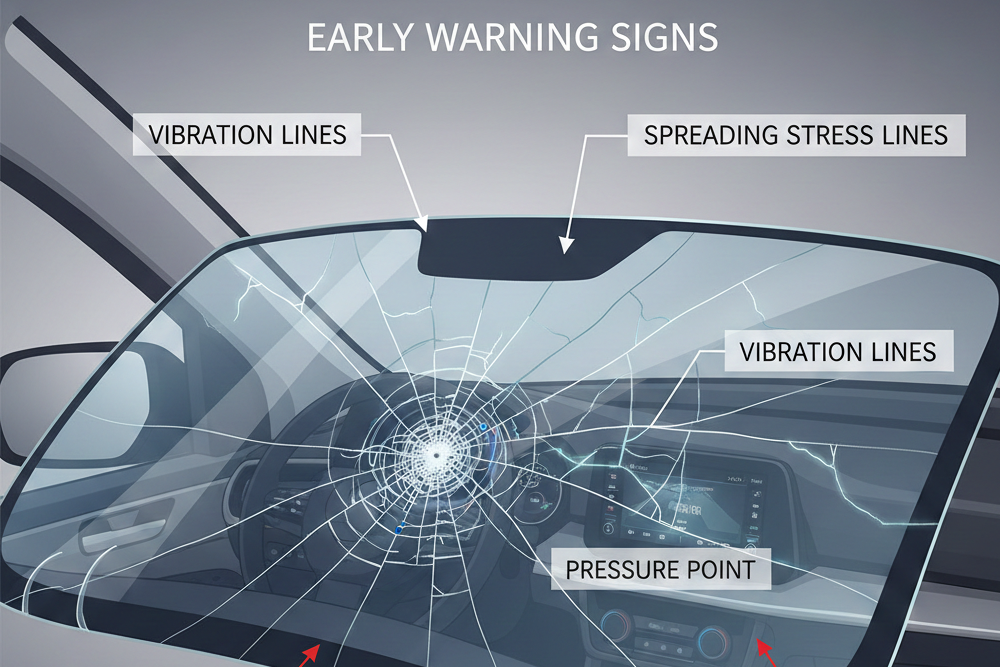
Windshield Crack Warning Signs Before Shattering
Every single one of us has experienced that. A boulder that has gotten loose from the rear of a dump truck smashes your windshield with a terrible thud while you are driving down the highway. You are completely oblivious to the situation. Even though you are cringing and wishing for the best, you are aware that the harm has already been done. An insignificant chip is staring back at you. At first, it can appear to be completely innocuous; after all, it is just a little cosmetic imperfection that you can ignore for a few weeks, right? Regrettably, that little chip is frequently the precursor to a lot more significant and even hazardous circumstances.
Get An Auto Glass Replacement Quote Now 866.278.7417

Windshield Replacement & Repair
Our competitors push you into going to their shop to get your glass fixed-making it cheaper for them. We make it easier for YOU to get back on the road by offering free mobile repairs at your home or work. With our free mobile services servicing the entire Orange County & Los Angeles area, we can often handle your windscreen replacement the same day! So the next time you need a windshield replacement, give us a call.
Talk to a Windshield Replacement Specialist Now 866.278.7417

Calibration
Calibration is the process of returning a vehicle’s ADAS to OEM specifications. Calibration is necessary after a new glass installation, particularly a windshield with a camera mounted to it, to ensure that the ADAS features continue to function properly despite having been moved during installation. If a car’s ADAS is not properly calibrated, the system may not function safely. A misaligned camera could jeopardize the functionality of the system and lead to dangerous driving or accidents, so it is crucial that the cameras are aligned perfectly, which is what windshield calibration ensures.
Talk to a Calibration Specialist Now 866.278.7417

Fleet Auto Glass Repair
We provide expert auto glass repair and windshield replacement services for commercial fleets of all sizes. We are experienced with all manufacturers and machine types of domestic or foreign cars, trucks, vans, or commercial vehicles, including heavy equipment. Our same day mobile auto glass and windshield repair service will enable you to get back on the road faster and start saving you time and money instantly. Give us a call today! We are here to help!
Talk to a Fleet Auto Glass Specialist Now 866.278.7417
Detailed Description of a Crack in a Windshield
Before you can comprehend the reason behind windshields shattering, you must first comprehend the construction of windshields. Glass used in automobiles is laminated, in contrast to the glass used in the windows of your home. The structure is made up of two layers of glass, with a layer of vinyl (PVB) nestled in between the two layers of glass. When the glass breaks, this design is meant to prevent it from flying apart into a million pieces.
On the other hand, the tension within the glass shifts once the outer layer is separated from the interior. It is possible for this vulnerability to be exploited by temperature variations, vibrations in the road, and even air pressure. It is possible for a chip that first seems to be a “bullseye” or a “star” to suddenly develop into a spiderweb of fractures that not only obstruct your vision but also jeopardize the stability of the glass.
A Crack Is Clearly Visible to You at This Moment
Location is of the utmost importance. The appearance of a crack or chip that is immediately in the line of sight of the driver is not only a nuisance; rather, it represents a potential threat to the driver’s safety. Your eyes have a tendency to concentrate on the flaw rather than the road in front of you, which might turn into a potentially hazardous distraction.
Furthermore, cracks in this particular region are subjected to continuous tension from the windshield wipers, which causes them to develop. The damage can be made worse by the friction and pressure that is exerted by the wiper blades, which can cause dirt and moisture to be forced into the crack. As a result of this expanding process, the glass becomes even more fragile, which increases the probability of an unexpected breakdown. When you find yourself gazing through a gap in order to view the traffic lights, you should immediately consider this to be a dangerous situation.
The Damage Is Getting Close To The Top
Chips and cracks that are placed close to the edge of the glass provide a substantially greater risk than those that are located in the middle of the windshield. The point at which the glass is attached to the metal frame of the vehicle is known as the edge of the windshield area. During driving, the body of the car flexes and twists, which causes this area to experience the greatest amount of stress and strain.
It is possible for a fracture that begins within two inches of the edge to expand out immediately. Due to the fact that the structural integrity of this area is already being loaded, even a slight impact or a rapid change in temperature can cause the fracture to “run” throughout the full length of the glass. The seal is disrupted once a fracture reaches the edge of the glass, which drastically increases the likelihood that the windshield will shatter or pop out in the event of an accident.
Do you have a Question?
Get An Auto Glass Replacement Quote Now 866.278.7417
You Detect Some Peculiar Sounds
There are occasions when the warning signals are not visible; rather, they are heard. When you are traveling at high speeds, you should pay attention if you start to hear a whistling sound or a rattling coming from the windshield. There is a possibility that this is an indication that the seal that was supposed to be between the glass and the automobile frame has been broken or that air is leaking in via a gap that you have not yet seen.
That the windshield is no longer airtight is shown by the presence of wind noise. It is possible for water to enter if air is able to do so, which can result in rust and corrosion surrounding the frame. What is more essential is that it indicates that the glass is vibrating or changing in ways that it shouldn’t be. As a result of this additional movement, existing weak places are subjected to additional stress, which speeds up the progression from a tiny fracture to a shattered mess.
This Crack Is Becoming Wider
Despite the fact that this may appear to be self-evident, many drivers fail to recognize sluggish progress until it is too late. A crack that was just one inch long during the previous week and is now two inches long is a time bomb that is about to explode. As a result of a number of circumstances, fractures get larger: Temperature swings: spraying the defroster on a windshield that is frozen or turning on the air conditioner on a day that is extremely hot causes the glass to rapidly expand and contract.
The vibrations that are transmitted through the chassis by the road conditions, such as speed bumps, potholes, and gravel roads, cause the glass to get agitated. The presence of moisture can cause water to freeze inside a fracture, causing the glass to expand and further separate. In the event that you observe any adjustments to the size or shape of a chip, it indicates that the structural integrity is actively deteriorating.
The glass seems to be cloudy or pitted. It is not always the case that a single, spectacular crack is the cause of shattering. Windshields are prone to pitting over time as a result of sand, dust, and other minute particles of road debris. A haze is produced as a result of this, and it is most noticeable while traveling in the direction of direct sunlight or when approaching headlights at night.
Despite the fact that pitting is not a “crack” in the conventional sense, it is indicative of a widespread deterioration of the outer glass layer. This not only makes the glass more susceptible to shattering when subjected to mild blows, but it also considerably lowers visibility. When the sun shines on your windshield, if it seems to be a night sky filled with stars, this indicates that the glass is old and brittle, making it far less robust than a brand-new pane.
Myself, Am I Able To Fix It
Windshield repair kits that are accessible for do-it-yourself repair may be found in abundance at car parts retailers. In most cases, these kits will utilize a resin to fix the crack, and then they will cure the resin with sunshine. It is possible that a do-it-yourself kit might serve as a temporary band-aid for relatively minor chips (those that are smaller than a quarter) that are not visible to the driver.
Nevertheless, these kits are not very effective in restoring the glass to its original structural integrity. In the case that the repair is not carried out properly, there is a possibility that you will trap moisture or air within, which may eventually lead to the glass splitting much deeper. When it comes to anything that is larger or closer to the margins, a professional evaluation is an absolute must.
Refrain from Waiting Until It Breaks
Just like your seatbelt or airbag, your windshield is a piece of safety gear that you should always have on. It is a risk that is just not worth taking to ignore the warning indicators that indicate a windshield that is experiencing failure. These are your vehicle’s ways of letting you know that the glass is beginning to fail, whether it be a chip along the edge, a crack that is becoming larger, or a mystery whistle that you hear while driving on the highway.
Take immediate action to repair the harm. Repairing a minor chip is a simple and inexpensive process, and it is frequently covered by insurance without requiring a deductible. If you wait until the windshield breaks, you will often need to replace it completely, which may be rather costly. Getting your glass checked out now will ensure that your safety and good eyesight are your top priorities.
Expectations That Were Not Met
You are traveling along the highway on a day when the sky is clear. Both the gravel trucks that are in front of you and the rubble that is flying in the air are not present. A sudden and loud crack may be heard throughout the entire cabin. Suddenly, what appears to be out of nowhere, a spiderweb fracture takes place on your windshield.
Glass that breaks on its own is not always a really spontaneous occurrence, despite the fact that it may feel random. In most cases, it is the culmination of a growing amount of stress that has been building up for several weeks or perhaps even months.
All of the glass in your car, especially the windshield, is considered to be a structural component. Additionally, it assists in the proper deployment of the passenger airbag and provides support for the roof in the case of a rollover. Considering that it is an essential component of the vehicle’s safety cell, it is continuously subjected to a variety of forces, including twisting, vibration, and temperature variations. When everything is functioning properly, the glass is able to bear these stresses without developing any problems. However, whether there are problems in the installation process, structural defects, or temperature shocks, the glass suffers from an accumulation of stress that eventually causes it to become incapable of remaining intact.
It is possible to avoid a potentially hazardous blowout on the highway by being aware of the subtle warning signals of car glass stress. This will also assist you in addressing installation difficulties before they become costly repairs. There is an unseen pressure that is building up in your windshield, and this is how you can identify it.
Distortion of the visual field and “Waving”
Optical distortion is one of the earliest and most subtle signs that stress starts to manifest in the body. It is possible to have an unobstructed view of the road thanks to the fact that automotive glass is produced to be optically transparent. In spite of this, glass is theoretically a hard liquid structure; yet, it is possible for it to warp somewhat when it is subjected to excessive stress or compression as a result of an improper fit.
At first sight, this warping might not be immediately apparent. In many cases, you will need to search for it in particular. To do the Light Pole Test, you should sit inside your parked vehicle and stare through the windshield at a straight object, such as a telephone pole or the edge of a building, through the glass. Make a gentle movement from side to side with your head. Be on the lookout for the following: if the straight line of the pole appears to bend, wave, or ripple as you move your head, this indicates that the frame is pinching or twisting the glass.
The fact that the glass is subjected to a continual torque is demonstrated by this “funhouse mirror” phenomenon. Even while it might be able to hold for a time, a minor speed bump or a rapid change in temperature could be the final straw that causes a stress fracture to appear.
Noises of Creaking or Popping That Cannot Be Explained
It is imperative that you be able to listen to what your vehicle has to say to you. Although it is common for us to listen for sounds such as the engine knocking or the brakes squeaking, we rarely pay attention to the cabin itself.
Pay attention if you are driving over bumps or entering a driveway at an angle and you hear sounds such as popping, clicking, or creaking coming from the region of the dashboard or the roofline. The presence of these sounds is frequently an indication that the pinch weld, which is the process of the glass moving against the metal frame, or the urethane glue has failed in particular areas.
It is not possible for the glass to move in harmony with the body of the car when the adhesive bond is not equally distributed. On the contrary, the metal frame is bending in one direction, while the glass is struggling to maintain its rigidity. This friction results in stress that may be heard. Given that there is no cushion between the glass and the bare metal, the vibration will ultimately cause a fracture to begin at the edge of the glass if it is rubbing against the metal.
A Noise from the Wind and Water Leaks
A stress fracture is frequently an indication of a more serious issue, which is the collapse of the seal. Two functions are performed by the urethane sealant that is used to attach your windshield to the vehicle. To begin, it ensures that the glass remains still. In the second place, it functions as a flexible buffer that absorbs the stress that the road causes. A damaged seal can be identified by the presence of a moist area on the dashboard, wet carpeting in the footwells, or a high-pitched whistling sound whenever the vehicle is traveling at highway speeds.
In the event that the seal is broken, the glass will no longer possess that vital buffer. At this point, it starts to come into close touch with the stiff frame of the automobile. The energy that is transferred from the chassis flex is transferred directly into the glass since there is no urethane there to absorb it. Because glass is unable to bend as much as steel, it cracks in order to release the energy that it has stored up. When you treat a leak, you are not only ensuring that you do not get wet; you are also ensuring that the structural integrity of the windshield is maintained.
Do you have a Question?
Get An Auto Glass Replacement Quote Now 866.278.7417
A “Halo” Appearing Around the Periphery
There is a black ceramic band that runs around the perimeter of the majority of contemporary windshields. This band is referred to as the fraction. The rough roughness of this band allows the adhesive to attach to the glass, and it also shields the glue from the harmful effects of ultraviolet light.
Cracks caused by stress almost always begin at the edge of the glass, which is frequently concealed behind the molding or behind this black frit band for the most part. Despite the fact that removing the trim is necessary in order to examine the edge itself, it is occasionally possible to discern the beginning stages of delamination.
Conduct a thorough inspection of the margins of your windshield. If you notice a “halo” of milky white color creeping inward from the border of the glass, this is an indication that the PVB (polyvinyl butyral) layer, which is the safety plastic that is sandwiched between the two layers of glass, is beginning to separate. Because of this separation, the glass is greatly weakened, and as a result, it is extremely vulnerable to stress breakage caused by even minute vibrations.
Unusually Poor Performance of the Defroster
Despite the fact that thermal shock is the most common cause of stress fractures, your vehicle is intended to withstand the effects of routine weather fluctuations. If, on the other hand, the glass is already under stress as a result of an improper installation, then it becomes extremely sensitive to temperature. When you operate the defroster or the air conditioner, pay attention to how your windshield responds to the changes occurring.
Inconsistent clearing: If a particular section of the windshield takes a considerably longer amount of time to clear fog than the other sections, this may be an indication of a variance in the thickness or density of the glass that is produced by stress warping. The “Thermal Pop”: If you turn on the heater on a chilly morning and hear a loud tick or pop from the glass (even if it doesn’t shatter immediately), that is the sound of the glass rapidly expanding against a frame that is holding it too tightly. This can happen even if the glass doesn’t break immediately.
Stress on Glass: Common Causes and Effects
It is helpful to have an understanding of the symptoms, but in order to prevent them, it is necessary to study the underlying reasons. In the first place, what is the reason that your glass is under stress? Incorrect installation is the most prevalent underlying cause of the problem. When a technician fails to properly prime the metal frame or when the glass is fitted into the frame in an uneven manner, it results in the creation of “high spots.” A significant portion of the structural load is supported by these pressure points. In due time, the glass will break as a result of the interaction of the physical forces involved.
The presence of rust on the pinch weld, which is the metal ledge that the glass rests on, is comparable to the presence of cancer in windshields. Rust, as it accumulates, grows larger and more expansive, exerting pressure on the glass from the inside out. This results in a very high pressure that is referred to as “rust jacking.” If you notice paint bubbling close to the molding of your windshield, it is probable that there is a substantial amount of pressure building up on the edge of the glass.
It is possible for the frame of older vehicles or vehicles that have been involved in significant accidents to become twisted or weakened. This phenomenon is referred to as chassis flex. It is necessary for the windshield to perform the function of a structural brace in the event that the body of the vehicle flexes more than the manufacturer predicted it would during turns or over bumps. Because of its fragile nature, glass will ultimately break under the force of this unwanted load.
Do Not Wait for the Breaking to Occur
Stress on auto glass is a risk that goes unnoticed. When a fracture first occurs, it is highly likely that the component’s structural integrity has already been damaged for a considerable amount of time. Do not wait for the eventual fracture to occur across your line of sight if you observe the telltale “wavy” distortion, hear the cracking of glass against metal, or discover indicators of seal failure. Instead, take action immediately.
It is recommended that the installation be inspected by a trained car glass specialist. It is possible for them to assess whether the glass has to be reseated or whether corrosion repair is required in order to alleviate the mounting pressure. A shield is provided by your windshield. You need to be sure that it is robust enough to defend you when it really matters.
Mobile Safe Auto Glass
14241 E Firestone blvd suite 400,
La Mirada, CA 90638
Phone: (562) 608-1154
Toll Free: 1 866 278 7417
Mail: sales@mobilesafeautoglass.com
Get a FREE QUOTE today! You can get a free quote and schedule 24/7 using this free quote wizard.
Mon – Fri 8am – 5pm
Saturday 8am – 1pm
Sunday Closed