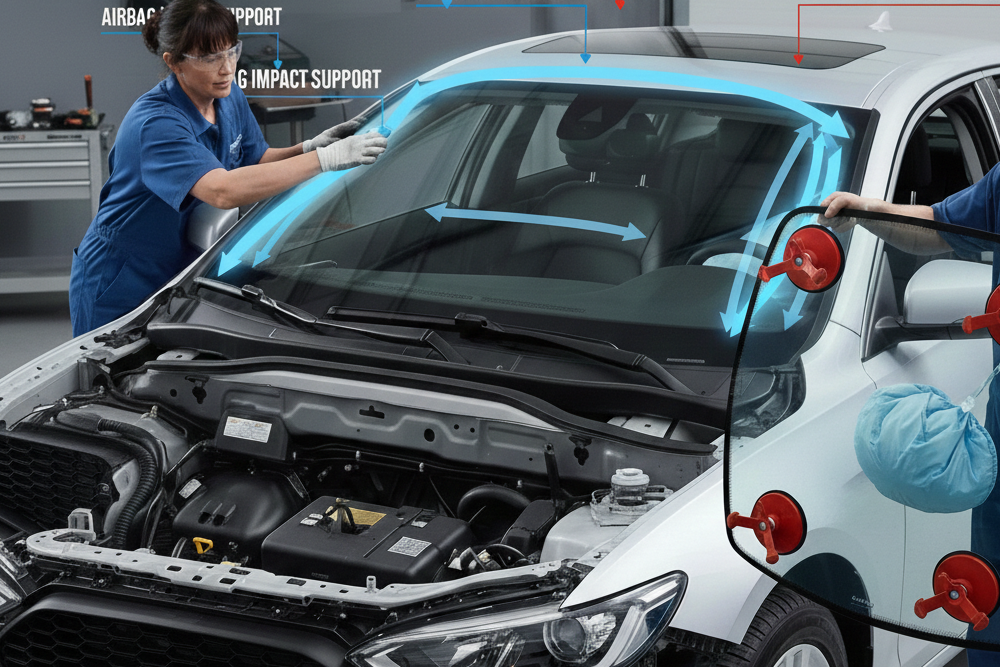
Front Window Repair and Vehicle Structural Integrity
Most drivers treat a stone chip in their front glass as a minor irritation. It is an unattractive blemish that distorts your perspective and spoils the smooth aspect of your automobile. You might persuade yourself you will get to it later, perhaps when you have free time or when the crack gets a little bigger. But delaying that maintenance is typically a gamble with your safety. A windshield is a piece of glass that is designed to protect your vehicle from the wind and insects, but it is much more than that. The front window is an essential part of the car’s safety restraint system (SRS) in contemporary automobile engineering. In the event of a collision, it works in conjunction with the airbags and the seatbelts to ensure the safety of the occupants. A small crack in that glass can compromise the structural integrity of the entire vehicle.
Get An Auto Glass Replacement Quote Now 866.278.7417

Windshield Replacement & Repair
Our competitors push you into going to their shop to get your glass fixed-making it cheaper for them. We make it easier for YOU to get back on the road by offering free mobile repairs at your home or work. With our free mobile services servicing the entire Orange County & Los Angeles area, we can often handle your windscreen replacement the same day! So the next time you need a windshield replacement, give us a call.
Talk to a Windshield Replacement Specialist Now 866.278.7417

Calibration
Calibration is the process of returning a vehicle’s ADAS to OEM specifications. Calibration is necessary after a new glass installation, particularly a windshield with a camera mounted to it, to ensure that the ADAS features continue to function properly despite having been moved during installation. If a car’s ADAS is not properly calibrated, the system may not function safely. A misaligned camera could jeopardize the functionality of the system and lead to dangerous driving or accidents, so it is crucial that the cameras are aligned perfectly, which is what windshield calibration ensures.
Talk to a Calibration Specialist Now 866.278.7417

Fleet Auto Glass Repair
We provide expert auto glass repair and windshield replacement services for commercial fleets of all sizes. We are experienced with all manufacturers and machine types of domestic or foreign cars, trucks, vans, or commercial vehicles, including heavy equipment. Our same day mobile auto glass and windshield repair service will enable you to get back on the road faster and start saving you time and money instantly. Give us a call today! We are here to help!
Talk to a Fleet Auto Glass Specialist Now 866.278.7417
The Technology of Laminated Glass
First, you need to have an understanding of the differences between the windshield and the other types of glass in your vehicle in order to comprehend the significance of the windshield from a structural standpoint. The side and rear windows are often made of tempered glass, which is meant to shatter into small, dull pebbles upon contact to prevent lacerations.
In contrast, the windshield in the front of the vehicle is made of laminated glass. In this method, a layer of polyvinyl butyral (PVB) plastic is positioned between two sheets of glass in order to create a sandwich.
Then, tremendous heat and pressure fuse these layers together. This design has a specific function: in the event that the glass breaks, the plastic inner layer keeps the fragments from flying into the cabin and acts as a barrier against the outside environment.
This lamination procedure provides a hard, durable sheet that contributes greatly to the stiffness of the vehicle’s cabin. Automotive engineers rely on this rigidity when calculating how a car will perform in a crash.
Preventing Roof Crush in Rollover Accidents
One of the most horrifying events on the road is a rollover collision. A rollover subjected the car’s roof to considerable force. If the roof collapses, it rapidly reduces the surviving room for the people inside, resulting in serious head and neck injuries.
The windshield gives the roof the essential vertical support it needs. The front glass of many modern automobiles is responsible for providing up to forty-five percent of the structural integrity of the cabin in the event of a front-end collision and up to sixty percent in the event of a rollover. It works as a pillar, helping to transfer the load of the hit throughout the chassis rather than letting it crush the passenger compartment.
The windscreen cannot sustain this load if it is broken or mounted incorrectly. The glass may bend or detach altogether under pressure. Without adequate support, the roof is substantially more likely to cave in, significantly increasing the probability of mortality in a rollover catastrophe. A flawless, factory-rated windshield is important to keeping the “safety cell” of the car intact.
The Backboard for Airbag Deployment: We frequently consider airbags to be soft pillows that blast out of the dashboard to cushion us. However, the mechanics of a passenger-side airbag deployment are forceful and rely significantly on the windshield.
When a front-end accident happens, the passenger airbag deploys upward at speeds of up to 200 miles per hour. It needs a solid surface to bounce off so it can position itself correctly to cushion the passenger’s chest and head. The windshield serves as this backboard.
A chip or crack in the glass could compromise its ability to withstand the explosive power of the airbag deployment. The glass could fracture or pop out of the frame entirely.
If the backboard fails, the airbag will likely deploy incorrectly—either flying out the front of the car or inflating towards the roof—leaving the passenger with little protection against the dashboard.
Ejection Prevention: Seatbelts are your primary defense against ejection during a crash, but the windshield serves as a secondary barrier. High-impact incidents may propel occupants forward with immense force. The windshield keeps passengers inside the car if they are unstrapped or if the crash’s mechanics are complicated.
A windshield is made to keep people inside the vehicle even if the glass cracks because of the durable PVB layer inside and the strong adhesive (urethane) used to attach the glass to the frame.
A weakened windshield, however, lacks the structural cohesion to operate as this barrier. A weak spot created by a pre-existing crack may lead the glass to collapse instantly upon impact.
Do you have a Question?
Get An Auto Glass Replacement Quote Now 866.278.7417
How Minor Damage Escalates to Structural Failure
You might question how a tiny rock chip could possibly contribute to a roof collapse. The answer rests in physics and stress distribution.
A windshield is under constant strain. It sustains strain and compression as the vehicle chassis bends and flexes over bumps, turns, and uneven road surfaces.
A solid piece of glass distributes these forces evenly. Forces that would typically be dispersed over the entire pane instead gather at the crack’s tip, acting as a “stress concentrator.”
Thermal Stress: Temperature variations worsen this impairment. If you blast the defroster on a frigid winter morning or crank the A/C on a hot summer day, the glass expands and contracts.
This quick expansion causes tremendous tension at the glass’s fault, which frequently results in a tiny chip quickly growing into a huge spiderweb break. The structural value of that glass significantly reduces once the crack extends.
Making the Safe Choice
The choice between replacing and repairing becomes crucial when one is aware of the risks.
When it comes to chips that are less than a quarter or cracks that are less than three inches in length, repair is frequently an option. A technician injects a specific epoxy into the injured area and cures it with UV light. This welds the glass back together and restores most of its structural strength. It stops the break from widening and saves the factory seal.
In situations when the damage is more severe or when it is directly in the line of sight of the driver, replacement is required. This is due to the fact that repairs can result in a slight distortion. More critically, if the damage spreads to the edge of the windshield, replacement is essential.
The edge is where the glass joins to the metal frame; damage here undermines the bond itself, meaning the windshield could separate in an accident.
Quality counts when replacing. Make sure the store uses high-modulus urethane adhesives and “OEM quality” glass. Safe Drive-Away Time (SDAT) is the amount of time that the adhesive requires to dry before it may be used. Driving the car before the glue has set means your windshield won’t hold in a crash.
The Role of ADAS Calibration
Modern structural integrity isn’t simply about physical strength; it is about digital safety nets. In the vast majority of brand-new automobiles, advanced driver assistance systems, sometimes known as ADAS, are fitted. Lane-keeping assistance, automatic emergency braking, and collision alarms are some of the features that are included in this category.
A direct position behind the windshield is where the cameras and sensors that are used for these systems are located. Because vehicle glass is a lens, even a fraction of a degree of distortion or misalignment in a new windshield might confound these sensors.
If your automobile thinks an impediment is three feet further away than it actually is due to defective glass, the automated brakes can activate too late.
Therefore, structural integrity maintenance necessitates recalibration. A technician must recalibrate these cameras after a replacement to ensure the car’s digital safety systems accurately align with the physical world.
Frequently Asked Questions: Is it against the law to operate a vehicle with a windshield that is cracked? Indeed, it is illegal in many jurisdictions. Laws frequently say that no damage can hinder the driver’s view. Even if your region doesn’t specifically prohibit it, a police officer may issue a ticket if they determine the vehicle to be unsafe.
When it comes to fixing a chip, how long can I wait? Zero days would be ideal. A fresh chip may become contaminated by dirt and moisture, which will hinder the repair resin’s ability to adhere. A clean, fresh chip is easy to repair; a dirty, aged one generally requires a whole replacement.
Does insurance cover windshield repair? Most comprehensive insurance policies cover glass damage. Many insurers would even waive the deductible for repairs (rather than replacements) because it is cheaper for them to pay for a $100 repair now than a $500 replacement later.
Is a replacement windshield as durable as the original from the factory? Yes, assuming the installation is done correctly. If the technician applies suitable primers and high-quality urethane and follows the manufacturer’s curing times, a replacement windshield will offer the same structural protection as the original.
Prioritize Safety Over Aesthetics
The windshield is a silent guardian in your vehicle’s safety architecture. It supports the roof, guides the airbags, and keeps you enclosed in the event of an accident. Viewing front window repair as solely a cosmetic matter is a dangerous fallacy.
If you notice a chip or crack, please address it promptly. Whether it requires a quick resin fill or a full glass replacement with ADAS calibration, the expense is small compared to the important protection it provides. Make sure that the construction of your vehicle is not damaged and that all of the safety systems are operational when you require them.
This is a situation that is all too familiar: your windshield does more than just block bugs. As you cruise along the highway, a gravel truck abruptly changes lanes in front of you. A tiny rock comes out, hits your glass with a sharp crack, and leaves a star-shaped imprint right in your line of sight.
The majority of us bemoan and condemn our good fortune, and then we quickly forget about it. Maybe we tell ourselves we’ll get it corrected “someday.” Isn’t it just a matter of personal preference? A source of annoyance?
In reality, it is a great deal more than that. In order to maintain the structural integrity of your car, that piece of glass is an essential component. It plays a surprisingly major part in keeping the roof from crushing you during a rollover and ensuring your airbags deploy appropriately.
Ignoring a chip or crack isn’t simply postponing car maintenance; it’s gambling with your safety system.
This article explains exactly how your windshield protects you during a crash, why even little damage impairs that protection, and what you need to do to keep your vehicle safe.
The Hidden Engineering of Auto Glass
To understand why damage is dangerous, you first have to grasp what a contemporary windshield actually is. Laminated glass is a complicated piece of safety engineering, not just a window.
Unlike the tempered glass used in your side windows—which shatters into thousands of tiny, dull cubes upon impact—a windshield is a sandwich. It is made up of a central layer of polyvinyl butyral (PVB) surrounded by two layers of glass.
The PVB’s Function: This plastic inner layer is the hero of the assembly. When a rock hits your windshield, the outer layer of glass can break, but the PVB layer holds the system together.
Glass fragments are prevented from flying into the cabin and causing injuries to passengers as a result of this. More significantly, it keeps people within the vehicle after a catastrophic impact.
However, this strength relies on surface tension and structural continuity. When a chip or crack breaches that surface tension, the structural capacity of the entire “sandwich” is diminished.
How Windshields Prevent Roof Crush: One of the most horrifying sorts of car accidents is a rollover. While seatbelts secure you in your seat, your vehicle’s frame has to ensure there is enough space for you to survive. This is where the windshield becomes a load-bearing wall.
In many modern automobiles, the windshield is responsible for providing up to sixty percent of the structural integrity of the cabin in the event of a rollover accident. Imagine your car’s cabin as a box. The windshield acts as a bracing element between the vertical pillars (A-pillars) that support the roof.
A crack damages the glass, preventing it from supporting the intended weight. During a rollover, a fractured windshield is substantially more likely to shatter or pop out totally. Without adequate bracing, the roof is considerably more likely to fall inward, significantly lowering the surviving room for the inhabitants.
Do you have a Question?
Get An Auto Glass Replacement Quote Now 866.278.7417
Airbag Deployment and Windshield Strength
The connection between your airbags and windshield is a crucial safety aspect sometimes overlooked.
When a front passenger airbag deploys, it doesn’t merely shoot straight out toward the passenger. It deploys upward and bounces off the windshield to position itself correctly to cushion the passenger’s chest and head.
The airbags deploy at speeds of up to 200 miles per hour, representing the explosive power that causes this event to take place. For the airbag to work, the windshield must be sturdy enough to survive that huge, rapid impact without breaking.
The Consequence of Damage: A large crack in your windshield already compromises its structural integrity. When the airbag strikes the glass, the windshield may fracture or detach from the frame.
The airbag has nothing to stop it if the windshield fails. It may deploy too far forward or out into the opening where the glass used to be. The result? The passenger slides forward without the requisite cushioning, hitting the dashboard or the A-pillar with significant force.
The “Safety Bubble” Theory: A “safety bubble,” or safety cell, is built around the occupants of automobiles by automotive engineers. This system relies on numerous components functioning in harmony:
The frame (including the windshield) preserves survival space. A broken link in this chain jeopardizes the entire safety bubble. A shattered windshield interrupts the continuity of the vehicle’s exterior.
In a head-on collision, the windshield helps distribute the force of the crash down to the chassis and away from the cabin. A damaged windshield cannot efficiently transfer this energy, perhaps allowing extra force to reach the passengers.
When to Repair vs. When to Replace
Now that we understand the stakes, how can you tell if your windshield is physically sound? According to the general rule, the size, depth, and placement of the damage are all important factors.
Repairable Damage: Small chips and cracks can typically be fixed if found early. This method involves injecting a specific resin into the injured area and curing it using UV radiation. This restores the strength of the glass and prevents the crack from expanding.
Chips that are less than a quarter and cracks that are shorter than three inches can typically be repaired after being found.Depth: It’s typically a candidate for repair if the damage hasn’t reached the inner plastic layer.
Replacement Is Required: The replacement process entails taking out the complete glass unit and using high-strength urethane adhesive to attach a new one to the car frame. In most cases, you will need to find a replacement if
A dollar bill is no match for the length of the crack. The damage is typically something that necessitates a replacement if
A dollar bill is no match for the length of the crack. Due to the extent of the damage, both layers of glass have been broken through. It is directly in the line of sight of the driver that the damage lies.
sufficiently deep to allow one to penetrate both layers of glass. It is directly in the line of sight of the driver that the damage lies. (Repairs can leave a minor distortion that distracts the driver).
The damage reaches to the border of the windshield. This is important because edge cracks undermine the overall construction by compromising the link between the glass and the metal frame.
The Peril of Incorrect Installation: If you need a replacement, quality matters as much as the glass itself. The windshield needs to be properly connected to the car’s body because it is a structural element.
The bond will be weak if a technician installs the glass on an unclean surface, applies the incorrect adhesive, or does not properly prime the metal frame. A badly installed windshield might come loose in an accident just as easily as a cracked one. Always verify you are utilizing certified technicians who follow the Auto Glass Safety Council (AGSC) regulations.
Frequently Asked Questions
Does a little chip really affect safety? A very small chip may not immediately cause structural failure, but it is a weak point. Alterations in temperature, such as turning on the defroster on a chilly morning, or just colliding with a pothole, have the potential to transform a little chip into a significant crack almost instantly. Once it fractures, the structural integrity is at risk.
Can I drive with a cracked windshield? Legally, it depends on your state laws. It is not advised for safety. You are operating a vehicle with a compromised safety system, even if the glass is unlikely to fall on you on its own. If an accident occurs, you have less protection than the car was meant to provide.
Will my insurance pay for windshield repair? In most cases, the answer is yes. Because insurance companies recognize that a windshield is safety equipment (and that repairs are cheaper than replacements), many policies include chip repair with no deductible. Replacement is often covered by comprehensive insurance and may have a deductible.
Don’t Ignore the Cracks: While it may be easy to disregard auto glass damage as a minor inconvenience, scientific evidence suggests otherwise. Your windshield is a shield, a brace, and a backstop all in one. It keeps the roof up, the airbags in place, and the passengers inside.
In the case that you discover a chip, have it repaired as soon as possible in order to stop it from spreading further. Make arrangements for a replacement with a qualified expert if you have a crack. Maintaining your vehicle’s glass is not just about having a clean view of the road; it’s about ensuring that if the worst happens, your automobile is sturdy enough to protect the people within.
Mobile Safe Auto Glass
14241 E Firestone blvd suite 400,
La Mirada, CA 90638
Phone: (562) 608-1154
Toll Free: 1 866 278 7417
Mail: sales@mobilesafeautoglass.com
Get a FREE QUOTE today! You can get a free quote and schedule 24/7 using this free quote wizard.
Mon – Fri 8am – 5pm
Saturday 8am – 1pm
Sunday Closed