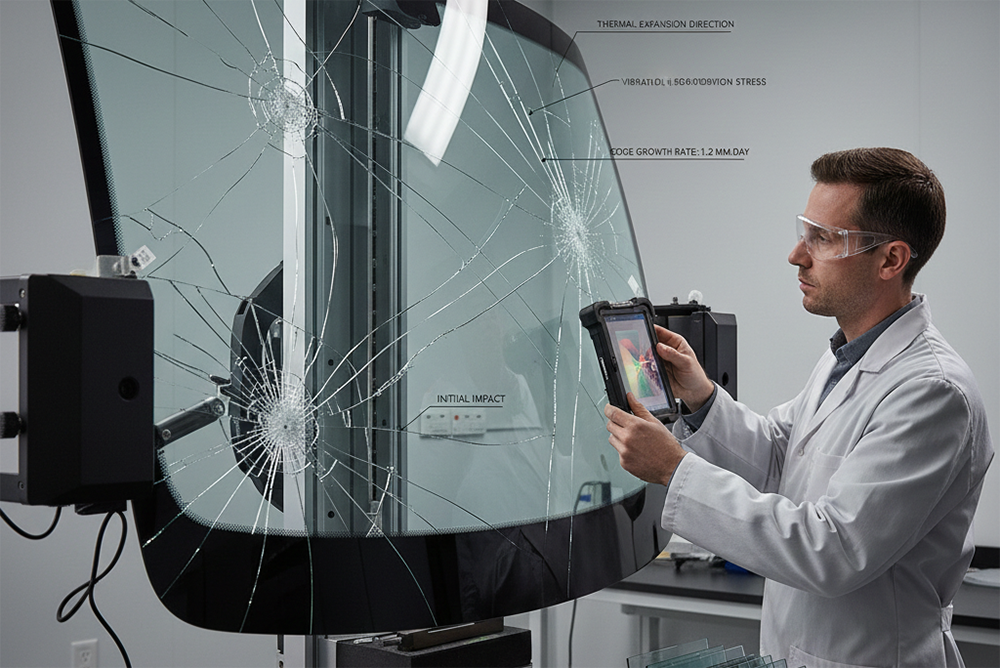
Windshield Crack Growth Patterns Drivers Should Understand
One of the sounds that every driver dreads hearing is a quick and abrupt shatter on the windshield. The windshield is inspected, and you find it: a little, inconsequential mark where a pebble made contact with the surface. It’s possible that you’ll choose to disregard it, expecting that it will remain the same size indefinitely. Unfortunately, windshield damage almost never remains steady for an extended period of time. It is a structural weakness that is waiting for the appropriate conditions to expand, and that little flaw is that weakness.
Get An Auto Glass Replacement Quote Now 866.278.7417

Windshield Replacement & Repair
Our competitors push you into going to their shop to get your glass fixed-making it cheaper for them. We make it easier for YOU to get back on the road by offering free mobile repairs at your home or work. With our free mobile services servicing the entire Orange County & Los Angeles area, we can often handle your windscreen replacement the same day! So the next time you need a windshield replacement, give us a call.
Talk to a Windshield Replacement Specialist Now 866.278.7417

Calibration
Calibration is the process of returning a vehicle’s ADAS to OEM specifications. Calibration is necessary after a new glass installation, particularly a windshield with a camera mounted to it, to ensure that the ADAS features continue to function properly despite having been moved during installation. If a car’s ADAS is not properly calibrated, the system may not function safely. A misaligned camera could jeopardize the functionality of the system and lead to dangerous driving or accidents, so it is crucial that the cameras are aligned perfectly, which is what windshield calibration ensures.
Talk to a Calibration Specialist Now 866.278.7417

Fleet Auto Glass Repair
We provide expert auto glass repair and windshield replacement services for commercial fleets of all sizes. We are experienced with all manufacturers and machine types of domestic or foreign cars, trucks, vans, or commercial vehicles, including heavy equipment. Our same day mobile auto glass and windshield repair service will enable you to get back on the road faster and start saving you time and money instantly. Give us a call today! We are here to help!
Talk to a Fleet Auto Glass Specialist Now 866.278.7417
The Components That Make Up Your Windshield
First, you need to have a solid understanding of what you are looking at in order to comprehend why fractures propagate. This is not your typical window glass; it is your windshield. The construction of this sandwich-like structure is made of laminated safety glass. A rock that strikes your windshield will typically shatter the outside layer of glass, but it will not destroy the inner layer or the plastic that is in the middle of the windshield.
Because of the way the glass is constructed, it will not break into sharp shards in the case of a hit, so it safeguards the passengers. Having said that, that outer layer is under strain all the time anyhow. After the surface tension has been broken by a chip, the glass will attempt to release the energy that it has stored, which will typically result in a fracture that spreads.
The Most Frequent Forms of Damage Patterns
The form of the first hit has a major influence on the likelihood that the damage will spread and the rate at which it will occur. One of the most popular impact shapes is the bullseye, which is also known as the bullet. The shape of the object is just what its name suggests: a black circle with an impact point in the center of it. When compared to other varieties, bullseyes are often less likely to spread rapidly than other types for the simple reason that the damage is limited and circular.
On the other hand, if dirt can find its way into the pit, it might make the restoration process more challenging. This is a well-known example of instability. At the “legs” of the star, where the glass has already started to split, there are already potential weak spots. The mere vibration of the road can induce these legs to extend at an accelerated rate.
Among all the other kinds of flaws, the edge crack is the most deadly. The molding is often reached shortly after it begins, which is normally within two inches of the edge of the windshield. As a result of the structure of the vehicle bending and flexing, the area around the windshield is subjected to the greatest amount of stress. When compared to a break that is placed in the middle of the pane, a crack that is located around the edge of the glass can spread throughout the full length of the glass considerably more quickly.
Sometimes, your windshield fractures even when nothing is striking it. This phenomenon is known as the stress crack. The appearance of a stress crack might be attributed to either significant temperature changes or structural flaws in the application of the glass. Due to the fact that they signal a loss in the integrity of the glass rather than localized damage, they nearly invariably require a complete replacement.
The Environmental Factors That Cause Them
It is hardly a miracle that a chip would transform into a fracture. The weakened glass is subjected to particular physical stresses, which cause the separation to become even more pronounced. By gaining an understanding of these triggers, you may lessen the severity of the damage until you are able to reach a repair shop.
Temperature: Temperature is the adversary of broken glass. Thermal stress and temperature fluctuations are other factors. In the presence of heat, glass expands, and in the absence of heat, it shrinks. A chip disrupts the consistent expansion and contraction that occurs in car glass, despite the fact that it is built to withstand this behavior.
If you have a chip on your windshield on a chilly winter morning and you blast the defroster on high heat, the quick temperature shift will cause “thermal shock.” This is because the glass will heat up unevenly, which will place a significant amount of stress on the weak area. This frequently results in a chip immediately erupting into a lengthy fracture that runs horizontally.
During the summer, the same idea is applicable. Inducing the same expansion effect may be accomplished by washing a heated automobile with cold water or by blasting the air conditioning on a windshield that has been scorching in the sun. Your vehicle is continually moving, vibrating, and bending, which causes you to experience physical stress and vibration. In reality, the windshield is a structural component of the car, acting as a contributor to the stiffness of the cabin.
In the event that you drive over a pothole, pass a speed bump, or just drive on a gravel road, kinetic energy will go through the frame of the vehicle and into the glass. An unblemished windshield is able to readily accommodate this flex. A windshield that has been compromised does not. Every vibration serves as a hammer and chisel on the damage that has already occurred, gradually bringing the fracture closer to the surface.
Creating sufficient air pressure and vibration to cause a fracture to widen can be accomplished with as little effort as slamming a car door. Glass is unexpectedly susceptible to damage by water, which can be a source of dampness. Moisture seeps into the small cracks of a chip as it weathers, whether it is raining or snowing. Whenever the temperature falls below freezing, the water in question will transform into ice.
During the freezing process, water expands. Because of this expansion, the layers of glass are being forced apart, which in turn causes the fracture to become more extensive. The damage to windshields tends to get substantially greater during the winter months because of this reason.
Dirt and debris: Although dirt may not necessarily cause a fracture to expand structurally, it may make it hard to fix if its presence is there. The process of repairing a windshield requires injecting a specific glue into the chip in order to reattach the glass to the windshield. It will be impossible for the resin to adequately bind if there is an accumulation of dust, road salt, or windshield washer fluid inside the crack. This results in a repair that is not well-made and is likely to fail and crack again in the future.
Do you have a Question?
Get An Auto Glass Replacement Quote Now 866.278.7417
The Repercussions That Broken Glass Has On Public Safety
The majority of motorists consider a crack to be a mere aesthetic inconvenience, something that should be disregarded until the time comes for the car to be inspected. However, a windshield that has been damaged poses a genuine risk to the driver’s safety. It is not just the wind that the windshield is designed to stop. This support system is weakened by a significant crack, which increases the likelihood that the roof may collapse.
Furthermore, the windshield is essential to the proper operation of the airbag on the passenger side of your vehicle. The passenger is protected from the impact of the airbag’s deployment by the airbag’s impact with the windshield. It is possible that the power of the airbag might completely shatter the windshield if the glass is weakened by a huge fracture. It is possible for this distortion to conceal pedestrians or impediments, which might result in increased reaction times during crucial periods.
Comparison of When to Repair and When to Replace
How can you tell whether the damage has reached an unacceptable level? It is always better to get the advice of a specialist, but there are broad rules that can help you determine how severe the situation is. In most cases, it is easy to repair the chip or fracture if it is less than the size of a dollar note, which is around six inches. Three chips or less are available to you. Neither the edge of the glass nor the glass itself is damaged. It is not possible for the motorist to see the damage right in front of them.
In the event that the crack is longer than six inches, replacement is required. The inner layer of the glass is broken as a result of the damage. The break is close to the edge, which reduces the structural strength of the structure. The damage is visible to the driver (repairs frequently result in a little distortion of the vision they provide).
Questions That Are Frequently Asked
Am I able to use Super Glue to prevent a fracture in my windshield from developing further? This DIY fallacy is rather widespread. It is possible that cyanoacrylate adhesive, sometimes known as super adhesive, might temporarily keep the glass together; however, it is not meant to endure thermal expansion or vibration from the road. To add insult to injury, applying glue to the fracture would most likely prevent the professional resin from functioning in the future, which means that a professional will not be able to fix it in an appropriate manner.
To prevent dirt from getting inside, it is preferable to use transparent tape and to take it to a store as soon as possible. If the police believe that the glass poses a threat to the safety of the vehicle, they have the authority to issue citations. The vast majority of chip repairs may be finished in less than half an hour. First, the region is cleaned, then resin is injected, and last, the resin is cured using ultraviolet radiation. This is a very rapid process. The process of replacing anything takes more time, often around an hour, and there is also an extra hour required for the glue to dry before the vehicle can be driven safely.
Preserving the Clarity and Safety of Your View
Rather than being static, fractures in windshields are dynamic. The environment has an effect on them, as seen by their growth in response to every pothole, temperature surge, and frigid night. It is possible for anything that begins as a little irritation to rapidly develop into a significant risk to one’s safety and a more expensive repair expense.
Speed is the most effective protection against the formation of cracks. Taking care of a rock chip as soon as it occurs, which is typically covered by insurance and does not need a deductible, helps to protect the factory seal of your windshield and ensures that your vehicle’s structural integrity is not compromised. You should not wait for the web to spread; instead, you should inspect your glass right now and take action before the harm is done.
What causes some cracks in the windshield to spread more quickly than others? The piercing “pop” that occurs when a rock hits your windshield is a sound that every motorist looks forward to hearing. Immediately, your eyes search the glass, hoping to discover nothing that may be there. On the other hand, it is frequently present: a small starburst or a tiny bullseye chip that is directly in front of your attention.
There are moments when you are fortunate. Over the course of many years, that tiny chip has remained unaltered, a slight nuisance because of its appearance that you finally come to accept. On the other hand, there are instances when you park your car in the evening with a chip the size of a penny, and when you wake up, you find a crack that is a foot long and runs across the passenger side.
The unpredictability of accidents involving broken auto glass may be quite frustrating. What causes a chip to remain in one vehicle for an infinite period of time while another vehicle’s windshield fails fairly immediately? It’s not only a matter of luck. In the end, it is determined by a mix of physics, ambient conditions, and the particular structural engineering of your vehicle. The more you know about these triggers, the better you will be able to judge when you have the luxury of waiting and when you need to make a hasty trip to the repair shop.
When It Comes To Laminated Glass
Before you can comprehend the reason behind windshield cracking, you must first comprehend the construction of windshields. Whereas the tempered glass that is used for your side and rear windows is intended to shatter into thousands of harmless pebbles upon impact, the laminated glass that is used for your windshield is meant to break into smaller pieces.
In most cases, the only layer of glass that is broken when a rock strikes the windshield is the outermost layer. The inner vinyl layer is responsible for holding the structure together, preventing fragments from flying into the cabin and preventing the roof from collapsing in the case of a rollover of the vehicle.
Once, however, that outer layer is weakened, the structural strain shifts in a different direction. When the glass is subjected to continuous stress, a chip is a weak point in the tension field that the glass is experiencing. After that point, it turns into a war between the structural integrity of the glass and the forces from the outside that are acting upon it.
Alterations in Temperature and Their Implications
Temperature fluctuations are the most insidious foe for a windshield that has been damaged. When glass is heated, it tends to expand, and when it is cooled, it tends to compress. Auto glass is intended to resist regular weather patterns; nonetheless, unexpected or excessive swings in temperature can cause “thermal stress.”
This indicates that the glass in your windshield has already been damaged, even if it is only a little chip. A decrease in temperature over the course of the night causes the glass to shrink. The glass will expand in an uneven manner if the temperature increases fast the next morning as a result of actions such as blasting the defroster or pouring hot water on the glass in order to remove the ice. The chip is the target of this push-and-pull effect, which focuses especially on the weak area.
They can expand horizontally over the whole windshield in a matter of minutes, and the result is sometimes referred to as a “stress crack.” It is for this reason that chips have a tendency to spread far more quickly during the depths of winter or the height of summer than they do during the warm weather of spring or fall.
Vibrating Roads And The Effects Of Physical Stress
The vehicle you drive is not a fixed item. As it travels, it continues to vibrate, twist, and bend in a continuous manner. Windshields are really structural components of the vehicle, and they can contribute up to forty-five percent of the cabin’s structural integrity in the event of a front-end collision and up to sixty percent in the event of a rollover. During the course of your driving, it takes in a considerable amount of kinetic energy due to the fact that it is attached to the frame.
Shockwaves are sent through the chassis of the car and into the glass whenever the vehicle encounters a washboard dirt road, a speed bump, or a pothole. When the glass is not broken, it is able to withstand these vibrations without any problems. Nevertheless, in the event that there is a fracture in the surface, such vibrations perform the function of a hammer and chisel on the crack.
A spread might be triggered by behaviors that appear to be really innocuous. When you slam a car door, you cause a quick increase in the pressure within the vehicle as well as a physical jolt. The slam of the door may be the final straw for a fracture that is already on the verge of spreading to other areas of the structure.
Considering the Dangers of Debris and Moisture
When it comes to damage to automobile glass, water is a power that is surprisingly damaging. A windshield chip is not only a divot; rather, it is a canyon on a microscopic scale. When it rains or when you wash your automobile, water penetrates the layers of the break and seeps further into the crack.
As soon as the temperature drops below freezing, this becomes extremely important. In the science class that we took in elementary school, we learned that when water freezes, it expands. In the event that water becomes enclosed within the micro-fractures of a windshield chip and then freezes, the expansion of the water causes the glass to become separated. Icing wedging is the procedure that causes the fracture to dramatically extend as a result of its application.
On the other hand, dirt is also involved, but in a different way. In the event that you do hire a professional to repair the glass, dirt will serve as a wedge, forcing its way into the fracture and preventing the glass from fusing back together. When additional dirt is introduced into the crack, it becomes more difficult for the repair glue to successfully connect with the fracture. This increases the probability that the repair will not be successful and that the crack will continue to widen.
Do you have a Question?
Get An Auto Glass Replacement Quote Now 866.278.7417
Once Again, The Location Is Everything
All chips are not made equal in every way. When it comes to the windshield, the location of the damage has a significant influence in determining how rapidly it will spread. The “Stress Zone” refers to the outermost margins of the windshield, which are typically the two inches that are nearest to the metal frame. These areas are the most susceptible to damage. This region is referred to as the “stress zone.”
During the manufacturing process, the glass is bent to conform to the curvature of the vehicle, which results in residual tension around the perimeter of the glass. If a rock were to strike this edge region, the fracture would very certainly expand rapidly and aggressively practically instantly. Furthermore, because the damage is so near to the seal, it frequently weakens the structural connection of the glass, which typically requires a complete replacement rather than a repair. This is because the damage is so localized.
In spite of the fact that a chip that is in the driver’s direct line of sight does not necessarily spread more quickly than one that is on the passenger side, it is handled differently and is regarded differently. Despite the fact that the chip was mended, the glass still has a little scar or distortion. In the event that this distortion is positioned directly in front of the driver, it has the potential to generate a hazardous glare from the sun or headlights. Because of this, chips that are visible to the driver typically result in an immediate replacement, regardless of whether or not they are spreading more widely.
What Role Does the Rate of Repair Play
The passage of time is the element that is shared by all of these elements, including temperature, vibration, moisture, and location. Whenever a chip is left neglected for an extended period of time, it is subjected to a greater number of stresses. In most cases, a chip that is less than a quarter may be repaired when it is found. In order to complete the operation, a particular resin is injected into the break, and then it is cured using ultraviolet radiation. The structural integrity of the outer layer of glass is restored as a result of this, and the fracture is stopped from spreading further.
The possibility to mend, on the other hand, disappears almost immediately once a fracture begins to spread itself outward. Repairing a crack that is longer than three to six inches (depending on the technology used by the business) is typically not a viable option from a structural standpoint. Having reached that stage, you are contemplating the possibility of replacing the entire windshield, which is a substantially more costly and time-consuming option.
Questions That Are Frequently Asked
Is it possible to use superglue to repair a fracture in the windshield? It is not something that is suggested. It is possible that superglue (cyanoacrylate) might temporarily keep the glass together, but it is not meant to resist the temperature expansion and contraction that a windshield experiences. In addition, the application of superglue to the fracture will prevent the professional repair resin from entering the damage at a later time. In the event that you use superglue, you will most likely be unable to obtain a competent repair, which would necessitate a complete replacement.
Does having a broken windshield make it unlawful to operate a vehicle? Yes, in a big number of jurisdictions. In the event that the crack makes it difficult for the driver to see or if it prevents the windshield wipers from functioning properly, you may be issued a penalty. Although the laws differ from state to state and nation to country, in general, any damage that puts people’s safety at risk is deemed a violation.
Is windshield repair covered by some insurance policies? Glass repair is typically covered by comprehensive vehicle insurance policies, and the deductible is typically waived in these policies. Insurance companies would rather pay for a relatively inexpensive repair (between fifty and one hundred dollars) than a costly replacement (between three hundred and one thousand dollars or more). In order to be certain, check your particular policy.
How long does it take to do a repair? The average time it takes for a specialist to fix a chip is thirty minutes. An hour or two may be required to complete the replacement of the entire windshield, and then an additional hour is required for the glue to dry before the car may be driven safely.
Avoid Putting Things Off Until It Is Too Late
The amount of time that passes between a windshield repair that is quick and inexpensive and a windshield replacement that is expensive is sometimes measured in days. Every time you turn the key, the physics of the road are fighting against that microscopic chip, even if it may appear to be harmless at this moment.
Your glass is always being put to the test by a variety of factors, including changes in temperature, vibrations from the road, and moisture. If you take care of the damage as soon as it occurs, you will not only save money but also ensure that your vehicle will continue to have a strong structural foundation. When it comes to vehicle glass, the most costly habit you can have is the habit of always putting things off till later.
Mobile Safe Auto Glass
14241 E Firestone blvd suite 400,
La Mirada, CA 90638
Phone: (562) 608-1154
Toll Free: 1 866 278 7417
Mail: sales@mobilesafeautoglass.com
Get a FREE QUOTE today! You can get a free quote and schedule 24/7 using this free quote wizard.
Mon – Fri 8am – 5pm
Saturday 8am – 1pm
Sunday Closed