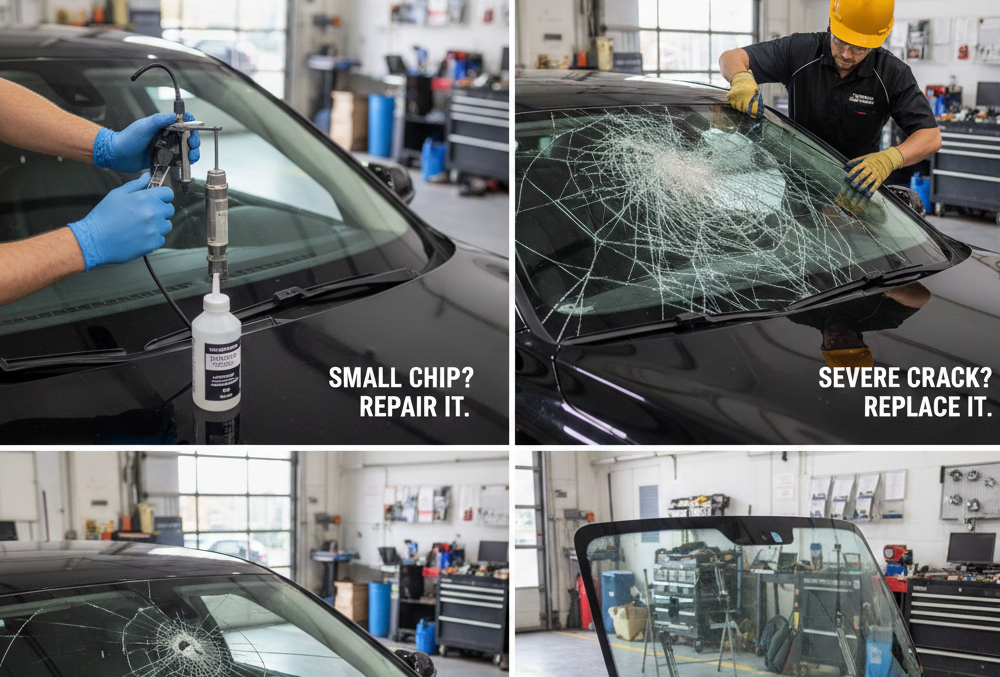
Front Window Repair vs Replacement A Safety-First Guide
Usually, it comes as a surprise. You are riding down the interstate, perhaps enjoying music or a podcast, when a startling, harsh crack breaks your trip. One of the rocks that was kicked up by the truck in front of you has left its mark on the windshield of your vehicle. Your first reaction can be frustration. Nobody wants to cope with the possible expense of auto repairs. But while you stare at that new blemish on your glass, a more vital worry should arise: Is my automobile still safe to drive? Beyond only keeping insects out of your mouth, the windshield does much more. The safety restraint system in your car depends on it. Making a choice between a straightforward repair and a complete replacement is not just a matter of financial consideration; it is also a matter of safety.
Get An Auto Glass Replacement Quote Now 866.278.7417

Windshield Replacement & Repair
Our competitors push you into going to their shop to get your glass fixed-making it cheaper for them. We make it easier for YOU to get back on the road by offering free mobile repairs at your home or work. With our free mobile services servicing the entire Orange County & Los Angeles area, we can often handle your windscreen replacement the same day! So the next time you need a windshield replacement, give us a call.
Talk to a Windshield Replacement Specialist Now 866.278.7417

Calibration
Calibration is the process of returning a vehicle’s ADAS to OEM specifications. Calibration is necessary after a new glass installation, particularly a windshield with a camera mounted to it, to ensure that the ADAS features continue to function properly despite having been moved during installation. If a car’s ADAS is not properly calibrated, the system may not function safely. A misaligned camera could jeopardize the functionality of the system and lead to dangerous driving or accidents, so it is crucial that the cameras are aligned perfectly, which is what windshield calibration ensures.
Talk to a Calibration Specialist Now 866.278.7417

Fleet Auto Glass Repair
We provide expert auto glass repair and windshield replacement services for commercial fleets of all sizes. We are experienced with all manufacturers and machine types of domestic or foreign cars, trucks, vans, or commercial vehicles, including heavy equipment. Our same day mobile auto glass and windshield repair service will enable you to get back on the road faster and start saving you time and money instantly. Give us a call today! We are here to help!
Talk to a Fleet Auto Glass Specialist Now 866.278.7417
The Structural Role of Your Windshield
Prior to debating whether to replace or repair your front window, it’s important to know what it does. In the early days of car history, glass was merely a wind blocker. Today, it is an engineering marvel.
Two layers of glass are used in the construction of modern windshields, and a film made of polyvinyl butyral (PVB) is sandwiched in between the two panes. This laminated design assures that the glass will remain intact in the event that it breaks, rather than fracturing into pieces that are extremely sharp by nature.
The windshield also helps keep the cabin of the car strong. The windshield contributes up to forty-five percent of the structural strength of the roof in the case of a rollover catastrophe. If the glass is compromised by a crack or faulty installation, the roof is more likely to collapse.
Furthermore, the windshield works as the backstop for the passenger-side airbag. When that airbag deploys, it hits the glass and cushions the passenger by bouncing its way back and forth. If the glass is weak, the airbag could blow right through it, rendering the safety device worthless.
When Can I Choose to Repair
Ideally, we would all want a fix. Instead of throwing away a massive chunk of glass in a landfill, this method is not only more efficient but also more cost-effective and gentler on the environment. However, repair is only effective under precise conditions. The glass is bonded back together by technicians injecting a specific resin into the chip or crack and curing it with UV light.
Here are the broad rules for when a repair is feasible:
The Damage’s Size: The industry standard for repairable damage has developed, but the “dollar bill rule” remains a useful comparison. Generally, if a chip or crack completely covers a dollar note or measures around six inches, it is a good candidate for repair. Some advanced shops can repair cracks up to 12 inches long, but the structural integrity may be less secure at that length.
The Depth of the Impact: Windshield repair works best on surface-level damage. If the rock impacted hard enough to penetrate both the exterior layer of glass and the inner plastic layer, a repair won’t be sufficient. The structure is already too compromised.
The Location of the Chip: Both the location and the extent of the injury are important.
Driver’s Line of Sight: Even the finest fixes cause the glass to slightly distort. If the damage is right in front of the driver, most reputable businesses will refuse to repair it since that distortion can confuse the driver or generate dangerous glare from sunshine and headlights.
The Perimeter: If a crack is within a few inches of the windshield’s edge, it probably requires repair. The margins of the glass are under the most stress, so a break there might spread quickly and impair the connection between the glass and the car frame.
Do you have a Question?
Get An Auto Glass Replacement Quote Now 866.278.7417
When Replacement is the Only Choice
Sometimes, the damage is simply too extensive for a resin injection to fix. Ignoring the signals and attempting a repair on a windshield that is too far gone puts everyone in the car at risk. You are likely going to require a complete replacement if:
The glass is pitted; sight is diminished, and the glass is compromised if there are several chips or if the glass is old and “sandblasted” by road debris.
The crack is spreading: Once a crack starts to spiderweb or expand, it becomes exceedingly difficult to halt. Temperature fluctuations—like firing the defroster on a cold morning—will cause the glass to expand and contract, causing the crack to fly across the windshield instantly.
Damage to the inner layer of the windshield: If you run your fingernail over the inside of the windshield and feel a catch, this indicates that the inner layer has been fractured. This requires immediate replacement.
The “Smart Car” Complication: In older vehicles, switching a windshield was an effortless mechanical job. You pop the old one out, clean the frame, apply urethane, and set the new glass. Today, the process is significantly more difficult due to Advanced Driver Assistance Systems (ADAS).
There are a number of safety features that are standard on the majority of modern automobiles, including rain-sensing wipers, automated emergency braking, and lane departure warnings. These systems rely on cameras and sensors frequently installed directly on the inside of the windshield, usually behind the rearview mirror.
Because these cameras view through the glass, the clarity and curve of that glass must be exact. Repairing a chip right in front of a camera lens may cause distortion that confuses the system. It may see an obstruction when none exists, or, worse, it may fail to recognize an actual obstacle.
Furthermore, if you replace the windshield, you must recalibrate the ADAS. Even a one-degree change in the camera angle can impact the system’s capacity to estimate distances by several feet down the road. This adds a layer of cost and time to the replacement process, but missing it means driving a car with failing safety eyes.
Insurance and Cost Considerations
The financial aspect frequently determines the ultimate decision for car owners. Repair Costs: An average repair costs between $100 and $150. However, because repairs are preventive (stopping a full replacement), many insurance companies may waive the deductible and cover the cost of the repair entirely.
Replacement Costs: Depending on the model of the car and the intricacy of the ADAS systems, a complete replacement can cost anywhere from $300 to more than $1,000. If you have a high deductible, you can end up paying for a large chunk of this out of cash.
Be mindful of the fact that it is tempting to shop for the least expensive glass that is offered. Aftermarket glass (OEE) can often have modest variances in thickness or clarity compared to Original Equipment Manufacturer (OEM) glass. When safety sensors are involved, sticking to OEM glass or high-quality substitutes is frequently the better approach.
Frequently Asked Questions: Will a windshield repair make the chip invisible? No. First and foremost, the objective of a repair is to restore the structural integrity of the structure and to stop the fracture from growing larger. While the resin will improve the appearance by 60% to 80%, you will likely still see a minor flaw or “scar” where the impact happened.
Is it possible for me to utilize a Windshield Repair Kit? DIY kits are available at car parts stores, but they come with hazards. If you inject the resin incorrectly or fail to remove all the air bubbles, the repair will fail, and you will likely have to replace the windshield anyhow. Professional technicians utilize vacuum pumps to ensure a firm binding. Expert assistance is advised for safety.
As soon as I have a replacement, could you please let me know how long I should wait before I start driving again? This depends on the urethane adhesive used. Some fast-curing adhesives allow you to drive away in as little as 30 to 60 minutes. To make sure the bond is robust enough to survive a possible airbag deployment, some people might need the automobile to sit for a few hours. Always ask your technician about the “Safe Drive-Away Time” (SDAT).
Could a minor chip potentially degrade the glass? Yes. Glass is strong because of surface tension. Once that surface is shattered, the tension is interrupted, creating a weak point. A minor chip diminishes the windshield’s capacity to withstand impact and structural stress.
Don’t Compromise on Road Safety
The windshield is likely one of the most overlooked safety heroes of your vehicle. While a minor chip can seem like a cosmetic irritation, it indicates a vulnerability in your car’s defense.
Please have a rock chip repaired promptly if you notice it early, while it is small and away from the edges. It saves money, keeps manufacturing seals intact, and reduces waste. However, if the damage is substantial, in your line of sight, or interfering with your car’s sensors, do not hesitate to opt for a full replacement.
That sturdy, transparent piece of glass is essential to both your and your passengers’ safety. See a qualified auto glass specialist who prioritizes safety whenever in doubt.
When is fixing auto glass a safety risk? Every driver on the highway fears the sound of a loud crack. A tiny rock bounces off your hood and creates a star-shaped mark on your windshield while you watch. Your first instinct is likely to be financial. You start worrying about how much the restoration is going to cost and if you can get away with a fast, affordable repair.
A resin injection repair is an appealing option. It’s rapid, often costs less than $100, and keeps the damage from spreading. However, repair isn’t always the responsible choice. The glass in your automobile serves as more than simply a wind and bug barrier; it is an essential safety feature that prevents the roof from collapsing during a rollover and guarantees that your airbags will deploy properly.
It is essential for your safety that you have a clear understanding of the distinction between a straightforward repair and a replacement that is required. Here is a complete tutorial on when repairing auto glass is no longer an option.
Understanding the Structural Role of Your Windshield
Before examining the types of harm, it is crucial to grasp what is at risk. Many drivers regard the windshield as a passive glass, whereas automotive engineers view it as a structural beam.
In modern automobiles, the windshield, in the event of a head-on collision, provides up to forty-five percent of the cabin’s structural integrity, and in the event of a rollover accident, it contributes up to sixty percent. Weakening the glass increases the likelihood of the roof collapsing after a catastrophic crash.
Furthermore, the passenger-side airbag employs the windshield as a backstop. When the bag deploys, it fires upward and bounces off the glass to cushion the passenger. The force of the airbag could completely shatter the glass if the windshield is damaged by a crack or a shoddy repair, making the safety feature worthless.
The Damage’s Size: The extent of the damage is the clearest sign that a replacement is required. While technology has progressed, there remain physical limits to what resin can glue together successfully.
The Dollar Bill Regulation
A popular industrial standard is the $1 bill test. The structural integrity of the glass is probably too damaged for repair if a crack is longer than a typical US dollar note, which is about six inches.
Long cracks tend to flex as the car drives over bumps or turns corners. This stretching prevents the repair glue from drying properly, which means the crack will likely reopen and spread.
Chip Diameter: For circular chips, such as “bullseyes” or “stars,” size matters as well. Generally, if the damage is more than a quarter (approximately one inch in diameter), a replacement is the safer choice. Even once the glass is filled, large chips leave behind noticeable weak places.
Location, Place, Place: The location where the rock strikes is just as essential as the size of the imprint. Even a little chip can compel a full replacement if it arrives in a vital zone.
The Driver’s Line of Sight: In order to repair the crack, a transparent resin must be injected into the crack, and then the resin must be healed using ultraviolet radiation. While this technique smoothes the surface and binds the glass, it is not optically perfect. Frequently, this technique leaves behind a faint blur, haze, or discoloration.
In the event that the damage is directly in the line of sight of the driver, which is a specific region roughly equivalent to the width of the steering wheel, you should immediately fix the windshield. That small distortion can generate deadly glare from sunshine or oncoming headlights at night, diminishing visibility when you need it most.
Do you have a Question?
Get An Auto Glass Replacement Quote Now 866.278.7417
The Area of the Critical Edge
The outer perimeter of the windshield—usually described as the 2-3 inches bordering the metal frame—is under the most stress. This is where the glass joins to the car’s body.
Two factors make cracks or chips in this “edge zone.” hazardous:
Rapid Spreading: Stress from the flexing chassis will cause edge cracks to spread quickly.
Bond Integrity: Damage in this area can compromise the structural seal. A weaker seal increases the chance that the windshield will completely blow out in a collision, weakening the roof and raising the possibility of passenger ejection.
Depth and Complexity of the Break: Glass that has been laminated makes up windshields. In the middle of this sandwich is a layer of polyvinyl butyral (PVB) plastic, which is sandwiched between two layers of glass. Due to the presence of this plastic coating, the glass is protected from being broken into sharp shards in the event of an impact.
Glass cannot be repaired if a rock strikes with sufficient force to pierce both the inner and exterior layers. You have a hole in your car, not a chip. In a similar vein, the windshield is destroyed if the damage penetrates the interior plastic layer and causes it to split from the glass (delamination).
It is also important to consider the degree of difficulty of the break. A tiny chip is one thing, but a complex crack with several legs spreading outward is tough to cover fully. The repair will be unsuccessful if the expert is unable to get resin into each and every little fracture.
Advancement Driver Assistance Systems, or ADAS for short. Problem: If your vehicle was manufactured during the past few years, it is highly likely that it is equipped with Advanced Driver Assistance Systems (ADAS). Functionalities such as adaptive cruise control, lane-keeping assistance, and automated emergency braking are included in this category.
Many of these systems rely on cameras installed behind the windshield, usually around the rearview mirror. The road must be completely clear and undistorted for these cameras to function.
If a chip or crack appears in the field of vision of an ADAS camera, you cannot simply repair it.
The tiny optical distortion generated by the resin can confuse the camera, causing safety systems to malfunction or fail to react to an obstruction. Furthermore, most manufacturers need the ADAS camera to be recalibrated every time the windshield is touched.
Many auto glass businesses will now automatically propose replacement over repair if the damage is anywhere near the camera array to assure liability protection and passenger safety.
Tempered vs. Laminated Glass
While we have concentrated mostly on windshields, other glass on your vehicle behaves differently.
Laminated glass is used for windshields and occasionally the front side windows of high-end vehicles. When broken, it remains intact.
For most side and rear windows, tempered glass is utilized. It is meant to shatter into thousands of little, dull cubes when impacted.
It is nearly always necessary to replace a side window or rear windshield composed of tempered glass if it becomes chipped or scratched. Tempered glass is under great stress; if the surface tension is broken, the entire pane will finally collapse. You cannot mend a chip in tempered glass.
Frequently Asked Questions: Is a replacement considerably more expensive than a repair? Yes, a replacement is substantially more expensive. A repair can cost $50 to $100, while a replacement might range from $300 to over $1,000, especially for automobiles with ADAS sensors that require calibration. However, most comprehensive insurance plans cover glass breakage, sometimes with a manageable replacement deductible and a waived repair deductible.
Can I use a DIY repair kit instead? DIY kits marketed at car parts stores can work for extremely minor, simple surface chips. However, they rely on consumer-grade glue and lack the vacuum pressure instruments that professionals employ to remove air from the crack. You only get one chance if you do it incorrectly; once the glue cures, it cannot be reversed. If safety is an issue, trust a professional.
I would appreciate it if you could provide me with an estimate of how long it will take to replace it. Don’t drag your feet. Temperature variations (using your defroster in winter or AC in summer) cause glass to expand and contract, which will turn a little scratch into a major crack in seconds. Additionally, moisture and dirt may seep into the fissure, making future repairs impossible or replacement more challenging.
Prioritizing Safety Over Savings: The decision to replace a windshield rather than fix it frequently feels like a hardship on your finances, but it is an investment in the safety of everyone in the vehicle.
Take an honest look at the chip in the glass. Is it in your line of sight? Is it near the edge? Is it longer than a $1 bill? In the event that you respond “yes” to any of these questions, it is straightforward to determine which option is accountable.
Don’t jeopardize your car’s structural integrity to make a small savings. Make sure your car continues to be the safety shield it was intended to be by speaking with a qualified auto glass technician and reviewing your insurance policy.
Mobile Safe Auto Glass
14241 E Firestone blvd suite 400,
La Mirada, CA 90638
Phone: (562) 608-1154
Toll Free: 1 866 278 7417
Mail: sales@mobilesafeautoglass.com
Get a FREE QUOTE today! You can get a free quote and schedule 24/7 using this free quote wizard.
Mon – Fri 8am – 5pm
Saturday 8am – 1pm
Sunday Closed