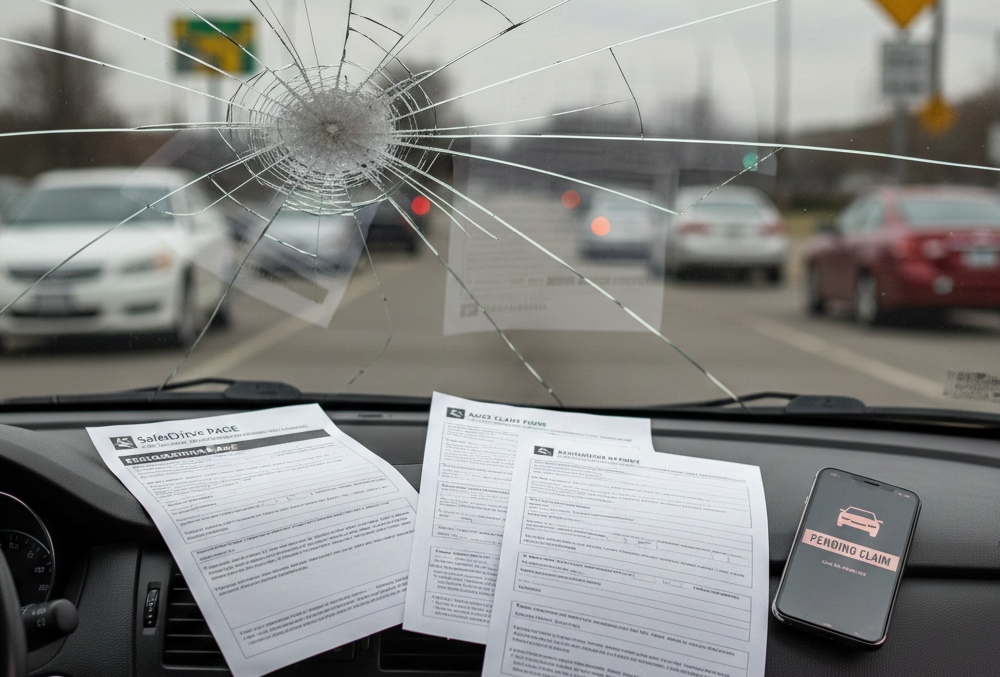
Windshield Crack and Insurance Claim Complications
Most often, it occurs when you least expect it. A loud snap reverberates through the cabin as you are traveling down the highway, possibly too closely following a truck. Your windshield has been impacted by a pebble. What begins as a bullseye chip or a little starburst can swiftly spiderweb over the glass, blocking your view and transforming a small irritation into a big headache. For most drivers, checking their insurance policy is the first thing they do. This is precisely what you pay premiums for, after all. Even while insurance is meant to insulate you from monetary loss, it’s not always as simple as it looks to file a claim for windshield damage. The calculations aren’t always in your favor because of deductibles, possible premium increases, and the intricacy of contemporary automobile technology.
Get An Auto Glass Replacement Quote Now 866.278.7417

Windshield Replacement & Repair
Our competitors push you into going to their shop to get your glass fixed-making it cheaper for them. We make it easier for YOU to get back on the road by offering free mobile repairs at your home or work. With our free mobile services servicing the entire Orange County & Los Angeles area, we can often handle your windscreen replacement the same day! So the next time you need a windshield replacement, give us a call.
Talk to a Windshield Replacement Specialist Now 866.278.7417

Calibration
Calibration is the process of returning a vehicle’s ADAS to OEM specifications. Calibration is necessary after a new glass installation, particularly a windshield with a camera mounted to it, to ensure that the ADAS features continue to function properly despite having been moved during installation. If a car’s ADAS is not properly calibrated, the system may not function safely. A misaligned camera could jeopardize the functionality of the system and lead to dangerous driving or accidents, so it is crucial that the cameras are aligned perfectly, which is what windshield calibration ensures.
Talk to a Calibration Specialist Now 866.278.7417

Fleet Auto Glass Repair
We provide expert auto glass repair and windshield replacement services for commercial fleets of all sizes. We are experienced with all manufacturers and machine types of domestic or foreign cars, trucks, vans, or commercial vehicles, including heavy equipment. Our same day mobile auto glass and windshield repair service will enable you to get back on the road faster and start saving you time and money instantly. Give us a call today! We are here to help!
Talk to a Fleet Auto Glass Specialist Now 866.278.7417
Evaluating the Severity
Determining the amount of the harm is the first step in navigating this process. Your insurer will handle glass damage differently depending on the remedy needed. The replacement of the entire windshield is not required for every single instance of broken glass.
The Easy Fix: It is frequently possible to fix a chip or crack that is smaller than a dollar bill and out of the driver’s direct line of sight. In order to cure and fuse the glass together, a technician injects a unique resin into the chip. This stops the crack from expanding and restores the windshield’s structural integrity.
Relevance to insurance: Many insurance companies may waive the deductible for a minor repair if the repair is not too extensive. They encourage you to have it mended as soon as possible because it saves them money compared to a complete replacement.
total Substitution: If the crack is longer than six inches, extends to the edge of the glass, or is deep enough to pierce the inner layer of the safety glass, then a total replacement is required rather than a partial replacement. Furthermore, because resin can leave a little distortion that impairs visibility, most shops will not repair damage that is right in front of the driver.
Implication for insurance: The cost of a replacement is much higher. At this point, the main determinants of your choice are your deductible and coverage limits.
The Deductible Trap: The deductible trap is the most frequent issue that drivers deal with. Windshield damage is typically covered under the “Comprehensive” component of your auto insurance policy. This section of your policy covers damage that was not caused by an accident, such as damage caused by fire, theft, falling items, or animals.
It is useless to file a claim if the cost of replacing your windshield is $450 and your comprehensive deductible is $500. Since you haven’t reached the deductible barrier, you would still be responsible for paying the entire amount out of pocket.
However, you might only save $100 if you file a claim, even if the replacement costs $600. You must consider whether a claim on your permanent insurance record is worth saving $100.
The Premium Hikes and the “CLUE” Report
Many customers believe their rates will stay the same because they are not to blame for a shattered windshield. Comprehensive claims are not invisible, even though they often have less impact on rates than accident claims.
The Comprehensive Loss Underwriting Exchange, also known as CLUE, is a database that is expanded via contributions from insurance companies. It keeps track of every claim you submit for a maximum of seven years. You will have two claims on your record in a short amount of time if you file a claim today for a damaged windshield and six months later have a more serious accident. For insurers, this claim frequency indicates risk.
A single glass claim is not likely to result in a significant increase in rates, but several small claims may:
Premium increases at renewal.
A “claims-free” discount is lost.
In severe circumstances, your policy won’t be renewed.
The Difficulty of Advanced Driver Assistance Systems (ADAS): A windshield used to be just a piece of glass. These days, it serves as a lens for advanced technology. In the event that your vehicle is relatively new (often 2016 or later), it is highly likely that it is equipped with Advanced Driver Assistance Systems (ADAS). The adaptive cruise control, automated emergency braking, and lane departure warning are some of the functionalities that are included in these.
Quite frequently, the cameras and sensors that are a part of these systems are situated just behind the windshield. It is necessary to re-calibrate these cameras in order to guarantee that they will point in the correct direction after the glass has been replaced. Any degree of variance, even a single degree, has the potential to cause the system to fail or malfunction.
Why this is relevant to your argument: The cost of calibration is high. It calls for certain tools and instruction. The cost of ADAS calibration can range from $300 to $800, whereas a typical glass repair may cost $300 to $500.
All of a sudden, a “simple” windshield repair costs $1,200. For many drivers, the only financially feasible course of action in this situation is to file an insurance claim because the expense greatly surpasses the majority of normal deductibles. Some budget policies try to avoid these expensive labor costs, so you need to be sure your insurance covers both the glass and the calibration.
Do you have a Question?
Get An Auto Glass Replacement Quote Now 866.278.7417
Free Windshield Laws by State
Verify your local laws before you begin calculating deductibles. A number of states have enacted laws to promote timely repairs because they acknowledge that a shattered windshield poses a serious safety risk.
If you have comprehensive coverage, your insurance company is legally required to waive the deductible for windshield repair in some states and regions, such as Florida, Kentucky, and South Carolina. In these states, submitting a claim is nearly always the best course of action because it guarantees a free replacement with no upfront expenses.
There are possibilities to purchase separate glass coverage with no deductible in other states, such as Arizona, Connecticut, Massachusetts, Minnesota, and New York. To find out if you choose this coverage, go over the policy declaration page.
When Is It Appropriate to Pay Cash? Knowledge of when it is appropriate to conceal information from your insurance provider is a valuable ability. You should definitely think about covering the cost of the repair yourself if:
This is a mathematical no-brainer: the price is lower than your deductible. The cost is only marginally higher than your deductible: Don’t submit a claim to save $50 if the repair costs $550 and your deductible is $500. The slight savings are outweighed by the chance of a premium hike.
You have recently submitted other claims: adding a glass claim to your backlog could result in a rate review if you have had a comprehensive claim or an at-fault collision within the previous three years.
You intend to change insurance companies: Having new open claims on your CLUE report makes it more difficult to shop for new insurance.
Commonly Asked Questions: Will my no-claims bonus be impacted by a windshield claim? Your particular policy and insurer will determine this. Certain providers will save your bonus because they consider glass damage to be a “no-fault” incident. Others demand that you pay an additional cost for “claim protection” or “accident forgiveness” in order to prevent your rates from increasing. Before filing, always ask your agent hypothetical questions.
Can I pick the glass repair shop of my choice? Indeed. It is against the law for insurance companies to demand that you choose a specific repair shop for your vehicle. They might have “preferred” networks that make billing easier, but you are free to utilize a reputable local store of your choice.
Is OEM (Original Equipment Manufacturer) glass covered by insurance? This is a frequent source of disagreement. Because “aftermarket” or OEE (Original Equipment Equivalent) glass is less expensive, insurers frequently want to cover it. OEM glass is frequently better if you drive a fancy car or one with sophisticated ADAS sensors. The price difference would have to be paid for out of pocket unless your insurance has an “OEM Endorsement.”
Choosing Clearly
A broken windshield is a real structural vulnerability that immediately jeopardizes your safety, not just a minor aesthetic inconvenience. The windshield is a vital component of modern cars, providing up to 40% of the roof’s structural strength in the event of a rollover collision. A crack in that glass weakens the vehicle’s ability to protect its occupants, raising the possibility of a roof collapse and severe injuries. Ignoring windshield damage is just not an option when it comes to safety.
However, moving swiftly does not always entail making an insurance claim right away. Spend some time gathering information before you take any action. Compare the cash quote you receive from a trustworthy neighborhood auto glass shop to your insurance deductible. Paying out of pocket can often be the more cost-effective option and help you prevent future premium rises, particularly for older cars or those with tiny cracks.
The age of your car and the technologies integrated into the windshield should also be taken into account. The ultimate cost may increase because of the inbuilt sensors, heating components, and ADAS cameras found in many newer automobiles, which need to be installed and calibrated precisely. Instead of behaving rashly or fearfully, you may make a better, more informed choice if you know what you’re paying for.
You take charge of your windshield crack by approaching it as a financial decision as well as a safety issue. In order to maintain the structural integrity of your vehicle while adhering to your financial constraints, you make a decision. More than just improved visibility, a clear windshield ultimately gives you peace of mind knowing you’ve safeguarded your financial future as well as your safety while driving.
Documents Required by Auto Insurance: Purchasing a car is typically a thrilling event. You put hours into finding the ideal model, trying out various options, and haggling over the cost. When the handshake is finished and you have the keys, however, the reality of the situation begins to hit in. It is illegal to drive that brand-new car from the lot without insurance.
The enthusiasm abruptly gives way to a rush to finish the papers. While an agent waits on the phone, you find yourself sifting through old emails, rummaging through glove compartments, and trying to recall your social security number. The excitement of a new purchase may be tempered by this difficult obstacle.
Nevertheless, it does not have to be a strain on your head. For the purpose of confirming your identification, determining your level of risk, and determining an exact premium, insurance companies need certain proof. If you are aware of exactly what they require and the reasons why they require it, you will be able to speed up the application process significantly.
The key to a seamless experience is keeping your documentation organized, whether you are applying for a new insurance, renewing an existing one, or making a claim following an accident. All the paperwork you might want at any point along your insurance journey is broken down in this guide.
Required Documents for a Quote
Typically, you get quotes before signing the dotted line. Insurers are attempting to create a profile of you as a driver during this first stage. They might not need hard copies of documents just yet, but they need enough information to determine risk. On the other hand, having the following details on hand guarantees that your quote is correct. Your final pricing may increase significantly if you make assumptions about these details.
Driver’s licenses and personal data: The specific individuals that the insurer is protecting must be known. This goes beyond simply mentioning your name and address. The driver’s license number of every individual who will be operating the vehicle must be presented with the vehicle. This enables the insurer to look up previous citations, collisions, or suspensions by pulling motor vehicle reports (MVR).
Social Security numbers might also be required. Many insurers utilize this to perform a “soft” credit check; however, it’s not necessarily required for a quotation. In most jurisdictions, your “insurance score,” which has a significant impact on your rate, is determined in part by your credit history.
Information about the Vehicle (VIN): Your vehicle is more than simply a “2020 Honda Civic.” It has a particular engine type, trim level, and safety features. To provide an insurance provider with the most precise information regarding this matter, the Vehicle Identification Number (VIN) is the most effective method.
The car’s fingerprint is represented by this 17-character code. It informs the insurance company whether your vehicle has a high-performance engine (which could increase your premium) or an anti-theft system (which could lower it). This can be found on the title of the car, inside the jamb of the driver’s side door, or on the dashboard close to the windshield.
Details of Mileage and Usage
You will have to record the odometer’s current mileage. Insurers also want to know how you utilize the vehicle. Is it for weekend pleasure riding, professional travel, or a daily commute? When you are ready, you should be able to estimate your annual miles. While overestimating could result in paying for risk exposure you don’t actually have, underestimating this could cause problems down the road.
Documents Needed to Make the Policy Legal: The insurer stops taking your word for it and begins requesting documentation as soon as you are satisfied with the quote and prepared to activate (or “bind”) the policy. When this phase is reached, it is necessary to have either digital or hard copies of the documents.
car Registration: In general, an insurance company will not insure a car that you do not own. This is because the insurance company owns the vehicle. The main document that proves your ownership of your car is its registration. It connects you to the particular car specified in the policy. The dealership’s bill of sale or title application will typically be adequate in the short term if the vehicle is brand new and hasn’t been registered yet.
Evidence of Previous Insurance: Loyalty and responsibility are valued by insurers. You frequently qualify for a discount if you have had continuous coverage with no lapses. On the other hand, a coverage gap raises the possibility that you are a more dangerous driver.
You might need to provide your former insurer’s Declaration Page (also known as the “Dec Page”) as proof of this. This one-page document lists the drivers, the policy period, and your prior coverage limits. Here, an ID card is typically insufficient; if you are asking for high-limit coverage, they require the entire Dec Page to confirm that you did not only carry state-minimum liability.
Information about Banking or Leasing: Your lender (the lienholder) needs you to get comprehensive and collision insurance if you are financing or leasing your car. In order for the insurance company to send the lienholder documentation proving their asset is protected, you will need to supply their name and address.
Additionally, you will need your bank’s routing and account numbers or a canceled check if you are using electronic fund transfers (EFT) to avoid installment fees.
Records of Discounts
Saving money is a goal shared by all. Although a lot of insurers provide significant savings, they nearly always demand proof of eligibility.
Excellent Student Evidence: A high school or college student’s grades can help you save money on insurance. Students with a “B” average (often a 3.0 GPA) or above are seen by insurers as more responsible. A copy of their most recent report card or a transcript that has been signed by a school official will probably need to be scanned and uploaded.
Certificates of Defensive Driving: Completing a certified defensive driving course gives you the right to a required discount in several states. After you have successfully completed the course, you will be presented with a certificate of completion. A copy of this should be sent right away to your agency.
Tracking and Telematics: The “documentation” is digital if you choose a usage-based insurance plan (such as DriveSafe or Snapshot). You provide your permission for the insurance company to remotely monitor your driving behavior by using a mobile application or a plug-in device. This is a data agreement that you must approve even though it isn’t written documentation.
Do you have a Question?
Get An Auto Glass Replacement Quote Now 866.278.7417
What You’ll Need to Submit a Claim
After an accident, documentation is most important. In this case, the insurer keeps their word to keep you safe, but in order to handle the claim, they require proof. You frequently have the duty of proving what occurred.
The Police Report: Police will make an official report if they show up at the scene of an accident. You need to get your hands on either the report number or the report itself as soon as you possibly can. This report, which includes information on the weather, witness accounts, and citations issued, is an unbiased third-party description of the incident. In a liability issue, it is possibly the most significant document.
Images and Visual Proof: Photographic evidence is now a typical criterion for claims, even if it is not a “document” in the conventional sense. You ought to record:
All participating vehicles sustained damage (from various angles).
The license plates worn by other cars.
These include street signs and traffic lights.
There are skid marks or debris on the road.
You may upload these images straight to your claim file using the majority of insurance apps. Sheet of Information Exchange
You ought to have recorded (or taken a picture of) the other driver’s details at the scene:
Complete name and contact details.
Company name and insurance policy number.
Number on the driver’s license.
Number on the license plate.
Reports on Medicine
When you or any of your passengers get injuries, the paper trail becomes even more extensive. Medical bills, emergency department discharge documents, and thorough records on any further treatments are required. The compensation for bodily injury or personal injury protection (PIP) claims is directly impacted by these documents.
Commonly Asked Questions: If I get stopped over, can I present digital evidence of insurance? Yes, in the majority of U.S. states. During a traffic stop, drivers in 49 states (as well as the District of Columbia) are permitted to present electronic proof of insurance on a smartphone. A paper copy should always be kept in the glovebox, though, in case your phone’s screen cracks or its battery runs out.
Do you need to have the actual title in order to get auto insurance? In most cases, the answer is no. Required is the act of registering. Although the title is the most definitive evidence of ownership, it is typically kept in a safe deposit box (or with the bank, if you have a loan). What matters to the insurance is the registration, which is the current document proving the vehicle is road-legal.
What paperwork is required for a vintage or customized vehicle? Classic cars have “agreed value,” but standard insurance uses “book value.” If you are insuring a vintage Mustang, you will probably require a professional evaluation document that details the car’s actual value. To make sure they are covered, you also need invoices for any parts you have added to your truck, such as a raise kit and custom rims.
Why is my social security number required by my insurer? To examine your credit-based insurance score, insurers use your Social Security number. Financial stability has been linked to fewer claims, according to studies. Insurers in other jurisdictions continue to utilize credit scores for identification and underwriting, even if other states (such as California, Massachusetts, and Hawaii) forbid their use in rate-setting.
Don’t Allow Documentation to Prevent Your Safety
Although the paperwork requirements for insurance aren’t random, it may seem like a necessary evil to have another payment to pay and another set of regulations to adhere to. They are there to keep you safe.
Accurate policy details, fraud prevention, and ensuring you obtain the discounts and coverage you are entitled to are all made possible by proper records. More significantly, having the proper documentation in place enables your claim to proceed promptly in the event of an issue rather than being delayed in review or rejected due to incomplete information.
The ideal course of action is to behave in a proactive manner rather than a reactive one. Now is the moment to organize your digital or physical insurance and car documents into a special folder. Keep all of your major maintenance records, repair receipts, registration, and declaration sheets in one location. Until they are required, whether it is following an accident, during a claim dispute, or while comparing quotes, many drivers are unaware of how important these documents may be.
Additionally, organization offers you power. You are in a better position to bargain for lower rates, switch insurance companies, or swiftly address problems when you can easily display your driving history, coverage limitations, and repair records. You will know exactly where everything is, so you won’t have to fumble through the glove box or go through old emails when under pressure.
You won’t be the one on hold with customer support or in a panic at the side of the road when it comes time to make a claim or shop for a new policy. You’ll be the one with the solutions; you’ll be self-assured, organized, and prepared to resolve the issue and resume your journey with the least amount of inconvenience.
Mobile Safe Auto Glass
14241 E Firestone blvd suite 400,
La Mirada, CA 90638
Phone: (562) 608-1154
Toll Free: 1 866 278 7417
Mail: sales@mobilesafeautoglass.com
Get a FREE QUOTE today! You can get a free quote and schedule 24/7 using this free quote wizard.
Mon – Fri 8am – 5pm
Saturday 8am – 1pm
Sunday Closed