When a Cheaper Windshield Replacement Wins
A sound that every motorist dreads hearing is the loud thwack that occurs on the highway. A little chip turns into a spiderweb crack, and it slowly makes its way across your line of sight. You watch helplessly as it happens. You are now confronted with a bill for repairs that you had not anticipated getting. It might be difficult to understand the pricing range when you first begin by contacting around for quotations. It is possible that one business may offer you a price of $250, while the dealership would argue that it will cost more than $900.
Get An Auto Glass Replacement Quote Now 866.278.7417

Windshield Replacement & Repair
Our competitors push you into going to their shop to get your glass fixed-making it cheaper for them. We make it easier for YOU to get back on the road by offering free mobile repairs at your home or work. With our free mobile services servicing the entire Orange County & Los Angeles area, we can often handle your windscreen replacement the same day! So the next time you need a windshield replacement, give us a call.
Talk to a Windshield Replacement Specialist Now 866.278.7417

Calibration
Calibration is the process of returning a vehicle’s ADAS to OEM specifications. Calibration is necessary after a new glass installation, particularly a windshield with a camera mounted to it, to ensure that the ADAS features continue to function properly despite having been moved during installation. If a car’s ADAS is not properly calibrated, the system may not function safely. A misaligned camera could jeopardize the functionality of the system and lead to dangerous driving or accidents, so it is crucial that the cameras are aligned perfectly, which is what windshield calibration ensures.
Talk to a Calibration Specialist Now 866.278.7417

Fleet Auto Glass Repair
We provide expert auto glass repair and windshield replacement services for commercial fleets of all sizes. We are experienced with all manufacturers and machine types of domestic or foreign cars, trucks, vans, or commercial vehicles, including heavy equipment. Our same day mobile auto glass and windshield repair service will enable you to get back on the road faster and start saving you time and money instantly. Give us a call today! We are here to help!
Talk to a Fleet Auto Glass Specialist Now 866.278.7417
Original Equipment Manufacturers, Original Equipment Manufacturers, and Aftermarket
Before you can determine whether or not a less expensive alternative is a win for your wallet, you must first have a solid understanding of what it is that you are purchasing. In most cases, the price difference is determined by the manufacturer of the glass and whether or not it depicts the brand of the automobile manufacturer.
The “name brand” choice is referred to as OEM, which stands for “original equipment manufacturer. ” It is the same windshield that was installed on your vehicle when it was completed on the manufacturing line. It is manufactured by the same manufacturer, according to the same requirements, and it has the emblem of the automobile brand prominently displayed in one corner. Additionally, it is considered to be the most expensive choice, frequently by a large amount.
OEE, which stands for “original equipment equivalent,” is the intermediate ground that frequently symbolizes the “sweet spot” for value. OEE glass is manufactured by the same businesses that manufacture OEM glass (such as Pilkington, PGW, or Saint-Gobain), but it does not have the logo of the automobile manufacturer when it is manufactured. Because it does not have the license costs that are connected with the logo, it is made to the same standards as the original, but it is marketed at a cheaper price point.
The most significant cost reductions may be seen in the aftermarket version of glass. The windshields in question are manufactured by businesses that do not provide direct supply to the automobile manufacturer. We reverse-engineer the glass so that it may be installed in particular types of vehicles. They are not bound to the exact proprietary requirements of the automobile manufacturers, despite the fact that they are required to fulfill federal safety regulations.
When the Option That Costs Less Resides
Making a decision to get a windshield that is less expensive is not about taking shortcuts; rather, it is about paying for what you truly require. In many instances, the extra price of original equipment manufacturer (OEM) glass is little more than paying for a brand name. In the following situations, selecting aftermarket or original equipment equipment (OEE) glass is the more financially prudent choice.
When you drive an older model vehicle, there is a great likelihood that aftermarket glass is the ideal choice. If your vehicle was constructed prior to 2015, you should consider purchasing aftermarket glass. Sensor arrays that are installed in the windshield of older automobiles are often not as advanced as contemporary ones. To protect yourself from the weather, you need a piece of glass that is not only able to fit but also does not leak.
Glass businesses that provide aftermarket products have had years to develop the molds that are used for earlier models. In most cases, the fit is accurate, and the lucidity is comparable to that of the original article. Putting a piece of glass that costs $900 on a car that is worth $4,000 is unusual to make financial sense when there is an option that costs $250 that functions perfectly fine.
In the event that you are presented with OEE glass, you are effectively obtaining the quality of the original equipment manufacturer (OEM) without the branding markup. When you do this, you get the acoustic interlayers that minimize road noise, the solar coating that blocks heat, and the perfect curve of the original. This is usually always a “win.” A little emblem, which you probably never noticed in the first place, is the only item that is missing from the picture.
There is a high deductible on your insurance policy: A lot of drivers have comprehensive deductibles that are either $500 or $1,000. The filing of a claim will not be of any assistance to you if the cost of an OEM replacement is $800 and the cost of an aftermarket replacement is $350. You will be able to keep more money in your pocket and prevent a claim from appearing on your insurance history if you pay the cash fee for an installation performed by a reputable aftermarket company.
When it comes to lease returns, you should carefully review your contract if you lease your vehicle. The majority of lease agreements provide that the vehicle must be returned in pristine condition; however, they seldom stipulate that any replacement components must be original equipment manufacturer (OEM) parts. If you discover a break in your windshield shortly before you turn in your lease, a normal aftermarket windshield will often be able to fulfill the inspection criteria. This will save you from having to pay the exorbitant repair fees recommended by the dealership.
The Argument Regarding “Safety”
The assumption that cheaper glass is harmful is a popular fear technique that is used to upsell those who are driving. If you are purchasing from a respectable store, this is mostly a fiction that you should not believe. All windshields that are marketed in the United States are subject to stringent safety regulations that are established by the Department of Transportation (DOT). This includes the thickness of the glass, the manner in which it breaks when it is struck, and the resistance of the glass to penetration.
In order to comply with these Federal Motor Vehicle Safety Standards (FMVSS), even the most inexpensive aftermarket windshield must be in compliance. As long as it bears the Department of Transportation stamp, it possesses the structural integrity necessary to prevent the roof from collapsing in the event of a rollover and to ensure that passengers remain within the vehicle in the event of a collision. The price difference is typically due to tiny distortions or slightly different tint hues, rather than structural safety. This is because fit and finish are more important than structural safety.
When It Is Appropriate To Use The Additional Funds
Although it is a wonderful thing to save money, there are certain situations in which the logic of “cheaper wins” does not hold true. There has been a shift in the landscape of windshield replacement as a result of modern vehicle technologies. Advanced Driver Assistance Systems (ADAS): If your vehicle is equipped with features such as lane-keeping assist, automated emergency braking, or rain-sensing wipers, these systems typically rely on cameras that are mounted directly on the windshield.
When it comes to clarity and curvature in the camera zone, original equipment manufacturer (OEM) glass is created with extremely stringent specifications. There is a possibility that certain aftermarket glass includes minute ripples or distortions that are not noticeable to the naked eye but can be perplexing to a computer. If the camera is unable to see well through the glass, it is possible that your safety systems may not operate properly or will not activate when you require them to do so.
In order to ensure that the ADAS systems can be calibrated correctly, several manufacturers need original equipment manufacturer glass for vehicles that include complicated ADAS. If the “cheaper” glass fails to calibrate properly and needs to be changed a second time, it might wind up costing you more money than you first anticipated in this particular scenario.
In order to use Heads-Up Displays (HUD), which reflect your speed and navigation information onto the windshield, you will require specialized glass. In order to minimize ghosting or multiple images, head-up display (HUD) windshields feature a wedge-shaped profile, which means that they are thicker at the bottom and thinner at the top. Cheap aftermarket glass sometimes lacks this polarization and wedge form, which causes your head-up display (HUD) to be hazy and difficult to view.
Do you have a Question?
Get An Auto Glass Replacement Quote Now 866.278.7417
The Real Threat: Installation Done At A Low Cost
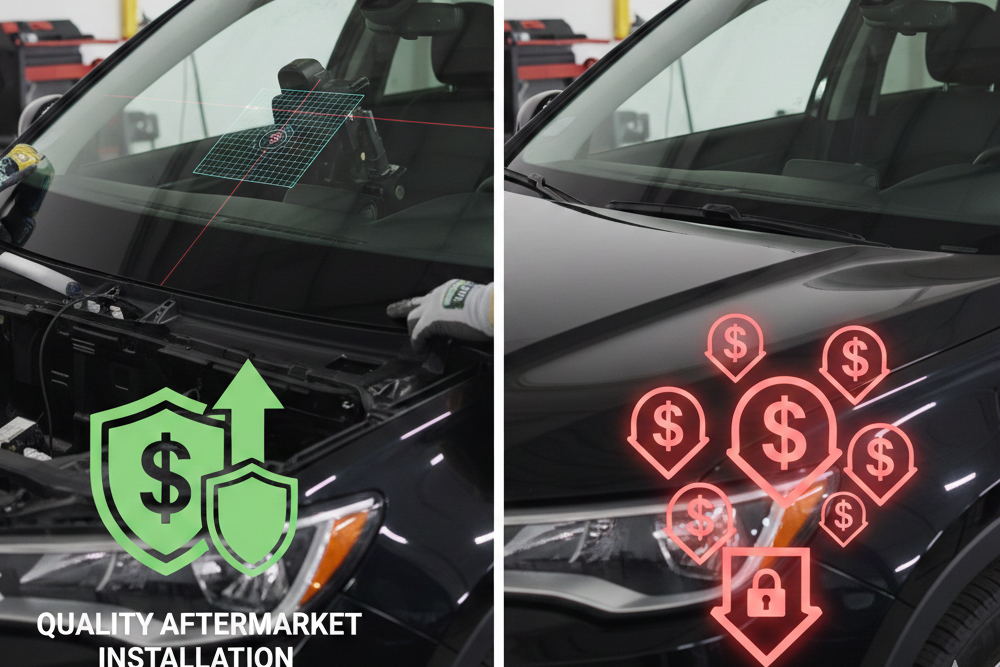
The glass itself is rarely the most dangerous part of replacing a windshield; rather, the installation is the most dangerous part. In spite of the fact that you may get the most costly piece of factory glass that is currently available, it is still risky to have it installed by a technician who lacks competence and uses adhesive of poor quality.
When a “cheap” quote is successful, it is not only about the price of the glass; rather, it is about the whole value. The quotes that are much lower than the typical market rate should be viewed with caution. It’s possible that these operators are reducing their expenditures on adhesives: high-quality urethane glue is expensive and dries in a short amount of time. Due to the fact that inexpensive glue takes longer to dry, the windshield may get detached if you are involved in an accident the following day.
Rust Prevention: If a technician scrapes the frame of your vehicle when removing the old glass and does not prime it, then concealed rust will grow on the frame. Eventually, this rust will consume the metal that is responsible for holding the glass in place, which will result in leaks and structural collapse in the future.
Learn How to Shop Wisely
The following actions should be taken in order to guarantee that your less expensive replacement will be a successful endeavor: Check for Certification: Look for businesses that are members of the Auto Glass Safety Council (AGSC). This demonstrates that their professionals have received training in the proper processes for safe installation. Request Information Regarding the guarantee, A respectable store will provide a lifetime guarantee on the installation (including protection against leaks and wind noise) as well as a manufacturer’s warranty on the glass itself, protecting it from distortions.
Confirm the Cure Time: Ask the shop, “When is it safe to drive my car?” If they say immediately or do not offer a specified “Safe Drive-Away Time,” you should locate another business. Check the Brand of the Glass: Inquire about the brand of glass that they use. As options for OEE and aftermarket, brands like Pilkington, PGW, Fuyao, and AGC are all good possibilities.
Choosing the Best Course of Action
The replacement of a windshield does not have to be prohibitively expensive. Aftermarket or original equipment manufacturer (OEM) glass is an option that is both completely risk-free and financially viable for the great majority of motorists, particularly those who do not have high-tech cameras installed to their rearview mirrors. You will be shielded from the wind, the structural integrity of your roof will be supported, and you will remain in compliance with the law while driving.
Avoid being swayed by scare tactics into spending more money than necessary on a logo. You can safely select the option that is cheaperon and still have money left in your pocket if you have a good grasp of the technology that is installed in your car and if you choose an installation that has a good reputation.
Questions That Are Frequently Asked
Will the resale value of my vehicle decrease if I install aftermarket glass? Yes, in most cases. During a trade-in assessment, the majority of buyers and dealerships do not even bother to examine the brand of the glass. Cracks, chips, and leaks are the only things they check for. On the other hand, the original glass might have an impact on the value of rare and expensive collector automobiles.
Is it possible for me to insist on original equipment manufacturer glass if I am going via insurance? There are “aftermarket endorsement” terms in many insurance contracts, but you are free to inquire about them. In other words, they will only be responsible for paying for the cost of aftermarket glass. If you insist on purchasing original equipment manufacturer (OEM) products, you can be required to pay the difference in price out of your own pocket.
Where can I find out if my windshield is equipped with ADAS sensors? When viewed from the outside, your windshield should be located close to the top center, which is where the rearview mirror is attached. You are most likely in possession of ADAS cameras if you see a cutout that is either triangular or trapezoidal and contains a lens. You might either consult the handbook that came with your vehicle or inquire with the glass business about running your VIN (Vehicle Identification Number).
With this counterintuitive guide, you will learn why new glass could ruin your old car. The majority of people who own cars approach the process of replacing auto glass in the same manner that they would when purchasing tires or changing oil: they locate the right specifications, purchase the most recent version, and then install it. This line of reasoning is valid for a contemporary Honda Civic. On the other hand, purchasing “new” glass is frequently a mistake whether you are driving a Dodge Mustang from 1968, a Bronco from the 1990s, or even a daily vehicle from the early 2000s that you hold dear.
The community of restoration and repair professionals is now dealing with an influx of imitation parts that do not fit properly, have an unattractive appearance, or do not have the same safety ratings as the original manufacturers. It is not always the case that the most recent choice available on the market is the finest one when it comes to vintage and older automobiles.
This book will explain why original equipment manufacturer (OEM) glass is more important than you may believe, why “New Old Stock” (NOS) is the holy grail, and why there are instances when a scratched piece of original glass is preferable to a reproduction that is in perfect condition.
A Misconception Regarding the “Perfect Fit” Reproduction Glass
The most common misunderstanding regarding auto glass for older automobiles is the notion that a reproduction component is an exact replica of the original that was manufactured by the manufacturer. In actuality, the tolerances that are necessary for the production of aftermarket glass are frequently substantially more lax than the tolerances that were required for assembly lines fifty years ago.
The Curvature Problem The curvature problem is the most typical problem that arises with contemporary replacement glass for older automobiles. While you try to install a windshield, you may discover that the corners do not lay flat against the pinch weld, despite the fact that the windshield appears to be perfect while it is sitting on a rack. This is not only a matter of a cosmetic inconvenience. In the event that the glass does not properly follow the precise curve of the body of the vehicle:
If the glass pulls away from the metal in the corners, the gaskets will not be able to properly seal, which can result in water leaks. Tension is created when a piece of glass that does not fit exactly into a frame is forced into the frame. This results in stress cracks. Shattering of that brand-new windshield can be caused by something as simple as a single speed bump or a temperature variation. Noise from the Wind: When traveling at highway speeds, whistling sounds are produced by gaps between the molding and the glass.
Glass production technique has evolved, resulting in changes to thickness and tint. For the purpose of reducing weight and saving fuel, modern glass is frequently thinner and lighter. In a hefty steel door from 1975, it feels fragile, despite the fact that it is excellent for an electric vehicle from 2024. The use of thinner glass in older window regulators can generate rattling or cause the window to lean forward in its track, both of which are undesirable outcomes.
In addition, it is infamously difficult to successfully achieve the desired hue. Factory “Soft Ray” or “Sun-X” tints were characterized by certain shades of green or blue. It is common for modern replacements to have a generic smoke tint that is gray in color, which is in contrast to the period-appropriate appearance of the car.
What Role Do Date Codes Play
The date code that is shown on a window is not significant to the typical driver. In the case of a collector or someone who is interested in preserving their resale value, it is essential. A bug, which is the manufacturer’s emblem and a code that indicates when the glass was manufactured, is etched into each and every piece of vehicle glass. It is vital for high-level assessment that a historic automobile with matching numbers has glass that was installed prior to the date the car was assembled.
If you replace a broken side window with a generic aftermarket piece, you are not only correcting a draft; you are possibly lowering the value of the automobile by thousands of dollars when it is put up for auction. It is for this reason that many restorers choose to buff scratches out of original glass rather than completely replace it.
Putting Replacement Glass in a Hierarchical Order
There are three primary choices available to you in the event that you need to repair a windshield or side glass in an obsolete automobile. Not by price, but by attractiveness, they are presented here for your perusal. NOS stands for “new old stock,” which is a term that describes components that were produced by the original supplier several decades ago but were never sold. They are still contained within the container and have been waiting at a warehouse.
The advantages include a perfect fit, the precise thickness, the correct color, the correct date codes (typically), and the correct brand logo (for example, LOF, Carlite, or Sekurit). Cons: It is extremely difficult to locate and quite costly to purchase. You are, in essence, searching for treasure that has been buried.
This is glass that was taken from a donor vehicle that was located in a junkyard. It is a good used original (OEM). The fact that it was produced on the same assembly line ensures that it will fit perfectly. A hue and thickness that is accurate. Much more affordable than NOS. The item is likely to have some signs of wear and tear, such as small scratches and wiper burns. The task at hand is to locate it, remove it without causing any damage, and then clean it up.
Glass that has been manufactured in recent times by businesses that may or may not have been the original suppliers is referred to as modern aftermarket or reproduction. Advantages: It is easily accessible, reasonably priced, and devoid of any scratches. Cons: Problems with the fit are rather prevalent. The logo is not going to line up. The tint color might not be accurate.
How Long Should You Keep Your Broken Glass
Although it may seem contradictory to preserve defective parts, in the world of older automobiles, “original but imperfect” is frequently preferable to “new but incorrect.” Polishing versus replacing: If your original windshield has wiper marks or mild haze, you should not rush to replace it. Miracles may be accomplished with modern glass polishing kits that make use of cerium oxide. Although it requires a lot of effort and time, it is possible to recover up to 80 percent of the clarity of the glass while still maintaining the outstanding fit and finish of the original glass.
When it comes to automobiles, there is a rising trend toward “survivor” cars, which are vehicles that are well-maintained yet reveal their past. This “survivor” aesthetic is becoming increasingly popular. A little delamination bubble in the corner or a few dents in the windshield are both indicators that there is a tale to be told. The history and personality of the item are lost when it is replaced with a piece of Chinese aftermarket glass that is sterile and does not fit properly.
The exception to the rule is represented by safety considerations. Even if it is essential to maintain individuality, safety is still the most crucial thing. There are some circumstances in which it is necessary to disregard the “counterintuitive” recommendation of preserving old bottle glass. It is possible for the plastic layer that is sandwiched between the two sheets of glass on earlier laminated windshields to delaminate, which results in the formation of a milky white bubble. In the event that this comes within the line of sight of the driver, the glass will need to be replaced.
In older automobiles, the side and rear windows are tempered. Tempering problems might arise. When broken, tempered glass shatters into thousands of pieces, in contrast to laminated glass, which maintains its integrity even after being broken. In the event that you see severe scratches on tempered glass, the structural integrity of the glass will be compromised. Just one forceful smack of the door might break it. It is imperative that a replacement be found in this scenario for reasons of safety.
Do you have a Question?
Get An Auto Glass Replacement Quote Now 866.278.7417
A Guide to Locating the Appropriate Glass
It is not necessary to call the 1-800 generic glass installers if you have established that replacement is an inevitable need. Their arrival is likely to be accompanied by the least expensive compatible component that does not correspond to your traditional trim. Dismantlers Specializing in Your Particular Make Instead of going to generic junkyards, you should hunt for dismantlers who specialize in your particular make. A Mustang wrecker that specializes in the vehicle is aware of the distinction between the rear windows of a 1965 and a 1966 coupe. They are able to send you a “Good Used Original” piece that is a great fit for each garment.
Forums for Owners: The finest resource is provided by other owners. The “For Sale” sections of enthusiast forums are frequently used by users to hoard various components. It is possible that you will come across someone sitting on a spare windshield that they purchased 10 years ago but have never utilized.
There are several high-end glassmakers who now provide replica glass with individualized date coding. This is known as the “Date Code” solution. They will engrave the glass with the precise month and year that is necessary to match the manufacture date of your car, but you will pay a premium for this particular service. This provides the assurance of brand-new glass while maintaining the authenticity of the original.
Locating an Installer Who Is Familiar with the Word “Old”
Only half the fight is won by purchasing the appropriate glass. A skilled installer who is familiar with working with rubber gaskets and locking strips is required for this project. Glue made of urethane is used in modern automobiles to attach the glass to the body. Rubber gaskets are typically used in older automobiles, which are typically pre-1980s. The majority of current technicians have never fitted a windshield that is set with a gasket. It is a part of their training to “cut and glue.”
Attempting to glue a windshield that was intended to be sealed with a gasket would result in the windshield leaking and perhaps cracking. “Do you have experience with gasket-set windshields?” is a question that should be asked particularly when hiring a shop. If they hesitate, you should look for someone else. You should look for a professional that has been working in this field for thirty years, not just three months.
Questions That Are Frequently Asked
I have an older automobile; is it possible to update to current “acoustic” glass? Yes, in most cases. The multi-layer technique known as acoustic glass was developed specifically for use in contemporary premium automobiles. In most cases, it is thicker and necessitates the use of certain window channels. In order to retrofit it to a vintage automobile, a significant amount of fabrication work would need to be done on the window frames and door frames.
Is it permissible to operate a vintage vehicle with a windshield that has a fracture in it? The laws that govern this matter differ from state to state, but in general, it is against the law for a crack to impair the driver’s view or to intersect with the windshield wiper sweep. Classic automobiles that are designated with “Historic” or “Antique” plates, on the other hand, may be subject to various inspection criteria. Check the requirements of your local Department of Motor Vehicles.
When I drive into the sun wearing my old windshield, I see that it has little sparkles all over it. Is this something? The process is referred to as “sandblasting” or pitting. Decades of road dust striking the window is the root cause of this problem. These are not scratches; rather, they are very little divots in the surface of the glass. It is not possible to smooth them out. If the pitting is significant enough to generate glare that might be hazardous, the only alternative available is to replace the pitting.
The Clearly Visible Option
When selecting glass for an older car, it is necessary to have a different mentality. Fit should take precedence over availability, and accuracy should take precedence over esthetic perfection. Consider what you already own before you decide to hire a repair service that specializes in general repairs. Could it be given a polish? Does the possibility of purchasing a secondhand original product exist? Simply by taking the effort to locate the appropriate glass, you can guarantee that your automobile will remain dry, that it will keep its worth, and that it will seem precisely as the designers meant it to look many years ago.
Mobile Safe Auto Glass
14241 E Firestone blvd suite 400,
La Mirada, CA 90638
Phone: (562) 608-1154
Toll Free: 1 866 278 7417
Mail: sales@mobilesafeautoglass.com
Get a FREE QUOTE today! You can get a free quote and schedule 24/7 using this free quote wizard.
Mon – Fri 8am – 5pm
Saturday 8am – 1pm
Sunday Closed