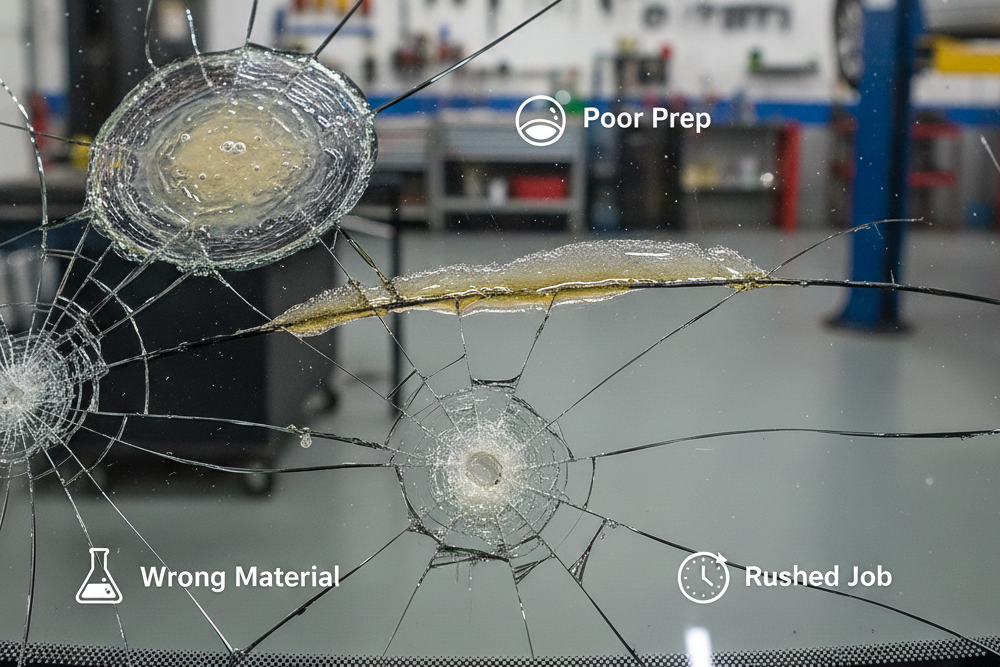
Crack Repair Mistakes That Lead to Repeat Damage
Finding a familiar jagged line on a driveway or wall that you believe you mended months ago is one of the most annoying things a homeowner can experience. After spending the weekend filling, painting, and scraping, the fissure reappears, sometimes bigger than before. It makes your property appear neglected and feels like a waste of effort and money. Recurring cracks are usually a good sign. Rather, they are typically the consequence of a repair procedure error. The fundamentals of a successful repair are the same whether you are working with concrete in the garage or drywall in your living room. The repair won’t work if you omit steps or misdiagnose the issue. It takes more than a putty knife and a tub of spackle to permanently fix a crack.
Get An Auto Glass Replacement Quote Now 866.278.7417

Windshield Replacement & Repair
Our competitors push you into going to their shop to get your glass fixed-making it cheaper for them. We make it easier for YOU to get back on the road by offering free mobile repairs at your home or work. With our free mobile services servicing the entire Orange County & Los Angeles area, we can often handle your windscreen replacement the same day! So the next time you need a windshield replacement, give us a call.
Talk to a Windshield Replacement Specialist Now 866.278.7417

Calibration
Calibration is the process of returning a vehicle’s ADAS to OEM specifications. Calibration is necessary after a new glass installation, particularly a windshield with a camera mounted to it, to ensure that the ADAS features continue to function properly despite having been moved during installation. If a car’s ADAS is not properly calibrated, the system may not function safely. A misaligned camera could jeopardize the functionality of the system and lead to dangerous driving or accidents, so it is crucial that the cameras are aligned perfectly, which is what windshield calibration ensures.
Talk to a Calibration Specialist Now 866.278.7417

Fleet Auto Glass Repair
We provide expert auto glass repair and windshield replacement services for commercial fleets of all sizes. We are experienced with all manufacturers and machine types of domestic or foreign cars, trucks, vans, or commercial vehicles, including heavy equipment. Our same day mobile auto glass and windshield repair service will enable you to get back on the road faster and start saving you time and money instantly. Give us a call today! We are here to help!
Talk to a Fleet Auto Glass Specialist Now 866.278.7417
Addressing the Signs Not the Illness
The main reason repairs don’t work is because the root cause of the crack was never fixed. Frequently, a crack is merely a sign of a more serious problem. The forces that produced the initial damage will simply tear your new patch apart if you close the gap without addressing the source of the stress.
The Solution: Look into the cause before opening a filler tube.
Water Damage: You most likely have a leak if the drywall is bloated or discolored. If the crack is repaired without stopping the water flow, mold will grow, and the crack will recur.
Foundation Settling: Movement of the foundation may be indicated by large, diagonal fractures close to windows or door frames. If the house is still settling, a cosmetic patch won’t hold.
Tree Roots: Roots that grow beneath sidewalks and roads have the potential to heave the concrete. Before fixing the surface, you might need to pull out the roots.
Ignoring the Preparation Work: It may seem appealing to squeeze a container of liquid filler into a small crack. It’s quick, simple, and attractive—for a week or so. However, moss, grease, dust, and loose debris frequently fill crevices. Filler adheres to dirt instead of drywall or masonry when it is applied on top of it. The patch comes off when the dirt moves.
The Solution: Although preparation is the most time-consuming aspect of the work, it cannot be compromised.
Clean it out: Scrub the inside of the crack with a wire brush. To get rid of any loose particles from concrete, use a vacuum or pressure washer.
Expand the crack: Although it may seem paradoxical, expanding a crack is frequently necessary to repair it. Make a “V” form with an angle grinder or a chisel. This method increases the surface area on which the repair material can adhere and keeps it from popping out while it dries.
Using Sturdy Materials on Joints in Motion
Every home moves. Concrete expands and contracts in response to temperature fluctuations, while wood expands and contracts in response to humidity. Using a tough repair substance, like mortar or regular grout, on a crack that moves is a common error.
Something must give if you use a substance that isn’t able to stretch to seal a moving crack. Usually, the surrounding concrete breaks away or the restoration material cracks. This condition is not the same as “active” structural cracks, which need to be stabilized by a professional. In the warm sun, even “dormant” driveway cracks may enlarge a little.
The solution is to select environmentally friendly products. Elastomeric Sealants: Apply a flexible silicone or polyurethane sealer to concrete fractures that shift. After curing, these stay stretchy, enabling the slab to move without rupturing the seal.
Fiber-Mesh Tape: Joint compound is never enough for drywall. To close the gap and give the patch more tensile strength, use paper tape or mesh.
Disregarding the weather: The chemistry of repair materials is delicate. The majority of cements, epoxies, and adhesives have stringent humidity and temperature requirements. The product might not adhere well if you try to fix a driveway crack when it is almost freezing. On the other hand, using some goods in hot, direct sunshine might cause them to dry too quickly, which can result in shrinkage and instant cracking.
The Solution: Examine the technical data sheet provided by the manufacturer. The acceptable temperature range is often between 50°F and 80°F. Make sure the surface temperature, not simply the air temperature, is within this range.
Moisture: While certain compounds, like hydraulic cement, truly require water to cure, others require a dry surface. It is essential to understand the distinction.
Do you have a Question?
Get An Auto Glass Replacement Quote Now 866.278.7417
Hurrying the Curing Process
To go on, we all want the project to be completed. This impatience frequently results in a patch being painted or sealed over before it has completely dried. Even if it feels dry in an hour, a patch may take days to fully cure in the crack.
Moisture is trapped within if paint is applied over uncured filler. Either the patch shrinks and pulls away from the edges, or the paint bubbles and peels as the moisture tries to escape.
The Solution: Your greatest asset is patience. If the bottle states that it will be “paintable in 24 hours,” then wait for that. Add more time if it’s cold or humid. Deep concrete repairs may require up to 28 days to cure before a large vehicle can drive over them.
Ignoring Deep Cracks and Not Using Backer Rods: Dumping filler into the abyss is a waste of money when addressing a deep fissure or a space between slabs. Moreover, the majority of sealants are made to stick to the sides of the crack rather than the bottom. When the slab moves, the sealant cannot expand correctly if it adheres to the bottom and both sides (a phenomenon called three-sided adhesion). It will rip through the center.
Installing a backer rod is the solution. Before using sealant, insert a flexible foam strip called a backer rod into the fissure. It saves you money on material by limiting the sealant’s depth, which is typically around half an inch. More significantly, it stops three-sided adhesion, which enables the sealant to move between the crack’s two walls like a rubber band.
Commonly Asked Questions: Is it possible to just paint over little cracks? Paint has little structural strength, but it can cover tiny flaws. If movement causes the hairline crack, the paint will immediately split apart again. Before painting, it is always preferable to slightly enlarge the crack and fill it with a suitable flexible spackling or sealer.
How can I determine whether a crack is structural? Structural fissures frequently exhibit particular traits. They can be more than 1/4 inch broad, offset (one side is higher than the other), or present with other crisis indicators like sloping floors or sticking doors in concrete. Jagged diagonal cracks in drywall that extend from door corners are frequently indicative of structural settling. Consult a structural engineer if you are uncertain about the situation.
Can cracks be repaired with hydraulic cement? Because hydraulic cement expands as it cures and sets quickly, it is excellent for halting active water leaks in brickwork. But it’s really inflexible. It is likely to fail if applied to a crack that undergoes heat expansion and contraction, such as a driveway. It works best on foundations and basement walls when preventing water leaks is a key concern.
Once It’s Fixed It Will Stay Fixed
Fixing cracks is about protecting your home’s long-term health and structural stability, not just aesthetics. Cracks are frequently signs of more serious problems, and if they are neglected, they frequently return, sometimes worse than before.
You can end the annoying cycle of repeated repairs and increasing damage by avoiding typical errors, including incorrect diagnosis, inadequate surface preparation, using the wrong materials, or hurrying through the operation.
Consider the reasons for the crack’s formation before attempting a hasty repair. Does it result from shifting soil, moisture incursion, temperature fluctuations, or regular settling? Finding the underlying reason enables you to select the best repair strategy rather than using a band-aid solution that will later break. Purchasing premium sealants, fillers, and equipment made for the particular kind of crack you’re fixing is equally crucial.
Materials are important, but so are patience and preparation. The repair will bond well and function as intended if the area is carefully cleaned, manufacturer instructions are followed, and the appropriate curing times are respected.
Even while a well-considered, well-done repair may require a few more hours today, it can save you a lot of money, time, and stress in the future. When done correctly, a crack repair preserves the value of your house and keeps you from having to deal with the same issue year after year.
Is Your Windshield Being Ruined by Your Daily Routine
You probably immediately associate auto maintenance with tire rotations, brake inspections, and oil changes. Usually, you don’t think about the glass around you until a spiderweb crack shows up right in front of you.
A crystal-clear windshield is an essential safety feature for your car, not just a luxury. It guarantees the proper deployment of the airbags in the event of a collision and gives the cabin structural integrity.
Although auto glass is designed to be durable and resistant to breaking, it can be broken. In actuality, many drivers unintentionally reduce the lifespan of their windows by neglecting them, driving carelessly, and washing them poorly.
A degree in engineering is not necessary to maintain the strength and clarity of your car’s glass. The most important thing is knowing what not to do. Here are the most frequent mistakes that erode car glass and how to prevent them to maintain a clear view of the road.
Using Inappropriate Cleaning Supplies: The idea that household glass cleaners are safe for use on automobiles is one of the most widespread misconceptions regarding car maintenance. You are probably doing more harm than good if you are grabbing for a roll of paper towels and the blue bottle of Windex.
The Ammonia Issue: Ammonia is a common ingredient in household glass cleaners. Ammonia works well for kitchen mirrors, but it is quite dangerous for automobiles. Ammonia damages the molding and rubber seals that hold your windshield in place, causing them to eventually dry out and crumble. Ammonia is also a death sentence if your windows are tinted. The color bubbles, peels, and turns purple as a result of the glue being broken down.
Paper Towels’ Scratch Factor
Although paper towels may feel soft, they are actually constructed of wood pulp on a microscopic level. They leave tiny minor scratches on glass surfaces because they are sufficiently abrasive. These tiny scratches build up over time to form a haze that reflects sunlight and headlights, producing hazardous glare.
The solution is to always use car glass cleaner that doesn’t include ammonia. Use it in conjunction with a premium microfiber cloth, which removes debris from the surface without causing scratches.
Ignoring the Wiper Blades: Although they are your first line of protection from rain and debris, your windshield wipers can quickly turn into its deadliest adversary.
The rubber used to make wiper blades deteriorates when exposed to UV light and changes in temperature. The rubber may break away as it hardens and fractures, revealing the metal arm underneath. The metal arm creates deep scratches on the windshield as it drags across the glass. These scratches necessitate a complete windshield replacement because they are persistent and frequently irreparable.
Using the wipers to remove light dust without washer fluid or inadvertently pressing the wiper switch on a dry day are two other common mistakes known as “dry wiping.” With each swipe, that dust grinds against the glass like sandpaper.
Check your wiper blades every six months to find the solution. Replace them right away if you hear chattering or notice streaks. Before using the wipers, always lubricate the glass with washer fluid.
Applying Thermal Shock to Glass: When heated, glass expands, and when cooled, it contracts. Although auto glass is made to withstand these variations, it has trouble with abrupt, sharp shifts. Thermal shock is the term used to describe this event.
The Error of Hot Water: It may be tempting to melt the ice immediately on your windshield by sprinkling hot water on it on a chilly winter morning. This will only end badly. The windshield frequently breaks instantaneously due to the tremendous force created by the cold glass’s quick expansion against the hot water.
The AC Error
In the summer, the same idea holds true. Stress cracks may result from blasting the air conditioner on “Max Cold” with the windscreen facing directly if your automobile has been roasting in 95-degree temperatures.
The solution is patience. Use your defroster on a warm setting during the winter and let the ice melt gradually. Before turning on the air conditioner in the summer, roll down the windows to allow hot air to escape. Do not aim freezing air directly at the glass.
Too Closely Following: In addition to being inconvenient and hazardous for stopping distances, tailgating is the main contributor to rock chips.
The tires of the car in front of you are continuously kicking up debris that bombards your windshield. When the debris hits your window, its velocity increases with your proximity. Because of their enormous tires’ deep treads, which trap and throw gravel, large trucks and construction equipment are especially dangerous.
A tiny rock chip may not look like much, but it weakens the glass’s structural integrity. When the car bumps or experiences temperature fluctuations, it produces a weak spot that could spread.
Keeping a safe following distance is the solution. The “three-second rule” allows most debris to fall back to the road before it strikes your windshield or hood, giving you enough time to react to traffic.
Ignoring minor cracks and chips: Procrastination is the greatest threat to auto glass. Since a tiny “bullseye” or “star” chip is out of their direct line of sight, many drivers choose to address it later.
However, the flexing of the car’s chassis and traffic vibrations put a windshield under constant stress. A single pothole or a door that is closed too forcefully can cause a little chip to quickly grow into a huge break that spans the entire windshield. A crack that is larger than a dollar bill typically cannot be fixed and needs to be replaced entirely, which is costly.
Over time, dirt and washer fluid can also leak into a chip. A weak or hazy repair is the result of the contamination’s interference with the repair resin’s ability to bond.
The Solution: Take care of damage right away. Because customers would prefer to pay for a minor repair now rather than a replacement later, the majority of insurance policies cover chip repairs with no deductible.
Do you have a Question?
Get An Auto Glass Replacement Quote Now 866.278.7417
Car Doors Slamming
Slamming your car door may seem insignificant, but it can ultimately lead to a damaged windshield. When you slam a door with all the windows rolled up, the cabin’s air pressure suddenly rises. This pressure pushes the glass outward.
It can cause the glass to pop free or a crack to expand fast if your windshield has a weak seal or an existing chip.
The solution is to softly but firmly close doors. Try to leave a window slightly open to let the air pressure equalize if you have to forcefully close a door.
Adoring Do-It-Yourself Repair Kits
Auto parts companies offer numerous do-it-yourself windshield repair kits. Despite their claims to provide expert outcomes at a fraction of the cost, they frequently leave customers disappointed.
Resin is injected into a chip under precise pressure and vacuum cycles in the art of windshield repair. You risk trapping air bubbles inside the chip or not filling it all the way if you use a do-it-yourself kit improperly. There isn’t another opportunity once the resin cures. If the repair fails, the windshield will likely need replacing since an expert can’t fix it again.
The Solution: Trust a qualified technician unless you have experience. A professional repair is far less expensive than replacing the glass after a do-it-yourself attempt fails.
Put Safety First and Clarity First
The state of your windshield, which serves as the lens through which you view the road, has a significant impact on your driving safety. You can detect dangers earlier, evaluate distances precisely, and respond swiftly to shifting traffic circumstances when your windshield is strong and clear.
Visibility can be affected by even little chips, stains, or distortions, particularly at night, in the rain, or when the sun strikes the glass at an angle that is not ideal. Maintaining strength and clarity requires careful attention. Steer clear of typical cleaning errors, such as using ammonia-based chemicals, which over time can deteriorate the glass and harm window tint.
Use vinegar or alcohol-based cleaners made specifically for car glass instead. Old or damaged windshield wiper blades can scratch the surface and leave streaks that impair vision, so it’s important to replace them on a regular basis. Additionally, take quick action to fix any chips or minor cracks before they spread due to temperature changes or vibrations in the road.
These simple practices not only help you see better, but they also help your windshield last longer and require fewer expensive replacements. More significantly, they guarantee that your windshield will continue to be a dependable component of your car’s safety system, supporting the roof, directing airbags, and shielding you from harm in the case of an accident.
If you treat your car glass like your brakes or engine, it will protect you for many miles. Having a clear windshield allows you to drive with comfort, confidence, and peace of mind in addition to being able to see the road ahead.
Mobile Safe Auto Glass
14241 E Firestone blvd suite 400,
La Mirada, CA 90638
Phone: (562) 608-1154
Toll Free: 1 866 278 7417
Mail: sales@mobilesafeautoglass.com
Get a FREE QUOTE today! You can get a free quote and schedule 24/7 using this free quote wizard.
Mon – Fri 8am – 5pm
Saturday 8am – 1pm
Sunday Closed