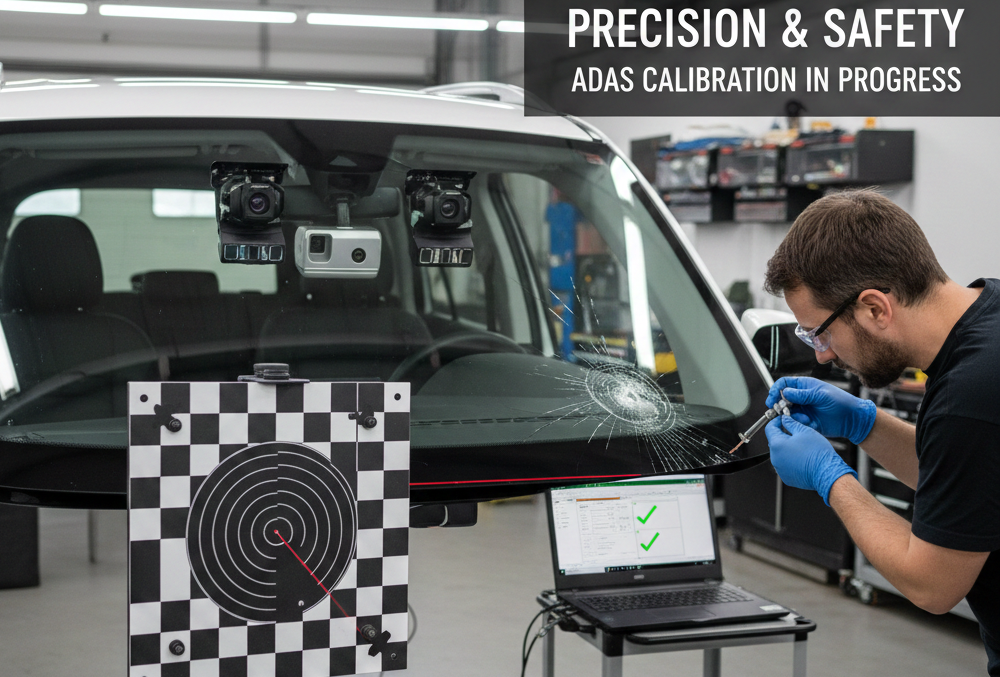
Front Window Repair and Modern Driving Assistance Systems
Have you ever seen the multitude of cameras and sensors nestled below your rearview mirror? It’s easy to overlook them until a rock chip or fracture emerges in your line of sight. A straightforward glass repair has evolved into a complex technical procedure as a result of the advent of Advanced Driver Assistance Systems (ADAS). These days, automobiles are more than just mechanical creatures; they are actually intelligent computers that are mounted on wheels. Adaptive cruise control, automatic emergency braking, and lane departure warnings are examples of features that rely heavily on sensors that are typically mounted directly on or behind the windshield. This means that a tiny crack is no longer just a cosmetic issue—it can endanger the safety systems designed to protect you. Understanding the relationship between your front window and your car’s safety technology is vital for every driver.
Get An Auto Glass Replacement Quote Now 866.278.7417

Windshield Replacement & Repair
Our competitors push you into going to their shop to get your glass fixed-making it cheaper for them. We make it easier for YOU to get back on the road by offering free mobile repairs at your home or work. With our free mobile services servicing the entire Orange County & Los Angeles area, we can often handle your windscreen replacement the same day! So the next time you need a windshield replacement, give us a call.
Talk to a Windshield Replacement Specialist Now 866.278.7417

Calibration
Calibration is the process of returning a vehicle’s ADAS to OEM specifications. Calibration is necessary after a new glass installation, particularly a windshield with a camera mounted to it, to ensure that the ADAS features continue to function properly despite having been moved during installation. If a car’s ADAS is not properly calibrated, the system may not function safely. A misaligned camera could jeopardize the functionality of the system and lead to dangerous driving or accidents, so it is crucial that the cameras are aligned perfectly, which is what windshield calibration ensures.
Talk to a Calibration Specialist Now 866.278.7417

Fleet Auto Glass Repair
We provide expert auto glass repair and windshield replacement services for commercial fleets of all sizes. We are experienced with all manufacturers and machine types of domestic or foreign cars, trucks, vans, or commercial vehicles, including heavy equipment. Our same day mobile auto glass and windshield repair service will enable you to get back on the road faster and start saving you time and money instantly. Give us a call today! We are here to help!
Talk to a Fleet Auto Glass Specialist Now 866.278.7417
The Evolution of the Windshield
Historically, a windshield’s primary duty was simple: protect occupants from wind, debris, and weather while giving structural support to the vehicle’s roof. The role of auto glass has grown dramatically over the past ten years, even if these functions are still crucial.
Today’s windshields serve as the ADAS’s lens. Manufacturers insert cameras, LIDAR, and radar sensors behind the glass to watch traffic, read road signs, and detect impediments. Because of this connection, the windshield becomes an essential part of the safety architecture of the car.
Because the glass serves as a lens for these optical sensors, clarity and optical quality are crucial. Even a little defect or a distortion in the glass caused by a low-quality replacement might confuse the system, leading to failures or incorrect readings.
What is ADAS: Modern Driver Assistance Systems (ADAS) refers to the electronic systems in a car that use modern technology to aid the driver. They incorporate a wide range of active safety features meant to limit human mistakes and avoid accidents.
Common ADAS Features Linked to Windshields
While ADAS incorporates sensors across the entire car, many essential systems rely specifically on the forward-facing camera located on the windshield:
The Lane Departure Warning (LDW) system is designed to notify the driver in the event that the vehicle begins to stray from its lane without providing a turn signal.
Lane Keep Assist (LKA) is a feature that, in the event that it detects drifting, actively guides the vehicle back into the lane.
Forward Collision Warning (FCW): Detects an approaching collision with a vehicle or obstacle ahead and informs the driver.
Automatic emergency braking, also known as AEB, is a system that applies the brakes automatically in the event that the driver is unable to respond in time to avoid or mitigate an accident.
Adaptive Cruise Control (ACC) is a system that modifies the speed of the vehicle in order to keep a safe distance from the vehicle in front of it.
Displays the speed limit and other traffic signs on the dashboard after reading them. This feature is known as traffic sign recognition.
The Significance of Calibration: When a windshield is replaced or even significantly fixed, the position of the camera installed to it can vary. Even a miscalculation of a single degree might have devastating implications.
One may compare it to the sight of a sniper rifle. If the scope is off by a fraction of an inch near the barrel, it can be off by many feet downrange. Similarly, if your car’s camera is misaligned by a millimeter, the ADAS system can miscalculate the distance to the car ahead or fail to see the lane lines accurately.
Do you have a Question?
Get An Auto Glass Replacement Quote Now 866.278.7417
The Risks of Skipping Calibration
Failing to recalibrate the ADAS after a windshield repair might lead to risky scenarios:
False Activations: The automobile might brake abruptly because it sees a ghost impediment.
System Failure: The system might not activate when it should, like failing to stop for a pedestrian.
Incorrect alerts: You could receive lane departure alerts when you are perfectly centered in your lane.
The dilemma of whether to repair or replace: Not all damage necessitates going through with a complete replacement. There are many instances in which minor cracks and chips can be repaired; however, when ADAS is present, the decision becomes more challenging.
When Can You Repair? Generally, a repair is doable if:
The chip makes up a size that is smaller than a quarter.
In terms of length, the crack is less than three inches. It is not possible for the driver to see the damage directly in front of them. The damage is not situated right in front of a camera or sensor, which is an extremely important fact.
If the damage obstructs a sensor’s view, a repair is rarely an option. The glue used to fill chips can create mild visual distortion. While undetectable to the human eye, this distortion can deceive sensitive camera sensors, necessitating a full windshield replacement.
The Calibration Process Explained
If you require a replacement, calibration is the next step. There are two primary forms of calibration, and your vehicle’s manufacturer specifies which one (or both) is required.
Static Calibration: This takes place in a regulated store environment. Specific targets or patterns are positioned at exact heights and distances from the vehicle when it is parked on a flat surface.
The technician uses a specialized computer to activate the camera to “look” for certain objects and adapt itself accordingly. This method demands precision and can take an hour or more.
During the Dynamic Calibration phase, the vehicle is driven on the road in order to be calibrated. The technician drives on clearly marked roads at a certain pace while plugging handheld equipment into the car’s diagnostic port. The technology uses the visible lane markers and other road elements to calibrate itself in real time.
Some vehicles require a “dual calibration,” comprising both static and dynamic operations to ensure optimal accuracy.
Choosing the Right Auto Glass Shop
Given the complexity of ADAS, choosing a qualified repair facility is more crucial than ever. Make the following inquiries while screening a service provider: Do you carry out ADAS calibration internally? Some stores outsource this, which might increase expenses and time.
Are your technicians certified? Look for certificates from groups like the Auto Glass Safety Council (AGSC).
What kind of glass do you use? Original Equipment Manufacturer (OEM) or Original Equipment Equivalent (OEE) glass is strongly recommended in order to assure that stringent optical criteria are met.
A common question that is frequently asked is whether or not insurance will fund ADAS calibration. Generally speaking, the answer is yes. If your comprehensive insurance covers the windshield repair, it normally covers the mandatory safety calibration as part of the claim. To be sure, always ask your provider.
How long does calibration take? The process can extend the typical windshield replacement time by 30 minutes to several hours, depending on the vehicle and the type of calibration needed (static, dynamic, or both).
Would it be possible for me to drive my automobile without first calibrating it? Relying on ADAS features without calibration is extremely risky. If you must drive, disable the safety features until the calibration is performed, though many experts recommend waiting until the systems are completely functioning.
Putting Safety Above Convenience: As automobiles get smarter, maintenance becomes more intricate. A windshield is no longer merely a screen against the weather; it is a critical component of your car’s safety brain. Cutting corners can jeopardize the sophisticated mechanisms meant to keep you safe, despite the temptation to go for the fastest and cheapest glass repair.
When faced with windshield damage, approach it as a technical repair rather than a cosmetic remedy. Please ensure that the shop you choose prioritizes accuracy over speed and is knowledgeable about the intricacies of ADAS. Your car’s capacity to defend you depends on it.
The Hidden Dangers of Misaligned Auto Glass
In the past, a windshield served only as a barrier that protected the driver from the elements, including wind, rain, and debris from the road. If it cracked, you swapped it out, let the urethane cure, and drove away. We’ve mostly moved on from those days.
The windshield has evolved from a basic shield to an essential part of the car’s safety ecology, and modern cars have become complex computers on wheels. As you travel along the highway, your car is continuously watching the road.
It monitors lane markers, measures the distance to the car ahead, and scans for pedestrians. This “vision” is powered by a complex network of cameras and sensors, many of which are affixed directly to the inside of your windshield.
Replacing a windshield does more than just improve your vision. For this delicate equipment, it resets the mounting point. If the glass isn’t aligned with mathematical precision, or if the cameras aren’t correctly recalibrated, the car’s safety systems can fail. Every modern driver must comprehend the connection between their car’s electronics and auto glass.
The Eyes of the Machine
The technology that is involved is the first thing that needs to be examined in order to comprehend the significance of glass alignment. Advanced Driver Assistance Systems, known popularly as ADAS, are the active safety measures designed to reduce human mistakes. While radar handles some responsibilities, forward-facing cameras are the backbone of systems like
The Lane Departure Warning (LDW) system will notify you if you traverse lane markers without signaling your intention to do so.
Lane Keep Assist (LKA): Actively directs the car back into the lane if you slide.
Forward Collision Alert (FCA): Warns of an approaching crash with an impediment ahead. The Automatic Emergency Braking (AEB) system will apply the brakes automatically in the event that the driver does not respond sufficiently swiftly.
This feature, known as adaptive cruise control, keeps a constant gap between your vehicle and the vehicle in front of you. These cameras are often installed in a bracket near the rearview mirror. They glance through the windshield glass to understand the world. The location and quality of the glass determine precisely what the computer sees because the camera is fixed to it.
The Geometry of Error: The “One Degree” Problem: It is easy to assume that a millimeter or two change in glass positioning is insignificant. To the human eye, a slightly moved windshield seems acceptable. However, to a computer that calculates distance and velocity, even a slight shift can have devastating effects.
The windshield camera can be compared to a surveyor’s laser or a sniper’s scope. A tiny twitch of your hand will only move the laser pointer’s dot a fraction of an inch if you aim it toward a wall three feet away. However, the same tiny twitch causes the dot to shift many feet if you direct that same laser at a building 300 yards away.
This is the geometry of error. When a camera misaligns by just one degree on the windshield, it can deviate several feet when looking down the road. This defect causes risky scenarios:
Phantom Braking: The vehicle may apply the brakes needlessly because it believes a metal plate on the road or the shadow of an overpass to be a physical barrier.
Delayed Reaction: The system can miscalculate the distance to the automobile ahead, braking too late to avert a collision.
Lane Drift: When a car is genuinely drifting into oncoming traffic or off the shoulder, the camera may think it is centered in the lane.
Do you have a Question?
Get An Auto Glass Replacement Quote Now 866.278.7417
The Lens of the Windshield
Precision isn’t just about the angle of the glass; it is also about the quality of the glass itself. The windshield works as a lens for the ADAS camera.
Engineers create these safety solutions using the unique optical characteristics of Original Equipment Manufacturer (OEM) glass. If a replacement windshield has even tiny distortions—often invisible to the driver—it might bend the light entering the camera lens. This refraction confuses the picture identification program.
For current cars, premium glass is therefore a must. The safety systems may disable themselves or, worse, malfunction if a less expensive aftermarket windshield doesn’t have the optical clarity necessary by the ADAS maker.
The Solution: Because the margin for error is so narrow, every windshield replacement on an ADAS-equipped car must be followed by calibration. This is the process of electrically aiming and checking the sensors to ensure they are reading the road appropriately.
There are two basic methods of calibration, and the type required varies depending on your unique car manufacturer.
Static Calibration: This procedure is carried out in a controlled shop setting. The car is parked on an exactly level floor. Technicians set highly precise targets and patterns on fixtures at certain distances and angles from the vehicle. The car’s computer examines these targets to orient its cameras.
This operation demands a “clean” environment. Crowded backgrounds or even bright sunlight coming through a window can hinder the calibration procedure.
Dynamic Calibration: In order to perform dynamic calibration, the vehicle must be driven on any road surface. A technician connects a handheld computer to the car’s diagnostic connection and travels at preset speeds on well-marked highways. Such calibration enables real-time camera focus adjustment and the system to “learn” the characteristics of the route.
Some vehicles require only static, some only dynamic, and many require both to provide the entire system’s correctness.
When Is Calibration Required
Many drivers believe their automobile is safe as long as the “Check Engine” light is off. However, ADAS systems can be misaligned without producing an immediate dashboard warning. In the following circumstances, calibration is required:
Windshield Replacement: The most typical trigger. Even if the original bracket is reused, the new glass rests differently.
Sensors can be jolted out of alignment by any contact, even a little fender accident, which is why collision repair is so important.
Suspension Changes: If you lift or lower your car, the angle of the camera relative to the road changes.
Wheel Alignment: Adjusting the wheels alters the vehicle’s thrust angle, which means the camera can be looking slightly left or right while the automobile goes straight.
Disconnecting the Camera: A reset is frequently necessary if the camera is unplugged for any electrical maintenance.
Frequently Asked Questions: Is ADAS calibration included in the cost of windshield replacement? Because it needs specialized equipment and skilled technicians, it is typically charged as a distinct line item. However, most comprehensive insurance policies that cover glass replacement will also cover the cost of the necessary calibration.
Can I perform the calibration on my own? No. Calibration involves expensive, manufacturer-specific targeting systems and diagnostic computers. It also requires training to grasp the individual specifications of each vehicle. This process is primarily a task for qualified professionals.
What are the steps I need to take to determine whether or not my vehicle is equipped with ADAS? If you built your car after 2016, it’s likely to have at least one ADAS feature. Near the rearview mirror, look for a triangular or trapezoid-shaped cutout with black dots (frit) surrounding the glass. That is the camera window. You can also read your owner’s manual or look for buttons on your steering wheel or dashboard linked to lane-keeping assistance or collision alerts.
When I skip the calibration process, what happens? It is a major safety hazard to skip the calibrating process. Your airbags may not deploy correctly, your automated brakes may fail, or your lane assist could steer you into danger. Furthermore, if an accident occurs and it reveals that you intentionally left your safety systems uncalibrated, you may face liability difficulties.
You cannot compromise on safety. The car sector is headed toward an autonomous future. As cars take over more of the decision-making process, the hardware that underlies those judgments becomes increasingly crucial. The windscreen is no longer only a sheet of glass; rather, it has evolved into a sophisticated lens that assists your vehicle in interpreting the world around it.
When you need a replacement, considering it as a simple repair is a mistake. It is a recalibration of your vehicle’s safety intelligence. Always ensure that your auto glass provider knows the intricacies of ADAS and possesses the technology to return your car to OEM specifications. Avoiding error codes is only one aspect of precision alignment; another is making sure your car responds appropriately when milliseconds count.
Mobile Safe Auto Glass
14241 E Firestone blvd suite 400,
La Mirada, CA 90638
Phone: (562) 608-1154
Toll Free: 1 866 278 7417
Mail: sales@mobilesafeautoglass.com
Get a FREE QUOTE today! You can get a free quote and schedule 24/7 using this free quote wizard.
Mon – Fri 8am – 5pm
Saturday 8am – 1pm
Sunday Closed