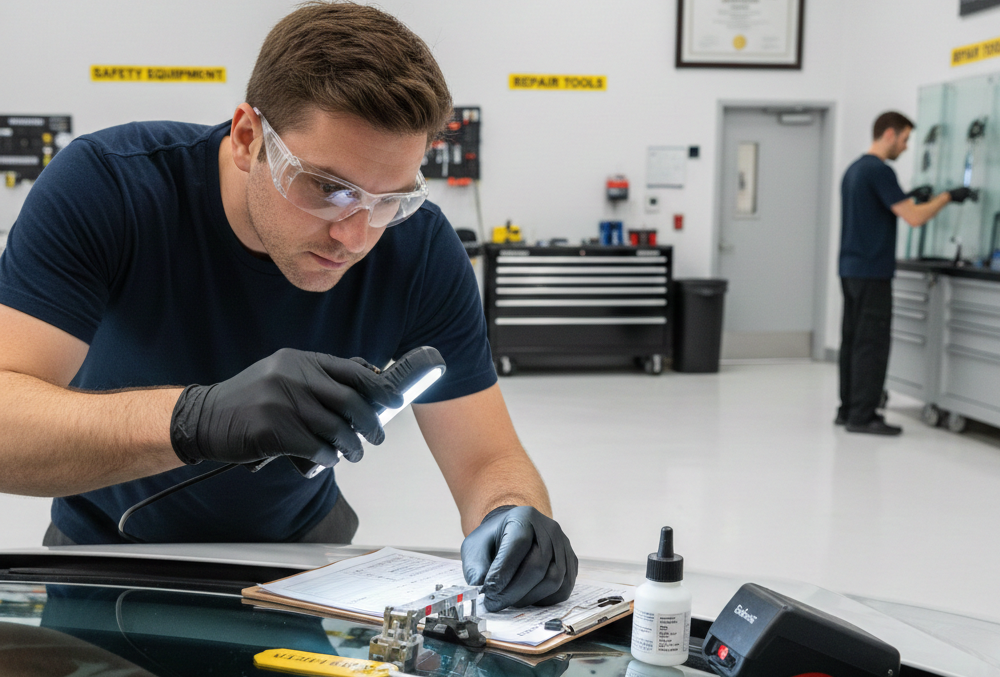
Front Window Repair Quality Standards Explained
More than just a bother, a chipped windshield is a structural weakness that could get worse. The science behind auto glass restoration is surprisingly complicated, although many drivers believe a simple patch job is sufficient. The type of resin chosen and the curing process have a significant impact on a repair’s lifespan and safety. Handling these factors correctly can determine whether the repair lasts the vehicle’s lifetime or breaks when you hit the next pothole. Understanding the chemistry and physics behind these decisions can help both car owners and professionals better understand the accuracy required for a truly long-lasting repair. This guide examines the crucial processes of resin selection and curing that ensure the strength, clarity, and safety of your car glass.
Get An Auto Glass Replacement Quote Now 866.278.7417

Windshield Replacement & Repair
Our competitors push you into going to their shop to get your glass fixed-making it cheaper for them. We make it easier for YOU to get back on the road by offering free mobile repairs at your home or work. With our free mobile services servicing the entire Orange County & Los Angeles area, we can often handle your windscreen replacement the same day! So the next time you need a windshield replacement, give us a call.
Talk to a Windshield Replacement Specialist Now 866.278.7417

Calibration
Calibration is the process of returning a vehicle’s ADAS to OEM specifications. Calibration is necessary after a new glass installation, particularly a windshield with a camera mounted to it, to ensure that the ADAS features continue to function properly despite having been moved during installation. If a car’s ADAS is not properly calibrated, the system may not function safely. A misaligned camera could jeopardize the functionality of the system and lead to dangerous driving or accidents, so it is crucial that the cameras are aligned perfectly, which is what windshield calibration ensures.
Talk to a Calibration Specialist Now 866.278.7417

Fleet Auto Glass Repair
We provide expert auto glass repair and windshield replacement services for commercial fleets of all sizes. We are experienced with all manufacturers and machine types of domestic or foreign cars, trucks, vans, or commercial vehicles, including heavy equipment. Our same day mobile auto glass and windshield repair service will enable you to get back on the road faster and start saving you time and money instantly. Give us a call today! We are here to help!
Talk to a Fleet Auto Glass Specialist Now 866.278.7417
The Science of Durability
Resins are not all made equal. Professional auto glass specialists really select from various resins according to the type of damage. The objective is always to restore the glass’s structural integrity while matching its refractive index. Viscosity, or simply the liquid’s thickness, is the most crucial property of repair glue.
Low-viscosity (thin) resins are ideal for tight fractures and star breaks where the damage radiates outward in fine lines. The fluid’s thickness allows it to capillary into even the smallest cracks, filling every little space. A thick resin wouldn’t go deep enough in this case, creating air pockets that might subsequently swell.
High Viscosity (Thick) Resins: These are usually saved for larger bullseye breaks or the impact site (the “pit”) where a sizable portion of glass is crushed or missing. Compared to its thinner competitors, thicker resin functions as a more resilient filler that can tolerate surface impact and environmental deterioration.
Optical Clarity and Tint: In addition to thickness, the resin’s optical qualities are crucial to a repair’s aesthetic success. Although clear resins are the norm, tinted resins—typically green or blue—are occasionally applied to improve the windshield’s factory tint or to offset the light-scattering effect of broken glass. The right tint ensures the damage “disappears” from the driver’s line of sight, a crucial safety feature.
Formulations Without Acid: High-quality resins nowadays are frequently acid-free. To improve adhesion, older formulas occasionally included acid to etch the glass; however, this could eventually cause the repair to deteriorate or turn yellow. Acid-free alternatives offer a robust chemical bond without sacrificing the glass’s long-term clarity.
The Curing Procedure
The strength of the auto glass must be restored by hardening (curing) the resin after it has filled the damaged area. This procedure turns the liquid resin into a solid, long-lasting polymer by causing a chemical reaction using ultraviolet (UV) light.
UV Light’s Function: Resin needs a particular UV light wavelength to harden; it won’t do it on its own. Although the sun naturally emits UV rays, it is dangerous to rely solely on sunlight.
Uneven curing may result from cloud cover, the time of day, and the sun’s slant. A specialized UV curing lamp is usually used for professional repairs. The resin will cure fully and uniformly in a matter of minutes thanks to these lamps’ steady, intense UV light delivery to the repair area.
Curing Under Stress: Curing is frequently carried out under pressure to produce the strongest connection. In the initial curing process, technicians do not remove the injector instrument.
The procedure protects the epoxy from shrinking or separating from the auto glass walls as it sets by forcing it deep into the crack as it starts to firm. This method is essential to prevent the repair from reopening later due to vibration or thermal expansion.
Completing the Cure: Following the initial hardening, the injector is taken out, and the injection port is sealed by applying a “pit fill” resin—typically one with a higher viscosity—to the surface.
To prevent oxygen from getting to the wet resin, a curing tab—a tiny piece of plastic film—is placed over it. Oxygen can prevent the surface layer from drying, making it sticky. To prepare the surface for polishing and scraping flush, the tab makes sure it cures hard and smooth.
Do you have a Question?
Get An Auto Glass Replacement Quote Now 866.278.7417
Why Glass Life Is Increased by Proper Curing
A partially cured repair is a failed repair in the making. Temperature changes will cause the resin to expand and contract at a different rate than the surrounding glass if it stays soft in the middle. The entire windshield will probably need to be replaced because of the stress that eventually causes the crack to spread.
A monolithic structure is produced by proper curing. The glue restores the windshield’s capacity to serve as a protective barrier by reinforcing the broken glass layers. A properly fixed windshield guarantees the passenger airbag deploys appropriately in an accident and adds to the cabin’s structural rigidity.
Environmental Factors’ Effects: The environment must be considered during the repair process, even with the best resin and curing techniques.
Moisture: Water can hinder a successful repair. If moisture remains inside the crack before injecting the resin, the bond will not hold. Before commencing, technicians often utilize a moisture evaporator instrument to ensure the brake is completely dry.
Temperature: When glass is heated, it expands; when it is cold, it contracts. Repairing a blazingly hot windshield might result in immediate damage spreading. On the other hand, cold glass may hinder the proper flow of resin. To make sure the resin flows and cures as planned, technicians will progressively raise the glass’s temperature to a moderate level.
How to Make Sure Your Windshield Lasts
The particulars of the work are what distinguish a permanent repair from a temporary patch. Trained technicians may repair a windshield to nearly factory strength and clarity by using precise, pressure-assisted UV curing techniques, choosing the right resin viscosity and tint, and correctly prepping the damaged region.
When done properly, the repair strengthens the glass and helps stop the damage from growing into a larger, more expensive crack rather than merely covering up the chip. The lesson for car owners is straightforward: fix chips right away, but choose your repairer carefully.
Select a service that is knowledgeable about the science underlying resin bonding, curing methods, and structural integrity rather than one that views the repair as a temporary cosmetic patch.
By prolonging the life of the original windshield, a high-quality repair lowers landfill waste from needless replacements, saves money, and—above all—keeps you safe while driving by maintaining the integrity of your car’s glass and safety systems.
The Expensive Price of Low-Cost Repairs: Everybody has been there. The drywall gets an ugly dent, the faucet begins to dribble, or the car engine makes an odd noise. There is a tremendous desire to hire the least expensive handyman available, watch a five-minute video tutorial, or just slap some duct tape on it. After all, if a short fix seems to solve the issue, why pay premium prices?
The difficulty is the word “disappear.” Rather than resolving issues, quick fixes frequently cover them up. They rarely endure overlong; however, they might keep things together for a week or a month.
Professional repairs, however, follow a different set of principles. Professionals prioritize longevity, security, and structural soundness over affordability and haste. Knowing the difference between a professional restoration and a temporary patch can help you avoid future difficulties and save thousands of dollars. Here is what professionals do differently.
Real Diagnosis as Opposed to Symptom Control
Before a single tool is raised, the biggest distinction between a professional repair and a quick fix is made. The diagnosis is the first step.
Stopping the immediate annoyance is usually the aim when choosing a quick remedy. Painting over a water stain on a ceiling is a simple solution. The room looks lovely again now that the stain has disappeared.
A professional takes a different tack on this. They know that painting over damp drywall promotes mold and damage, so they question themselves, “Where is the water coming from?” as they examine the stain. A specialist will identify the cause of the leak—a loose roof shingle or a sweating pipe—fix it, restore the damaged drywall, and then apply paint.
The symptom is addressed with quick treatments. The illness is cured by expert repairs. Quick repairs frequently result in a catastrophic failure by neglecting the underlying cause and allowing the harm to grow.
Industrial-Grade Material Availability: The supplies used by experienced contractors differ significantly from those found at a nearby big-box hardware shop.
Unlike the general population, professionals have access to supply chains. Trade-grade materials, whether they are used for construction adhesives, plumbing fixtures, or automobile parts, are designed to last longer and perform better.
For instance, a “quick fix” mechanic might use generic, one-size-fits-all parts that may not precisely fit your car. A factory-trained technician will use Original Equipment Manufacturer (OEM) parts specifically designed for your car’s make and model. These components wear uniformly, fit flawlessly, and perform precisely as intended by the designer.
High-quality materials will enable the repair to withstand normal wear and tear. A patch constructed from inferior materials is just a countdown to the next breakdown.
Respect for Safety Regulations and Codes
Safety is usually prioritized over quick fixes. Usually, speed and aesthetics come first. But disregarding safety regulations can be fatal in industries like structural construction, plumbing, and electrical work.
Expert repair specialists are knowledgeable about local safety and construction laws. These rules are in place for a reason: they make sure that plumbing won’t release dangerous gases into your house, that wiring won’t cause a fire behind the walls, and that a refurbished deck won’t collapse.
When an expert fixes anything, they are not only mending it; they are also attesting to its safety. They have knowledge of electrical loads, load-bearing capacities, and chemical reactions that the average individual might not.
Following the regulations is especially crucial if you ever want to sell your house or vehicle. Unauthorized, noncompliant labor might ruin a deal or drastically reduce its resale value.
Experience and Intuition’s Value
Experience cannot be purchased at a hardware shop. A professional’s library of past errors and accomplishments is one of the primary things you pay for when you hire them.
A seasoned expert has probably encountered your particular issue hundreds of times. Before a bolt snaps, they know precisely how much torque to apply. They are aware of which paint primers will flake off in damp environments. They are able to distinguish between an engine’s failing bearing and a loose belt.
They can operate effectively and steer clear of “trial and error” repairs thanks to their intuition. Guessing, trying a solution, seeing it fail, and trying again are common components of a quick-fix strategy. This loop wastes both time and money. A professional’s experience enables them to use the appropriate technique for the given situation and do it correctly the first time.
Guarantees and Extended Liability: The guarantee is arguably the most obvious distinction. Whether you or an unlicensed worker performs a quick fix, there is no accountability involved. Two days later, if the fix doesn’t work, you’re starting over and have wasted your time and money.
Expert businesses guarantee their work. They provide labor and part warranties. A skilled plumber will return and fix a pipe at no additional expense to you if it bursts a week after they fixed it.
This liability compels professionals to perform their work accurately. They have a financial interest in ensuring the durability of the repair because they don’t want to lose money on warranty calls. Quick-fix situations lack this alignment of interests, where the repairer wants the fix to stay as long as you do.
Do you have a Question?
Get An Auto Glass Replacement Quote Now 866.278.7417
Keeping Your Resale Value Safe
Every fix you make to a home or car becomes a part of its past. Prospective purchasers will carefully examine the maintenance history when the time comes to sell.
Expert repairs, accompanied by warranties and invoices, enhance the value of a property. It shows the buyer that the asset has been well-maintained. On the other hand, a home with blatant do-it-yourself patches, uneven tile work, and questionable wiring shouts “risk.” Buyers will deduct the cost of necessary repairs from the offer price.
Paying for a professional repair is an investment in the asset’s future equity. By taking this action, you safeguard the value of your property and ensure a high price upon sale.
Frequently Asked Questions: Is it ever wise to choose a quick fix? In certain emergency situations, the answer is indeed yes. The best course of action if a pipe bursts at 2:00 AM is to use tape or a clamp to prevent flooding until a plumber can come. As short-term stabilization measures, quick fixes are fine, but they should never be considered long-term repairs.
How can I determine whether a repairman is a real expert? Check for reviews, insurance, and licensure. A professional will possess liability insurance and hold a license from the relevant local authorities. Additionally, they ought to be prepared to offer references or samples of their prior work. Anyone who refuses to sign a contract or demands full payment up front should be avoided.
What factors contribute to the higher cost of expert repairs? You are paying for more than just your work hours. You’re paying for years of training, the cost of keeping a car and specialist equipment, insurance, license fees, and the assurance that they’ll take care of things if something goes wrong.
The Real Worth of Experience
How you initially perceive the issue will frequently determine whether you choose a professional repair or a quick cure. It can be tempting to find a quick fix if you consider it a temporary annoyance that should be concealed or silenced.
The professional way becomes the only sensible option if you see your house or car as a valuable, interconnected system that needs to operate securely, effectively, and dependably throughout time. It promises speed and savings and gives the appearance that the problem is “handled.”
Professional work may incur higher upfront costs, but it provides a level of confidence that a temporary fix cannot. Having confidence that the roof can withstand the next storm, the engine won’t break down at the worst possible time, and the wiring behind the wall is secure provides you with greater peace of mind.
Experts identify the underlying reasons and make the necessary repairs rather than merely covering up symptoms, which lowers the possibility of future issues and expensive damage. The cliché “if you think hiring a professional is expensive, try hiring an amateur—and pay for the consequences twice” still holds true in the maintenance industry.
Mobile Safe Auto Glass
14241 E Firestone blvd suite 400,
La Mirada, CA 90638
Phone: (562) 608-1154
Toll Free: 1 866 278 7417
Mail: sales@mobilesafeautoglass.com
Get a FREE QUOTE today! You can get a free quote and schedule 24/7 using this free quote wizard.
Mon – Fri 8am – 5pm
Saturday 8am – 1pm
Sunday Closed