Is Gorilla Glass the Future for Cars
It is quite likely that you engage with Gorilla Glass on a daily basis several times without even being aware of it. It is most likely the shiny, long-lasting surface that is covering the tablet that is sitting on your coffee table or the smartphone that is in your pocket. Corning’s chemically toughened glass has been so effective that it has prevented numerous displays from shattering as a result of accidental drops ever since it was first introduced on the first iPhone. On the other hand, this technology is currently making its way from your hand to your garage. Standard automobile glass, a technology that has not seen substantial change in decades, is ripe for disruption.
Get An Auto Glass Replacement Quote Now 866.278.7417

Windshield Replacement & Repair
Our competitors push you into going to their shop to get your glass fixed-making it cheaper for them. We make it easier for YOU to get back on the road by offering free mobile repairs at your home or work. With our free mobile services servicing the entire Orange County & Los Angeles area, we can often handle your windscreen replacement the same day! So the next time you need a windshield replacement, give us a call.
Talk to a Windshield Replacement Specialist Now 866.278.7417

Calibration
Calibration is the process of returning a vehicle’s ADAS to OEM specifications. Calibration is necessary after a new glass installation, particularly a windshield with a camera mounted to it, to ensure that the ADAS features continue to function properly despite having been moved during installation. If a car’s ADAS is not properly calibrated, the system may not function safely. A misaligned camera could jeopardize the functionality of the system and lead to dangerous driving or accidents, so it is crucial that the cameras are aligned perfectly, which is what windshield calibration ensures.
Talk to a Calibration Specialist Now 866.278.7417

Fleet Auto Glass Repair
We provide expert auto glass repair and windshield replacement services for commercial fleets of all sizes. We are experienced with all manufacturers and machine types of domestic or foreign cars, trucks, vans, or commercial vehicles, including heavy equipment. Our same day mobile auto glass and windshield repair service will enable you to get back on the road faster and start saving you time and money instantly. Give us a call today! We are here to help!
Talk to a Fleet Auto Glass Specialist Now 866.278.7417
The Development of Plastics Used in Automobiles
In order to comprehend the significance of Gorilla Glass, it is necessary to initially examine the material that it is replacing. For almost a century, automobiles have employed two primary types of glass: laminated glass for windshields, which is a “sandwich” of plastic between two layers of glass to prevent ejection in the case of a collision, and tempered glass for side and rear windows, which shatters into safe, dull cubes.
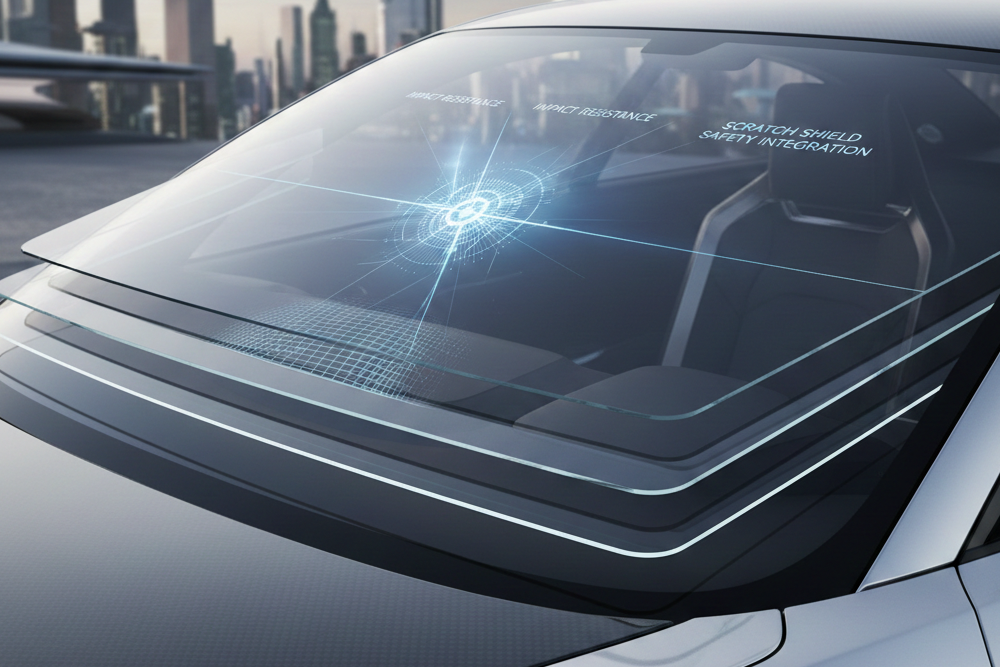
Glass used in classic automobiles is heavy and somewhat soft, despite its overall effectiveness. It is prone to breaking from slight impacts and pits quickly from road debris while also being easily pitted. The solution that Corning has come up with is a hybrid laminate. By combining a thin coating of ordinary soda-lime glass on the exterior with a layer of Gorilla Glass that has been chemically reinforced on the interior, they have eliminated the need for two thick layers of soda-lime glass. The revolutionary composition of this material results in a windshield or glass that is substantially more durable than its predecessors while also being significantly lighter.
Losing Weight in Preparedness for the Electric Era
In the automotive industry, the decrease of weight is one of the key motivating factors behind the use of Gorilla Glass. When it comes to the transition toward electrification, efficiency is of the utmost importance today. The batteries that power electric vehicles are quite heavy, and engineers strive to reduce their weight as much as possible in order to enhance their handling and expand their driving range.
When it comes to the glass components of a car, replacing traditional windows with laminates made of Gorilla Glass can lower the weight of the vehicle by up to thirty percent. It may seem insignificant, but eliminating forty pounds from the greenhouse, which is the highest area of a car, will result in a decrease in the center of gravity of the vehicle. This in turn leads to:
Lighter cars take less energy to move, which allows them to get more miles out of each battery charge. This results in an extended fleet range. A lower center of gravity allows for better handling since it lowers body roll, which in turn improves cornering and overall driving dynamics. Less weight immediately correlates to greater fuel efficiency and fewer emissions for internal combustion engines, which in turn leads to a reduction in carbon dioxide emissions.
A high-performance supercar known as the Ford GT was one of the first vehicles to make use of this technology in order to reduce weight, which is essential for achieving speed. This is now beginning to trickle down into applications that are more consumer-focused and where efficiency is the most important factor.
Where It Really Matters: Toughness
The sinking sensation that comes with hearing a loud crack is something that is familiar to anybody who has traveled on a highway behind a gravel truck. It is common knowledge that traditional windshields are notoriously weak when it comes to hits that are acute and at high speed.
The Gorilla Glass that is designed for use in automotive applications is designed to be significantly more durable. Corning claims that its glass is capable of withstanding impact energy that is up to two times greater than that seen in ordinary glass. The Jeep Wrangler is an example of a vehicle that has a vertical windshield, which makes its resilience extremely significant.
The windshield of the Wrangler is designed in such a way that it captures stones rather than diverting them into other directions. In order to alleviate this particular problem, Jeep has lately begun selling an update to its windshield made of Gorilla Glass. This upgrade promises owners that they will make fewer trips to the repair shop for stone chips and cracks.
The Virtual Control Panel of the Future
It is not just the outside that may benefit from the use of this technology. In the event that you have just entered a contemporary automobile, you are aware that the tactile buttons and knobs are gradually becoming obsolete. On the other hand, huge touchscreens that extend from pillar to pillar, like the Mercedes-Benz MBUX Hyperscreen, are gradually replacing them.
In light of the fact that automobile interiors are effectively becoming huge smartphones, the material that covers those screens is of utmost importance. Screens made of plastic are prone to scratches and do not possess the high sensitivity that is necessary for multi-touch movements. Gorilla Glass provides a solution that is comparable to the experience provided by consumer devices that drivers are accustomed to.
Optical Clarity and Anti-Glare Characteristics: The interior glass of automobiles must be able to withstand intense sunshine without causing the driver to become blind. It is possible to apply superior anti-reflective and anti-glare coatings to Gorilla Glass, which guarantees that maps and media controls will continue to be visible even when exposed to the sun during the middle of the day.
Safety in Accidents: In the case of a collision, the manner in which the inside glass behaves must be predictable. Gorilla Glass, which is used in interiors, is engineered to shatter safely or bend upon head contact (in a standard Head Contact Certification test), hence decreasing the risk of damage to passengers. This is in contrast to ordinary glass, which may produce deadly shards.
Do you have a Question?
Get An Auto Glass Replacement Quote Now 866.278.7417
What Does It Cost to Innovate
After considering all of these advantages, it seems puzzling that a Gorilla Glass windshield is not standard equipment on every new Honda Civic or Toyota Camry. The answer, as one might expect, is the price. When compared to the production of normal soda-lime glass, the manufacturing process for chemically enhanced aluminosilicate glass is more intensive in terms of both complexity and energy consumption. As of right now, the expense of this premium is being passed on to the customer. For instance, the cost of updating a Jeep’s windshield to one made of Gorilla Glass might be much more than the cost of having a regular replacement installed.
Additionally, there are reasons to be concerned about the capacity to restore it. Minor chips in conventional glass can be readily filled with resin, but the peculiar tension features of chemically reinforced glass can often make repairs more difficult, perhaps needing a full replacement more often than a simple repair. This is because chemically strengthened glass has a higher tension than regular glass.
Questions That Are Frequently Asked
Gorilla Glass is now used in which automobiles? There are a number of manufacturers who have implemented the technology for particular models. Certain automobiles, such as the Ford F-150, Jeep Wrangler and Gladiator, Porsche 911 GT3 RS, and McLaren 720S, are notable examples of this material. Additionally, it is commonly utilized in the interior displays of automobiles manufactured by manufacturers such as BMW and Mercedes-Benz.
Is it impossible to break Gorilla Glass? There is no glass that is completely indestructible. Despite the fact that Gorilla Glass is substantially more resistant to fractures and chips caused by stones and hail, it is nevertheless susceptible to being broken by an impact that is sufficiently severe or by considerable structural stress.
Is Gorilla Glass effective in reducing noise in the cabin? Indeed. Excellent acoustic dampening capabilities are possessed by the laminate structure that is utilized in the production of automobile Gorilla Glass. This contributes to the reduction of wind and road noise, resulting in a more peaceful and luxurious experience within the cabin.
An Improved Path Ahead of Us
Gorilla Glass: Is it the way of the future? However, the change will be slow, despite the trend suggesting that the answer is a loud yes. In light of the fact that electric cars are currently dominating the market, the requirement for lightweight materials is anticipated to enforce the widespread use of chemically toughened glass that is thin. In addition, the interior market for this glass is almost certain to expand as a result of the growing demand coming from customers for dashboards that have screens that are both larger and more sensitive.
Despite the fact that it is still considered a luxury feature in the present day and is often reserved for high-end sports vehicles or off-road enthusiasts who are ready to spend more for durability, the cost will soon decrease due to economies of scale. Within the next ten years, we may anticipate that the glass that altered the way in which we interact with the environment will also revolutionize the way in which we drive through it.
How New Technology Is Changing Windshields and How Future-Proof Glass Can Help
The majority of motorists don’t give their windshields much thought until they are hit by a rock traveling at sixty miles per hour. That “crack” that comes out of nowhere is a common language of feeling frustrated. For several decades, the answer has been straightforward: replace the shattered glass with a new piece of laminated safety glass.
The car industry, on the other hand, is now going through a significant transformation, and the seemingly insignificant windshield is getting a high-tech makeover. In the near future, there will be windshields that are lighter, stronger, and more intelligent thanks to the development of new materials and production techniques. We are not simply discussing improved vision; rather, we are looking at glass that has the ability to repair itself, show navigation data, and endure hits that would shatter ordinary screens.
The windshield repair sector is undergoing a transformation as a result of these technologies, which are posing a challenge to technicians to acquire new skills and providing drivers with a level of safety that was previously only seen in science fiction. The cutting-edge materials that are new to the market are discussed in this article, along with the ways in which they are beneficial to car owners and the implications that this has for the future of auto glass repair.
The Development of Laminated Glass from the Prevalent Standard
While it is helpful to know where we have been, it is also helpful to know where we are headed. Laminated glass has been used for the construction of windshields ever since the middle of the 20th century. In order to do this, a layer of polyvinyl butyral (PVB) is made by sandwiching it between two sheets of glass. The PVB layer is designed to retain the shards of glass together in the event that the glass breaks, so preventing them from flying into the cabin and endangering passengers.
Although it has prevented the loss of innumerable lives, this technology has several drawbacks. Because of its weight, traditional laminated glass has a negative influence on both the fuel economy and the range of electric vehicles (EVs). Additionally, it is susceptible to chipping and breaking as a result of very modest vibrations. Automobile manufacturers are in need of a new type of glass as they work toward meeting increasingly stringent fuel efficiency rules and incorporating more electronics into their cars. A surge of material innovation has been triggered as a result of this need.
For Your Automobile Gorilla Glass
You presumably already have some experience with chemically enhanced glass because you probably use it on a daily basis and tap on it hundreds of times. Corning’s Gorilla Glass, which is so well-known for its ability to shield smartphone screens, is currently being modified for use in automobiles.
This material is substantially more durable than the typical soda-lime glass while also being significantly lighter. It is possible for manufacturers to lower the weight of a typical laminated windshield by as much as thirty percent by using chemically reinforced glass for the inner layer of the windshield. The automobile engineering industry is one in which every ounce matters, and this is a significant reduction in that regard.
Impact Resistance: These hybrid windshields are far more resistant to damage from hail and stones than traditional windshields. As a result, hybrid windshields offer this benefit. It is possible that a small pebble that would cause a regular windshield to break may be able to bounce off of this more durable surface without leaving any marks.
Weight Reduction: The center of gravity of the vehicle is lowered when the glass is lighter, which results in improved handling. In the case of electric cars, a larger range per charge is directly proportional to a lower overall weight. Chemically reinforced glass may be produced thinner without compromising its strength, which results in less distortion and sharper visibility for the driver. Optical clarity is achieved by this manufacturing process.
A problem is presented by this for the industry that deals with replacements. Considering that the production of these new materials is more expensive, it is possible that customers may incur higher replacement expenses. The windshield, on the other hand, will require replacement much less frequently. This is the trade-off.
Do Materials That Heal Themselves Represent Science Fiction or Reality
It is possible that the idea of self-healing glass is the most fascinating advancement in the field of material science this year. Despite the fact that the majority of the mass manufacturing process is still in the research and development phase, prototypes are demonstrating an astounding amount of potential.
Transparent polymers that are capable of repairing their own molecular structure when heat is applied are the subject of research projects being conducted by scientists. Consider the possibility that your windshield has a little fracture or scratch on it. You could just park your vehicle in the sun or use a particular heat source, and the material would bond back together. This would be an alternative to scheduling an appointment for a repair.
When it comes to how it operates, the technology is dependent on polymers that have dynamic chemical connections. There is a breaking of these linkages if the substance is damaged. Through the application of the appropriate circumstances, which are often heat or ultraviolet light, the molecules regain their mobility and re-form their bonds, therefore successfully “zipping” the split close.
The non-structural components and sensor covers that are now being tested with this technology are currently being assessed. Nevertheless, as the materials continue to improve in terms of durability and optical clarity, they have the potential to transform windshields. There is a possibility that the replacement business may transition from replacing glass to applying specific heat treatments in order to regenerate windshields that are already in use.
Do you have a Question?
Get An Auto Glass Replacement Quote Now 866.278.7417
Integrated Smart Glass with Head-Up Display
It is no longer sufficient to just be a window; the windshield is evolving into a screen. It is possible for drivers to keep their eyes on the road thanks to Heads-Up Displays (HUDs), which show information such as speed, navigation, and safety alerts straight onto the windshield.
In order to avoid the projected picture from looking double (also known as ghosting), traditional glass often requires a specific plastic interlayer that is formed like a wedge instead. In order to manage these projections in a more natural manner, new composite materials are now being researched. This will result in an improvement in the display’s clarity and brightness.
Electrochromic Glass: Another significant advancement is electrochromic technology, which is sometimes commonly referred to as “smart glass.” This material gives the driver the ability to alter the tint of the windshield with the simple push of a button. When a low-voltage electrical current is applied to the glass, ions travel between the layers of the glass, which alters the amount of light that is able to pass through.
Because of this, sun visors are no longer required, and the burden on the air conditioning system of the vehicle is reduced because heat is blocked on days when the sun is shining. A new level of complexity is added for replacement technicians as a result of this. In order to replace a smart windshield, it is necessary to connect electrical components and calibrate sensors, which transforms a mechanical process into an electrical engineering endeavor.
Composites for Polycarbonate and Acrylic Materials
Certain specialist vehicles are moving away from glass totally in favor of polycarbonate and acrylic composites in order to achieve the highest possible level of durability attainable. These materials are employed in a variety of applications, including race cars, forestry equipment, and security vehicles, since they are nearly impossible to break.
Despite the fact that conventional polycarbonate scratches too easily for everyday use on the highway, emerging technologies that apply durable coatings are redefining the relationship between the two. These coatings give the surface a hardness that is comparable to that of glass while preserving the quality of plastic that makes it shatterproof.
Polycarbonate is used by a lot of people; why is that? Cost and scratch resistance over extended periods of wiper usage have always been the primary obstacles that have been encountered. On the other hand, as the technology behind hard coatings continues to advance, we could discover hybrid designs in which high-impact regions are made of polycarbonate while the primary viewing area is made of toughened glass.
The Influence on the Industry Devoted to Replacement
In order to keep up with these material breakthroughs, the car glass sector is being forced to quickly adapt. Installations that are as straightforward as “cut and paste” are becoming less common. There is an increase in the cost of the raw item, which in turn leads to an increase in insurance premiums. Windshields are becoming increasingly high-tech components that are composed of specialist materials. This is likely to result in increased prices for insurance policies that cover glass coverage. On the other hand, due to the fact that certain materials are more long-lasting, claims can become less consistent.
Technicians now need to have specialized training in order to grasp the characteristics of chemically toughened glass, how to handle electrochromic connections, and the precise adhesives that are necessary for various composite materials. An error that occurs during the installation process is no longer only a risk of leakage; it has the potential to disable safety sensors or destroy an expensive piece of intelligent equipment.
In order to function properly, Advanced Driver Assistance Systems (ADAS), such as lane-keeping assist and automated braking, require cameras to be installed behind the windshield. Calibration of these systems is required. These cameras are affected by the new materials because of how light travels through them. In order to guarantee that the vehicle “sees” the road in the appropriate manner, careful recalibration of the system is required whenever a windshield is replaced, particularly with these new materials.
The Path That Lies Ahead
The windshield of the future will be an advanced and integrated component of the vehicle’s design for both safety and information and entertainment systems. On the other hand, the shift from plain glass to complex composites is well underway, even though we have not yet reached the point when every automobile is equipped with an augmented reality screen that can repair itself.
When it comes to automobile owners, this implies rides that are safer, more efficient, and more comfortable. It signifies a transition toward labor that requires a greater level of competence and technology that is more sophisticated for the sector. It is important to bear in mind that the windshield is doing a great deal more than just preventing insects from getting into your teeth the next time you gaze through it.
Mobile Safe Auto Glass
14241 E Firestone blvd suite 400,
La Mirada, CA 90638
Phone: (562) 608-1154
Toll Free: 1 866 278 7417
Mail: sales@mobilesafeautoglass.com
Get a FREE QUOTE today! You can get a free quote and schedule 24/7 using this free quote wizard.
Mon – Fri 8am – 5pm
Saturday 8am – 1pm
Sunday Closed