Automobile Window Replacement and Vehicle Safety Design
Every driver fears hearing a loud crack on the highway. A rock flies off a truck, arcs through the air, and leaves a spider web fracture directly in front of you. This typically occurs in slow motion. The expense of the deductible or the trouble of making an appointment for a repair is probably the main source of your current annoyance. A broken windshield, however, is a far more serious issue than a flaw in your vision. In modern automotive engineering, glass is used for much more than merely keeping out wind and insects. It is crucial to the vehicle’s structural soundness and safety. If that glass is compromised, it could endanger your safety. Every car owner has to understand the connection between window replacement and vehicle safety design.
Get An Auto Glass Replacement Quote Now 866.278.7417

Windshield Replacement & Repair
Our competitors push you into going to their shop to get your glass fixed-making it cheaper for them. We make it easier for YOU to get back on the road by offering free mobile repairs at your home or work. With our free mobile services servicing the entire Orange County & Los Angeles area, we can often handle your windscreen replacement the same day! So the next time you need a windshield replacement, give us a call.
Talk to a Windshield Replacement Specialist Now 866.278.7417

Calibration
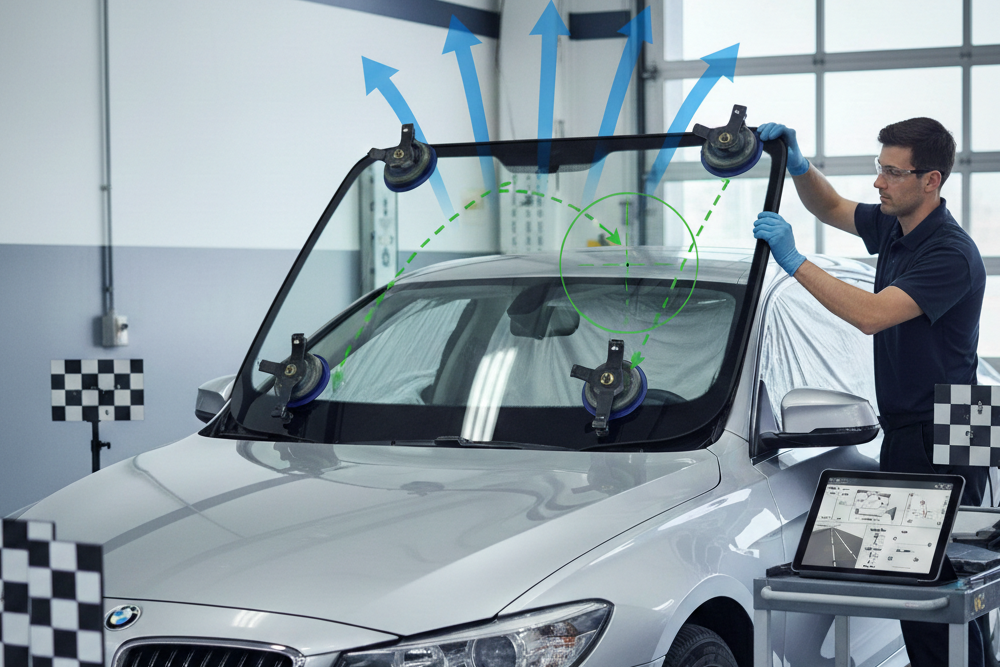
Calibration is the process of returning a vehicle’s ADAS to OEM specifications. Calibration is necessary after a new glass installation, particularly a windshield with a camera mounted to it, to ensure that the ADAS features continue to function properly despite having been moved during installation. If a car’s ADAS is not properly calibrated, the system may not function safely. A misaligned camera could jeopardize the functionality of the system and lead to dangerous driving or accidents, so it is crucial that the cameras are aligned perfectly, which is what windshield calibration ensures.
Talk to a Calibration Specialist Now 866.278.7417

Fleet Auto Glass Repair
We provide expert auto glass repair and windshield replacement services for commercial fleets of all sizes. We are experienced with all manufacturers and machine types of domestic or foreign cars, trucks, vans, or commercial vehicles, including heavy equipment. Our same day mobile auto glass and windshield repair service will enable you to get back on the road faster and start saving you time and money instantly. Give us a call today! We are here to help!
Talk to a Fleet Auto Glass Specialist Now 866.278.7417
The Development of Auto Glass
We must examine the evolution of auto glass in order to see why replacement is so delicate. In the early days of the automobile, windshields were essentially just ordinary window panes. They would shatter into big, hazardous pieces if they did.
There are two main kinds of safety glass used in cars today: Laminated glass, which is mostly used for windshields, is made up of two glass layers encased in a polyvinyl butyral (PVB) layer. The inner layer of plastic prevents glass fragments from flying into the cabin in the case of a breach, keeping people inside.
Tempered Glass: Used for side and rear windows, this kind of glass rapidly heats and cools. Instead of shattering into sharp knives when struck, it breaks into thousands of small, dull pebbles, lowering the chance of harm.
These materials’ predictable response is used by automakers to create the vehicle’s “safety cell.”
The Windshield as a Part of the Structure: The fact that the windshield gives the car’s cabin a substantial amount of structural support sometimes surprises drivers. Actually, in many modern cars, the windshield can contribute up to 60% of the cabin’s structural integrity in a rollover accident and up to 45% in a head-on collision.
Protection Against Rollover
The roof is susceptible to tremendous crushing force if a car flips over. As a result of its function as a pillar, the windshield prevents the roof from falling on the people within the vehicle. The windshield may come out upon impact if the glass replacement was done incorrectly, such as with the incorrect adhesive or without adequate surface preparation. The roof has a far higher chance of crushing the cabin without that support.
When the airbags are deployed, the windshield is a significant component of the airbag that is located on the passenger side. The deployment of the airbag causes it to explode upward and bounce off the windshield, which provides the passenger with some kind of protection. In a matter of milliseconds, this takes place with incredible force.
The power of the airbag can separate the glass from the frame if the windshield was replaced at a low cost using subpar glue. The airbag is ineffective, and the passenger is left unprotected if the windshield flies off because it has nothing to press against.
ADAS: The advent of Advanced Driver Assistance Systems (ADAS) has significantly increased the stakes for window replacement. If your vehicle was made during the recent few years, it probably has the following features:
Warning of the Departure of the Lane
The Automatic Braking System for Emergencies
Control for the cruise that can adapt
Detection of Rainwater Wipers
It is common practice to mount the cameras and sensors of these systems directly on the windshield, behind the rearview mirror when they are fitted. They keep an eye on the road through the glass.
Do you have a Question?
Get An Auto Glass Replacement Quote Now 866.278.7417
The Importance of Adjustment
These cameras can shift during a windshield replacement, sometimes by as little as a millimeter, but the impact of that tiny movement can be enormous once the vehicle is in motion. Modern ADAS cameras are calibrated to extremely tight tolerances. A change of just one degree in camera angle can translate into several feet of error at highway speeds.
That margin of error can mean the difference between your vehicle braking in time or failing to recognize an obstacle altogether. In real-world terms, the car may not slow down for stopped traffic, may misjudge the distance to a pedestrian, or may believe it is centered in its lane while slowly drifting into another.
The danger is that these errors are often invisible to the driver. The dashboard may not display a warning light, and the system may appear to function normally—until the moment it is needed most. The exact alignment of the camera is necessary for the operation of a number of features, including automatic emergency braking, adaptive cruise control, lane-keeping assistance, and front collision warning notifications. When that alignment is off, the safety net you are relying on becomes unreliable, unpredictable, or ineffective.
Because of this, recalibration is now an essential and non-negotiable step in any proper windshield replacement. ADAS systems must be precisely realigned with the newly installed glass using manufacturer-approved procedures and specialized equipment.
Using this method guarantees that the cameras and sensors are reading the road in the precise manner that was planned. A trustworthy auto glass shop will not simply replace the windshield and send you on your way. They will identify whether your vehicle requires static calibration in a controlled shop environment, dynamic calibration through monitored driving, or a combination of both.
By completing this final step, a professional shop restores not just your windshield, but the entire safety ecosystem of your vehicle. Proper recalibration ensures your advanced safety features respond accurately, predictably, and at the right moment—giving you confidence that the technology designed to protect you will perform exactly as engineered when it matters most.
The Dangers of Incorrect Installation
The industry maintains stringent requirements (such as the Auto Glass Replacement Safety Standard, or AGRSS) since auto glass is so important. Regretfully, not every service provider follows them to the letter.
Taking shortcuts during installation results in hidden risks:
Rust and Corrosion: Under the glue, rust will develop if a technician scrapes the vehicle’s pinch weld, which is the metal frame where the glass is located, without priming it. As a result of the rust eating away at the metal over time, the windshield has lost its ability to adhere to the surface. This won’t become apparent unless the glass breaks or leaks after a collision.
Inappropriate Adhesives: Top-grade urethane adhesive can withstand pressures of thousands of pounds. Although less expensive sealants might keep out water, they can’t survive a collision’s force.
Ignoring Safe Drive Away Time (SDAT): It takes time for urethane to cure and become strong enough to support glass in a collision. It is important to exercise caution if a technician asserts that you can immediately continue driving after having your replacement done. Depending on temperature and humidity, reputable stores will provide you with a unique SDAT.
Does OEM Glass Matter More Than OEE Glass? The abbreviation “OEM” refers to “Original Equipment Manufacturer,” while “OEE” stands for “Original Equipment Equivalent,” often known as “Aftermarket.” These phrases are frequently used when changing a windshield.
The term “Original Equipment Manufacturer” (OEM) refers to glass that is manufactured by the same company (such Pilkington, PGW, or Saint-Gobain) that manufactured the original glass for your car. It meets all of the original requirements exactly.
Aftermarket glass is produced by outside businesses. Federal safety regulations must be followed, but there may be some variation in the tolerance for size, thickness, and curvature.
Aftermarket glass is normally acceptable for older cars. On the other hand, many industry professionals recommend sticking with original equipment manufacturer (OEM) glass for automobiles that have advanced ADAS systems. Camera systems may become confused by minor distortions in aftermarket glass that are not visible to the naked eye, making calibration challenging or impossible.
Never Sacrifice Your Safety Cell
A cracked windshield represents a structural flaw in the safety armor of your car, not just an aesthetic annoyance. When choosing a provider of window replacement services, it is important to take into consideration more than just the lowest price.
Inquire about the certification, adhesive cure times, and ADAS system recalibration capabilities of prospective technicians. Make sure your replacement upholds the major safety feature of the glass that was incorporated into your car’s design. Putting quality above price guarantees that your car will be prepared to defend you in the worst situation.
Commonly Asked Questions: Is it possible to fix a tiny chip rather than replace it? Yes, a unique resin can frequently be used to fill tiny chips, which are typically smaller than a quarter. This stops the crack from expanding and restores the glass’s structural integrity. Nevertheless, it is generally recommended to replace the chip if it is located in close proximity to the edge of the glass or if it is in the driver’s direct line of sight.
The amount of time that is necessary to replace a windshield is specified. An hour or so is often needed for the actual removal and installation. On the other hand, the adhesive needs some time to fully cure. You might have to wait anywhere from one to twenty-four hours before it’s safe to drive the car, depending on the type of urethane used.
Will windshield repair be covered by my insurance? In many cases, comprehensive insurance policies will pay for protection against glass damage. In order to incentivize drivers to address safety risks, several jurisdictions even mandate that insurance companies waive the deductible for windshield repair. For more information, see your particular policy.
Why does a windshield change require me to reset my camera? The glass has the camera fixed to it. There are variations in the curve of glass, and fresh glass sits a little bit differently than old glass does. Recalibration guarantees that the camera is pointed precisely where the vehicle’s computer believes it should.
Your windshield serves as a protective barrier. You most likely don’t give the glass in front of you much thought when you’re driving. It appears to be functioning as long as it is spotless and free of fractures. However, the windshield on your car serves far more purposes than merely keeping out wind and insects. To ensure that your vehicle is structurally sound, it is absolutely necessary.
The windshield serves as a safety shield in contemporary vehicle engineering, intended to cover the cabin and its occupants in the event of an accident. On the other hand, the efficiency of this safety device is contingent upon the manner in which it is installed. Windshield replacement done incorrectly jeopardizes the life-saving safety features.
When it’s time for a replacement, knowing the principles of auto glass installation will help you make wiser choices. This tutorial looks at how a safe installation maintains the cabin’s security and enhances impact resistance.
The Function of Auto Glass in Structure
Rubber gaskets held windshields in place decades ago. The glass may come out if you crash into something too hard. Auto glass now makes up as much as 60% of the roof’s strength in a rollover collision, making it a structural component of the car.
How to Avoid Roof Crush: The weight of the automobile is supported by the roof in the terrible case of a rollover. The cabin roof is supported by the windshield, which keeps it from caving inward on the occupants.
The glass may separate during the rollover phase if it is not properly glued to the frame. In the absence of the support provided by the glass, the roof is significantly more likely to collapse, which significantly increases the likelihood that the individuals may sustain major injuries. When the glass is installed correctly, it will remain in place and preserve that crucial survival area inside the cabin.
Facilitating the Deployment of Airbags: The windshield is a major component of the passenger-side airbag. The airbag cushions the passenger in a front-end accident by deploying upward and bouncing off the windshield.
The force of the airbag can blow the windshield out of the frame entirely if it is poorly placed or the adhesive is inadequate. The airbag loses its backstop and deploys out through the opening if the glass ejects, providing the passenger with no protection. The glass is guaranteed to withstand this enormous internal pressure with a factory-standard installation.
The Study of a Strong Bond: Chemistry and accuracy are key to a safe installation. It’s more complicated than just sticking a piece of glass to metal. To guarantee that the bond—where the glass joins the car frame—is unbreakable, technicians must adhere to a strict procedure.
Urethane’s Function
Automotive urethane is a high-strength glue used by installers. This molecularly bonding agent isn’t your typical silicone; it’s made to sustain thousands of pounds of pressure per square inch.
In order for the urethane to function properly, the surface must in fact be chemically clean. The connection may be weakened even by the natural oils in a technician’s fingerprint. The new urethane won’t fuse with the car body if the frame isn’t prepared with the proper primers or if the old adhesive isn’t cut down to the proper level. This creates a “weak bond,” which may keep the glass in place when driving normally but will break right away in a high-impact collision.
When it comes to impact resistance, patience is one of the most crucial components. Drive-Away Safe Time follows this principle. It takes time for urethane to solidify and gain the strength required to retain glass in a collision. This is referred to as the Safe Drive-Away Time, or SDAT for short.
In the event that you drive the vehicle before the glue has had a chance to dry, the glass may shift due to the vibrations of the road, which will leave microscopic gaps in the seal. Reputable auto glass shops will specify the exact amount of time you must wait before moving the car, which is typically an hour or longer. Ignoring this window instantly jeopardizes the safety of the cabin.
ADAS, or advanced driver assistance systems: Modern automobiles depend as much on technology as on their structural integrity. A number of technologies, including adaptive cruise control, automated emergency braking, and lane departure warnings, are typically implemented with the assistance of cameras that are mounted directly on the windshield.
There is a possibility that these cameras will only shift a few millimeters when the windshield is replaced. Even though it may seem insignificant, a one-degree shift in camera angle can have a significant impact on the system’s focus in the future—by several feet.
Calibration is now part of proper installation. This is how the camera sensors are electronically aimed to make sure they accurately read the road. Your car’s safety brain is essentially blind or misaligned if the installer omits this step. The crash-prevention systems won’t be able to prevent an impact from occurring in the first place, even if the glass is secure.
Do you have a Question?
Get An Auto Glass Replacement Quote Now 866.278.7417
Typical Indications of Subpar Installation
How can you determine whether your cabin security has been jeopardized? Even though the chemical link is invisible, there are tangible signs of a hastily completed or amateurish job.
Wind Noise: Air is entering the cabin if you notice a whooshing noise at highway speeds that wasn’t present previously. The seal is not airtight, and the binding is weak if air may enter.
Water Leaks: A urethane crack is indicated by moisture on the dashboard or wet carpet following a downpour. Water erodes the metal that the glass is held to by causing rust on the pinch weld, or the metal frame.
Wavy Glass: Deformations are common in low-quality glass. This suggests the store used less expensive materials, but it doesn’t always mean the installation is loose.
Messy Molding: The technician most likely hurried the finishing touches if the rubber trim around the glass is protruding or appears uneven.
Commonly Asked Questions: Is it possible to fix a crack without having to replace the entire windshield? The location and size determine this. Chips are typically able to be repaired if they are less than a quarter in size and are found to be out of the driver’s direct line of sight. To restore cabin safety, a complete replacement is necessary if the crack reaches the windshield’s edge, as this compromises the structural integrity.
Does the cost of replacing my windshield fall within my insurance policy policies? Yes, in a lot of instances. Glass damage is frequently covered with comprehensive coverage. Because windshield repair is seen as a safety element, several jurisdictions even require insurance carriers to pay it with no deductible. For more information, see your particular policy.
What distinguishes OEM glass from OEE glass? OEM glass, which stands for “Original Equipment Manufacturer,” is manufactured by the same manufacturer that manufactured the glass that was originally installed in your car. Aftermarket glass that is manufactured by a different company but meets the same criteria is known as OEE (Original Equipment Equivalent). If both adhere to safety regulations, they are both safe; nevertheless, OEM guarantees a proper fit, which facilitates a safe installation.
Never Sacrifice Cabin Safety
Every time you drive, the windshield discreetly protects you by acting as your car’s guardian. It guarantees the proper and efficient deployment of airbags, maintains the precise alignment of advanced driver-assistance system (ADAS) sensors, and keeps the roof structurally supported in the case of a rollover.
It’s a serious error to think of a windshield replacement as a straightforward cosmetic fix; it’s a structural fix that immediately impacts everyone’s safety inside your car. When choosing a repair or replacement shop, give preference to those that use premium urethane adhesives, have access to the right calibration equipment for your car’s safety systems, and employ qualified and experienced specialists.
Verify warranty guarantees to guard against installation faults, and inquire about Safe Drive-Away Times to make sure the glue has dried completely before the car is used again. These are the specifics that set a trustworthy, expert service apart from a hasty, sometimes dangerous fix.
Insisting on correct auto glass installation protects the integrity of your car’s safety systems in addition to repairing a chipped or cracked windshield. This meticulous attention guarantees that your vehicle will continue to be a safe refuge for you, your passengers, and even any future occupants, equipped to handle whatever difficulties the road may bring.
A competent installation’s materials, technique, and calibration all contribute to long-term protection, structural safety, and peace of mind. Don’t cut corners on something that could literally save your life while driving.
Mobile Safe Auto Glass
14241 E Firestone blvd suite 400,
La Mirada, CA 90638
Phone: (562) 608-1154
Toll Free: 1 866 278 7417
Mail: sales@mobilesafeautoglass.com
Get a FREE QUOTE today! You can get a free quote and schedule 24/7 using this free quote wizard.
Mon – Fri 8am – 5pm
Saturday 8am – 1pm
Sunday Closed