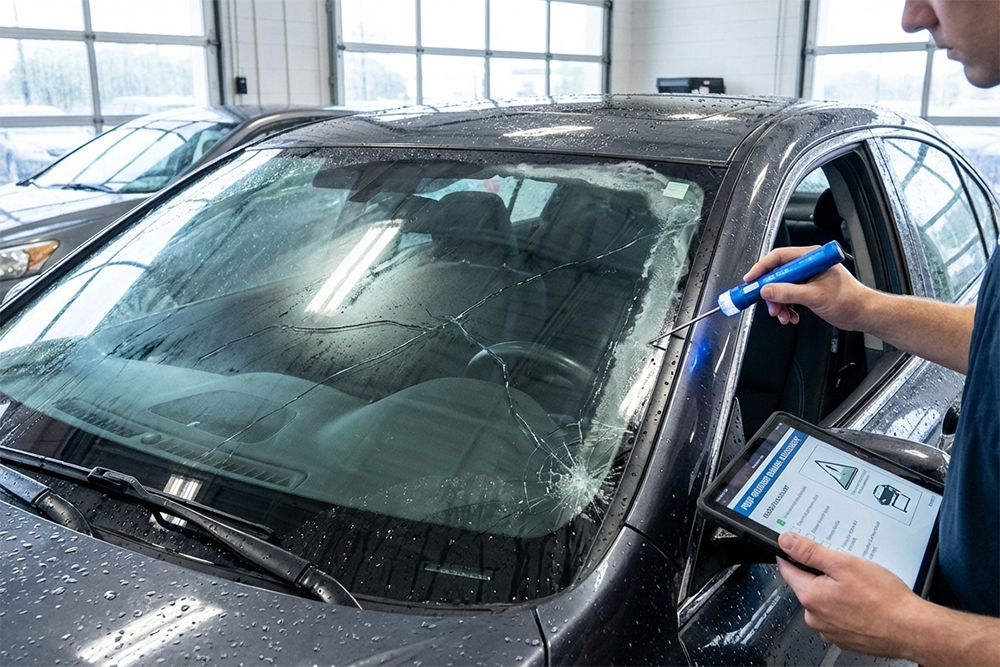
Front Window Repair After Extreme Weather Exposure
The storm has passed, the wind has slowed down, and the sun is breaking through the clouds for the first time in a long time. To have a better understanding of the issue, you go out to your driveway. Your front auto window is a more vulnerable component of your car that frequently receives the brunt of Mother Nature’s fury. While you may be checking for dents on the hood or falling branches on the roof, there is another component of your vehicle that is more likely to sustain damage. The windshield on your vehicle is durable, but it is not invincible.
Get An Auto Glass Replacement Quote Now 866.278.7417

Windshield Replacement & Repair
Our competitors push you into going to their shop to get your glass fixed-making it cheaper for them. We make it easier for YOU to get back on the road by offering free mobile repairs at your home or work. With our free mobile services servicing the entire Orange County & Los Angeles area, we can often handle your windscreen replacement the same day! So the next time you need a windshield replacement, give us a call.
Talk to a Windshield Replacement Specialist Now 866.278.7417

Calibration
Calibration is the process of returning a vehicle’s ADAS to OEM specifications. Calibration is necessary after a new glass installation, particularly a windshield with a camera mounted to it, to ensure that the ADAS features continue to function properly despite having been moved during installation. If a car’s ADAS is not properly calibrated, the system may not function safely. A misaligned camera could jeopardize the functionality of the system and lead to dangerous driving or accidents, so it is crucial that the cameras are aligned perfectly, which is what windshield calibration ensures.
Talk to a Calibration Specialist Now 866.278.7417

Fleet Auto Glass Repair
We provide expert auto glass repair and windshield replacement services for commercial fleets of all sizes. We are experienced with all manufacturers and machine types of domestic or foreign cars, trucks, vans, or commercial vehicles, including heavy equipment. Our same day mobile auto glass and windshield repair service will enable you to get back on the road faster and start saving you time and money instantly. Give us a call today! We are here to help!
Talk to a Fleet Auto Glass Specialist Now 866.278.7417
The Scientific Theory Behind Temperature and Glass
To comprehend the reason behind the cracking of your windshield during a weather event, it is necessary to examine the physical properties of glass. Windshields for automobiles are constructed out of laminated glass, which consists of two layers of glass that are sandwiched over a layer of plastic. The shape of the glass protects it from shattering into sharp fragments when it is struck by something. Glass, on the other hand, expands when it is extremely hot and shrinks when it is really cold.
The phenomenon known as thermal stress takes place when the temperature of the glass undergoes a shift that is either too quick or too uneven. This is the case in areas that see significant variations in the weather. Making the mistake of pouring hot water on a windshield on a chilly morning causes the outside layer of glass to rapidly expand, while the interior layer of glass remains cold and contracts. This is known as the hot water mistake. In virtually every instance, a crack is the end outcome.
The Defroster Shock: In a similar manner, if you blast the heater on “high” against a windshield that is frozen, you may cause a stress fracture to begin at the bottom of the glass (where the vents are located) and then shoot upward. Sun scorch occurs when the margins of the windshield, which are often enclosed in black rubber or metal, heat up more quickly than the middle of the glass when the temperature is extremely high.
Due to the disparity in temperatures, stress is generated at the margins, which ultimately results in fractures that develop out of nowhere. Not all cracks are made equal, and impact is not the same as stress. You will be better able to communicate the problem to a repair specialist if you are aware of the difference. Breaks caused by impact are those that occur when an item collides with the glass. It is typically hail, flying tree branches, or debris that is blown up by high winds that causes this to occur during severe weather.
During the stress cracking process, you will see a distinct point of impact, which is sometimes referred to as a “bullseye” or a “star break.” Stress cracks are created by changes in temperature. The majority of the time, they begin near the edge of the windshield and do not have a point of impact. Long lines that are either straight or slightly curved are what they are.
Assessing the Damage Caused by Hail and Debris
The front glass is frequently the first part of a vehicle to be destroyed by hailstorms, which are known for destroying vehicles. The term “pitting” refers to the formation of microscopic craters on the surface of the glass that do not penetrate the inner plastic layer. Pitting can be caused by hail of any size. In spite of the fact that pitting may appear to be a small irritation, it really reduces the surface tension of the glass. That little depression has the potential to explode into a big fracture the next time you drive over a pothole or bang the door of your car.
In the event that your car has been subjected to severe winds, it is important to check for a phenomenon known as “sandblasting.” Sandblasting happens when the wind presses sand or fine grit against the glass for an extended moment. Particularly while driving in the light or at night, it produces a hazy, pitted texture that makes visibility extremely difficult to achieve. Sandblasting, in contrast to chipping, cannot be fixed; in most cases, the entire windshield needs to be replaced.
What the Risk Is When Repairs Are Delayed
There is a strong temptation to disregard a little chip, particularly if it is located on the passenger side of the vehicle or if it is not in your line of sight. Procrastination, on the other hand, is the enemy of vehicle glass repairs. A chip in the windshield is an open wound that can be contaminated with moisture and dirt. It’s possible for rain, washer fluid, and dirt from the road to leak into the crack. This material has the potential to obscure the laminate layer that is contained within the glass.
After the dirt has gotten ingrained, it is no longer feasible to execute a repair that is clean. You will be left with a fault that is forever evident or a weak region that will ultimately fracture again because the glue that was used to fix the crack will not bind correctly the way it should. Safety Features That Have Been Compromised Your windshield does more than just obscure the view of the wind. It plays an essential role in the safety system. When it comes to providing structural support, the windshield is responsible for up to forty-five percent of the structural integrity of the cabin roof in the case of a rollover accident.
Failure of the windshield to provide adequate support for the roof might result in the roof collapsing. The deployment of airbags occurs when the airbags on the passenger side of the vehicle bounce off the windshield. It is possible for the force of the airbag to shatter the glass if it is weakened by a fracture. This would result in the bag not effectively protecting the passenger since it would deploy in an improper manner.
Do you have a Question?
Get An Auto Glass Replacement Quote Now 866.278.7417
Finding the Right Choice Between Repair and Replacement
How can you determine whether or not your windshield, which has been damaged by the elements, can be saved? When it comes to determining whether or not a repair is feasible or whether or not a complete replacement is required, auto glass specialists often adhere to a few conventional principles. Taking the Magnitude Test: The magnitude of the damage is the basic rule of thumb that should be remembered.
Chips that are smaller than a quarter and cracks that are less than three inches (about the length of a dollar note) are typically able to be filled with specialist resin after they have been chipped or cracked. Replacement Is Necessary: If the crack is longer than a dollar note, it is usually always the safest decision to replace the item. In terms of both depth and location, even very little damage may necessitate a replacement depending on the position of the item. A little distortion in the driver’s line of sight is frequently left behind when repairs are made to the glass.
In order to guarantee complete visibility, the majority of repair shops will propose replacement if the damage is located directly in front of the driver. Edge Cracks: If a crack makes contact with the edge of the windshield, it affects the connection that exists between the glass and the metal frame of the vehicle. These cannot be corrected in a secure manner. Damage to the Inner Layer: The windshield is considered to be finished if the damage extends through the glass and into the plastic laminate or the inner layer of the glass.
When It Comes To Windshield Repair, The Role of ADAS
ADAS, which stands for advanced driver assistance systems, is standard equipment in modern automobiles. Rain-sensing wipers, automated emergency braking, and lane departure alerts are some of the features that fall under this category. Cameras and sensors that are located right behind the front glass of the vehicle are the foundation of these systems. In the event that severe weather causes your windshield to be destroyed and you require a complete replacement, the process is not finished after the adhesive has dried.
In order to guarantee that the cameras “see” through the new glass in the proper manner, they will need to be recalibrated. Even a slight deviation of a few millimeters can throw off the sensors, which can result in the failure of safety systems or the activation of them at the incorrect moment. Always inquire with the service provider about whether or not they are able to do ADAS calibration before scheduling a repair following a storm.
The Protection of Your Automobile’s Glass against Potential Storms
Even if you have no control over the weather, you may take precautions to reduce the danger that your car will face during the next period of harsh weather. Take precautions when parking: if a storm is expected, you should avoid parking under trees. When there is a strong windstorm, the most common reason for windshield damage is the presence of dead branches. Invest in a heavy-duty car cover or a customized windshield cover if you do not have a garage. This will allow you to protect your vehicle from damage. Heavy blankets that are fastened inside the doors can, in an emergency situation, protect the glass from hail.
Changes in Temperature Gradually: When de-icing your vehicle, you should never use hot water. Allow the glass to gradually warm up by scraping it with a scraper and using the defroster in the car on a low level before proceeding. Make repairs right away: address those little rock chips right away. When compared to a windshield that already has structural defects, a windshield that is solid and unbroken is far more resistant to the effects of thermal stress and hail impact.
Questions That Are Frequently Asked:
Will the damage to my windshield caused by the weather be covered by my insurance? The majority of the time, the answer is yes. Weather damage is often covered by “comprehensive” coverage, which is the most common type of coverage. As a result of the fact that it is more cost-effective for insurance companies to repair a chip than to replace the entire windshield at a later time, many plans may even waive the deductible for chip repairs. What kind of time is required to fix a windshield? It typically takes between thirty and forty-five minutes to fix a simple chip.
Before the car is safe to drive again, it may take an hour or two to complete a full replacement, and then it will take an additional hour for the glue to dry. Is it possible for a crack to become more noticeable when exposed to cold weather? In a word, yes. The cold causes the glass to shrink, which causes it to pull away from the fracture, which in turn causes the crack to widen. It is also possible for moisture that penetrates the fracture to freeze and expand, therefore functioning as a wedge that pushes the breach further apart.
Is it safe to drive with a windshield that has a visible crack? It may be possible to drive a short distance to a repair shop if the fracture is not directly in your line of sight and is quite minor. Nevertheless, if the glass is broken to the point that it blocks your view or if the break is substantial, the car is considered hazardous and ought to be towed or serviced by a mobile glass repair unit rather than being driven.
Don’t Hold Out for the Next Storm to Come
As well as providing protection from the weather, the front glass of your vehicle serves as a window to the outside world. Extreme weather puts your car through its paces, and the glass is frequently the component that sustains the most damage. In the event that you take fast action to remedy the issue, whether it is a star break caused by a hailstorm or a stress fracture caused by a deep freeze, you will save money and ensure the safety of your passengers.
Seek the assistance of a trained vehicle glass specialist as soon as possible if you discover any damage following a weather event. In the future, a rapid resin fill might forestall the need for an expensive replacement as well as a potentially hazardous rupture.
Why the Crack in Your Windshield Won’t Remain Small for a Long Duration
It begins with a sound that every motorist dreads hearing: a loud ping, which is then followed by the sickening knowledge that a wayward rock has hit your windshield. A small bullseye or a chip in the shape of a star is visible to you when you examine the glass. It appears to be of little significance, possibly the size of a cent. You might persuade yourself that you will make a decision about it later. In the end, it is not obstructing your view, and life is generally rather busy.
On the other hand, disregarding that very little imperfection is like taking a wager with the chances stacked against you. The glass in your car is subjected to continuous stress since it is an essential component of the vehicle’s structural integrity. That little chip is a weak point in the armor, and the environment around you is actively striving to tear it apart. This is a point of vulnerability.
Environmental elements like blazing summer heat, unexpected downpours, and tiny road debris not only have an impact on the comfort of your drive, but they also rapidly accelerate the spread of glass damage. The fact that a chip that is easily repairable may suddenly become a pricey replacement overnight can be explained by having an understanding of how these elements interact with your windshield.
The Scientific Study of the Structure of Your Windshield
First, you need to have a solid understanding of the material you are looking through in order to comprehend why fractures propagate. Laminates of safety glass are used in the construction of modern windshields. A layer of polyvinyl butyral (PVB) plastic is sandwiched between two layers of glass so that this structure may be constructed. In most cases, the outer layer of glass on your windshield is broken when a rock strikes it, while the interior layer of plastic is responsible for keeping everything together.
During an accident, shards will not be able to enter the cabin because of the construction of this structure. Unfortunately, once the strain on the outer surface is broken, the structural integrity of the structure is undermined. The glass is no longer a sheet that is uniform; rather, it is a piece of a jigsaw that has been fractured and is being kept in place by tension, waiting for a push to further split it.
A Look at How Heat Stress Causes Glass to Break
One of the most prevalent factors that can cause damage to a windshield is temperature. Materials are expected to expand when heated and compress when cooled, according to the laws of physics. Among the exceptions is glass. Thermal Expansion: The windshield of your vehicle causes it to heat up when it is left out in the sun. The glass starts to thicken and expand. On a windshield that is in perfect condition, this expansion is consistent and risk-free. However, the expansion is not uniform on a windshield that has been chipped.
The chip, which is the weak spot, is subjected to pressure from the heat, which causes the microscopic fractures that are located at the margins of the damage to stretch and run. The effect of the defroster and the air conditioner: The true threat frequently originates from sudden shifts in temperature. Imagine for a moment that your vehicle has been sitting in a parking lot on a day that is 90 degrees. Upon entering, you immediately turn on the air conditioning and speed it up. While the interior of the glass rapidly cools and compresses, the exterior of the glass continues to increase in temperature and expands.
Within the layers of the glass, this “thermal shock” generates forces that are in competition with one another. Eventually, the tension will make its way to the point of least resistance, which is the chip. This is because the stress needs to go somewhere. As a result of this, a significant number of motorists have reported that they parked their vehicle with a little chip and then returned to discover a crack over half of the windshield.
How Rain and Moisture Affect the Environment
Even while water does not appear to be harmful, it may be a formidable obstacle for a windshield that has been damaged. Hydraulic Pressure: When it rains, water does not simply lie on the surface; rather, it seeps into the cracks and fissures of the surface. While you are driving, the power of the wind and the impact of the raindrops cause water to accumulate deeper within the break. Hydrostatic pressure is generated within the laminate layer as a result of this.
In order to cause the crack to become more extensive, the water exerts pressure on the glass from the inside out. When it rains, you are compelled to use your windshield wipers, which can be stressful for your visibility. If you have a chip, the rubber blade will increase the amount of drag it experiences each time it travels over the uneven surface. Damage might be made worse by the repetitive mechanical force that is being applied. To add insult to injury, if the chip is filthy, the wipers can crush the grit into the fracture, which acts as an abrasive and further damages the glass.
Temperatures Below Freezing Rain is a nuisance, but freezing rain is far more troublesome. When water seeps through a gap and the temperature falls below freezing, the water has the potential to transform into ice. Water experiences a freeze-thaw expansion of around nine percent. Because of this expansion, the glass is subjected to a large amount of strain, which easily causes the material to break and leads to a substantial extension of the fracture.
Do you have a Question?
Get An Auto Glass Replacement Quote Now 866.278.7417
In The World Of Microwedges
Dust, dirt, sand, and chemical residue are all things that may be found on the road. Although a huge boulder was responsible for the initial damage, the presence of numerous smaller particles makes it difficult to repair the damage correctly and may even make it worse. The process of repairing a windshield involves injecting a specific resin into the chip, which then dries and ties the glass back together. Contamination might prevent the repair from being successful. On the other hand, if dirt and debris make their way into the crack, they prevent the resin from reaching the bottom of the split.
A “cloudy” repair or a weak connection that is unable to prevent the break from widening in the future is the outcome of this kind of repair. The presence of microscopic material that is trapped inside a fracture works as a wedge, causing physical stress. Because of the vibrations caused by the engine or the surface of the road, these particles grind against the inner walls of the crack as the vehicle moves. The structure of the glass is gradually eroded as a result of this internal friction, which enables the fracture to “creep” across the windshield over the course of time.
Vibration in Vehicles and Their Importance
Vehicle vibration is the element that is responsible for all of the problems that have been discussed above, despite the fact that it is not an external aspect like rain or sun. Your automobile is never completely motionless. In addition to the bass from your audio system, vibrations are produced by things like potholes, speed bumps, and slamming car doors. These vibrations travel through the chassis and end up on the windshield. In the event that the chip has already been degraded by heat or wetness, a simple speed bump may be the point at which it breaks. As soon as the strain in the structure is released, the fracture immediately appears in your line of sight.
Questions That Are Frequently Asked:
Am I able to use super glue to prevent a fracture from expanding further? This is not true; it is a widespread misconception. In order to endure the heat expansion and contraction that a windshield experiences, super glue is not meant to do so. It is possible for it to plug the crack, which would make it hard for a professional to inject the appropriate resin at a later time. As a result, you would be required to pay for a complete replacement.
To what extent is it possible to fix a chip? In most cases, the chip or fracture may be fixed if it is less than the size of a dollar note, which is around six inches thick. Nevertheless, this is contingent upon the location of the damage as well as its extent. If the crack is directly in the line of sight of the driver or if it approaches the edge of the glass, it is typically necessary to replace the windshield instead.
Does having a broken windshield make it unlawful to operate a vehicle? Yes, in a big number of jurisdictions. You run the risk of receiving a penalty if a crack in your vehicle either impedes the driver’s view or threatens the structural integrity of the vehicle. A substantial safety risk is posed by a huge fracture in the windshield because it plays a role in providing protection against roof crush in the event of a rollover.
It is not worth waiting till it breaks. The shift from a chip that can be repaired to one that requires a costly replacement frequently takes place in a rapid and stealthy manner. Something as simple as a hot afternoon, an unexpected thunderstorm, or a rough road is all that is required to permanently damage the glass.
When you take care of windshield damage as soon as it occurs, you will be able to save money and secure your safety through the most effective method. Modern repair technology is not only quick and inexpensive, but it is also frequently covered by insurance policies that do not need a deductible. By taking prompt action, you are able to close the gap before the elements, including heat, rain, and debris, have a chance to do their worst.
Mobile Safe Auto Glass
14241 E Firestone blvd suite 400,
La Mirada, CA 90638
Phone: (562) 608-1154
Toll Free: 1 866 278 7417
Mail: sales@mobilesafeautoglass.com
Get a FREE QUOTE today! You can get a free quote and schedule 24/7 using this free quote wizard.
Mon – Fri 8am – 5pm
Saturday 8am – 1pm
Sunday Closed