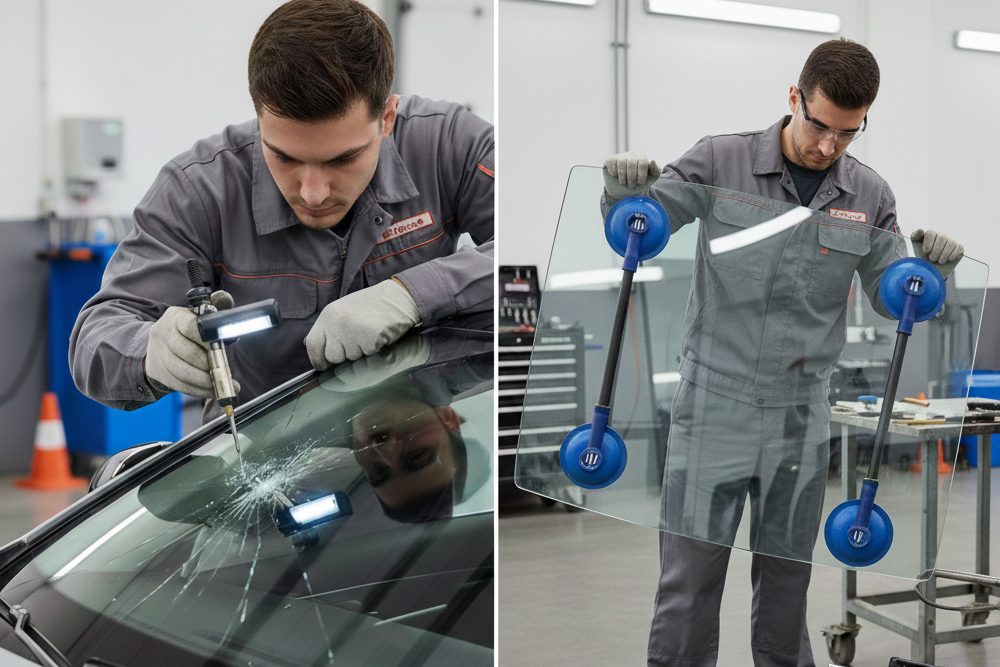
Car Window Glass Repair Near Me vs Full Replacement
It would destroy anyone’s morning to hear that abrupt, harsh snap on the roadway. You hear the impact, see the pebble hit, and then notice the damage—a thin line across your windshield or a chip in the shape of a star. Often, panic strikes right away. Modern safety glass makes it unlikely that the glass would break in your face, but you could still ask how much this will cost. Taking out your phone and searching for “car window glass repair near me,” in the hopes of finding a speedy solution, may be your first response. However, not all types of damage are equal. Some small chips can be repaired using resin in less than 30 minutes, but other kinds of damage jeopardize your car’s structural stability and necessitate replacing the entire glass.
Get An Auto Glass Replacement Quote Now 866.278.7417

Windshield Replacement & Repair
Our competitors push you into going to their shop to get your glass fixed-making it cheaper for them. We make it easier for YOU to get back on the road by offering free mobile repairs at your home or work. With our free mobile services servicing the entire Orange County & Los Angeles area, we can often handle your windscreen replacement the same day! So the next time you need a windshield replacement, give us a call.
Talk to a Windshield Replacement Specialist Now 866.278.7417

Calibration
Calibration is the process of returning a vehicle’s ADAS to OEM specifications. Calibration is necessary after a new glass installation, particularly a windshield with a camera mounted to it, to ensure that the ADAS features continue to function properly despite having been moved during installation. If a car’s ADAS is not properly calibrated, the system may not function safely. A misaligned camera could jeopardize the functionality of the system and lead to dangerous driving or accidents, so it is crucial that the cameras are aligned perfectly, which is what windshield calibration ensures.
Talk to a Calibration Specialist Now 866.278.7417

Fleet Auto Glass Repair
We provide expert auto glass repair and windshield replacement services for commercial fleets of all sizes. We are experienced with all manufacturers and machine types of domestic or foreign cars, trucks, vans, or commercial vehicles, including heavy equipment. Our same day mobile auto glass and windshield repair service will enable you to get back on the road faster and start saving you time and money instantly. Give us a call today! We are here to help!
Talk to a Fleet Auto Glass Specialist Now 866.278.7417
The Rule of Repair First
Whenever possible, technicians would rather fix a windshield than replace it. It is much less expensive, more environmentally benign (keeping old glass out of landfills), and maintains the original glass’s manufacturer seal.
Repairs, however, have their limitations. The car glass industry commonly uses three measures to assess the salvageability of a windshield: size, depth, and placement.
The Test of Size: Comparing a chip to currency is the most popular method of determining if it can be repaired.
The Quarter Rule states that damage is nearly always repairable if it is less than a quarter in size, including any cracks extending from the impact point.
The Dollar Bill Rule: Larger repairs are possible with some technologies. If a break is less than six inches long—the length of a $1 bill—some stores will attempt to repair it. However, the success rate decreases with crack length.
The amount of the damage: Windshields are made of laminated glass, which is made up of two layers of glass sandwiched by a layer of vinyl. The rock chip is a viable candidate for repair if it simply breaks through the outer layer of glass. The structural integrity is lost if the impact penetrates all the way to the inner layer or the middle of the vinyl. There must be a replacement.
Location Is Important: The location of the rock’s impact is equally as significant as its force. If it falls under certain “no-go” zones, even a little chip may require a complete replacement:
The Driver’s Line of Sight: To fix a fracture, a clear resin is injected into it and then exposed to UV light to cure it. Strength is restored, but the injury is not entirely invisible. It frequently leaves a faint deformation or imperfection. This flaw becomes a safety threat if it is right in your line of sight.
The bond between the glass and the metal frame is weakened if there is a chip or break within two or three inches of the edge. Because of the increased strain on the edges, these cracks propagate more quickly and pose a greater risk to safety.
Sensors and Cameras: Modern cars come equipped with Advanced Driver Assistance Systems (ADAS). These cameras often look through windshields. Repairing damage in front of a sensor or camera could make it more difficult for the system to “see” the road.
When the Only Choice Is Replacement
Searching for repair services can occasionally be futile because the damage is just too great. The windshield may fail when you need it most if you try to fix non-salvageable glass despite the warning indicators.
Long and Deep Cracks: The force on the windshield makes it nearly impossible to stop the spread of a crack once it has grown more than six inches. The crack will immediately sprint across the glass due to temperature changes, such as blasting the defroster on a cold morning, which will cause the glass to expand and shrink.
Although most rear windshields and side windows are composed of tempered glass, windshields are laminated. This glass is designed to shatter when struck into thousands of dull, pebble-like bits to protect against damage from sharp shards.
There is nothing to be done if your side window is broken in a break-in or struck by a rock. In essence, the glass breaks. Cleanup and complete replacement are your only options in these situations.
Internal Damage: Although they are uncommon, stress cracks may develop from the inside of the glass as a result of severe temperature fluctuations or structural flaws. If you run your fingernail over the break on the outside and feel nothing, but you catch it on the inside, the glass must be changed.
Do you have a Question?
Get An Auto Glass Replacement Quote Now 866.278.7417
The Unstated Expenses of Contemporary Replacement
A decade ago, changing a windshield was a simple mechanical task. You removed the old glass, cut the urethane seal, and cemented the new one in place. Because of ADAS technology, the procedure is much more complicated now.
Directly placed cameras on the windshield are the foundation of these systems. When you change the glass, the camera’s angle sometimes shifts by a millimeter. The system may miscalculate roadway distances as a result of that small change. Thus, following the actual glass replacement, the shop needs to do a “recalibration.”
Static Recalibration: To align the cameras, the vehicle is parked in front of particular targets and lasers.
Dynamic Recalibration: To program the camera, the technician drives the vehicle on designated roads at predetermined speeds. Although a low-cost estimate may cover the glass, it may leave your safety systems broken.
Insurance rather than non-insurance. When it comes to auto glass, this is the most common financial query. Is it covered by insurance?
Regarding Repairs: Instead of paying $800 for a replacement, most insurance companies would much prefer to pay $80 for a repair. As a result, the deductible for windshield repairs is often waived under comprehensive coverage. You could likely get the chip filled for free if your rates don’t increase.
Your deductible will probably need to be paid. There is no need to submit a claim if the replacement cost is $450 and your deductible is $500. The insurance claim is worthwhile, though, because OEM glass and calibration can easily cost more than $1,000.
What to Anticipate
The next step is to locate a trustworthy store if you are unsure which path to choose. When searching for “car window glass repair near me,” seek qualified professionals (such as those who have earned certification from the Auto Glass Safety Council).
The 30- to 60-minute repair process: The technician cleans the impact area and removes any loose glass fragments. To remove air from the chip, they create a vacuum over it. After being scraped off, the surplus is polished.
The Procedure for Replacement (1–3 hours): The wipers and trim are taken off. The glass is removed, and the old seal is cut. To stop corrosion, the frame is primed. A fresh coat of urethane adhesive is used. The windshield has been replaced. To allow the adhesive to set, the car must sit for a “Safe Drive Away Time”—typically an hour.
Frequently Asked Questions: After a windshield repair, will the chip completely disappear? No. Stopping the crack from spreading is the main structural objective of a repair. Even though the resin will significantly improve the visual appearance (usually clearing it up by 80% to 90%), you may still notice a tiny pit mark or blemish where the rock struck.
Can I use a do-it-yourself kit to mend the crack? There are DIY kits, but they are dangerous. You only get one shot if the resin doesn’t cure properly or if all the air isn’t removed. A failed repair cannot be fixed again. Compared to over-the-counter kits, professional equipment uses resin of superior grade and significantly higher pressure.
Choosing the Best Option for Your Car
Your windshield is an essential safety feature of your car that is much more than simply a piece of glass. It helps maintain the cabin’s structural integrity, supports the roof in the case of a rollover, and makes sure the airbags deploy properly in the event of an accident.
A small pothole, a rapid change in temperature from sun to shade, or even running over a speed bump can easily escalate minor damage into a $1,000 replacement.
A professional repair is nearly always the best choice if the damage is less than a quarter in size and does not block your direct line of sight. Repairing the chip not only saves you money but also prevents further cracking and preserves the factory seal. It is an effortless and affordable approach to keep your windshield safe and structurally sound.
Don’t take shortcuts, though, if the damage is significant, on the glass’s edge, or blocks your view. The safest course of action is a complete replacement, which guarantees that your car will continue to meet safety regulations and that your passengers will be safe.
If in doubt, seek professional advice. The majority of authorized auto glass companies perform free examinations and will give you an honest opinion on whether the glass needs to be replaced or repaired. In addition to saving you money over time, taking the time to consult a professional will guarantee that your car stays safe and roadworthy.
Is it safe to repair a car’s rear and side windows? Every one of us knows what to do when a rock hits the windshield. Before it spreads, you identify the chip, hear the awful thwack, and contact a mobile repair service to have it filled with resin. For most drivers, it’s a routine maintenance process.
However, what occurs if that errant pebble or piece of road debris strikes your back or side window instead? It has long been believed that side and rear windows need to be replaced rather than mended. A typical auto repair shop might tell you that the moment the glass chips, it compromises its structural integrity. But because of advancements in automotive technology, glass utilized in contemporary cars has changed during the past 20 years.
The type of glass your car uses and the extent of the damage will determine whether you can save your window or if you have to pay for a complete replacement. Making the appropriate decision is important for everyone’s safety inside the car, not only for financial savings.
The Story of Two Glasses
You must first comprehend how automotive glass is created to comprehend why some windows can be fixed while others cannot. When building vehicles, manufacturers often utilize two different kinds of glass: tempered and laminated.
Glass Lamination: This is the material that makes up your windshield. Two layers of glass are sandwiched by a layer of polyvinyl butyral (PVB) plastic. The plastic inner layer keeps the structure intact even though the outer layer may shatter if something impacts the glass. The material keeps passengers from being ejected in the event of a collision and stops shards from flying into the cabin.
Tempered Glass: Tempered glass has traditionally been used for the majority of side and rear windows. But it is made to fail in a particular way. Tempered glass fractures into thousands of tiny pebbles with dull edges rather than into a spiderweb pattern. The purpose of this safety device is to protect people from injuries caused by large, sharp glass fragments.
The Reasons Behind the “Replace Only” Rule: For a while, a hit to your side window could spell disaster. Side windows broke rather than chipped because they were nearly always made of tempered glass.
The surface tension of tempered glass meant that even if a minor hit didn’t damage the window right away, a small fault would eventually cause the entire pane to explode into those safety pebbles.
It is impossible to fix broken tempered glass. Since all structural integrity has been lost, there is no surface onto which resin may be injected. Consequently, the only choice was to replace the pane and sweep up the filth. Laminated side windows significantly improve the situation.
Automakers have begun to change course recently. Manufacturers are increasingly using laminated glass inside windows to improve cabin soundproofing (acoustic glass) and to comply with more stringent safety rules governing passenger ejection.
Although this tendency is prevalent in premium cars, it is also influencing regular SUVs and sedans. The guidelines for fixing your car’s laminated side windows have changed.
Laminated side windows are prone to chips and cracks without totally breaking since they function similarly to windshields. This indicates that, as long as the damage falls within certain bounds, repair is a completely safe and practical choice.
How to Determine the Type of Glass You Have
Please take a moment to carefully inspect the lower corner of your window before deciding on a replacement. The manufacturer’s stamp (commonly referred to as a “bug”) will be present.
Should it read “Tempered” or simply show a basic code without the word “Laminated,” repair is probably not possible. If it reads “Laminated” or “Lamisafe,” you might be able to fix the destruction.
When Is It Safe to Repair Side Windows? You can assess the damage if you’ve established that your side glass is laminated. In general, it is safe to repair a laminated side window if the damage satisfies the following requirements:
The harm is not severe.: Size is important, just like a windshield. If the chip is smaller than a quarter or the break is less than three inches, a specialist can usually inject glue to bind the glass and restore its strength.
It’s Not Perilous: Damage that reaches the windowpane’s edge jeopardizes the structural seal. In these situations, even after a repair attempt, the flexing and twisting of the automobile body while driving can place tension on the glass, which would likely cause the crack to widen. Almost always, edge cracks need to be replaced.
The sensors are still there: Contemporary side mirrors and windows frequently feature sensors for security or blind-spot monitoring. To make sure that safety measures work properly, a replacement (and recalibration) is required if the damage affects the technology contained in or close to the glass.
The Conundrum of the Rear Window
A special issue arises with rear windows (back glass). The great majority of cars still have tempered glass for the rear window, while some more recent trucks and SUVs have laminated rear glass. Another challenge is defrosting grids, even if you are among the few with a laminated back window.
Electrical heating elements are the small orange lines that cross your back window. Your defroster will not function if a chip or crack passes through one of these lines, indicating a malfunction in the circuit. The tiny electrical breach in the grid is difficult for a glass specialist to fix, even though they might be able to cover the fracture structurally.
Even if it is theoretically possible, fixing a rear window could put you in danger of poor vision if you depend on your rear defroster for visibility during the winter or rainy seasons. The safer and wiser course of action is typically to replace damaged back glass.
DIY Repair Kits’ Dangers: You may be tempted to buy a $15 repair kit from the auto parts store if you have verified that your side window is laminated. These kits are rarely as successful as a professional repair, even if they can fix extremely small surface pits.
Skilled technicians use high-quality resins cured by UV light and injected under pressure or vacuum. By doing this, you can ensure that the resin reaches the deepest part of the crack and prevent its expansion. In the brake, DIY kits frequently trap air. That trapped air expands and contracts with temperature changes, which can lead to further glass cracking and ultimately the need for a complete replacement.
Do you have a Question?
Get An Auto Glass Replacement Quote Now 866.278.7417
Comparing the Costs of Repair and Replacement
There is a compelling economical case for repair.
Repair: The average cost of a professional chip repair is $100 to $150. Many insurance companies will waive the deductible for repairs if you have complete coverage.
Replacement: Depending on the make and model, replacing a side window can cost anywhere from $250 to more than $500. The cost increases if the window contains intricate tinting or power features.
Price should never take precedence over safety, though. The only prudent course of action is to replace the window if a specialist determines that the location or extent of the damage jeopardizes its strength.
Commonly Asked Questions: Is it okay to drive while your window is taped up? A temporary fix to keep moisture and debris out of your automobile while you travel to a repair facility is to use clear packing tape or crash wrap. It provides neither structural support nor accident protection. Driving with a taped glass should not be done for longer than a day or two.
Will the fracture completely disappear after it is fixed? No. Preserving structural integrity and preventing further damage are the goals of a repair. A faint outline or spot will typically remain even though the resin will greatly reduce the blemish’s visibility (generally increasing clarity by 80–90%).
Does a shattered side window affect the airbag? Indeed. The side windows serve as a surface for side curtain airbags to deploy against. The airbag may not deploy properly and provide passengers with less protection if the window is missing or structurally deficient.
Avoid Waiting Until It Breaks
The kind and makeup of your car’s glass frequently determine whether it is “safe to repair” or “needs replacement.” Older side windows frequently include traditional tempered glass, which is made to break into tiny, blunt pieces when struck.
Even while this makes it safer in an accident, any evident damage, no matter how minor, is an obvious indication that the window needs to be replaced right away. Tempered glass cannot be consistently restored, and even a little chip can weaken the structure.
However, laminated side glass—which is created by joining several glass layers with a plastic interlayer—is becoming more and more common in modern automobiles. Because laminated glass behaves differently, car owners can save time and money by safely repairing minor chips and cracks without sacrificing strength or visibility.
If done properly and quickly, a repair of this kind of glass can preserve the original factory seal while restoring structural integrity, making it a sensible substitute for a complete replacement. The most crucial thing you can do to safeguard your windshield or side window is to act right away.
What could have been a little, repairable chip can become a huge, irreparable break when exposed to dirt, moisture, and temperature changes. In addition to raising expenses, waiting too long puts your safety in danger. Please identify the type of glass you have and consult with a qualified car glass expert at your earliest convenience upon noticing any damage.
They can provide you with a professional assessment and the final decision on whether a repair is a safe and effective solution, or if a complete replacement is the only way to maintain the structural integrity and safety of your vehicle. Taking prompt action guarantees peace of mind and safeguards your car and all occupants.
Mobile Safe Auto Glass
14241 E Firestone blvd suite 400,
La Mirada, CA 90638
Phone: (562) 608-1154
Toll Free: 1 866 278 7417
Mail: sales@mobilesafeautoglass.com
Get a FREE QUOTE today! You can get a free quote and schedule 24/7 using this free quote wizard.
Mon – Fri 8am – 5pm
Saturday 8am – 1pm
Sunday Closed