Detailed Auto Glass Windshield Repair Process
There is a familiar sinking sensation that every driver knows. Keeping a safe space from the vehicle in front of you as you go down the highway, all of a sudden—crack. A stray rock skips off the pavement and collides with your windshield. A brief scan shows the damage: a tiny, jagged chip directly in your range of view. It is tempting to disregard a tiny chip. It looks tiny compared to the rest of the car’s maintenance requirements. That little imperfection, however, is a structural vulnerability that is just waiting to grow. Temperature variations, road vibrations, and even activating your defroster may develop a dime-sized chip into a vast break that covers the whole glass. Repairing a windshield is nearly always quicker, cheaper, and more ecologically friendly than a complete replacement.
Get An Auto Glass Replacement Quote Now 866.278.7417

Windshield Replacement & Repair
Our competitors push you into going to their shop to get your glass fixed-making it cheaper for them. We make it easier for YOU to get back on the road by offering free mobile repairs at your home or work. With our free mobile services servicing the entire Orange County & Los Angeles area, we can often handle your windscreen replacement the same day! So the next time you need a windshield replacement, give us a call.
Talk to a Windshield Replacement Specialist Now 866.278.7417

Calibration
Calibration is the process of returning a vehicle’s ADAS to OEM specifications. Calibration is necessary after a new glass installation, particularly a windshield with a camera mounted to it, to ensure that the ADAS features continue to function properly despite having been moved during installation. If a car’s ADAS is not properly calibrated, the system may not function safely. A misaligned camera could jeopardize the functionality of the system and lead to dangerous driving or accidents, so it is crucial that the cameras are aligned perfectly, which is what windshield calibration ensures.
Talk to a Calibration Specialist Now 866.278.7417

Fleet Auto Glass Repair
We provide expert auto glass repair and windshield replacement services for commercial fleets of all sizes. We are experienced with all manufacturers and machine types of domestic or foreign cars, trucks, vans, or commercial vehicles, including heavy equipment. Our same day mobile auto glass and windshield repair service will enable you to get back on the road faster and start saving you time and money instantly. Give us a call today! We are here to help!
Talk to a Fleet Auto Glass Specialist Now 866.278.7417
Understanding the Canvas
To comprehend the repair, you first need to understand the material. Your windshield is not simply a single sheet of glass like your home windows. It is a safety sandwich known as laminated glass.
This construction comprises two layers of glass bound together by a central layer of Polyvinyl Butyral (PVB). For safety, this inner layer of vinyl is essential. If the glass breaks, the PVB locks the pieces in place, preventing them from flying into the cabin and hurting people. It also gives structural support to the top of the automobile in the case of a rollover.
The outside layer of glass is often broken when a rock strikes your windshield, but the inner layer and PVB remain intact. The “chip” you perceive is simply an air pocket generated as the glass detached from the vinyl or split inside itself. The purpose of repair is to remove the air and replace it with a curable liquid glue that ties everything back together.
The Critical Assessment: Before any tools touch the glass, a technician must establish whether the damage is genuinely repairable. Not every fracture can be mended. The evaluation focuses on three primary factors: type, size, and location.
Types of Damage: Different impacts yield different shapes. A “bullseye” is a clean, circular break with a separated cone of glass. A “star break” features tiny fractures spreading outward from the impact site. A “combination break” includes both. Generally, tidy breaks like bullseyes are the simplest to disguise, but star fractures need more effort to ensure resin pours into every little leg of the crack.
Size and Depth
The industry standard rule of thumb is the “dollar bill test.” If the damage can be covered by a $1 bill, it is probably a candidate for repair. However, many stores want the damage to be less than a quarter for the greatest cosmetic benefits. If the fracture has pierced both layers of glass (which is unusual) or damaged the inner PVB layer considerably, a replacement is needed.
Location matters: Where the chip rests on the windshield is just as crucial as how large it is. Many technicians would suggest replacement if the damage is immediately in the region directly above the steering wheel, which is the driver’s crucial line of sight.
Even the greatest restoration leaves a tiny blemish—similar to a dried water spot—which might confuse a motorist. Furthermore, if the damage is at the extreme edge of the windshield, the structural integrity is typically affected too badly for a simple repair.
Preparing the Impact Point: Once the technician gives the green signal, the actual job starts. The repair region must be surgically clean. Dirt, road filth, and glass grit may contaminate the resin, causing the repair to seem murky or fail to adhere effectively.
The technician uses a probe (a sharp, needle-like instrument) to pick away stray shards of glass from the impact center. This is a sensitive procedure; too much pressure might widen the fracture.
A proper repair is hampered by moisture. If water is trapped within the fracture, the resin cannot fill the vacuum. Technicians fight this by evaporating any moisture trapped in the layers using a heat tool or a specific drying solution. This ensures the channel is clear for the resin to flow.
In other circumstances, the impact point is too tiny to enable resin to penetrate. To reach the air pocket, the technician may drill into a “bullseye” or gently expand the entrance site using a tiny drill with a carbide burr. This doesn’t make the harm worse; it generates a vital pathway for the healing fluid.
Do you have a Question?
Get An Auto Glass Replacement Quote Now 866.278.7417
The Resin Injection
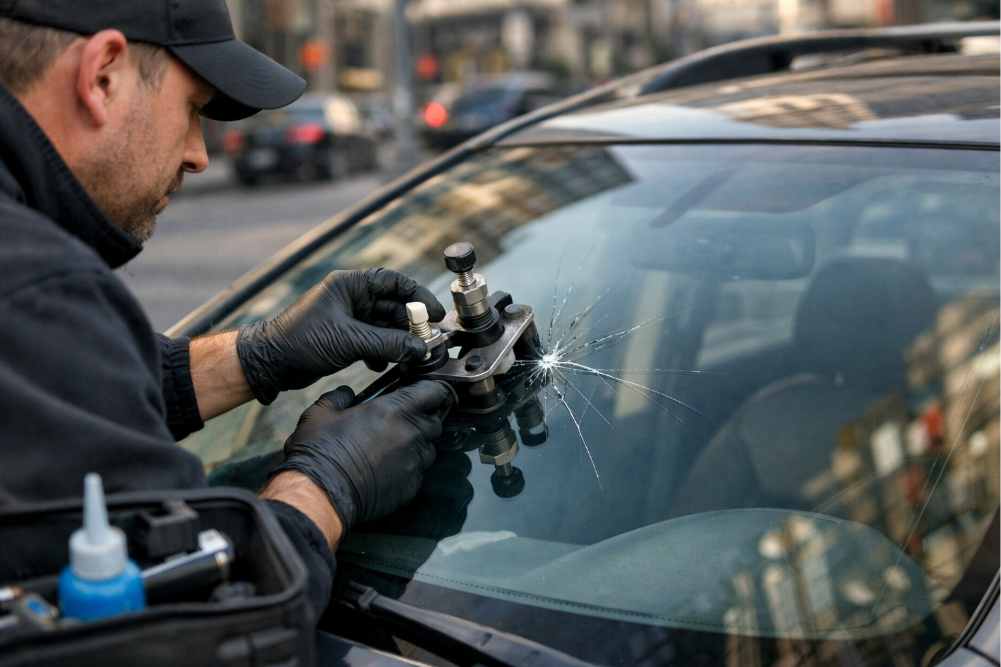
The mending procedure revolves around this. A bridge assembly is fastened to the windshield by the technician. This instrument employs a suction cup to adhere firmly to the glass, holding an injector right above the impact point. The injector lines exactly with the damage, producing a sealed environment.
The Vacuum Cycle: Before resin gets in, air must come out. The gap is now filled with air, which takes up space. The injector is activated to generate a powerful vacuum, drawing the air out of the brake. You may typically see the damage visibly alter as the air is pushed out—the bright, reflected aspect of the fracture (produced by light reflecting off the air gap) starts to decrease.
The Pressure Cycle: Once the air is evacuated, the technician changes the tool to a pressure cycle. This drives a specific acrylic resin into the vacuum. This is more than superglue. It is an optically matched resin, meaning it has the same refractive index as glass. When it fills the fracture and cures, light flows through it exactly like it goes through the surrounding glass, making the damage practically unnoticeable.
The technician generates a cycle of alternating vacuum and pressure. The epoxy is worked into the tiny points of the fissures by this “breathing” action. For persistent star breaks, technicians may gently bend the glass from the inside of the automobile to encourage the resin to flow to the very ends of the cracks.
Curing Under UV Light
At this step, the crack is filled with liquid resin. It is keeping the glass together, yet it is still flowing. The resin has to be “cured,” or hardened, in order for the repair to be permanent.
Auto glass resin is anaerobic and photopolymerizable. This implies it heals when exposed to particular wavelengths of ultraviolet (UV) radiation.
The technician sets a UV light over the restored region. Professional businesses utilize high-intensity UV lights to guarantee a consistent, quick cure regardless of the weather, although natural UV rays in strong sunshine may cure the resin in a few minutes.
The resin’s molecules are cross-linked during this process, transforming it from a liquid into a solid, hard plastic that holds the broken glass pieces together. This restores the windshield’s strength and prevents the fracture from growing further.
Pit Filling and Polishing: Once the main resin within the crack is cured, the bridge tool is removed. However, there is generally still a little indentation on the surface of the glass where the rock really made contact.
To repair this, the technician adds a thicker, specific epoxy called “pit filler” to the surface. A little curing tab (a piece of plastic film) is put over it to restrict oxygen, which enables the resin to cure totally flat and rigid. The UV light is administered one final time.
After the pit filler solidifies, the plastic tab is pulled away. The extra resin is scraped off with a razor blade, flush with the surrounding glass. Lastly, a cork or polishing pad and a light abrasive compound are used to polish the area. This restores the sheen and makes the restoration area smooth to the touch.
When Repair Is Not Enough
While the technique is incredibly successful, it has limits. A windshield that has been fixed will never have flawless optics. You will likely observe a faint imprint or a little patch where the collision happened. If you are aiming for visual perfection, replacement is the only alternative.
Furthermore, contemporary automobiles confuse the situation. Many automobiles now come equipped with Advanced Driver Assistance Systems (ADAS)—cameras and sensors located behind the windshield that manage emergency braking, lane-keep assist, and cruise control.
Because even the smallest deformation in the glass might mislead the sensors, the manufacturer often forbids repair if a break is immediately in front of these cameras. In these situations, the ADAS system must be completely replaced and then either dynamically or statically recalibrated.
Keep Your View Clear and Safe: Knowing how to fix a windshield emphasizes how crucial it is to act quickly. A clean, dry break is essential to the procedure. The longer you wait, the more moisture and grime build up in the crack, making it more difficult to create a clean connection.
You may preserve your factory seal, lessen trash going to landfills, and guarantee the structural integrity of your car by fixing a chip as soon as it occurs. It is a thirty-minute operation that may save you hundreds of dollars—and perhaps your life—down the line.
How Windshield Resin Injection Actually Works
Everybody has had that depressing sensation. You’re cruising down the interstate, enjoying the wide road, when suddenly—pop. A semi-truck kicks up a stone that smashes against your windshield. You flinch, examine the glass, and notice it: a little, star-shaped chip directly in your range of view.
Your initial inclination could be to ignore it, believing it won’t develop. But temperature variations and traffic vibrations nearly ensure that little chip will evolve into a big break, ultimately needing a complete (and costly) windshield replacement.
The alternative is a windshield repair, frequently termed “resin injection.” But what really is occurring during this process? Is it simply glue? How does it stop the fracture from spreading? Knowing the science underlying resin injection helps to explain why it is such an important part of car maintenance.
The Chemistry of the Resin: It is helpful to comprehend the material being utilized before delving into the mechanical procedure. The “glue” isn’t your typical epoxy or superglue from a hardware store drawer. Windshield repair resin is often a complex acrylic acid composition.
This chemical has two major roles. First, it has to connect forcefully with the glass to restore structural integrity. Second, and probably most interestingly, it must replicate the optical qualities of glass.
Glass has a certain “refractive index”—a measurement of how much it bends light. The air trapped within the glass partition is what you notice when you observe a crack. Light strikes the air pocket, bends differently than it does through the glass, and reflects back to you, making the break noticeable.
High-quality repair resin is manufactured to have a refractive index almost comparable to windshield glass. When the resin fills the vacuum, light flows through it exactly as it would through the glass, thereby making the damage vanish (or become substantially less noticeable).
The Injection Process in Steps
The exact process of professional windshield repair involves balancing vacuum, pressure, and chemical curing. While DIY kits exist, professional experts utilize specialized equipment to guarantee the resin enters the deepest sections of the break. This is what takes place throughout the injection process.
The Prep and Drill: Resin cannot adhere to dirt or moisture. The technician initially cleans the impact location, removing any stray pieces of glass. If the break is tight or the impact point is too tiny for the resin to enter, they may utilize a micro-drill to create a cleaner entrance channel. This doesn’t make the crack worse; it opens the way for the healing substance to perform its work.
The Vacuum Cycle: This is the stage most people don’t know about. Because a fracture is already filled with air, you cannot just press resin into it. Air bubbles, which serve as weak areas and reveal the damage, are produced when fluid is forced in without the air being removed.
Technicians apply a “bridge” or injector tool to the windshield immediately over the chip. This device draws a vacuum and forms a seal. It draws the air out of the brake, producing a negative pressure chamber that is ready to take the fluid.
The Pressure Cycle: Once the air is evacuated, the tool shifts to a pressure cycle. The injector drives the acrylic resin into the vacuum. Because the air was eliminated first, the resin may flow into the minuscule fingers of the fracture.
The technician would commonly alternate between vacuum and pressure cycles—sometimes termed “cycling”—to ensure every minuscule pocket of air is replaced with resin. To encourage the resin to flow into difficult-to-reach locations, they may also use a probe to gently bend the glass.
Do you have a Question?
Get An Auto Glass Replacement Quote Now 866.278.7417
Curing and Polishing
At this point, the resin is still liquid. It has to be cured in order to become a strong structural bond. Windshield resin is anaerobic (meaning it cures in the absence of air) and photoreactive.
After cutting off oxygen with a specific curing film, the technician exposes the repair to intense ultraviolet (UV) radiation. This may be done with a specialist UV lamp or, on a bright day, natural sunshine. The UV light initiates a chemical process that hardens the resin in minutes, joining the glass together.
Finally, the extra solidified resin is scraped off, and the region is polished to match the smoothness of the surrounding glass.
Why the Repair Isn’t Always Invisible: One widespread misperception is that resin injection acts like a magic eraser. While the visual recovery is frequently dramatic—generally enhancing clarity by 75% to 95%—some sign of the impairment usually remains.
Because the resin cures, it may shrink somewhat. Additionally, any debris or tiny glass particles that were caught in the crack before the repair might still be visible. The fundamental objective of resin injection is not visual perfection; it is structural stability. The patch stops the fracture from going over the glass, which preserves the factory seal intact and guarantees the airbag can deploy appropriately against the windshield in an accident.
When Injection Is Insufficient
Although resin injection is a miracle of contemporary vehicle repair, it has many drawbacks. It is typically not a suitable choice if:
If the damage is excessively large, such as a chip larger than a quarter or a fracture longer than a dollar note, the structural integrity is likely beyond repair.
The position is critical: if the damage is immediately in the driver’s line of sight, the tiny distortion left by the repair might be distracting. In this case, the majority of technicians will advise replacement.
The damage is complex: If the break extends to the edge of the windshield, or if the glass is smashed (not simply chipped), injection won’t hold.
Frequently Asked Questions: Is the resin injection procedure permanent? Indeed. Once the acrylic resin is cured with UV light, it makes a permanent connection. Over time, the fix won’t melt, wash away, or get discolored.
Can I use a DIY kit instead of a professional? DIY kits employ the same fundamental concepts but lack the strong suction and pressure capabilities of professional equipment. They work well for tiny, straightforward surface chips, but they often fall short of completely eliminating air from deeper fractures or “star” cracks, resulting in a repair that may subsequently expand.
Does the weather affect the repair? Indeed. Cold glass should be warmed up gradually before a repair to avoid the resin from curing too rapidly or the glass from shattering. Similarly, rain adds moisture into the crack. A technician must ensure the break is bone-dry (using a dehydrator if required) before injecting resin; otherwise, the bond will fail.
Do Not Wait for the Crack to Spread
Seldom does windshield damage remain constant in size. Every bump in the road and every fluctuation in temperature puts stress on that weak place in the glass. Restoring the strength of your windshield with resin injection is quick, economical, and supported by science.
By discovering the damage early, you save yourself the expense of a deductible and the trouble of a complete replacement. Check for the chip and make an appointment for a resin injection as soon as you hear the pebble hitting your glass.
Mobile Safe Auto Glass
14241 E Firestone blvd suite 400,
La Mirada, CA 90638
Phone: (562) 608-1154
Toll Free: 1 866 278 7417
Mail: sales@mobilesafeautoglass.com
Get a FREE QUOTE today! You can get a free quote and schedule 24/7 using this free quote wizard.
Mon – Fri 8am – 5pm
Saturday 8am – 1pm
Sunday Closed