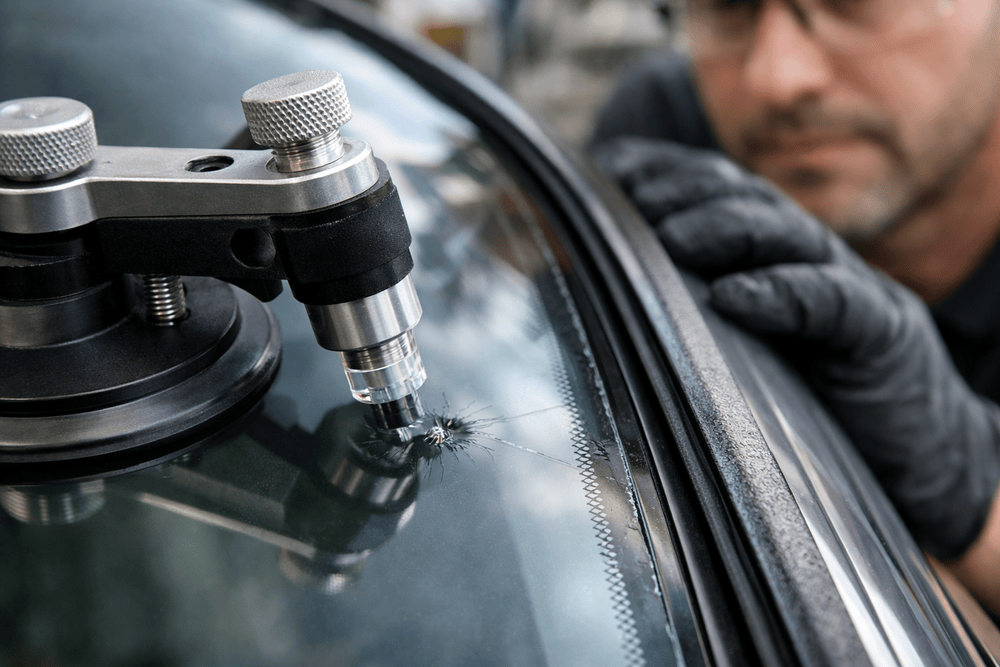
Small Chip in Windshield Repair Cost by Damage Type
Typically, it happens when you least anticipate it. You are driving down the highway, probably following a vehicle a bit too closely, when a piercing crack resonates through the cabin. A quick inspection of the glass shows the culprit: a little, ugly chip in your line of sight. Panic over the expense is generally the initial emotion. Many drivers delay correcting windshield damage because they fear a costly charge. Unfortunately, procrastination is the most costly error you can make. A little chip may tolerate temperature variations and traffic vibrations for only so long before it crawls out into a large fracture, needing a complete windshield replacement. The good news is that fixing a minor chip is often inexpensive, fast, and frequently covered by insurance.
Get An Auto Glass Replacement Quote Now 866.278.7417

Windshield Replacement & Repair
Our competitors push you into going to their shop to get your glass fixed-making it cheaper for them. We make it easier for YOU to get back on the road by offering free mobile repairs at your home or work. With our free mobile services servicing the entire Orange County & Los Angeles area, we can often handle your windscreen replacement the same day! So the next time you need a windshield replacement, give us a call.
Talk to a Windshield Replacement Specialist Now 866.278.7417

Calibration
Calibration is the process of returning a vehicle’s ADAS to OEM specifications. Calibration is necessary after a new glass installation, particularly a windshield with a camera mounted to it, to ensure that the ADAS features continue to function properly despite having been moved during installation. If a car’s ADAS is not properly calibrated, the system may not function safely. A misaligned camera could jeopardize the functionality of the system and lead to dangerous driving or accidents, so it is crucial that the cameras are aligned perfectly, which is what windshield calibration ensures.
Talk to a Calibration Specialist Now 866.278.7417

Fleet Auto Glass Repair
We provide expert auto glass repair and windshield replacement services for commercial fleets of all sizes. We are experienced with all manufacturers and machine types of domestic or foreign cars, trucks, vans, or commercial vehicles, including heavy equipment. Our same day mobile auto glass and windshield repair service will enable you to get back on the road faster and start saving you time and money instantly. Give us a call today! We are here to help!
Talk to a Fleet Auto Glass Specialist Now 866.278.7417
General Repair Costs
Before studying various damage types, it is essential to learn the industry averages. For a professional windshield repair in the United States, you can normally anticipate spending between $60 and $150 for a single chip.
If you have many chips, businesses sometimes charge a discounted price for each additional impact corrected at the same appointment, often ranging from $10 to $25 per extra chip.
While the form of the chip influences the technical difficulties of the repair, many car glass companies offer a set amount for the service regardless of the precise geometry, providing the damage is minor enough to be repaired. The true cost variance generally comes from the degree of the damage and whether it has impacted the structural integrity of the glass.
Repair Costs by Damage Type: Auto glass specialists classify chips depending on their form. Identifying which kind you have will help you decide whether a repair is viable or if you are looking at a more costly replacement.
Bullseye Chip: Estimated Repair Cost: $60–$100 This is one of the most prevalent and repairable forms of damage.
As the name says, it appears like a black circle with an impact point in the center. It happens when a rock strikes the glass at a perpendicular angle, resulting in a cone of damage within the glass’s outer layer.
Because there are no radiating fractures, bullseye chips are particularly responsive to resin injection. They are often the fastest to mend and frequently result in the cleanest, least noticeable fixes.
Star Break
Estimated Repair Cost: $80–$130 A star break contains a center impact point with small fractures extending outward, mimicking a starburst. These are more complicated than bullseye chips.
If the technician does not fill every “leg” of the star with resin, the fracture might easily widen later. Because they need more time and skill to ensure the resin reaches the points of the cracks, some businesses may charge somewhat extra for this service compared to a conventional bullseye.
Half-Moon Chip: Estimated Repair Cost: $60–$100. A half-moon is simply a partial bullseye. The collision caused the glass to split in a semicircular form rather than a complete circle.
These are often easy to fix. The cost typically matches with the conventional flat charge for chip repair, since the structural damage is confined and simple to fill.
Combination Break: Estimated Repair Cost: $90 – $150. A combo break is exactly what it sounds like: a blend of a bullseye and a star break. You have the round body of the bullseye with fractures spreading from it.
These are tough to fix since the damage is substantial. The technician must treat both the deep impact cone and the expanding fractures. Although generally repairable, the likelihood of these fractures becoming somewhat noticeable after the operation increases.
Stress Cracks: Estimated Cost: Replacement Needed ($300 – $1,000+) Unlike the chips stated above, a stress crack is not formed by a rock. It occurs due to excessive temperature swings (such as using hot water to de-ice a windshield) or structural instability.
If you have a large crack going across your windshield, fixing it is seldom an option. You will likely need to replace the entire windshield.
Do you have a Question?
Get An Auto Glass Replacement Quote Now 866.278.7417
Factors That Influence the Final Bill
While the form of the chip counts, other variables might boost the price tag dramatically.
Technology and Sensors (ADAS): Modern automobiles are equipped with Advanced Driver Assistance Systems (ADAS), such as lane-keeping assist and automated braking. These systems depend on cameras and sensors situated right behind the windshield.
If your chip is immediately in front of a camera or sensor, a simple repair may not be feasible since the resin might distort the sensor’s “view.” In this situation, you must replace the windshield. Following replacement, the safety systems must be recalibrated, which may add $300 to $1,000 to the total amount.
Location of the Damage: If a chip is placed at the extreme edge of the windshield, it threatens the seal and structural strength of the glass. Most technicians will refuse to fix edge chips owing to safety concerns, demanding a complete replacement. Similarly, damage immediately in the driver’s line of sight is typically grounds for replacement, since the resin used for repairs might leave a minor blur that disturbs the driver.
Luxury vs. Economy Vehicles: The repair method (injecting resin) is virtually the same for a Honda Civic as it is for a Porsche. However, labor rates at dealerships or specialty facilities for expensive automobiles tend to be higher.
If you require a replacement rather than a repair, the cost difference is substantial, with premium OEM (Original Equipment Manufacturer) glass costing much more than aftermarket glass.
Do It Yourself Repair Kits
Cost: $10–$20. Walk into any car parts shop, and you will discover DIY windshield repair kits. These kits employ a similar premise to professional repairs: you generate a vacuum above the chip and press resin into the void.
For a very tiny, basic bullseye chip, a DIY kit may be useful. However, they lack the high-pressure equipment and higher-quality resin utilized by specialists.
If you fail to remove all the air from the chip or if the resin doesn’t cure completely, the chip will ultimately spread. Once you have tried a DIY remedy, a professional typically cannot go back in and redo it. If you screw up the DIY effort, you are likely purchasing a new windshield.
The Role of Insurance: Before you take out your wallet, verify your motor insurance coverage. Comprehensive insurance policies often cover windshield repairs with no deductible. Insurance companies prefer paying $80 to mend a chip now rather than $800 to replace the glass later.
If you have comprehensive coverage, the repair might be absolutely free for you. However, check this with an insurance agent, since submitting a claim may occasionally increase your rates depending on your provider and state legislation.
Avoid Waiting Until It Cracks: Timing often determines the difference between a $100 repair and a $1,000 replacement. A little chip is an annoyance, but a broken windshield is a safety failing.
Whether it’s a simple bullseye chip or a complex star break, promptly seeking expert assistance is the most cost-effective approach. Check your insurance coverage, examine the damage, and arrange a repair before that next speed bump transforms a minor chip into a huge price.
Identifying Your Windshield Chip
Every motorist fears that sharp, abrupt snap. While you are driving down the highway and minding your own business, a rock thrown up by a semi-truck strikes your window. Your heart drops. You stare at the windshield, expecting to see nothing, but there it is: a flaw right in your line of view.
Frequently, panic strikes right away. Does this imply that you need a brand-new windshield? Will it break when you are driving? What will the price of such an upgrade be?
The good news is that not all windshield damage is fatal to your vehicle’s glass. To endure impact without breaking inside the cabin, modern windshields are made of laminated layers. The kind of damage, however, is significant. The type of damage, such as a bullseye, star break, or combo chip, determines whether a repair expert can salvage your glass or if a complete replacement is necessary.
Understanding the structure of a rock chip may save you time, frustration, and money. This is all you need to know about windshield damage and how to fix it.
Understanding Laminated Glass: To understand why chips develop the way they do, it helps to know what your windshield is constructed of. Unlike the tempered glass used for your side windows—which is meant to shatter into thousands of dull, harmless cubes upon impact—your windshield is constructed of laminated glass.
A layer of polyvinyl butyral (PVB) is placed between two layers of glass to create laminated glass. Usually, just the outer layer of glass is broken when a rock strikes your windshield. The size of the item, the angle of contact, and the rock’s velocity all affect the chips’ different forms.
The Break in the Bullseye
The bullseye is one of the most prevalent and immediately visible kinds of windshield damage. As the name indicates, this chip looks like a target on a dartboard. It is characterized by a circular break with a definite impact point in the middle, surrounded by concentric rings of glass separation.
Characteristics of a Bullseye: Shape: Nearly or completely round.
Appearance: Often has a circular black outline created by air trapped between the glass layers.
Size: Usually less than a quarter.
Repairability: The bullseye is frequently regarded as the “best” sort of chip to receive, if there is such a thing. It is more structurally stable than other fractures because the damage is confined inside a circle and does not have extensive cracks extending outside.
A trained expert can often fill a bullseye chip with resin neatly. Once cured, the resin fills the void, the black ring vanishes, and the structural integrity is restored. The cosmetic outcome is typically excellent, frequently leaving just a small, scarcely noticeable hole.
The Star Break: The star break represents the opposite extreme of the damage spectrum. This form of damage looks just like a star or an asterisk made by a youngster. It includes a central impact point with multiple fractures, or “legs,” extending away from the center.
Characteristics of a Star Break: Shape: radiating fractures in a starburst pattern.
Appearance: Usually lacks the big circular “cone” of missing glass observed in a bullseye.
Risk: High potential of spreading.
Repairability: Star breaks are difficult. The legs spreading from the center are basically small fissures ready to expand. If you drive over a pothole or activate your defroster on a chilly morning, those legs may run over the whole windshield immediately.
While they are repaired, the expert must be extremely cautious. The resin has to be pressed into each individual leg to attach the glass adequately. If even a minor piece of a leg is missing, the fracture might continue to expand even after the repair. Speed is crucial here; a star break should be handled within days, if not hours, after the impact.
The Combo Break: Sometimes, luck is just not in your favor. A combo break, also known as a combination break, combines the characteristics of both a bullseye and a star break.
This damage happens when a boulder impacts with tremendous velocity, generating the circular crater of a bullseye but also causing the radiating fractures of a star to shatter. You have the deep impact injuries paired with the spreading danger of the legs.
Do you have a Question?
Get An Auto Glass Replacement Quote Now 866.278.7417
Characteristics of a Combo Break
Shape: A circular chip with fractures running from the center or the edges.
Appearance: Often seems sloppy and vast compared to a neat bullseye.
Risk: There is a very high chance of dirt accumulation and spreading.
Repairability: Combo breaks are challenging yet doable. They demand a specialist with patience and high-quality equipment.
The repair technique requires drilling into the impact site to open up the damage, enabling the resin to flow into the circular void and out into the radiating legs. Because there is more glass missing and more cracks present, the aesthetic outcome may not be as inconspicuous as a basic bullseye repair, but the structural connection will stay.
When to Repair vs. When to Replace: Just because a chip can be fixed doesn’t necessarily imply it should be. There are industry standards that define when a windshield has been degraded beyond the threshold of a safe repair.
The Size Test
Traditionally, the size of a quarter served as the standard guideline. If the chip was less than a quarter, it was repairable. However, technology has progressed. Many specialists can now repair chips up to the size of a half-dollar or even a credit card, depending on the sort of break.
Bullseye: Usually repairable up to one inch in diameter.
Star/Combo: If the legs extend beyond 1.5 to 2 inches, a replacement is typically safer.
The Driver’s Line of Sight: This is a vital safety aspect. Even the greatest restorations leave a tiny deformation in the glass—similar to a smudge or a wet spot. Most respectable stores would suggest a replacement if the damage is directly in the driver’s line of sight or in the portion of the windshield that is obscured by the steering wheel. That little distortion might generate sun glare or confuse the motorist, posing a safety issue.
The Edge of the Windshield: If a star break or combination fracture is situated within two or three inches of the windshield’s edge, the integrity of the glass is seriously threatened.
In a rollover accident, the windshield provides up to 60% of a vehicle’s structural strength. Cracks around the edge weaken the link between the glass and the metal frame, meaning the windshield typically has to be replaced.
Reasons Not to Wait
Auto glass suffers greatly when procrastination persists. A little, repairable bullseye may develop into an unfixable fracture overnight. Two key variables create this:
Temperature Fluctuations: Glass expands when heated and shrinks when cold. If you park your automobile in the sun, the glass warms up. If you then blast the A/C, the quick cooling generates tension. The vulnerable point—the chip—will shatter. The same applies in winter with defrosters.
Contamination: Windshield repair works by injecting a transparent resin into the chip. If you wait weeks to have it mended, rain, windshield washer fluid, dirt, and road filth will make their way into the crack. This debris stains the interior of the glass. The pollution is permanently trapped within, so even if a professional fills it, the repair will seem hazy or unclean.
FAQs Regarding Windshield Chips: After repair, will the chip entirely vanish? No. A windshield repair is a structural correction, not a cosmetic one. The objective is to prevent the fracture from expanding and to restore the strength of the glass. While the visual acuity frequently improves by 80% to 95%, you will likely still notice a little mark where the impact happened.
Is chip repair covered by insurance? In many circumstances, yes. Many plans waive the deductible for chip repairs since insurance companies would much rather pay $70 for a repair than $400+ for a replacement. Check with your carrier to determine whether you have glass coverage.
Does a do-it-yourself repair kit work? You may get DIY kits at car parts shops, but they come with hazards. The resin provided in these kits is frequently lesser quality than professional grade, and the plastic tools cannot achieve the high vacuum pressure required to suck all the air out of the chip. If you botch a DIY repair, a professional cannot restore it later; the glue will have already hardened, plugging the fracture.
Don’t Let a Chip Become a Crack: Whether you have recognized a clean round bullseye or a jagged star break on your glass, the course of action remains the same: act swiftly.
A straightforward repair safeguards your windshield’s factory seal, prevents waste from entering the landfill, and preserves your financial resources. If you discover damage, wrap it with a piece of transparent tape to keep the dirt out (only make sure the tape doesn’t hinder your vision) and contact a professional glass technician immediately.
Mobile Safe Auto Glass
14241 E Firestone blvd suite 400,
La Mirada, CA 90638
Phone: (562) 608-1154
Toll Free: 1 866 278 7417
Mail: sales@mobilesafeautoglass.com
Get a FREE QUOTE today! You can get a free quote and schedule 24/7 using this free quote wizard.
Mon – Fri 8am – 5pm
Saturday 8am – 1pm
Sunday Closed