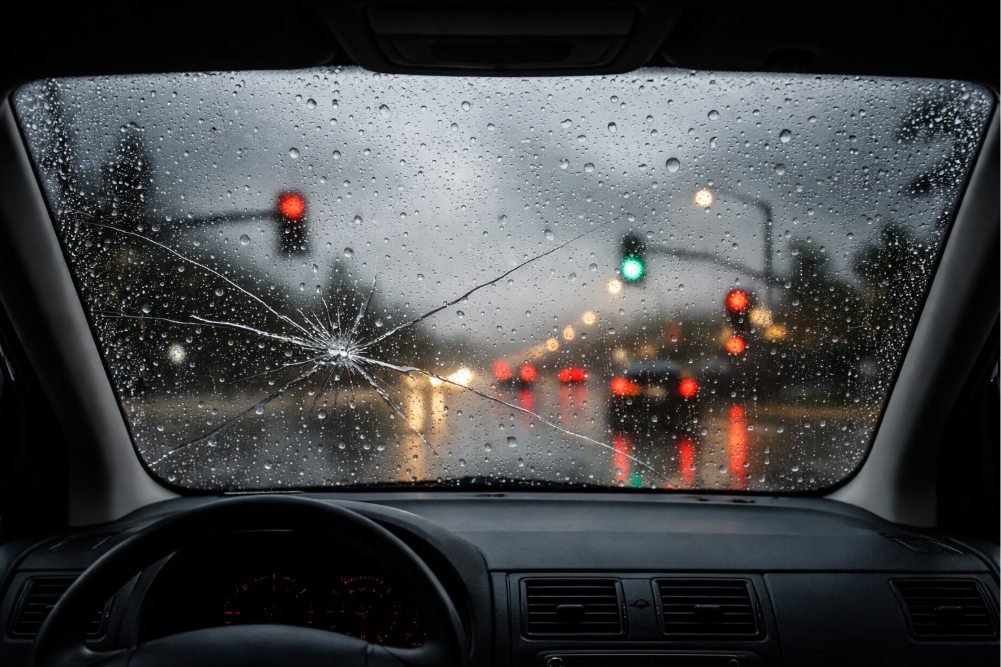
Auto Glass Windshield Repair Safety Guidelines
Suddenly—crack. A rock comes up from the vehicle in front of you and smashes your windshield. It’s a minor chip now, but you know it won’t remain that way for long. Many drivers neglect windshield damage, figuring it’s simply a cosmetic concern. They think they’ll get to it “eventually.” However, your windshield is an essential part of your car’s safety, helping with airbag deployment and structural integrity. Ignoring a crack may be harmful in addition to being bothersome. It is vital to understand whether to repair or replace your vehicle’s glass to ensure the safety of you and your passengers. This article outlines the key safety rules for windshield repair, why quick action counts, and what to anticipate throughout the procedure.
Get An Auto Glass Replacement Quote Now 866.278.7417

Windshield Replacement & Repair
Our competitors push you into going to their shop to get your glass fixed-making it cheaper for them. We make it easier for YOU to get back on the road by offering free mobile repairs at your home or work. With our free mobile services servicing the entire Orange County & Los Angeles area, we can often handle your windscreen replacement the same day! So the next time you need a windshield replacement, give us a call.
Talk to a Windshield Replacement Specialist Now 866.278.7417

Calibration
Calibration is the process of returning a vehicle’s ADAS to OEM specifications. Calibration is necessary after a new glass installation, particularly a windshield with a camera mounted to it, to ensure that the ADAS features continue to function properly despite having been moved during installation. If a car’s ADAS is not properly calibrated, the system may not function safely. A misaligned camera could jeopardize the functionality of the system and lead to dangerous driving or accidents, so it is crucial that the cameras are aligned perfectly, which is what windshield calibration ensures.
Talk to a Calibration Specialist Now 866.278.7417

Fleet Auto Glass Repair
We provide expert auto glass repair and windshield replacement services for commercial fleets of all sizes. We are experienced with all manufacturers and machine types of domestic or foreign cars, trucks, vans, or commercial vehicles, including heavy equipment. Our same day mobile auto glass and windshield repair service will enable you to get back on the road faster and start saving you time and money instantly. Give us a call today! We are here to help!
Talk to a Fleet Auto Glass Specialist Now 866.278.7417
Why Windshields Are More Than Just Glass
It’s easy to think of a windshield as only a protection against wind and bugs. Nonetheless, contemporary car glass is designed to carry out essential safety tasks in the event of an accident.
In the event of a rollover accident, the windshield is responsible for providing up to sixty percent of the vehicle’s structural integrity in a head-on collision and up to forty-five percent of the vehicle’s structural integrity in a rollover accident. A windshield that has been compromised is more likely to shatter or pop out, which makes it possible for the roof to push inward more rapidly.
Airbag Deployment: Passenger-side airbags depend on the windshield as a backstop. When the airbag deploys, it shoots upward, impacts the windshield, and then cushions the passenger. Should a fracture or incorrect installation weaken the glass, the airbag’s force could potentially shatter it. Such an event makes the airbag useless and puts the passenger at significant danger.
Driver Visibility: This requirement sounds basic, yet it is frequently ignored. Cracks, chips, and “spiderwebs” in the glass may diffract light, generating blinding glare from the sun or approaching headlights at night. Even a little flaw in your line of sight might delay your response time dramatically.
When to Repair vs. When to Replace: Not every damage necessitates a complete windshield replacement. Auto glass technology has progressed, enabling professionals to replace small damage fast and efficiently. However, strict safety regulations limit the scope of repairs.
Repairable Damage
In general, a repair is a secure choice if the damage meets certain criteria.
Size: The chip is less than a quarter, or the fracture is shorter than three inches.
Depth: The damage has not reached the inner layer of the glass. Windshields are composed of laminated glass (two layers of glass with a plastic layer in between). If the damage passes through to the plastic or the inner glass layer, a repair won’t hold.
Location: The motorist cannot see the damage immediately. Repairs typically leave a minor deformation. If this distortion is precisely where you look to drive, it becomes a safety threat.
Mandatory Replacement: A complete replacement is essential for safety concerns if any of the following conditions are met:
Edge Cracks: The crack meets the edge of the windshield. These fissures weaken the structural link between the glass and the metal frame.
Old Damage: Dirt and moisture have made their way into the fracture over time. As a result, the repair resin cannot properly bind.
Tempered Glass: The damage occurs on side or rear windows (which are normally tempered glass, not laminated). These break totally upon contact and must be replaced.
Sensors: The damage is over a camera or sensor needed for ADAS (Advanced Driver Assistance Systems), such as lane departure alerts or automated braking.
Do you have a Question?
Get An Auto Glass Replacement Quote Now 866.278.7417
The Dangers of DIY Repair Kits
Any car parts shop will have shelves filled with do-it-yourself windshield repair kits. While they could appear like a cost-effective option, they come with concerns.
Professional specialists utilize high-quality resin and vacuum pumps to eliminate all air from the crack before filling it. DIY kits frequently lack the pressure necessary to fill the chip entirely. If air pockets are still present, the fracture may eventually widen, often at unexpected times, such as following an abrupt shift in temperature or a little bump on the road.
Furthermore, if you botch a DIY repair, a professional typically cannot fix it thereafter. You’ll wind up paying for a complete replacement, which costs substantially more than a competent repair would have cost originally.
Post-Repair Safety Guidelines: After having your windshield fixed or replaced, you need to take certain precautions to make sure the adhesive dries correctly and the glass stays in place.
The “Drive-Away” Time: Adhesives used in windshield replacement require time to set. Your technician will give you a “safe drive-away time.” This process may vary from 30 minutes to several hours depending on the urethane used and weather conditions. It is very risky to drive until this time has elapsed since an abrupt halt might cause the windshield to come off.
Handle with Care: For the first 24 to 48 hours after a windshield replacement, please follow these guidelines:
Steer clear of car washes because the weight of the heavy brushes and the intense pressure of the water jets might move the new glass or harm the seal.
Leave a Window Cracked: Air pressure fluctuations within the automobile (such as slamming a door) might impose tension on the drying seal. This pressure may be balanced by cracking a window.
Take It Easy: Avoid slamming your vehicle doors. Close them softly.
Retention of Tape
Technicians typically use special retention tape to keep the windshield in place while the glue cures. Don’t remove this tape for at least 24 hours, even if it may appear ugly. It keeps the glass from sliding down while the adhesive cures.
Advanced Driver Assistance Systems (ADAS) Calibration: If you drive a modern car (usually 2016 or later), your windshield likely includes cameras and sensors for safety systems like
Lane Keep Help
Emergency Braking Automation
Cruise control that adapts
Rain-Detecting Wipers
When a windshield is changed, these cameras are repositioned. Even a single degree of angle variation can throw off the system. For instance, your car may think it’s in the lane while it’s actually drifting.
Safety Rule: Anytime a windshield with ADAS features is changed, the system must be recalibrated by an expert. Never miss this step.
Don’t Wait Until It’s Too Late: Your safety is protected by your windshield. Treating cracks and chips with haste isn’t just about keeping your automobile looking beautiful; it’s about assuring the structural safety of your vehicle.
If you find damage, examine the extent and location immediately. If it’s tiny, have it fixed by a skilled specialist before it spreads. Make sure that the shop complies with all safety procedures, including ADAS calibration, if it has to be replaced. Safe driving begins with a clear vision and robust protection.
How Windshield Cracks Shatter Your Visibility
We have all experienced that startling, heart-sinking sound. You are driving down the interstate, enjoying the wide road, when a stone shoots off the back of a dump truck and hits your window with a loud crack. You survey the damage. It’s a little chip, perhaps a thin line. It’s harmless, yet it appears unpleasant. You decide to disregard it.
Ignoring windshield damage is a frequent response for many drivers. We often ignore these imperfections as primarily aesthetic problems and wait to take action until the fracture has developed across the whole glass.
However, a broken windshield is a huge safety issue that extends well beyond the appearance of your car. The windshield is your main window to the world when driving.
It is built to give structural support to the car interior and, most critically, to provide an undistorted vision of the road ahead. Damage to that glass also impairs your ability to observe and respond to threats. Windshield cracks influence your sight in ways you may not even realize until it’s too late, from blinding glare to cognitive distractions.
The Science of Light Refraction: Automotive glass is meant to be optically transparent. When light flows through a spotless windshield, it travels in a straight path to your eye, enabling your brain to precisely register the position of automobiles, pedestrians, and traffic signs.
A fracture physically affects the structure of the glass. It forms new, irregular edges inside the layers of the windshield. When light strikes these shattered edges, it doesn’t travel through smoothly. Instead, it bends—or refracts.
The Prism Effect with Sunlight: During the day, a fracture functions like a prism. When sunlight reaches the damage at the appropriate angle, it may disperse into a blinding flash of light. This intense light might briefly dazzle a motorist.
If you are moving at 60 miles per hour, being blinded for even two seconds means you have traveled the length of a football field without seeing where you are going. When the sun is low on the horizon at dawn and dusk, this erratic light dispersion is very hazardous.
The Night Time Halo Effect
Even when the sun sets, the issue still exists. Driving at night is already difficult since there are fewer visual clues and less contrast. When the headlights of approaching cars contact a spiderweb fracture or a bullseye chip, the light refracts to produce a “halo” or starburst appearance.
Instead of two separate headlights approaching, a big, blossoming ball of light may obscure the center line or the border of the road. This glare causes eye strain as your pupils continually adapt to the varying brightness, slowing your response time dramatically.
Cognitive Distraction and Focus Problems: Your brain’s processing of information affects visibility, not simply what your eyes see. A fissure in your line of sight produces a focus point conflict.
Naturally, the items in the front are what your eyes prefer to concentrate on. When you are driving, your concentration should be on the road, hundreds of feet ahead. A crack puts a distinct item inches from your face. Your eyes may automatically shift focus back and forth between the damage on the glass and the road ahead.
This frequent movement creates eye strain, but the cognitive load is the true threat. The brain needs to work harder to “look past” the impediment to put together the world outside.
This condition essentially produces a mental blind hole. You may theoretically see a cyclist on the road, but since your brain is occupied processing the visual cacophony of the crack, you might not recognize their existence quickly enough to stop.
Do you have a Question?
Get An Auto Glass Replacement Quote Now 866.278.7417
Disrupted Wipers and Smearing
For wiper blades to operate properly, a windshield’s surface must be smooth. A fracture, even a tiny one, generates a ridge or a gap in that smooth surface.
The rubber blade of your wipers snags on the uneven edge of the crack when you use them in the rain or snow. Over time, this destroys the wiper blade, creating nicks and rips in the rubber.
As a result, the wiper stops efficiently removing water. The broken blade smears streaks of water, mud, and road filth right across your field of view rather than cleaning the glass.
In severe rain, a streaky windshield paired with a refracting crack may limit vision to near zero. The failure to disperse precipitation rapidly converts a moderate storm into a driving emergency.
The Impact on ADAS (Advanced Driver Assistance Systems): Modern visibility isn’t just about the driver’s eyes; it is also about the car’s eyes. The recent decade has seen the development of many automobiles equipped with Advanced Driver Assistance Systems (ADAS).
Sensors and cameras, typically positioned just behind the windshield and close to the rearview mirror, often power these systems. These cameras are set up to see through transparent glass.
A crack that enters these cameras’ field of vision may interfere with the system’s “visibility.” The camera may mistake a crack for a lane marker, which might cause the vehicle to abruptly drift or jerk.
Alternatively, the distortion can prevent the camera from perceiving an impediment, leading autonomous braking systems to fail. In this case, a crack blinds the driver as much as it blinds the car’s safety computers.
Inspections and Legal Visibility
Because visibility is vital to public safety, driving with a damaged windshield is frequently a legal concern. While rules differ by state and nation, most jurisdictions have prohibitions governing obstacles to a driver’s vision.
The “Critical Area”: The area directly in front of the driver’s steering wheel, roughly the size of a standard piece of paper (8.5 x 11 inches), or the area swept by the driver’s side wiper blade is commonly referred to by law enforcement and vehicle inspectors as the “critical area” or “acute area.”
Damage in this zone is usually legally unacceptable. You may get a citation and a fee if a police officer finds that a crack obstructs your vision. Furthermore, if your location needs yearly vehicle safety inspections, a fracture in the driver’s line of sight is an automatic fail. You will be prevented from driving the car lawfully until the glass is replaced.
Frequently Asked Questions: Is it safe to drive with a minor crack? Even while a little chip may not break the glass right away, there is still a chance. Small cracks might expand fast owing to temperature fluctuations or striking a pothole. If the damage is in your direct line of sight, it is risky regardless of size owing to the potential for glare and distraction.
Does a crack need to be replaced, or can it be fixed? This varies on size, depth, and location. Generally, injecting a resin can repair chips less than a quarter and cracks shorter than three inches. However, if the damage is squarely in the driver’s line of sight, competent repair companies will frequently suggest replacement since the repair resin may still leave a tiny blur or distortion.
Does a fracture weaken the top of the car? Indeed. A car’s windshield plays a major role in maintaining the cabin’s structural integrity. The windshield prevents the roof from crushing the passengers in the case of a rollover. A significant break affects the glass’s strength, increasing the likelihood of roof collapse in catastrophic incidents.
Will my insurance cover windshield repair? Many comprehensive insurance plans include windshield repair and replacement. To encourage drivers to mend chips before they become significant cracks that need a complete replacement, insurance companies often waive the deductible for repairs (resin injection).
Seeing Clearly for the Path Ahead
Designating a windshield crack as a future problem and putting it on the to-do list for another pay cycle is tempting. But the fact is that vision impairment comes rapidly. A stray beam of sunlight striking a crack at the wrong moment might completely obscure a road danger.
Your response time is your strongest protection when driving, and reaction time relies totally on perception. If you cannot see it, you cannot escape it. Whether it is the distraction of a jagged line, the blinding glare of refracted light, or the failure of your car’s safety systems, the hazards are too great to ignore.
Please take a moment to assess the condition of your Prioritize a repair or replacement if the crack is visible to you or bigger than a dollar note. Keeping your window clean guarantees that while you are behind the wheel, your concentration stays precisely where it should be: on the safe road ahead.
Mobile Safe Auto Glass
14241 E Firestone blvd suite 400,
La Mirada, CA 90638
Phone: (562) 608-1154
Toll Free: 1 866 278 7417
Mail: sales@mobilesafeautoglass.com
Get a FREE QUOTE today! You can get a free quote and schedule 24/7 using this free quote wizard.
Mon – Fri 8am – 5pm
Saturday 8am – 1pm
Sunday Closed