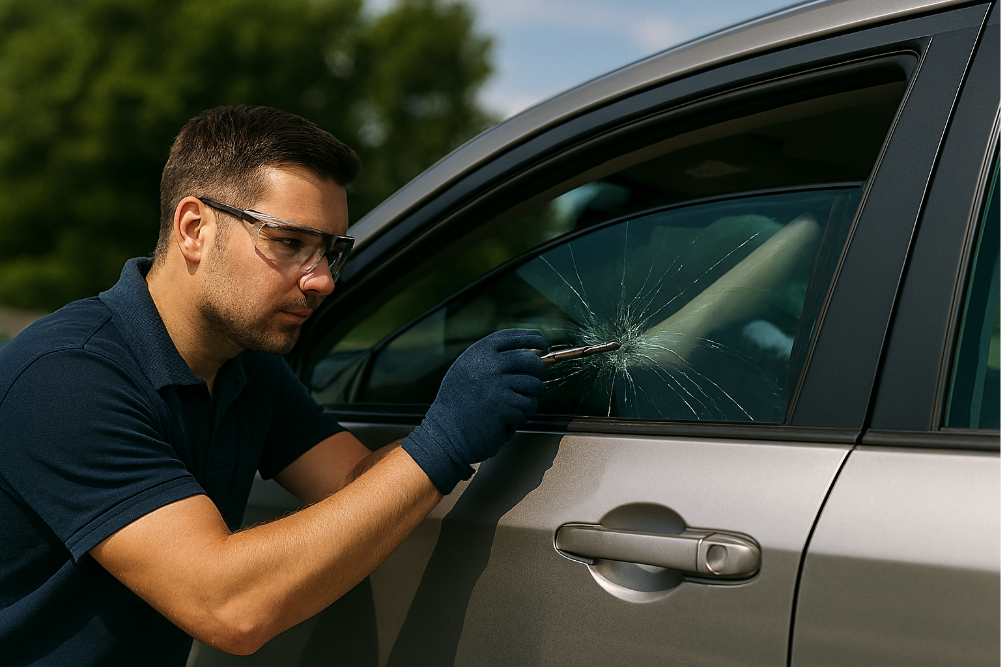
Car Side Window Repair Safety Tips for Drivers
Not only is a broken or cracked side window inconvenient, but it is also a safety risk that has to be fixed right away. Damaged car windows weaken the structural integrity of your vehicle and expose you to the weather, whether the damage is the result of temperature changes, road debris, or attempted break-ins. By knowing how to correctly address side window damage, you may avoid further issues, save money, and drive safely. Everything you need to know about fixing a vehicle side window is covered in this article, from determining the extent of the damage to deciding between do-it-yourself and expert treatments.
Get An Auto Glass Replacement Quote Now 866.278.7417

Windshield Replacement & Repair
Our competitors push you into going to their shop to get your glass fixed-making it cheaper for them. We make it easier for YOU to get back on the road by offering free mobile repairs at your home or work. With our free mobile services servicing the entire Orange County & Los Angeles area, we can often handle your windscreen replacement the same day! So the next time you need a windshield replacement, give us a call.
Talk to a Windshield Replacement Specialist Now 866.278.7417

Calibration
Calibration is the process of returning a vehicle’s ADAS to OEM specifications. Calibration is necessary after a new glass installation, particularly a windshield with a camera mounted to it, to ensure that the ADAS features continue to function properly despite having been moved during installation. If a car’s ADAS is not properly calibrated, the system may not function safely. A misaligned camera could jeopardize the functionality of the system and lead to dangerous driving or accidents, so it is crucial that the cameras are aligned perfectly, which is what windshield calibration ensures.
Talk to a Calibration Specialist Now 866.278.7417

Fleet Auto Glass Repair
We provide expert auto glass repair and windshield replacement services for commercial fleets of all sizes. We are experienced with all manufacturers and machine types of domestic or foreign cars, trucks, vans, or commercial vehicles, including heavy equipment. Our same day mobile auto glass and windshield repair service will enable you to get back on the road faster and start saving you time and money instantly. Give us a call today! We are here to help!
Talk to a Fleet Auto Glass Specialist Now 866.278.7417
Recognizing Damage to Car Side Windows
Tempered glass, which is used to make car side windows, is engineered to break into tiny, comparatively innocuous bits rather than sharp fragments. Although this safety element keeps people safe in the event of an accident, once it is damaged, the window usually has to be replaced entirely rather than just repaired. Depending on the kind and degree of damage, you may be able to drive safely for a while or need rapid repair.
Quick Action After Window Damage: Protecting your safety and preventing escalation are two benefits of acting quickly after finding a damaged side window.
Determine the Severity: Start by closely examining the damage. Small cracks or chips around the border could hold for a while, but any damage to the main window area has to be fixed right once. Do not try to drive until you have taken precautions if the window is entirely broken.
Secure the Area: Use gloves and safety glasses to carefully remove any stray glass from windows that are totally smashed. Fragments of tempered glass may still cut, so never use your bare hands. To capture tiny fragments, vacuum and thoroughly sweep the inside.
Make a Temporary Seal: Use sturdy tape and heavy-duty plastic sheeting to cover the opening if you must drive before a professional repair is done. Make sure there are no openings for wind or rain to enter by securing it from the inside as well. This temporary solution should only be used for a day or two, or until you can go to a repair shop.
DIY Repair vs. Professional Service: Depending on a number of criteria, you may choose to do repairs yourself or hire specialists.
Selecting a Trustworthy Repair Company
Not every car glass business offers the same level of quality. Your safety and investment are safeguarded when you choose the correct service provider.
Verify Credentials: Seek for stores with technicians qualified by the National Glass Association (NGA) or the Auto Glass Safety Council (AGSC). These certifications show continued training and conformity to industry standards.
Check for Insurance Compatibility: Glass repair is often covered by insurance plans with low or no deductible. Verify that the store of your choice is affiliated with your insurance company and is able to manage claims directly, saving you money and paperwork up front.
Read Reviews and Ask Questions: Look up internet reviews to learn about past customers’ experiences, but also speak with the store personally about:
Types of glass they utilize (aftermarket vs OEM)
Coverage and duration of warranties
Time estimate for completion
Whether they provide mobile services. A trustworthy store gives written estimates and offers honest responses to these queries.
Safety Considerations During Repair: Safety is always the first priority, regardless of whether you’re handling the damage temporarily or waiting for expert assistance. If you have to drive when your window is damaged before it is repaired:
Steer clear of roadways where wind pressure is increased by high speeds.
Maintain modest speeds to avoid the failure of temporary covers.
If at all possible, avoid driving in the rain by checking the weather forecast.
To preserve cabin pressure, make sure all other windows are closed.
Exercise particular caution since visibility can be impaired.
Keeping Passengers and Yourself Safe: Broken windows put you at danger for a number of things.
Weather exposure: The car is exposed to wind, rain, and very high or low temperatures.
Security flaws: Priceless items become accessible and visible
Structural weakness: The rollover safety of your car is jeopardized.
Legal concerns: Driving with severely broken windows is illegal in several areas. Passengers should never be transported in seats next to windows that are broken or missing.
Do you have a Question?
Get An Auto Glass Replacement Quote Now 866.278.7417
Insurance Coverage and Cost Considerations
Making educated judgments is aided by being aware of the costs associated with side window repair.
Normal Repair Prices: Replacing a side window typically costs $150 to $400, depending on:
Extra features, such as sensors or tinting. The upper end of this spectrum is often occupied by luxury cars or those with cutting-edge technology.
Insurance Considerations: Window damage from non-collision occurrences is usually covered by comprehensive insurance. Many plans cover glass with no deductible, which eliminates the financial burden of expert repair. As soon as damage is discovered, get in touch with your insurance company to find out what is covered and to begin the claims procedure.
Avoiding Future Window Damage: Although you have no control over everything that happens on the road, you may lower your chance of side window damage by following these guidelines. Tips for Maintenance;
Avoid parking near construction sites and places where there are a lot of trucks.
Keep a safe following distance to prevent other cars from kicking up debris.
Steer clear of drastic temperature swings, such as blasting cold air on heated windows.
Examine weather stripping and window seals on a regular basis.
Take care of little chips right away to prevent them from spreading.
Protective Measures: Think about making an investment in:
Window film: Provides a layer of protection that keeps broken glass together.
Parking covers: If you often park outside in locations where hail is common,
Comprehensive insurance: Should it not be covered by your policy already
When Damage to Windows Signals Serious Problems
Side window issues might sometimes be an indication of more serious issues with your car. Recurrent window problems might be a sign of:
Damage to the frame from a prior collision that affects how windows fit
Electrical issues if the power windows don’t work
Problems with the door mechanism that result in incorrect closing
Window rails compromised by corrosion or rust. Have a technician examine the whole door assembly and frame if window issues occur often.
Take Action to Preserve Your Safety: In order to preserve both your safety and the integrity of your car, damaged side windows need immediate care. Taking prompt action avoids issues and extra expenses, whether you decide to replace it professionally or with interim do-it-yourself solutions.
To begin, honestly evaluate the harm. Avoid makeshift solutions and arrange a professional replacement right once if the window is seriously affected. Professional service is the wise economical decision since your insurance may pay the whole cost.
Put interim safeguards in place for small damage, but make a commitment to expert repair within days, not weeks. You run a higher chance of being hurt, having your property stolen, or suffering more weather-related damage the longer you wait.
Investigate reputable repair firms in advance of your urgent requirement. Identifying a reliable service provider can help you make better judgments under pressure than picking the first alternative that comes up in an emergency.
Protect Passengers During Side Window Repair
A side window that is broken or cracked poses a safety risk in addition to being an annoyance. Getting it fixed as soon as possible is crucial, regardless of the cause—a stray pebble, an attempted break-in, or an accident.
However, if appropriate safety measures aren’t followed, the repair procedure itself may endanger people. Many car owners are unaware of the risks associated with side window repair, which include flying glass fragments and hazardous chemical exposure.
Everyone will remain safe while your car is restored to roadworthy condition if you are aware of these hazards and know how to reduce them. The main safety precautions for passengers before, during, and after side window repair are outlined in this handbook.
Recognizing the hazards associated with side window repair: It’s useful to know what makes side window repair potentially dangerous before implementing any protective measures.
Sharp glass shards: Tiny glass fragments may still be lodged in carpets, seats, and door panels even after the original damage has occurred. More pieces could come free during installation and removal.
Chemical adhesives: Polyurethane-based adhesives that release volatile organic compounds (VOCs) are used in modern window installation. If breathed in confined places, these vapors may induce headaches, dizziness, and respiratory discomfort, even though they are essential for a solid binding.
Physical harm during removal: The instruments and methods used to remove broken glass have the potential to launch debris into the air. Passengers or surrounding bystanders may be at danger if containment is not done properly.
Post-repair structural weakness: The glass could not provide enough protection in a collision if the glue hasn’t completely dried. This results in a transient vulnerability that has to be handled carefully.
Safety Preparations Before Repair
Passengers’ danger is significantly decreased by taking the proper precautions before repair work starts.
Eliminate all passengers: This may seem apparent, but it’s important to stress that nobody should be inside the car while the window is being repaired. Particularly at risk from glass pieces and chemical exposure are children and pets.
Make sure passengers wait inside your home or another car if you’re having the repair done at home rather than at a shop. Establish a secure waiting space at least 20 feet from the work area for mobile repairs that are done on-site.
Thoroughly clear the damaged area: Take any personal belongings out of the area around the impacted door and before specialists arrive. This comprises:
Child car seats (whose buckles and fabric may contain glass particles)
Mats for floors
Seat coverings
Anything kept in the pockets of the door
Before being put back in the car, these things need to be cleaned completely. For fabric objects, a portable vacuum with a brush attachment is ideal, and a moist cloth may be used to clean off hard surfaces.
Share any specific concerns with your technician: Let the repair specialist know in advance if any passengers have allergies, respiratory sensitivities, or other health issues. They may be able to take additional ventilation measures or utilize low-VOC adhesives.
Likewise, make it clear if you require the car to be available for passengers by a certain time. Safety is compromised if the glue curing process is rushed.
Do you have a Question?
Get An Auto Glass Replacement Quote Now 866.278.7417
Safety Procedures While Repairing
Although professional specialists adhere to defined safety procedures, knowing what ought to occur enables you to confirm that the right safety measures are being followed.
Appropriate work area containment: Reputable repair companies utilize tarps or plastic sheeting to keep glass fragments contained.
In order to capture any pieces that could spread during removal, this barrier should extend beyond the immediate work area. In order to facilitate cleaning and avoid glass being embedded in pavement or dirt where people may walk, technicians doing mobile repairs should additionally shield the area around the vehicle.
Sufficient ventilation is a must if the repair is being done in a garage or other enclosed area. To improve ventilation, open all garage doors and windows and think about installing fans.
For this reason, a lot of mobile repair firms prefer to operate outside. Natural ventilation aids in the correct curing of adhesives and lowers the quantity of volatile organic compounds.
Personal protection equipment: To protect oneself, technicians should dress appropriately, use gloves, and wear safety glasses. Although this mostly affects the employee, it also shows a safety-conscious attitude that includes safeguarding the inside of your car and anybody else in the vicinity.
Securing the surrounding area: To keep individuals from straying too near while the car is being repaired, the area should be roped off or prominently marked. In residential driveways where kids may be playing nearby, this is particularly crucial.
Passenger Safety Procedures After Repair
After the replacement window is placed, the repair is not finished. A number of crucial safety precautions are then taken.
Observe the curing time: It usually takes 1–8 hours for modern automotive adhesives to fully cure, which takes 24–48 hours, to allow for safe driving. The precise time is determined by:
Humidity and temperature
The kind of glue that was used
The window’s size
If a primer was required
Your technician needs to provide detailed instructions. Don’t accelerate this process since using the window too soon might weaken its structure and endanger passengers in the case of an accident or rollover.
Ventilate before passengers reenter: VOC off-gassing persists for many hours after the window is fitted. Prior to passengers reentering the car, particularly youngsters or those with respiratory sensitivities:
For at least 15 to 30 minutes, all windows and doors should be open. Instead of recirculating, operate the ventilation system in fresh air mode.
If at all feasible, park with doors open for many hours in a well-ventilated place. Before the car is utilized for passenger transportation, the fresh glue odor should be considerably reduced.
Perform a comprehensive glass cleaning: Before letting passengers return, you should perform your own inspection, even though professional technicians should vacuum the inside completely. Take particular note of:
Seat seams and cracks
Pockets and knobs on doors
Floor spaces under and around the impacted seat
Vents on the dashboard (if the window is close to the front)
Anchor points for child car seats. To see microscopic glass particles that could otherwise go unnoticed, use a powerful spotlight. To feel for any leftover fragments, run your hand over surfaces while wearing a thick glove.
Check for Proper Installation
Make sure of the following before driving with passengers:
The window and door frame are flush.
There are no openings through which air or water may seep.
When it comes to power windows, the window runs smoothly.
Every weatherstripping is placed correctly.
Any anomalies have to be fixed right away. During regular driving, a badly placed window may break, thereby hurting other passengers.
Special concerns for young passengers: When it comes to side window repair, children need additional care.
Reinstalling a vehicle seat requires careful glass inspection if you took one out of the area around the restored window. Examine the base, all of the cloth, and the buckles. If the damage was significant, think about getting it cleaned by a professional.
First rides should be scheduled for when VOCs have completely subsided, preferably 24 hours following repair with adequate ventilation, for young children who are unable to express their discomfort.
Instructions about the new window: It is important to warn young children not to push against or lean on the just installed window until it has completely dried. The temptation may be greater with a “new” window, even if they shouldn’t be doing this anyway.
Safeguarding the most important things: Although side window repair is a standard car maintenance procedure, passenger safety demands that it not be neglected. Structural issues, chemical exposure, and glass fragments are all real threats that can be controlled with the right measures.
Everyone who travels in your car is protected when you remove passengers while repairs are being made, make sure there is enough ventilation, observe curing schedules, and do comprehensive post-repair checks. Keep in mind that the safety of your loved ones is worth a few additional hours of vigilance.
Mobile Safe Auto Glass
14241 E Firestone blvd suite 400,
La Mirada, CA 90638
Phone: (562) 608-1154
Toll Free: 1 866 278 7417
Mail: sales@mobilesafeautoglass.com
Get a FREE QUOTE today! You can get a free quote and schedule 24/7 using this free quote wizard.
Mon – Fri 8am – 5pm
Saturday 8am – 1pm
Sunday Closed