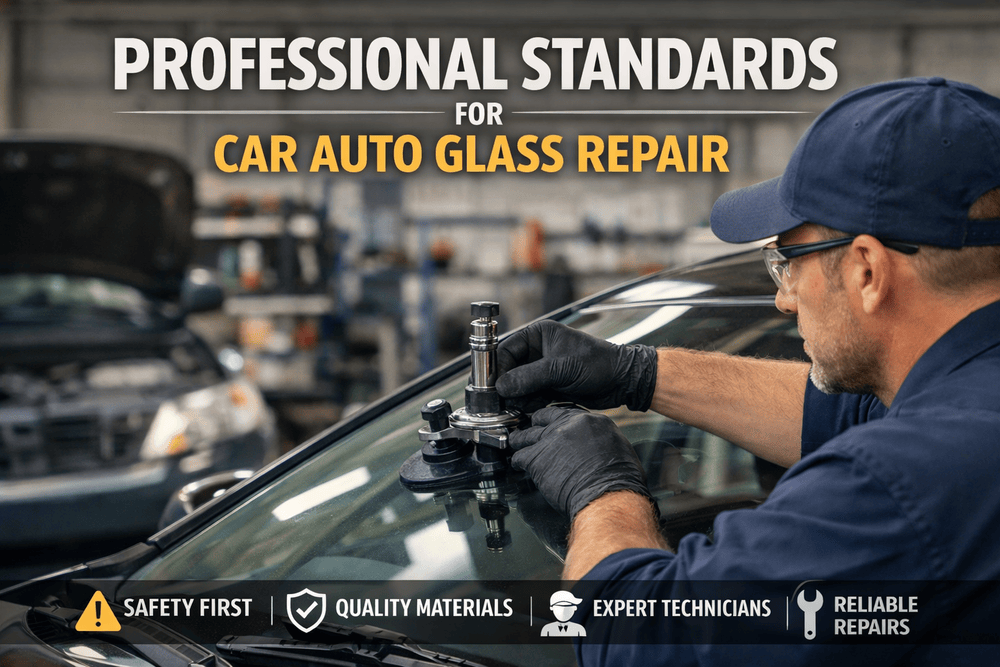
Professional Standards for Car Auto Glass Repair
There’s more to your windshield than just keeping insects away from your teeth. Knowing expert repair standards may make the difference between a liability on wheels and a safe remedy when damage happens. Strict regulations aimed at protecting drivers and passengers govern the vehicle glass repair sector. These guidelines control everything, including the materials and methods that professionals must use as well as the kinds of damage that may be fixed. Understanding what constitutes professional labor enables you to make well-informed choices about the safety of your car, regardless of whether you’re dealing with a little chip or are thinking about getting a complete replacement.
Get An Auto Glass Replacement Quote Now 866.278.7417

Windshield Replacement & Repair
Our competitors push you into going to their shop to get your glass fixed-making it cheaper for them. We make it easier for YOU to get back on the road by offering free mobile repairs at your home or work. With our free mobile services servicing the entire Orange County & Los Angeles area, we can often handle your windscreen replacement the same day! So the next time you need a windshield replacement, give us a call.
Talk to a Windshield Replacement Specialist Now 866.278.7417

Calibration
Calibration is the process of returning a vehicle’s ADAS to OEM specifications. Calibration is necessary after a new glass installation, particularly a windshield with a camera mounted to it, to ensure that the ADAS features continue to function properly despite having been moved during installation. If a car’s ADAS is not properly calibrated, the system may not function safely. A misaligned camera could jeopardize the functionality of the system and lead to dangerous driving or accidents, so it is crucial that the cameras are aligned perfectly, which is what windshield calibration ensures.
Talk to a Calibration Specialist Now 866.278.7417

Fleet Auto Glass Repair
We provide expert auto glass repair and windshield replacement services for commercial fleets of all sizes. We are experienced with all manufacturers and machine types of domestic or foreign cars, trucks, vans, or commercial vehicles, including heavy equipment. Our same day mobile auto glass and windshield repair service will enable you to get back on the road faster and start saving you time and money instantly. Give us a call today! We are here to help!
Talk to a Fleet Auto Glass Specialist Now 866.278.7417
Recognizing the Types of Auto Glass Damage
Not all types of windshield damage are the same. In order to assess whether repair or replacement is necessary, professional technicians classify damage according to its size, location, and severity.
Chips are tiny impact sites that haven’t penetrated fractures. They include combo breaks, bulls-eyes, and stars and are usually smaller than an inch in diameter. If a chip is out of the driver’s direct line of sight, it may usually be fixed.
Lines that emanate from an impact site or develop on their own as a result of stress are called cracks. According to the Auto Glass Safety Council, cracks that are less than six inches may usually be repaired, albeit placement is crucial. Windshield edge cracks jeopardize structural integrity and often need complete replacement.
Damage to the edges is especially concerning. The glass-to-frame seal is impacted by any chip or fracture that occurs within two inches of the windshield’s perimeter. Damage of this kind undermines the whole system and spreads quickly.
Certification Bodies and Industry Standards: A number of organizations set and maintain industry standards for vehicle glass repair. With its accreditation program for shops and technicians, the Auto Glass Safety Council (AGSC) is the industry leader. Repair methods, supplies, and continuing education needs are all covered under AGSC regulations.
Through its Auto Glass Division, the National Glass Association (NGA) offers best practices and technical recommendations. Their guidelines include both replacement and maintenance processes, with a focus on advanced driver assistance systems (ADAS) that depend on windshields that are calibrated correctly.
Another set of standards is added by state regulations. Some jurisdictions keep particular regulations regarding judgments about repairs vs replacements, warranty obligations, and technician certification, while others accept industry standards in bulk.
Through their authorized repair networks, insurance firms can have an impact on standards. By requiring participating businesses to use recognized materials and maintain certain qualifications, many insurers establish a de facto standard for professional service.
The ROLAGS Repair Standard
The most thorough recommendations for figuring out when damage may be properly repaired are provided by the Repair of Laminated Automotive Glass Standard (ROLAGS). Before clearing a windshield for repair, ROLAGS takes into account a number of variables that were developed by industry specialists.
First on the list are size restrictions. Damage up to one inch in diameter for chipping and six inches for cracks may be repaired with ROLAGS. In order to preserve structural integrity, anything greater has to be replaced.
Size is important, but so is location. Though it may be possible to fix damage that is directly in the driver’s field of vision, damage that is about the size of a baseball and centered on the steering wheel might cause distortion that makes it harder to see. Despite technological repairability, many experts advise replacement in these situations.
Repair viability is determined by the extent of damage. The windshield is made up of two glass layers separated by a plastic layer. Repair is difficult if damage reaches the core layer of the plastic. For the glass to provide enough protection, its laminated structure must be preserved.
Repairs are complicated by several effects. Although specialists may repair several individual chips, significant damage erodes the structure as a whole. Before suggesting replacement, the majority of regulations restrict repairs to three distinct impact locations.
Standards for Materials and Equipment: Professional vehicle glass repair calls for certain materials that fulfill exacting performance requirements. The optical clarity and bond strength of the resin used to repair chips and cracks must match those of the windshield.
Do you have a Question?
Get An Auto Glass Replacement Quote Now 866.278.7417
The Choice to Replace
There are certain damages that are just too dangerous to fix. According to professional standards, a number of circumstances call for replacing the windshield entirely rather than attempting repairs.
Replacement is usually necessary when damage reaches the edge of the windshield. To stop leaks and preserve structural integrity, the seal between the glass and the frame must stay unbroken. Edge cracks cannot be consistently prevented and propagate quickly.
Even when it is theoretically repairable, damage in the driver’s field of view often requires replacement. Although a correctly fixed chip would not substantially reduce vision, most experts advise replacing it to get rid of any possible distortion or weak spots right in front of the driver.
Repairing contaminated damage is difficult. Cleaning a chip or fracture thoroughly becomes difficult or impossible if dirt, moisture, or glass particles have gotten within. Repair failure results from contamination, which inhibits adequate resin bonding.
It is impossible to repair extensive damage to the inner layer of the windshield. For the laminated structure to function well in a collision, it must stay intact. This important trait is compromised by penetrating injury.
ADAS Calibration Requirements: Advanced driver assistance systems in modern cars are dependent on cameras and sensors installed on or behind windshields. Features including adaptive cruise control, automated emergency braking, and lane departure alerts are managed by these systems.
ADAS calibration may be impacted by windshield replacement or even minor repairs. Recalibration is now required by professional standards after any work that might cause the sensor’s location to change. Usually, specialist equipment is needed to position cameras according to manufacturer standards.
Targets positioned around the vehicle at predetermined heights and distances are used in static calibration. Driving the car under controlled circumstances while the system relearns its settings is necessary for dynamic calibration. Some cars need both steps.
Vehicles having ADAS components located on the windshield should not be serviced by shops without the necessary calibration equipment. Systems that are not calibrated correctly may fail to activate safety measures or provide misleading alerts, resulting in hazardous circumstances.
Standards for Documentation and Warranty
Professional vehicle glass repair shows trust in the job done by providing warranty coverage. Although the exact conditions vary, reputable stores provide lifetime guarantees against repair failure.
Both the actual repair and any harm that results from it should be covered under the warranty. The guarantee ought to include complete windshield replacement at no extra expense if a fixed chip expands into a fracture. Customers are shielded from having to pay twice for the same issue because of this.
Documentation serves as evidence of expert labor. The date, the identity of the technician, the location and extent of the damage, the materials used, and any ADAS calibrations should all be included in the repair documents. Future repairs and resale value both benefit from this knowledge.
Before-and-after pictures show the degree of damage and the quality of the repairs. As a normal procedure, many professional businesses now take pictures of every repair, which serves as visual proof for customer records and warranty claims.
Selecting a Qualified Repair Shop: A shop’s dedication to professional standards is shown by its certification. Seek for NGA membership or AGSC registration, which call for further education and adherence to industry best practices.
Inquire about the tools and supplies used. Expert stores are happy to describe their resin brands, injection processes, and curing techniques. Reluctance to talk about these specifics points to poor behavior.
With the right tools, mobile repair services may be up to professional standards. However, environmental elements like dust, humidity, and temperature have an impact on the quality of repairs. For best outcomes, indoor businesses provide more regulated circumstances.
Insurance partnerships show a minimum level of professional operation, but they do not always ensure quality. Insurance firms check the equipment, accreditation, and customer satisfaction of their network shops.
Quality Standards All Auto Glass Repair Services Adhere to
More than just keeping insects out of your teeth as you’re speeding down the freeway is what your windshield accomplishes. It is an essential safety feature that promotes airbag deployment, preserves the structural integrity of your car, and keeps you safe in collisions.
Selecting a trustworthy vehicle glass repair provider becomes crucial when damage occurs. However, how can you determine if a repair company satisfies industry standards?
Expert car glass experts adhere to stringent quality standards to guarantee that each repair restores the functionality and safety of your windshield. You may make more educated judgments regarding where to take your car and what to anticipate from the servicing if you are aware of these standards.
The main criteria for quality that distinguish professional vehicle glass repair services from inferior ones are broken down in this guide. You’ll discover what goes on behind the scenes during a good repair, including professional credentials and adhesive curing durations.
Standards of Training and Industry Certifications: Skilled car glass technicians acquire knowledge beyond their work experience. Reputable repair companies make sure that their employees are certified by reputable trade associations.
The most well-respected certification scheme is provided by the Auto Glass Safety Council (AGSC). Technicians need to finish extensive training that covers safety procedures, adhesive choices, and correct installation methods. They must also pass difficult tests to prove their expertise.
Additional training materials and certifications are offered by the National Glass Association (NGA). For cars with driver assistance systems, their programs include everything from simple maintenance methods to complex replacement processes.
Reputable repair firms spend money on their professionals’ continuous education. Rapid advancements in vehicle technology need updated understanding of new camera systems, sensors, and glass compositions. To remain up to date with manufacturer requirements and industry best practices, quality shops often send technicians to training sessions.
Appropriate Procedures for Damage Assessment
The damage must be carefully inspected by professionals before any repairs are made. This assessment establishes if a full replacement is required or whether repair is feasible.
When assessing damage, professional services adhere to certain standards. Cracks less than three inches and chips smaller than a quarter are usually repairable. But location is important. Replacement is often necessary for damage that penetrates both layers of glass, is directly in the driver’s line of sight, or occurs at the edge of the windshield.
When doing an evaluation, technicians look at a variety of aspects. By measuring the extent to which the chip or fracture pierces the layers of glass, they determine the extent of the damage. They take into account the location of the damage and how it can jeopardize the structural integrity. Since repeated repairs in the same spot might degrade the glass, they also assess if prior efforts at repair have been attempted.
Even when replacement is more cost-effective than repair, reputable stores provide frank evaluations. They assist clients in comprehending the safety implications of their proposal and provide an explanation of their thinking.
Standards for Tools and Materials: The equipment and materials used in vehicle glass repair have a direct effect on the outcome. Expert services make investments in top-notch machinery that satisfies or beyond manufacturer requirements.
Quality of Repair Resin: High-quality repair resins restore clarity, bind with car glass efficiently, and stop more damage from spreading. High-quality stores employ resins made especially for vehicle glass, not generics used for other uses.
These specialty resins form bonds that complement the optical characteristics of the glass when they cure under UV light. They thoroughly fill up damaged regions, removing any air pockets that can jeopardize the restoration.
Adhesive Systems: The adhesive system is essential for replacing windshields. Urethane adhesives that adhere to Federal Motor Vehicle Safety Standard (FMVSS) 212, which regulates windshield retention, are used by professional services.
In order to preserve structural integrity in the event of an accident, these adhesives must adhere the glass to the vehicle frame with enough strength to provide a waterproof seal. Reputable stores choose adhesives according to the make, model, and climate of the car.
Tools for Installation
Using the right tools guarantees precise installation and guards against harm. Expert shops make use of climate-controlled curing chambers, specialized cutting equipment for removing old glue, and calibrated torque drivers.
Additionally, they replace damaged parts and calibrate equipment on a regular basis, maintaining tools in accordance with manufacturer specifications.
Safe Drive-Away Time Compliance: Safe drive-away time (SDAT), or the bare minimum amount of time needed before a car may be driven safely after having its windshield replaced, is one of the most important quality standards.
The chemical curing process is the basis on which adhesive manufacturers define SDAT. Depending on the adhesive type, temperature, and humidity levels, this period usually lasts anywhere from one to twenty-four hours.
Reputable repair companies follow SDAT guidelines to the letter. They never push clients or advise driving before the glue is strong enough. In an emergency, some establishments employ primers and fast-cure adhesives, but they nevertheless adhere to minimal curing timeframes.
Reputable stores also provide precise records of when a car is safe to drive. Any limitations, including avoiding vehicle washes or drastic temperature fluctuations during the early curing phase, are explained.
Do you have a Question?
Get An Auto Glass Replacement Quote Now 866.278.7417
Advanced Driver Assistance System Calibration
Advanced driver assistance systems (ADAS) that use cameras and sensors installed on or close to the windshield are becoming more and more common in modern cars. These technologies include adaptive cruise control, automated emergency braking, and lane departure alerts.
These sensors may become misaligned when a windshield is replaced, making safety systems unreliable or non-operational. ADAS calibration is a component of professional auto glass services’ quality requirements.
To guarantee that cameras and sensors properly match vehicle requirements, technicians employ calibration equipment designed by the manufacturer. Specialized targets, measuring equipment, and diagnostic software are used in this procedure.
High-quality shops spend money on calibrating equipment for a variety of car models and manufacturers. As new cars and system upgrades are released by manufacturers, they remain informed about the calibration needs.
Standards for Cleanliness and Preparation: An effective repair might be the difference between one that fails too soon and one that lasts. Professional services adhere to strict preparation and cleaning guidelines.
Technicians meticulously clean the damaged area prior to repair or replacement. They eliminate impurities, moisture, and grime that could obstruct the bonding of adhesives or resin. They make use of lint-free cloths and residue-free cleaning solutions.
When replacing a windshield, technicians take care to remove any remaining glue from the pinch weld, which is where the new windshield attaches to the automobile frame. To provide the best possible adhesive performance, they prep the surface in accordance with product standards.
During maintenance, reputable businesses additionally safeguard the car’s exterior and interior. To guard against damage from tools or debris, they employ floor mats, fender coverings, and seat covers.
Practices for Documentation and Warranty
Expert vehicle glass providers keep thorough records of each replacement and repair. The date of service, the name of the technician, the materials used, the SDAT details, and any calibrations are all included in this paperwork.
Copies of this paperwork and warranty details are sent to customers. Reputable stores provide warranties that cover both labor and materials, usually for a period of one year to the lifespan of the car.
Any terms or exclusions should be made explicit in the warranty, along with what it covers. Reputable providers don’t have any exorbitant criteria or gaps in their warranties.
Additionally, documentation is useful for insurance and car selling. It proves that skilled specialists used the right tools and techniques to complete the repairs.
Insurance and Safety Compliance: Reputable vehicle glass repair businesses keep up-to-date insurance coverage and adhere to all applicable safety laws. This covers professional liability, workers’ compensation, and general liability insurance.
They also adhere to the safety regulations set out by the Occupational Safety and Health Administration (OSHA). This shields workers and clients from risks related to handling glass, being around chemicals, and using machinery.
Reputable stores are happy to explain their safety procedures and provide confirmation of insurance. They should never be reluctant to respond to inquiries on their adherence to industry rules.
Things to Consider While Selecting a Repair Service
You can assess possible providers more skillfully now that you are aware of the standards for quality that professional services adhere to.
Inquire about training courses and technical certifications. Ask them about the adhesives and materials they use. If your car has ADAS systems, ask about their calibration capabilities.
Examine prior customers’ feedback, taking note of remarks about warranty fulfillment, communication, and service quality. Verify the shop’s accreditation with trade associations such as the AGSC or NGA.
Don’t let pricing be your only consideration. The least expensive choice often skimps on supplies, instruction, or procedure adherence. These quick cuts may jeopardize your safety and lead to more expenses in the event that repairs are not successful.
Safeguarding Your Investment and Safety: The structural integrity and safety of your car are greatly influenced by your windshield. Selecting a firm that adheres to set quality standards guarantees that the job is completed appropriately when repair or replacement becomes required.
Certified specialists, high-quality materials, appropriate equipment, and respect to manufacturer standards are some of the ways that professional vehicle glass repair services set themselves apart. They calibrate cutting-edge safety devices, adhere to safe drive-away times, and provide extensive warranties to support their work.
You may choose a glass repair business that puts your safety first and produces long-lasting results with confidence if you are aware of these quality standards. Professional care from specialists that adhere to industry best practices is what your windshield deserves.
Mobile Safe Auto Glass
14241 E Firestone blvd suite 400,
La Mirada, CA 90638
Phone: (562) 608-1154
Toll Free: 1 866 278 7417
Mail: sales@mobilesafeautoglass.com
Get a FREE QUOTE today! You can get a free quote and schedule 24/7 using this free quote wizard.
Mon – Fri 8am – 5pm
Saturday 8am – 1pm
Sunday Closed