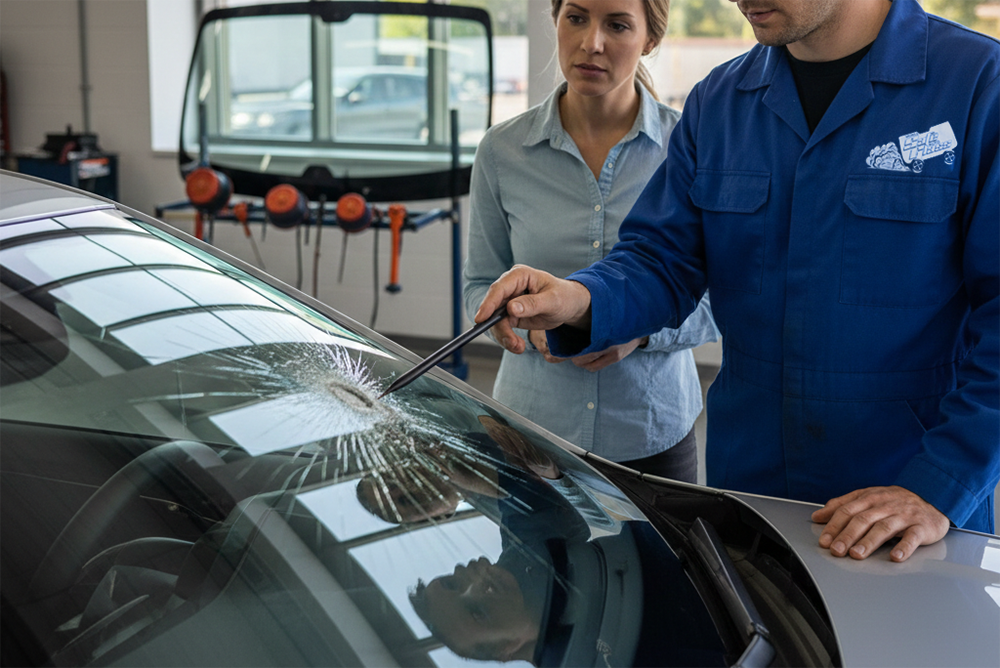
Auto Glass Replacement After Minor Damage When Repair Fails
There is a possibility that a little chip in your windshield may appear to be a minor irritation, which can be easily overlooked until your next appointment for vehicle wash or servicing. There are a lot of drivers who choose to do a fast repair because they believe that a small amount of resin will keep things together forever. However, there are situations when even the most exemplary repairs are not successful, or when what appears to be “minor” damage is in fact an indication of structural weakness that necessitates a complete replacement. For your own safety, it is essential that you are aware of when it is time to quit patching up the problem and when it is time to invest in new glass.
Get An Auto Glass Replacement Quote Now 866.278.7417

Windshield Replacement & Repair
Our competitors push you into going to their shop to get your glass fixed-making it cheaper for them. We make it easier for YOU to get back on the road by offering free mobile repairs at your home or work. With our free mobile services servicing the entire Orange County & Los Angeles area, we can often handle your windscreen replacement the same day! So the next time you need a windshield replacement, give us a call.
Talk to a Windshield Replacement Specialist Now 866.278.7417

Calibration
Calibration is the process of returning a vehicle’s ADAS to OEM specifications. Calibration is necessary after a new glass installation, particularly a windshield with a camera mounted to it, to ensure that the ADAS features continue to function properly despite having been moved during installation. If a car’s ADAS is not properly calibrated, the system may not function safely. A misaligned camera could jeopardize the functionality of the system and lead to dangerous driving or accidents, so it is crucial that the cameras are aligned perfectly, which is what windshield calibration ensures.
Talk to a Calibration Specialist Now 866.278.7417

Fleet Auto Glass Repair
We provide expert auto glass repair and windshield replacement services for commercial fleets of all sizes. We are experienced with all manufacturers and machine types of domestic or foreign cars, trucks, vans, or commercial vehicles, including heavy equipment. Our same day mobile auto glass and windshield repair service will enable you to get back on the road faster and start saving you time and money instantly. Give us a call today! We are here to help!
Talk to a Fleet Auto Glass Specialist Now 866.278.7417
The Restrictions That Come With Windshield Repair
Repair technology for windshields has come a long way in recent years. For the purpose of restoring strength and visibility, technicians can inject transparent resin into chips and cracks and then cure the resin using ultraviolet radiation. Nevertheless, this method is not a magic wand in any way. It does not restore the glass to its full factory strength and is designed to repair particular forms of damage, which are often chips that are smaller than a quarter or cracks that are shorter than three inches.
Repair is not a reversal approach; rather, it is a mitigation method. However, the structural weakness is still there inside the laminated glass layers, despite the fact that it can prevent the fracture from expanding and enhance the visual look. The failure of a repair or the inability to fix it in the first place can be attributed to a number of different factors:
When it comes to location, damage that is located close to the edge of the windshield or in the driver’s direct line of sight typically requires repair. In the event that the damage penetrates both the exterior and interior layers of the glass, it is extremely unlikely that the glass can be repaired. The presence of contamination, such as dirt, moisture, and road salt that is trapped inside a chip, might render the resin incapable of bonding properly.
Symptoms That Your Repair Is Not Working
You could have previously paid for a repair, but after a few weeks or months have passed, you might discover that something is not quite right. In spite of the fact that a specialist filled the chip, this does not ensure that the glass will remain intact indefinitely. There are a few frequent indications that the small damage you experienced has developed into a significant issue that requires repair.
The crack is resurfacing or spreading: The most evident indication that something has failed is the reappearance of the damage that was once there. If the crack is visible beyond the region that has been filled, this indicates that the resin has not been successful in preventing the stress fracture. The expansion and contraction of the glass are caused by changes in temperature, such as when the defroster is turned on late in the morning or when the air conditioner is turned on in the afternoon. In the event that the connection is not flawless, the sheet of glass will break apart, and the fracture will spread.
Discoloration of the Resin: The repair location may become hazy or yellow over time if the resin you used was of poor quality or if the curing process was not done properly. This may appear to be nothing more than a cosmetic concern; yet, it is an indication that the material is deteriorating. In the event that the resin is degrading, it will no longer be able to supply the structural support that is essential for maintaining the integrity of the auto glass.
In order to correct surface irregularities or pitting, carefully run your finger over the region that has been fixed. The glass that surrounds it ought to feel like it is flush with it. In the event that you locate a pit, a lump, or rough edges, it indicates that the resin did not entirely cover the hole or that it has shrunk with time. Because of these abnormalities, weak areas are created, which allow tension to collect and eventually lead to a bigger break inside the material.
Do you have a Question?
Get An Auto Glass Replacement Quote Now 866.278.7417
The Reasons Why Replacement Is More Secure Than Subsequent Repairs
Sometimes, when a repair is unsuccessful, drivers may ask, “Can’t you just fill it again?” The response to this question is virtually never accepted. It is not possible to successfully re-inject resin into a fissure that has already been filled with resin. Both the routes and the second layer of healing material are obstructed, and the second layer will not attach securely.
At this point, replacement is the only alternative that can really be considered. A full windshield replacement is more expensive than a repair, but it provides certain safety advantages that a patchwork job cannot equal. These advantages cannot be matched by a patch job.
Bringing Back the Structural Integrity of Your Windscreen Your windshield does more than just block the wind; it also supports the top of your vehicle. After an accident that causes the vehicle to roll over, the windshield protects the occupants from the roof crashing on them. If the windshield is damaged in any way, whether it be from a botched repair or substantial cracking, it will no longer be able to offer the necessary support. It is possible to restore the vehicle’s structural safety rating by installing a new windshield consisting of urethane of an industrial grade.
When deployed correctly, airbags on the passenger side of the vehicle exert a great amount of power, causing them to bounce off the windshield and provide the passenger with protection. The power of the airbag has the potential to shatter the windshield or completely pop it out of the frame if the glass is damaged in any way, including broken or chipped components. As a result, the airbag is rendered ineffective, and the passenger is put in a precarious position. By replacing the glass, you ensure that it will be able to survive the impact of deployment.
Advanced Driver Assistance Systems (ADAS) are cameras and sensors that are located behind the windshield of modern automobiles. These systems are responsible for controlling lane departure alerts and automated braking. Visibility and ADAS calibration are also included in these systems. Even a slight distortion caused by a poor repair might cause these sensors to become confused. It is possible for professionals to recalibrate your ADAS in order to guarantee that your safety features are functioning appropriately when you replace the windshield. This ensures that the glass is clear to the naked eye.
When Irregular Damage Is Not Irregular
The appearance of damage that appears to be minor can often be deceiving. It is possible that a “bullseye” chip appears to be confined, but if it has minuscule legs that radiate outward, it is a time bomb that is about to explode. Both “star breaks” and “combination breaks” are examples of cracking patterns that incorporate many impact locations and intricate patterns of shattering. In spite of the fact that a technician could try to fix them, the likelihood of success is smaller than it is with straightforward chips.
In the long term, it may be possible to save time and money by forgoing the attempt to repair the small damage and instead opting to replace it. This is especially true if the damage is complex. At the end of the day, you should always repair the glass if the damage is in your direct line of sight (an area that is about the size of a sheet of paper in front of the steering wheel). The minor distortions that are left behind by repairs can cause light to refract, which can result in glare from headlights or the sun that can cause you to become blind while driving.
A Guide to Making the Appropriate Choice for Your Automobile
Cost versus safety is a common consideration that must be taken into account when deciding whether to repair or replace anything. Repairs are frequently recommended by insurance carriers since they are less expensive, and the deductible may even be waived in some cases. On the other hand, as the owner of the car, you have the authority to provide priority to safety.
It is recommended that you seek the advice of a trained auto glass specialist if you have unsuccessfully attempted to repair your vehicle or if you have damage that causes you to feel uneasy. Instead of focusing just on the glass’s aesthetic look, you can request that they evaluate the structural integrity of the glass. Rather than having to cope with a smashed windshield on the highway much later, it is far preferable to make an investment in a replacement right now.
Is Your Windshield Safe to Drive On? The Identification of Cracks That Pose a Danger to Visibility
You are familiar with the sound. When a dump truck switches lanes in front of you on the highway, you are driving at a rather fast speed. All of a sudden, a rock hits the glass after ricocheting off of your hood. You groan and look for any signs of injury. There are occasions when you are fortunate enough to not have any scratches. On other occasions, you come across a minute mark that appears to be so minor that it may be ignored.
The minor flaw may appear to be innocuous at this moment; nevertheless, damage to vehicle glass is seldom caused by static. A modest cosmetic nuisance can rapidly develop into a complicated web of cracks that impairs both your perspective of the road and the structural integrity of your car. This can happen very fast.
Not only does your windshield prevent insects from getting into your teeth, but it is also an essential safety component that is meant to protect you in the event of a rollover and guarantee that your airbags can deploy in the right manner. It is crucial for every driver to have a solid understanding of the various forms of damage and to be able to recognize when a chip is on the verge of developing into a large crack.
Anatomy of a Windshield
It is helpful to have an understanding of what you are looking through in order to comprehend how fractures originate and propagate. In contrast to the glass that is used in the windows of your home, which can shatter into sharp fragments, the windshield of your vehicle is constructed of laminated safety glass. A layer of polyvinyl butyral (PVB) lies between two layers of glass in this structure, which is sandwiched between the two layers of glass.
It is possible for the glass to shatter if it is struck by an object on the outer layer; however, the plastic layer in the inner layer provides support and prevents the glass from collapsing on the people within. Even while its design is extremely long-lasting, it is not completely impregnable. At the moment when the outer layer is broken, the tension that is present over the entire surface modifies. This weakness is what makes it possible for a little chip to develop into a substantial fracture that threatens visibility.
Deciphering the Damage Consisting of the Most Common Chips
Damage is not generated equally in every instance. When it comes to the likelihood of the impact spreading and the difficulty of repairing it, the form and depth of the impact are the most important factors. One way to determine what it is that you are working with is as follows. There are many different kinds of damage, but one of the most prevalent is the bullseye. According to what the name says, it has the appearance of a black circle with a point of impact in the midst of it. Typically, it is brought on by a rock striking the glass at an angle that is perpendicular to the ground.
The level of risk is moderate. Because bullseyes are round, they do not necessarily have “legs” that spread instantly; nonetheless, if they are left for an extended period of time, they can get clogged with dirt and oil, making it difficult to repair them. Star Break: This type of damage is characterized by a central impact point that is surrounded by small fractures that radiate outward, giving the appearance of a star.
Elevated level of risk. A star break is extremely prone to spreading due to the fact that the fractures have already begun to appear before it. There are a number of factors that might cause those legs to stretch swiftly beyond your field of sight, including road vibrations and weather variations. The Half-Moon: The half-moon form is created by debris hitting the glass at a blunt angle, and it is comparable to a bullseye but is not a complete circle.
The level of risk is moderate. In the same way as the bullseye, it is structurally cleaner than a star break; nonetheless, it still considerably weakens the surface of the glass. A combination break is exactly what it sounds like: damage that combines elements of a bullseye break and a star break. This type of break is more common than you may think. Extremely high level of risk. This sort of damage is characterized by severe glass loss and cracking, which makes it challenging to repair and gives it a high probability of spreading.
Whenever Chips Develop Into Cracks
It’s possible that you’ll notice a little crack on the passenger side of the vehicle and choose to put off fixing it until the next time you get your oil changed. The field of physics, however, frequently has other intentions. There are three primary causes that cause tiny chips to develop into fissures that cannot be repaired.
As the temperature changes, glass undergoes a process of expansion when heated and contraction when cooled. A significant amount of stress is caused by the sudden shift in temperature that occurs when you blast your defroster on a windshield that is frozen and has a chip. The glass has a desire to expand, but the imperfection prevents it from expanding in a consistent manner across its structure. As a result, the glass breaks and the crack spreads. When you blast the air conditioner on a hot windshield during the summer, the same thing happens.
Road Vibrations: Every uneven surface, such as a speed bump, a pothole, or a rumble strip, causes vibrations to travel through the chassis of your car and reach the windshield. If the glass is not broken, it is able to manage this effectively. If there is a defect, the vibrations will act at the weak area, gradually moving the crack further and further outward as they pass through the material.
The minuscule layers of a chip are susceptible to water seeping in, which is a kind of moisture. In the event that temperatures fall below freezing, the water will transform into ice and expand, causing the glass to become more fractured. In addition, the chip might become contaminated with dirt and washer fluid, which reduces the effectiveness of the resin that is used in the repair process.
The Unseen Danger: Stress Cracks or Fractures
The impact of a rock on your vehicle is not the cause of every sight problem. Sometimes, a crack will suddenly occur out of nowhere. Those fissures are referred to as stress cracks. It is common for stress cracks to begin around the edge of the windshield, and there is no obvious point of impact where they begin. Incorrect installation, structural weakness in the production of the glass, or significant heat change (such as pouring hot water on an icy windshield) are all potential causes of these types of cracks. Due to the fact that these cracks frequently begin beneath the molding and spread out to a significant extent before you become aware of them, most of the time, a complete replacement of the windshield is required.
Do you have a Question?
Get An Auto Glass Replacement Quote Now 866.278.7417
The Ways in Which Broken Glass Impairs Visibility
One of the most apparent risks associated with a broken windshield is the possibility that it could shatter. However, the more subtle risk is the impact that it will have on your eyes. Refraction of Light: A windshield that has not been damaged is transparent. However, a windshield that is chipped or cracked will form facets similar to those seen in a diamond. Refracting and scattering light occur whenever sunlight or headlights coming from behind collide with a fracture.
This phenomenon, which is referred to as the “halo effect,” can produce a dazzling glare that can briefly hinder a driver’s vision. Nighttime, as well as the hours between sunrise and dusk, is an especially hazardous time for this. Optical Distortion: Even if the glass does not break, optical distortion can be caused by repairs of low quality or via warping of the glass. This causes your eyes to strain as your brain attempts to rectify the vision, or it causes items to appear to be moved from their real position rather than where they are.
The human eye has a natural tendency to be drawn to abnormalities, which is a distraction factor. There is a persistent, low-level distraction that comes with having a crack in your peripheral vision. This distraction can be the difference between being able to apply the brakes in time and being involved in an accident while driving in a circumstance where split-second reflexes are important.
The Complicated Nature of ADAS
ADAS, which stands for advanced driver assistance systems, is standard equipment in modern automobiles. Some examples of these are rain-sensing wipers, automated emergency braking, and lane-keeping assistance, among other available options. Cameras and sensors that are located right behind the windshield are utilized by a significant number of these systems. It is possible for a sensor or camera to become confused if there is a crack or chip in the glass, even if the fracture or chip does not impair your personal view.
In the event that the camera detects a crack and deduces that it is a lane marking or an obstruction, the vehicle may respond in an unpredictable manner. Recalibrating these cameras to ensure that they “look” through the new glass correctly is required in order to replace the windshield on a contemporary automobile. Additionally, changing the windshield is not simply about replacing the glass. If you choose to disregard a fracture in the sensor zone, you will be operating a smart car with a diminished level of intelligence.
Do you fix or replace it? The General Guidelines and Regulations
The question is, how can you determine whether your sight can be restored by a repair or whether you require a complete replacement? Despite the fact that the finest advice is always that of a professional, the following are the basic industry standards. In the event that the chip or crack is less than a quarter (about one inch), it is probable that it is feasible to repair it. There is a possibility that the repair resin will leave a tiny blur in the driver’s line of sight because the damage is not immediately in there.
A total of less than three chips are present. It is not at the extreme edge of the glass where the damage is located. If the crack is longer than a dollar note, then it is quite likely that replacement is required. Two layers of glass are broken as a result of the damage. The edge is where the fracture is located, which puts the structural integrity at risk. The driver gets a clear glimpse of the devastation that has occurred. It appears that the damage is above an ADAS camera or a rain sensor.
Avoid Putting Things Off Until It Is Too Late
Although it acts as a window to the outside world, your windshield also serves as a protection. Ignoring a modest chip is like taking a wager, and the chances are stacked against you all the time. Under the influence of fluctuations in temperature and bumps on the road, that chip will ultimately turn into a fracture. You should take prompt action in the event that you discover a bullseye, a star break, or any other flaw in your glass.
It is common for minor repairs to be completed quickly, at a low cost, and occasionally even completely covered by insurance without the need for a deductible. Putting yourself, your passengers, and other drivers in danger by waiting until visibility is impaired is a questionable decision. The glass should be inspected today. In the event that you notice a crack, ensure that it is repaired as soon as possible so that you may maintain a clear view of the road.
Mobile Safe Auto Glass
14241 E Firestone blvd suite 400,
La Mirada, CA 90638
Phone: (562) 608-1154
Toll Free: 1 866 278 7417
Mail: sales@mobilesafeautoglass.com
Get a FREE QUOTE today! You can get a free quote and schedule 24/7 using this free quote wizard.
Mon – Fri 8am – 5pm
Saturday 8am – 1pm
Sunday Closed