What Raises Small Chip in Windshield Repair Cost
You are traveling down the interstate, enjoying the wide road, when you hear that unmistakable, heart-sinking thwack. A particle of gravel flung up by a passing vehicle has hit its target, creating a tiny, jagged chip in your windshield. At first view, it seems small, maybe no bigger than a cent. You may imagine mending it would be a short, inexpensive task. However, once you start collecting bids, the price tag can surprise you. While simple repairs are frequently reasonable, numerous variables might push the expense of mending even a little chip much higher. What seems like simple cosmetic damage to the untrained eye might really include sophisticated structural or technical difficulties.
Get An Auto Glass Replacement Quote Now 866.278.7417

Windshield Replacement & Repair
Our competitors push you into going to their shop to get your glass fixed-making it cheaper for them. We make it easier for YOU to get back on the road by offering free mobile repairs at your home or work. With our free mobile services servicing the entire Orange County & Los Angeles area, we can often handle your windscreen replacement the same day! So the next time you need a windshield replacement, give us a call.
Talk to a Windshield Replacement Specialist Now 866.278.7417

Calibration
Calibration is the process of returning a vehicle’s ADAS to OEM specifications. Calibration is necessary after a new glass installation, particularly a windshield with a camera mounted to it, to ensure that the ADAS features continue to function properly despite having been moved during installation. If a car’s ADAS is not properly calibrated, the system may not function safely. A misaligned camera could jeopardize the functionality of the system and lead to dangerous driving or accidents, so it is crucial that the cameras are aligned perfectly, which is what windshield calibration ensures.
Talk to a Calibration Specialist Now 866.278.7417

Fleet Auto Glass Repair
We provide expert auto glass repair and windshield replacement services for commercial fleets of all sizes. We are experienced with all manufacturers and machine types of domestic or foreign cars, trucks, vans, or commercial vehicles, including heavy equipment. Our same day mobile auto glass and windshield repair service will enable you to get back on the road faster and start saving you time and money instantly. Give us a call today! We are here to help!
Talk to a Fleet Auto Glass Specialist Now 866.278.7417
The Type and Complexity of the Chip
Not all chips are made equal. The severity of the break dictates the amount of time and resin needed to repair it. Auto glass experts classify damage into several sorts.
Bullseye vs. Star Break: A “bullseye” chip is exactly what it sounds like: a circular break with a defined impact point and concentric rings. These are often the simplest and cheapest to fix since the damage is limited.
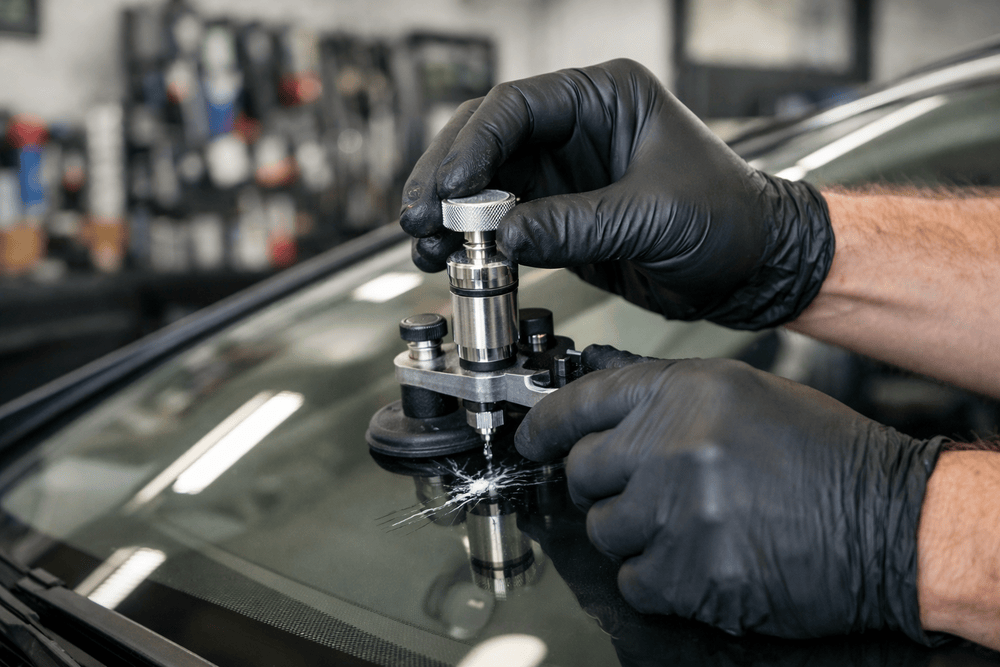
A “star break,” on the other hand, has tiny fissures that radiate outward from the core. These are more difficult to fill entirely. If the resin doesn’t reach the exact tip of every little fracture, the harm will ultimately expand. Because they require more accuracy, time, and resources, businesses generally charge a premium for them compared to a basic pit or bullseye.
Combination Breaks: The most costly sort of minor damage is a combination break—essentially a blend of a bullseye and a star break. These include substantial damage to the glass and the plastic interlayer. Repairing them takes longer and needs a greater level of skill to guarantee the glass preserves its structural integrity and clarity.
Location of the Damage: Where the rock impacts your windshield counts just as much as how powerfully it hits. The location of the chip may determine whether a repair is straightforward or calls for specialist care, which might increase costs or necessitate a complete replacement.
The Driver’s Line of Sight: If a chip is directly in front of the driver (about the width of the steering wheel), repairs become difficult. The glass still has a little flaw or distortion even after the greatest resin repairs. In the driver’s line of sight, this distortion might be a safety issue, creating glare from sunshine or headlights.
Many respected businesses may refuse to repair damages in this “critical zone” owing to liability concerns, mandating a complete windshield replacement. A replacement is substantially more costly than a repair, changing a $100 issue into a $500+ investment.
The Zone of Danger
The edge of your windshield, approximately two inches away from the frame, is where the glass experiences the most stress. It establishes a structural connection with the vehicle’s frame. A chip in this location weakens that relationship more dramatically than a chip in the middle.
Technicians typically charge extra to undertake repairs here because they are high-risk; the pressure of the repair tool itself may often cause the fracture to expand rapidly. You will once again have to pay for a complete replacement rather than just a repair price if the specialist determines that the structural integrity is damaged.
The Hidden Cost of Advanced Technology (ADAS): The most major element pushing up vehicle glass prices recently is not the glass itself, but the technology behind it. Most current automobiles (built after 2016) are equipped with Advanced Driver Assistance Systems (ADAS).
Why ADAS Raises Repair Costs: These systems depend on cameras and sensors frequently situated immediately behind the windshield. If a chip repair produces any optical distortion in front of a camera, the system may not work properly.
If the damage is serious enough to warrant a replacement, or if the repair disrupts the sensors, the vehicle’s computer system must be recalibrated. Static calibration needs a controlled shop setting with lasers and targets, whereas dynamic calibration involves driving the vehicle at defined speeds for a particular duration.
This calibration procedure requires highly skilled specialists and expensive equipment. As a result, if your “small chip” interferes with a sensor, you are paying for computer diagnostics and calibration in addition to glass repair, which might result in a total fee that is doubled or tripled.
Do you have a Question?
Get An Auto Glass Replacement Quote Now 866.278.7417
Specialized Glass Features
Beyond safety sensors, luxury and cold-weather packages offer elements that complicate maintenance.
Heated Windshields: Vehicles with heated windshields feature a mesh of scarcely visible wires or a conductive layer inside the glass. If a rock chip severs one of these heating elements, a simple resin fill won’t repair the electrical connection. The defrost function in that region will cease operating. To restore complete functioning, a replacement is required.
Heads-Up Displays (HUD): Cars that display speed and navigation data onto the windshield need particular glass with a wedge-shaped profile to avoid “ghosting” (double images).
If you try to fix a chip in the projection region, the resin could distort the picture, leaving the HUD illegible or distracting. This uniqueness makes the glass more costly to operate on and typically drives owners toward replacement rather than repair.
The Cost of Waiting: Procrastination is a hidden fee in windshield repair. Chips usually grow larger over time, so repairs are almost always cheaper than replacing a windshield with lengthy cracks.
Temperature Fluctuations: Glass expands and contracts with temperature variations. If you have a chip and you blast the defroster on a chilly morning, the sudden temperature difference may cause the chip to burst into a big fracture instantaneously. The same occurs in the summer when washing a heated automobile with cold water.
Dirt and Debris Accumulation
Over time, road dirt, washer fluid, and wax build up within the chip. When you eventually take it in for repair, the technician needs to spend additional time cleaning up the impact spot to guarantee the resin adheres to the glass.
If the contamination is too deep, the repair will seem milky or unclean, perhaps passing inspection requirements. This problem may lead to additional labor expenditures or, again, the necessity for a complete replacement.
Mobile Service vs. In-Shop Repair: Convenience frequently comes with a price tag. Many car glass firms provide mobile service where they come to your house or workplace. While some insurance covers this cost or some major chains provide it for free, individual operators may charge a “trip fee” or “convenience fee” to cover fuel and travel time.
Conversely, getting the automobile into the shop is generally the basic price. However, for cars needing ADAS calibration, mobile service may not even be a possibility, since the calibration objectives frequently demand a level surface and regulated illumination that a driveway cannot supply.
Insurance Deductibles and “Free” Repairs: Financial complications can have a part in the apparent cost. If you have comprehensive coverage, many insurance carriers may waive the deductible for chip repairs. They do this because they would rather spend $100 for a repair now than $800 for a replacement later. In this instance, the cost to you is nothing.
However, you are liable for your regular deductible if the insurance policy does not include a glass waiver. If your deductible is $500 and the chip repair is $150, you are paying the whole $150 out of pocket. Additionally, depending on your provider and area, submitting a claim for a modest repair may affect your premium rates, so “raising” the cost of that repair over time.
Don’t Let a Small Chip Become a Big Bill: While a $20 DIY kit or a fast roadside repair seems attractive, the reality of contemporary car glass is significantly more complicated. Factors such as ADAS calibration, the location of the damage, and the specific technology in your car all influence the final cost.
The most efficient strategy to keep expenses down is speed. Treating a chip promptly reduces its likelihood of spreading, becoming contaminated, or interfering with your vehicle’s safety systems. Please promptly assess the damage and seek expert advice if you hear that a rock has struck your glass. Paying for a decent repair now is always less expensive than paying for a complete windshield replacement later.
Why Heat and Dirt Make Windshield Cracks Spread Fast
Everybody has heard that nauseating “ping” when traveling on a highway. A stray pebble, thrown up by a vehicle tire, collides with your windshield. You look at the glass and see a little chip in the form of a star. It appears minuscule, possibly smaller than a cent. You could be inclined to dismiss it, believing it’s only a cosmetic defect that you can deal with “later.”
But “later” typically comes far sooner than planned. You park your vehicle in the sun for an afternoon, or perhaps you drive along a dusty road, and suddenly that little chip has shot across the driver’s side vision. Now, instead of a fast, affordable repair, you are looking at a complete windshield replacement.
Why does such an event happen? The glass on your car is resilient, yet it is under continual stress. When you insert external elements like severe heat, temperature swings, and tiny particles, the structural integrity of the glass is affected. Understanding the physics underlying crack propagation may save you money and keep your car safe.
The Science of Laminated Glass: You must first comprehend the composition of your windshield to comprehend why chips spread. Unlike the tempered glass used for your side windows—which is engineered to shatter into dull, safe cubes—your windshield is composed of laminated glass.
Laminated glass consists of two layers of glass with a layer of vinyl (typically polyvinyl butyral, or PVB) layered in between. Because of this design, if the glass breaks, the fragments will adhere to the vinyl instead of flying into the cabin and hurting people.
However, this layered architecture also provides distinct stress spots. When a rock strikes the windshield, it normally destroys just the outer layer of glass. This process generates a weak point in a surface that is supposed to be under stress. The glass wants to rip apart, and the only thing keeping it together is the residual structural integrity surrounding the injury.
How Heat Quickens the Spread of Cracks
The biggest threat to a broken windshield is heat. Although the link between temperature and glass expansion is fundamental to physics, automobile owners may experience immediate and expensive consequences.
Thermal Expansion: Materials expand as they become heated. Glass is no exception. The windshield of your automobile warms up when it is exposed to direct sunshine. This reaction causes the glass to grow on a molecular level. This expansion would occur consistently if the glass were completely intact. However, a chip or fracture signifies a disruption in that regularity.
As the glass grows, the sides of the fracture press against each other. That energy must go somewhere if there is nowhere for the glass to move. The easiest path is for the fracture to extend. This phenomenon is why a little bullseye crack may grow into a lengthy spiderweb fracture after only a few hours in a heated parking lot.
The Danger of Thermal Shock: While extreme heat is harmful, rapid temperature changes—known as thermal shock—are far worse. This happens when the temperature abruptly changes or when there is a significant temperature differential between the glass’s outside and interior surfaces.
Imagine a typical summertime situation: Your automobile has spent hours frying in the heat. The internal temperature could reach a high of 120°F (49°C), and the glass feels hot to the touch. You climb in and immediately blast the air conditioning on “Max,” aiming the vents toward the windshield to chill the vehicle down.
Suddenly, the inner layer of the glass is shrinking swiftly from the cold air, while the outside layer stays stretched from the heat. This push-and-pull action produces tremendous stress on the laminate. If there is a pre-existing chip, the glass cannot resist the conflicting pressures, and it breaks.
The Function of Debris and Dirt
Dirt and debris guarantee that the damage is irreversible, while heat creates the force needed to enlarge a fracture. Essentially, a windshield chip represents an exposed area on your vehicle. Contaminants may be readily trapped in this small valley.
Contamination Prevents Repair: Injecting a clear, specific glue into the void is the main technique for repairing a rock chip. This glue cures under UV light, gluing the glass back together and restoring structural strength.
However, for the resin to adhere successfully, the region must be clean. If you continue to drive with an open chip, road dust, pollen, windshield washer fluid, and rain are driven deep into the crack.
Dirt acts as a wedge once it settles into the small fissures of a fracture. It takes up the area where the glass ought to be reassembled.
Furthermore, many pollutants are difficult or impossible for a repair specialist to totally remove. If the resin cannot attach to the glass because of a coating of filth, the repair may fail, or the technician may refuse to try it, requiring a complete replacement.
Do you have a Question?
Get An Auto Glass Replacement Quote Now 866.278.7417
Pressure from Hydraulics
Moisture performs an especially active function with soil. When water enters a crack—whether from rain or a car wash—it fills space. If the temperature lowers (or if the automobile flexes), that water puts hydraulic pressure on the glass.
Water is incompressible. If the split narrows due to vehicle bending, the water pushes outwards against the tips of the fissure, functioning like a hydraulic jack that drives the glass to separate more.
Vehicle Stress and Vibration: Even if you placed your automobile in a climate-controlled garage, a chip might still expand owing to the simple act of driving. Your windshield does more than stop the wind; it is a structural component of the vehicle, adding to the stiffness of the car’s structure.
Torsional Stress: As you drive, your car’s chassis bends and flexes. When you drive over speed bumps, turn corners, or negotiate uneven driveways, the frame shifts somewhat, but you may not notice it. This flexing is transmitted to the windshield.
An unbroken windshield takes this stress effortlessly. A damaged windshield is unable to. The tension accumulates at the weakest point—the chip. The fracture eventually runs, and the glass becomes fatigued.
Road vibrating: The tires’ continuous vibrating on pavement produces a resonance frequency that passes through the car. These micro-vibrations may irritate a fracture, leading it to inch forward slowly over time until it suddenly breaks way under a greater impact, like a pothole.
Keep Your Windshield Safe Until Repairs Are Made
A professional repair is the only long-term remedy if you have a chip. But before you reach the store, you may take action to stop the harm from becoming worse.
Cover the Damage: As soon as you see a chip, cover it with a piece of transparent packing tape. This is not a structural fix—it allows the fracture to widen owing to heat. However, it will keep dirt and moisture out of the crack. This maintains the wound “clean” and considerably boosts the chances of a satisfactory, undetectable healing later.
Park in the Shade: Reduce the temperature of the glass as much as you can. If shade isn’t available, break the side windows slightly to reduce the interior air temperature, lowering the thermal stress on the glass.
Avoid Sudden Temperature Changes: If you must use the A/C, do not point it toward the windshield immediately. Use the floor vents to cool the cabin gradually. On a hot day, don’t wash the automobile with cold water.
Drive Carefully: Steer clear of slamming doors and potholes since the abrupt vibration might start a spread.
Don’t Wait for the Crack to Spread: The difference between a repair and a replacement is typically a matter of days—or even hours. A repair is often rapid, affordable, and frequently covered by insurance without a deductible. A replacement is pricey and damages the factory seal of your car.
Heat, dirt, and road vibrations work ceaselessly to convert little dents into significant damage. By understanding the factors at play, you can see why haste is crucial. Check your glass right away if you hear that pebble strike it. Cover it to keep it clean, keep the glass cold, and arrange a repair as soon as feasible. It is the best approach to safeguard your pocketbook and your safety on the road.
Mobile Safe Auto Glass
14241 E Firestone blvd suite 400,
La Mirada, CA 90638
Phone: (562) 608-1154
Toll Free: 1 866 278 7417
Mail: sales@mobilesafeautoglass.com
Get a FREE QUOTE today! You can get a free quote and schedule 24/7 using this free quote wizard.
Mon – Fri 8am – 5pm
Saturday 8am – 1pm
Sunday Closed