Broken Windshield Warnings You Should Not Ignore
Every motorist dreads the unique, piercing thwack of a rock striking their windshield. Naturally, you look through the glass, hoping to see nothing. You get fortunate sometimes. Sometimes you see a little flaw there in front of you, like a star-shaped chip or a tiny bullseye. There is a tremendous urge to overlook these little flaws. The radio still works, the vehicle still drives, and the fracture is little larger than a cent, after all. Instead of feeling like a technical failure, it seems like a cosmetic irritation. But the function of your windshield extends much beyond just shielding your face from wind. In contemporary automobiles, the windshield contributes up to 60% of the structural integrity of the cabin in a rollover accident and up to 45% in a head-on collision.
Get An Auto Glass Replacement Quote Now 866.278.7417

Windshield Replacement & Repair
Our competitors push you into going to their shop to get your glass fixed-making it cheaper for them. We make it easier for YOU to get back on the road by offering free mobile repairs at your home or work. With our free mobile services servicing the entire Orange County & Los Angeles area, we can often handle your windscreen replacement the same day! So the next time you need a windshield replacement, give us a call.
Talk to a Windshield Replacement Specialist Now 866.278.7417

Calibration
Calibration is the process of returning a vehicle’s ADAS to OEM specifications. Calibration is necessary after a new glass installation, particularly a windshield with a camera mounted to it, to ensure that the ADAS features continue to function properly despite having been moved during installation. If a car’s ADAS is not properly calibrated, the system may not function safely. A misaligned camera could jeopardize the functionality of the system and lead to dangerous driving or accidents, so it is crucial that the cameras are aligned perfectly, which is what windshield calibration ensures.
Talk to a Calibration Specialist Now 866.278.7417

Fleet Auto Glass Repair
We provide expert auto glass repair and windshield replacement services for commercial fleets of all sizes. We are experienced with all manufacturers and machine types of domestic or foreign cars, trucks, vans, or commercial vehicles, including heavy equipment. Our same day mobile auto glass and windshield repair service will enable you to get back on the road faster and start saving you time and money instantly. Give us a call today! We are here to help!
Talk to a Fleet Auto Glass Specialist Now 866.278.7417
The Star Chip or Bullseye
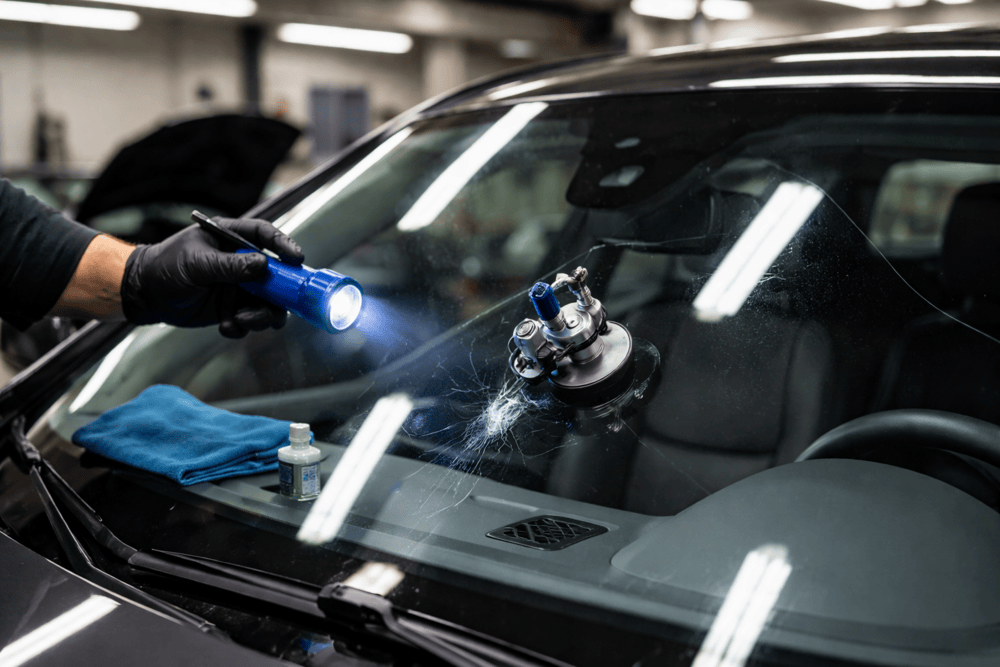
The most prevalent kind of damage is this one. A tiny pebble pops up from a passing car’s tire or shoots off a truck bed, hitting your glass and leaving a scratch.
A bullseye is a circular crack with a cone-shaped hole in the outer layer of glass. Small fissures radiate outward from the point of impact in a star break.
These are volatile even if they seem steady. These cracks may allow moisture and dirt to seep in. Water may freeze and expand after it enters, creating a wedge-like effect that pushes the breach further apart. Additionally, this weak area is constantly stressed by the vibration of your automobile while you drive at highway speeds.
A technician can usually fix a chip smaller than a quarter by injecting a specific resin. This fixes the visible flaw and restores the structural integrity. Repair is challenging and expensive, however; if you wait too long and damage occurs, your only option is to replace.
Cracks Near the Glass Edge: It is especially harmful to have damage near two inches of the windshield’s edge. At the edge of the windshield, the glass is bonded to the vehicle’s metal frame. This area is the most stressed and strained while driving an automobile.
The seal and the strength of the connection are compromised by a break that begins at the edge or rapidly moves toward it. A windshield with edge cracks is far more likely to separate from the frame in an accident.
The roof is more likely to collapse into the passenger compartment in the event of a rollover if the windshield comes out because it loses a significant amount of support.
Since the mounting point’s structural integrity is already weakened, edge fractures almost invariably need a complete windshield replacement rather than a repair.
The Appearance of a White Haze
Delamination is indicated if a milky white haze appears around the edges of your windshield.
Windscreens for cars are made of laminated glass. This is composed of a polyvinyl butyral (PVB) plastic layer surrounded by two layers of glass. This plastic layer keeps the broken pieces together and prevents the glass from shattering into jagged pieces when it is hit.
The PVB layer may begin to split from the glass over time or as a result of manufacturing flaws. This causes the white haze by allowing moisture and air to pass between the layers.
The glass stops functioning as a single, coherent unit when delamination takes place. The laminated glass’s safety features are deteriorating, making it easier for things to pierce the windshield in an accident.
Pitting and “Sandblasting”: A single, powerful hit does not cause all damage. Your windshield is continuously being blasted by tiny particles whenever you travel on highways, gravel roads, or in sandy areas.
This causes microscopic holes to form in the glass’s surface over time. On an overcast day, pitting could go unnoticed, but at night or in full sunshine, it poses a serious risk.
Sunlight: When driving toward the sun, the pits scatter light, making the whole windshield shine or dazzle and dazzling you.
Driving at night is made more difficult by the pits’ ability to scatter light from approaching headlights and streetlamps, producing starbursts and halos that make it challenging to see people or gauge distances.
Since the damage is extensive over the surface, pitting cannot be fixed. The glass has reached the end of its life if glare is continuously distorting your vision.
Advanced Driver Assistance Systems (ADAS) Distortion: The majority of contemporary cars, usually those built after 2016, include ADAS features. These consist of adaptive cruise control, automated emergency braking, and lane-keeping assistance.
Cameras installed behind the windshield, often close to the rearview mirror, are frequently the basis of these systems. These cameras are set up to see the glass from a certain angle. The device is unable to see well if there is a chip, fracture, or even noticeable pitting right in front of the camera lens.
Like a prism, a crack bends the light that enters the camera. This may result in the vehicle misjudging distances or failing to detect lane markings. Examine the glass in front of the camera if your dashboard shows warning lights about your safety sensors. The damage could be blinding your car’s computer, even if it seems little to you.
Do you have a Question?
Get An Auto Glass Replacement Quote Now 866.278.7417
Unexpected Variations in Temperature
When heated, glass expands, and when cooled, it shrinks. Although it has limitations, your windshield is designed to withstand these variations to some extent. Thermal shock is often the last straw that causes a little chip that you’ve been neglecting to become a large break. This often occurs in two situations:
Winter: You turn on the defroster to high heat after discovering your automobile is frozen. The inner layer of the glass expands while the outside layer stays frozen due to the glass’s fast heating.
In the summer, you either wash your hot automobile with cold water from a hose or let it roast in the heat and turn on the air conditioner.
Examine the glass right away if you hear a loud pop when regulating the temperature in your vehicle. Thermal stress fractures may spread over the whole windshield in a matter of seconds and often emerge abruptly.
Sometimes the warning indicator is auditory rather than visible, such as rattling or wind noise. Your windshield may have been placed incorrectly if you hear a rattling sound when you hit bumps in the road or a whistling wind noise when you drive fast (even with your windows up).
This implies that the urethane glue that was used to secure the glass to the frame has either failed or was never properly applied. Unsealed windshields pose a serious danger to public safety. The passenger-side airbag employs the windshield as a backstop in the event of an accident.
It cushions the passenger after deploying upward and striking the glass. The power of the airbag may blast the windshield off the automobile entirely if the adhesive is inadequate, making the airbag ineffective and leaving the passenger exposed.
Evaluating the Damage
Identifying the danger sign is followed by figuring out the solution. Drivers may choose between a complete replacement and a speedy repair by using the typical industry rule of thumb.
Avoid Waiting Until It Breaks: Your car’s windshield is the unsung hero of its safety equipment. It guarantees that you can see the road clearly, supports the roof, and directs the airbags. Ignoring damage indicators doesn’t save you money; instead, it often results in a more costly complete replacement down the road or jeopardizes your safety just when you need it most.
Get a chip filled if you see one. Make a professional call if you see a crack widening. The value of your safety outweighs the deductible.
Is Your Windscreen in Danger? Five Early Indications of Damage: Everyone has had the unexpected, depressing sensation while traveling on a highway. A tiny stone shoots backward and cracks, and a loud snap strikes the glass as a dump truck joins ahead.
You squint to see the damage as you lean forward. If you’re fortunate, you may not see anything. Sometimes you see a little white dot in your range of vision.
Ignoring that speck is tempting. You’re busy, and it doesn’t look like much in comparison to the rest of the immaculate glass. But it’s seldom worth the risk to ignore small windshield damage. A little cosmetic irritation may soon develop into a structural issue, requiring a complete windshield replacement instead of a fast, inexpensive fix.
Modern windshields are technical marvels that support the roof in collisions and make it easier for airbags to deploy. Your safety is at stake when that integrity is violated.
Additionally, repairing a windshield now includes more than simply changing the glass due to the emergence of Advanced Driver Assistance Systems (ADAS); it also requires complicated camera recalibration, which may double the cost. By identifying the early warning signs of problems, you can protect your car and save money.
The Deceptive Nature of the Bullseye
The bullseye is among the most prevalent types of impact injury. A circular crack with a clear impact point in the middle is produced when a rock or other debris strikes the glass with considerable power. A little glass cone seems to have been detached from the outer layer.
Many drivers believe the damage is steady since it is often confined inside a clean circle. This is a risky misunderstanding. As time passes, dirt, oil, and washer fluid may leak into the impact spot. These impurities reduce the effectiveness of the resin used for repairs after they have been embedded in the glass’s layers. The repair will be hazy or, worse, fail completely if the resin does not bind correctly.
Make an appointment for a repair right away if you see a bullseye. A technician can generally fill the circle as long as it remains tiny, usually less than a quarter. If you wait too long, that tidy circle will extend out across the dashboard.
Star breaks and expanding cracks: A star break poses an immediate hazard, in contrast to a confined bullseye. This kind of chip resembles a spider web or star because of the tiny cracks that radiate outward from the main impact zone.
Star breaks are infamously erratic. In essence, the little legs extending outward from the center are preset routes for the glass to further divide. It takes relatively little effort to spread such fractures since the windshield’s structural tension is already broken in many locations.
A star break may fly across the glass when you hit a pothole, feel vibrations on the road, or even close your vehicle door too tightly. Here, speed is crucial. It is probably repairable if the break’s diameter is less than that of a half-dollar coin. The opportunity for a straightforward solution forever closes as those legs sprout.
Stress Cracks Due to Variations in Temperature
Rocks are not the only source of windshield damage. Glass may sometimes break without any impact at all. Known as stress cracks, they often start around the windshield’s edge.
When heated, glass expands, and when cooled, it shrinks. Your windshield’s perimeter, which is attached to the vehicle’s metal frame, is subject to differing levels of thermal stress than the glass’s core.
The glass cannot withstand abrupt temperature fluctuations. This often occurs in two situations:
Winter: You step out into a frozen automobile and slam the defroster on the cold glass on high heat.
Summer: You use cold water to wash your car on a scorching day.
An edge fracture might shoot across the windshield very instantly. These fractures are seldom repairable since they often begin at the seal and spread into the driver’s vision. Unfortunately, you are probably already considering a replacement if you see a crack developing close to the car’s frame.
The risk of micro-pitting: If you travel on highways or sandy roads a lot, you may notice that your windshield seems “glittery” or glittering when the sun shines directly on it. This does not bode well. We refer to this phenomenon as pitting.
Years of driving cause high-speed sand, dust, and small road debris to batter the glass’s surface, causing pitting. The glass’s surface has been worn, but there aren’t any noticeable fractures.
Here, visibility is the main risk. When light strikes these hundreds of micro-pits at a low angle at sunrise or sunset, it refracts and produces blinding glare. Even with your visor down, you may still be unable to see the road well.
Similar problems may arise from worn-out wiper blades. Permanent grooves are left on the glass if the rubber deteriorates and the metal arm scratches it. Pitting and scratches cannot be filled, in contrast to chips. They cover too much ground. The only practical solution is to replace it when the glare becomes hazardous.
Why waiting costs you money: The first step is to comprehend the different forms of damage; the second is to understand the economics of repair vs. replacement.
The average cost of a basic chip repair is $50 to $150. Since they know it will save them money in the long run, many insurance plans may even waive the deductible for repairs. The procedure preserves your windshield’s original factory seal and repairs the glass’s structural integrity; it takes around thirty minutes.
A replacement is another matter entirely. Depending on your car’s make and model, the glass itself may cost $300 to more than $1,000. However, the expenses don’t end there.
Do you have a Question?
Get An Auto Glass Replacement Quote Now 866.278.7417
The Hidden Cost of ADAS
Safety features like rain-sensing wipers, automated braking, and lane-keeping assistance are standard on the majority of cars made in the last ten years. Cameras and sensors installed right behind the windshield are the foundation of these systems.
Those cameras move a little when the glass is replaced. The system’s calibration may be thrown off by even a millimeter of variation. This implies that while you are really crossing the line, the computer in your automobile may believe you are in the middle of the lane.
After the glass is placed, the cameras need to be recalibrated in order to correct this. This calls for certain tools and instruction. Calibration is seldom optional and might raise your price by $300 to $600. Ignoring it might cause your safety systems to malfunction. You can prevent this whole issue by fixing a chip before it spreads.
How to evaluate the damage yourself: You can tell whether you need to take quick action without being a mechanic. Using a dollar note and a basic visual examination, you may quickly conduct an evaluation.
The Dollar Bill Test involves covering the damage with a dollar bill. There’s a good chance the chip or crack can be fixed if the bill covers it all. You will probably need to replace it if the crack goes beyond the bill.
Line of Sight: Take a seat behind the wheel. Is the damage in your direct field of view, or about where the driver’s side wiper is located? Even with a good repair, a little distortion could remain. For liability concerns, many stores will not fix damage that is in the direct line of sight.
Run your fingernail over the impact spot to do the fingernail check. Dirt may enter if your nail snags in a deep hole. To keep the chip clean until you can go to a repair, cover it with a piece of transparent tape (not duct tape). This is a stopgap step to increase the likelihood of a successful repair.
Frequently Asked Questions
I have a shattered windshield; can I still drive? Yes, the glass is laminated, so it won’t break in your lap. However, if the damage impairs the vehicle’s safety or obstructs your vision, it is unlawful to drive with a cracked windshield in many areas. A ticket that exceeds the cost of the repair might be issued to you.
Will the harm totally vanish after a repair? No. The goal of a repair is to restore structural strength and prevent further deterioration. Even though the look will much improve—typically by 80% to 90%—you could still see a little imperfection or “scar” where the impact happened.
Does an insurance policy cover windshield replacement? This will be decided by your insurance. Comprehensive coverage often covers glass damage. For glass replacement, several jurisdictions have “zero deductible” legislation, which implies you don’t have to pay anything. Check the details of the laws and regulations in your area.
What is the duration required to fix a windshield?? Although the installation typically takes an hour or so, you must watch the “safe drive-away time” to give the urethane glue time to dry. This might take an hour or a whole day, depending on the glue and the conditions.
Your windshield works hard to keep you safe by shielding you from wind, debris, and structural collapse. Don’t allow a chip to turn into a shatter. Maintenance may easily be neglected, particularly if the damage seems to be small.
But that broken glass is continually being pushed back by the environment. Rain, heat, cold, and vibrations from the road are all working together to make that little chip grow into a huge fracture.
Today, take some time to check your glass. Get in touch with an expert right away if you see a bullseye, a star break, or a little pit. Waiting for the issue to spread is a significant expenditure; treating it now is a little annoyance.
Mobile Safe Auto Glass
14241 E Firestone blvd suite 400,
La Mirada, CA 90638
Phone: (562) 608-1154
Toll Free: 1 866 278 7417
Mail: sales@mobilesafeautoglass.com
Get a FREE QUOTE today! You can get a free quote and schedule 24/7 using this free quote wizard.
Mon – Fri 8am – 5pm
Saturday 8am – 1pm
Sunday Closed