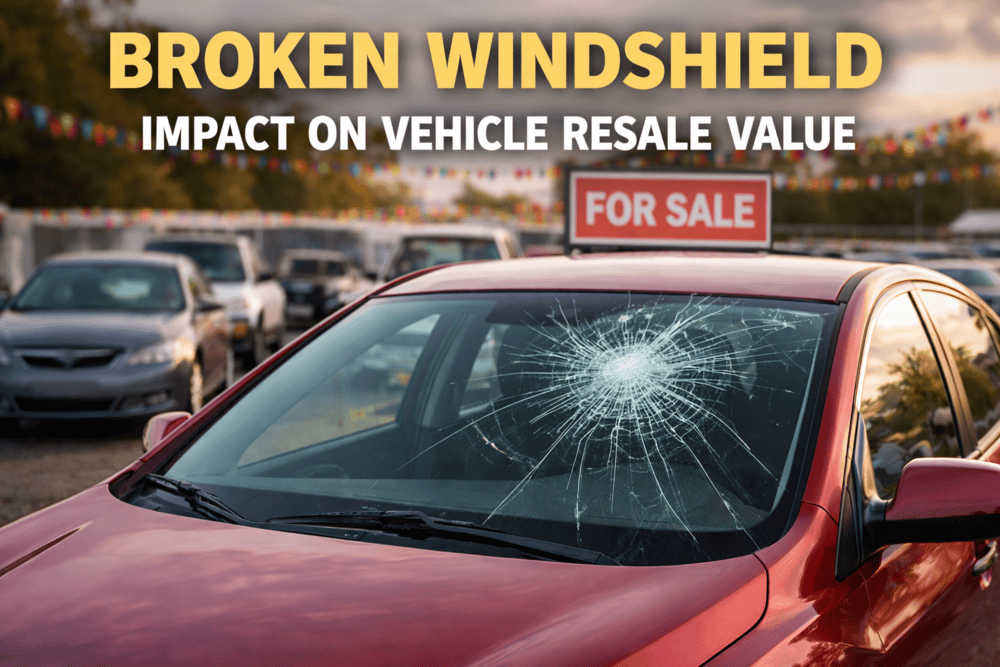
Broken Windshield Impact on Vehicle Resale Value
At last, you’ve decided to sell your vehicle. You’ve polished the paint, detailed the inside, and even located the three-year-old service paperwork. The car appears nearly perfect, yet one glaring flaw stands out: a crack in the glass. If the crack is on the passenger side or next to the wipers, it may seem to be a little cosmetic problem. You might even think that the new owner won’t mind doing the repairs themselves if you take a few dollars off the sale price. Unfortunately, you might lose hundreds or even thousands of dollars if you make this error. More than simply an eyesore, a broken windshield raises serious concerns for prospective purchasers. It gives astute negotiators the power they need to drive your price down, raises safety issues, and communicates disregard.
Get An Auto Glass Replacement Quote Now 866.278.7417

Windshield Replacement & Repair
Our competitors push you into going to their shop to get your glass fixed-making it cheaper for them. We make it easier for YOU to get back on the road by offering free mobile repairs at your home or work. With our free mobile services servicing the entire Orange County & Los Angeles area, we can often handle your windscreen replacement the same day! So the next time you need a windshield replacement, give us a call.
Talk to a Windshield Replacement Specialist Now 866.278.7417

Calibration
Calibration is the process of returning a vehicle’s ADAS to OEM specifications. Calibration is necessary after a new glass installation, particularly a windshield with a camera mounted to it, to ensure that the ADAS features continue to function properly despite having been moved during installation. If a car’s ADAS is not properly calibrated, the system may not function safely. A misaligned camera could jeopardize the functionality of the system and lead to dangerous driving or accidents, so it is crucial that the cameras are aligned perfectly, which is what windshield calibration ensures.
Talk to a Calibration Specialist Now 866.278.7417

Fleet Auto Glass Repair
We provide expert auto glass repair and windshield replacement services for commercial fleets of all sizes. We are experienced with all manufacturers and machine types of domestic or foreign cars, trucks, vans, or commercial vehicles, including heavy equipment. Our same day mobile auto glass and windshield repair service will enable you to get back on the road faster and start saving you time and money instantly. Give us a call today! We are here to help!
Talk to a Fleet Auto Glass Specialist Now 866.278.7417
The Psychology of the Buyer
A potential buyer is searching for reasons to say “no” or to pay less while they are looking at your car. A shattered windshield immediately generates an unfavorable bias, and first impressions are hard to overcome.
In sales psychology, this phenomenon is sometimes called the “halo effect”—or, in this instance, the opposite of it. If the customer notices obvious damage on the outside, they may subconsciously assume that the rest of the automobile has not received proper maintenance.
Did the owner care enough to change the oil if they weren’t concerned enough to mend a broken window? Was the transmission fluid flushed? Will the timing belt break soon? The cracked glass raises questions about the whole car, even if your engine is in perfect working order.
Changing your marketing from a “well-maintained, reliable car” to a “fixer-upper” significantly reduces your pool of potential buyers.
A turnkey car is what many private purchasers want since it allows them to drive home right away without having to schedule maintenance. Offering a vehicle with damage repels consumers who are willing to pay the highest price for convenience.
The “Hassle Tax” and Negotiation Leverage: The financial toll that a cracked windshield takes during negotiations is perhaps the most obvious effect.
Customers are not irrational; they are aware that replacing a windshield would cost money. The cost of the repair alone, however, is seldom subtracted from their offer. The cost of the repair will be subtracted, along with a “hassle tax.”
For example, a customer will not request a $300 discount on a windshield repair. They’ll probably lower the asking price by $500 or $600.
You give the buyer a strong negotiating chip when you leave the damage for them to handle. In essence, you are paying them more to solve an issue that you could have done yourself. Fixing the glass before listing the automobile is nearly always less expensive than taking the damage during price negotiations.
Safety Mechanisms and Unstated Expenses
Previously, replacing a windshield was a simple mechanical task that included glue, rubber, and glass. Because of Advanced Driver Assistance Systems (ADAS), the procedure is much more complicated and costly on newer cars.
Cameras and sensors located directly behind the windshield often operate these life-saving features. These sensors need to be carefully recalibrated to make sure they work properly when the glass is changed. If the camera is even a millimeter off, the automobile may veer out of its lane or fail to stop during an emergency.
Astute consumers are aware of this. They are considering a possible $1,000 cost for OEM (Original Equipment Manufacturer) glass and dynamic recalibration, not simply a $300 piece of glass. You risk a large devaluation if your automobile has these features and the glass is shattered, unless you have the paperwork to show the system is operational or get it fixed beforehand.
Roadworthiness and Legal Obstacles: Selling a vehicle with a shattered windshield may not only be challenging but also legally complex depending on where you reside.
Before a car’s title may be transferred or a new owner can register it, many jurisdictions and nations require that the vehicle undergo a safety check. An automated inspection failure is often caused by a crack that is in the driver’s line of sight or that is greater than a certain diameter, which is typically the size of a dollar note.
The buyer has a logistical problem as a result. They may need to tow the automobile from your driveway to a repair shop since they are not allowed to lawfully drive it on public roads until it is repaired.
The majority of purchasers just won’t put up with this hassle. Selling a vehicle that fails a roadworthy examination restricts your market to: Because they want to restore it and resell it for a profit, mechanics and flippers will give you very low pricing.
Scrap dealers: Those who determine the car’s worth by its steel weight rather than its use as a vehicle.
The car must be able to be driven lawfully as soon as money is exchanged to enter the retail sector, where purchasers pay full price.
Do you have a Question?
Get An Auto Glass Replacement Quote Now 866.278.7417
Issues with Structural Integrity
Beyond vision, glass damage presents real safety risks. The windshield is a crucial part of the vehicle’s safety restraint system in contemporary automobile engineering.
Roof Crush Protection: In the event of a rollover collision, the windshield protects up to 60% of the roof cabin’s structural integrity. The chance of the roof falling on passengers increases when a break weakens the glass.
Passenger-side airbags deploy by bouncing off the windshield and adjusting their position to safely catch the passenger. The power of the airbag deployment might shatter the windshield entirely if the glass is weakened, leaving the passenger exposed and the airbag useless.
Buyers who are concerned about safety, especially those searching for a safe family hauler or a car for their teen’s first automobile, are likely to pass on a car with damaged glass. The discount is just not worth the risk.
When to Repair vs. Replace: Complete replacement is not necessary for all damage. Determining the most economical method of preparing your vehicle for sale might be aided by knowing the extent of the damage.
Repair (Resin Injection): Damage may usually be fixed if it is a tiny chip (often referred to as a “bullseye” or “star”) that is less than a quarter in size and out of the driver’s direct line of sight. The glass is cured and bonded when a technician injects a transparent resin into the impact location.
Cost: Usually between $50 and $100, or free if you have insurance. As a result, structural integrity is restored and the fracture is prevented from expanding; however, a minor imperfection could still be present.
Conclusion: Do this before you sell. It repairs the flaw at a very low cost.
Replacement: The windshield has to be replaced if the crack is more than a few inches long, reaches the glass’s edge, or is in the driver’s direct line of sight.
Cost: Depending on the ADAS sensors, $200 to $1,000+.
Conclusion: To maintain the vehicle’s worth before selling, it is strongly advised.
Check Your Insurance Policy
Examine your auto insurance coverage before worrying about the out-of-pocket expenses of repairing your vehicle for a future sale. Many drivers have full-coverage insurance that covers some glass advantages.
Insurers are obliged by law to waive the deductible for windshield repair if you have comprehensive coverage in some areas, including Florida, Kentucky, and South Carolina. In other situations, your insurance may include an optional “full glass” rider that enables a replacement with no deductible.
If you can repair the windshield for free or with a minor deductible (e.g., $50 or $100), it’s an obvious choice. You may quickly raise your car’s resale value by hundreds of dollars with no further cost other than calling your agent.
Optimize Your Return: The sale of an automobile is a trust-based and perception-based transaction. A shattered windshield erodes both trust and perception. It signifies a project that needs attention, a potential danger, or a safety issue with the vehicle. The market data indicates that selling the automobile “as is” and leaving the trouble to the next owner is a losing approach, despite the temptation to do so.
Repairing the glass eliminates a significant negotiation point. You display a well-maintained vehicle that is safe to drive and passes inspection. A better ultimate selling price and a quicker, more seamless transaction are almost always the results of the original investment made in a repair or replacement. Don’t allow a piece of glass to prevent you from realizing your car’s full worth.
How Sales Are Killed by Windshield Damage
You’ve likely heard that you only have one chance to make a first impression. This cliché is a financial reality in the car industry.
Within seconds of walking onto a lot or meeting a private seller, a prospective buyer has an opinion about a car. They look at the tires, the paint, and, of course, the glass.
A car’s immaculate, shining exterior is a statement that it has been well-loved, cared for, and maintained. However, a bullseye chip in the driver’s line of sight or a spiderweb crack across the passenger side conveys a completely different message. It implies carelessness. It suggests that the previous owner probably overlooked the unseen problems as well if they weren’t concerned enough to address the apparent ones.
Windshield damage is a psychological barrier that diminishes customer confidence, lengthens the sales cycle, and eventually decreases the final selling price for both individual sellers and dealerships. Protecting your profit margins requires an understanding of how a single piece of glass affects the psychology of a transaction.
The Psychology of the “Halo Effect”: We must examine how people receive information to comprehend why a shattered windshield is so detrimental to a sale.
This cognitive bias is known by psychologists as the “Halo Effect.” It occurs when our general perception of a person—or in this example, a product—is shaped by our thoughts and feelings about its personality.
When a consumer sees a vehicle with immaculate paint and a clean inside, they unconsciously believe the engine and gearbox are in similarly fine shape. The favorable quality creates a “halo” around the rest of the vehicle.
However, this phenomenon also occurs in reverse. When a buyer notices a crack in the windshield, their mind instantly starts looking for further defects to support their belief that the automobile is a lemon. This phenomenon is known as the “Horn Effect.”
The crack alerts the buyer, acting as a warning sign. All at once, they are asking about the service history, listening more intently for engine knocks, and examining the area more closely for oil leaks. The confidence erodes even before the test drive begins.
Safety and Structural Integrity Perception
A windshield was only a bug shield decades ago. It is now an essential part of safety. Consumers now are more informed than ever before about car safety, and they know that glass serves more purposes than just keeping wind out.
The windshield greatly enhances the structural integrity of the vehicle’s cabin. The glass helps save people from being crushed by the roof in the case of a rollover. Additionally, the windshield serves as the backstop required for the proper deployment of the passenger-side airbag in a front-end accident. The airbag could not work as intended if the glass is damaged.
When a consumer notices a crack, they are perceiving a safety threat rather than simply an unsightly flaw. Families searching for a dependable SUV or parents purchasing vehicles for their adolescents will probably leave right away.
The perceived danger is greater than the car’s possible worth. Presenting a vehicle with broken glass forces the buyer to make a safety sacrifice, which is a trade-off that most people are hesitant to engage in.
The ADAS Complication: It’s Not Just Glass Anymore. Windscreens have evolved into more sophisticated electronic devices over the last five to ten years. Most contemporary automobiles feature Advanced Driver Assistance Systems (ADAS). These systems provide functions such as rain-sensing wipers, automated emergency braking, and lane departure warning.
Cameras and sensors located right behind the windshield often operate these life-saving features. Astute purchasers are well aware of the additional complexity and expense this brings.
A broken windshield may obscure these sensors’ vision, potentially leading to system malfunctions. It takes more than just changing a pane of glass to replace the glass in an automobile with ADAS. To make sure the cameras are pointed in the precise location, they must be recalibrated.
Buyers who are aware of such issues are aware that a contemporary car’s shattered windshield may need expert technicians to fix, costing up to $1,000. This information serves as a powerful disincentive. In the consumer’s view, it turns a little aesthetic problem into a significant mechanical pain.
Do you have a Question?
Get An Auto Glass Replacement Quote Now 866.278.7417
The Turn Key Expectations and the Hassle Factor
Our economy is based on demand. Consumers expect seamless interactions and immediate gratification. When someone makes the decision to purchase a vehicle, they often see themselves on a road trip that weekend or driving it to work the following day.
They are purchasing mobility and independence. Purchasing an automobile that requires immediate repair can derail your dream. It causes “friction” in the exchange.
The Burden of Repair: Selling a car with glass damage is like giving the customer a “to-do” list in addition to the keys. The majority of purchasers are prepared to shell out more money for a “turn-key” car, which just requires petrol.
On the other hand, if a car needs repair, they will demand a significant discount. The “hassle factor” is often evaluated at a much larger amount than the repair’s true cost. For a windshield that would have cost the dealer $150 to repair wholesale, a buyer may seek $500 off the asking price.
Dealership Image and Reputation: The stakes are significantly greater for dealerships with licenses. The state of the company’s inventory directly reflects its brand. A car lot full of vehicles with broken, damaged, or shattered glass gives the neighborhood the impression that the dealership is taking shortcuts.
The Reconditioning Standard: Reconditioning requirements are strict at premium dealerships. Before a vehicle ever reaches the front line, they repair broken glass, touch up paint, and patch dents. This creates a benchmark for excellence.
Customers are more willing to pay the asking price when they visit a store with flawless inventory because they have faith in the product’s quality. The dealership may be struggling, indolent, or dishonest if it lets broken glass stay on front-line vehicles.
Lowball bids are encouraged, and purchasers who are searching for a “steal” rather than a high-quality car are drawn to it. Skipping glass repairs to save money eventually devalues the brand as a whole.
The Leverage in Negotiations
For a negotiator, every imperfection on a secondhand automobile is a weapon. Both seasoned purchasers and professional buyers are taught to inspect the car and point out any flaws to reduce the price.
One of the simplest targets is windshield damage. It suggests safety concerns, is quite noticeable, and has an upscale appearance. The instant the customer identifies the flaw, you, the vendor, are no longer in control. Now that you’re on the defense, you’re trying to convince them that “it’s not that bad” or explain why you didn’t fix it.
You take away that advantage if you fix the glass first. You eliminate a significant objection. Instead of focusing on the car’s flaws, the discussion remains on its characteristics, capabilities, and worth.
Choosing When to Repair vs. Replace: The majority of the time, unsure sellers whether to spend money on repairs will say that they should. However, the extent of the damage determines the method of restoration.
Chip Fixes
Resin may typically fill tiny rock chips (less than a fifth). By doing this, the glass’s structural integrity is restored, and the fracture is stopped from becoming worse.
Even if a little scar could still be there, it is far less obvious and concerning than an open hole. This inexpensive fix keeps the windshield’s original factory seal intact.
Complete Replacement: Replacement is often required if the crack is longer than a dollar note or if it is in the driver’s direct line of sight. Although replacing the glass is more costly, it returns the car’s visibility to “showroom” condition. This type of fix is often the only way to guarantee that safety features in cars with ADAS function properly.
Fix the Glass to Increase Value: When selling a car, the objective is to make the most money possible while reducing the amount of time it is on the market. Clearly visible windshield damage undermines both of these objectives. It deters purchasers who are concerned about safety, encourages aggressive price haggling, and detracts from the vehicle’s overall quality image.
Repairing windshield damage eliminates a substantial psychological barrier for a very cheap cost. It lets the customer focus on the car’s shape, seat comfort, and engine sound instead of the cracks.
An automobile with clean glass is obviously ready for the road. By ensuring your merchandise offers a clear perspective, you can provide customers with the confidence they need to make a purchase.
Mobile Safe Auto Glass
14241 E Firestone blvd suite 400,
La Mirada, CA 90638
Phone: (562) 608-1154
Toll Free: 1 866 278 7417
Mail: sales@mobilesafeautoglass.com
Get a FREE QUOTE today! You can get a free quote and schedule 24/7 using this free quote wizard.
Mon – Fri 8am – 5pm
Saturday 8am – 1pm
Sunday Closed