Broken Windshield Repair Options for Modern Vehicles
Typically, it happens when you least anticipate it. A dump truck in the adjacent lane bumps into you while you are enjoying the journey down the highway. A rock bursts out, swings through the air, and then, with a terrible crunch, hits your windshield. Suddenly, your otherwise perfect vision is ruined by a running crack or a star-shaped chip. Previously, resolving such issues was a simple inconvenience. For a few hundred dollars, you may go back on the road after calling a glass company and having the pane replaced. Modern automobiles, however, have altered the situation. Your automobile has evolved into a moving computer rather than just a means of mobility.
Get An Auto Glass Replacement Quote Now 866.278.7417

Windshield Replacement & Repair
Our competitors push you into going to their shop to get your glass fixed-making it cheaper for them. We make it easier for YOU to get back on the road by offering free mobile repairs at your home or work. With our free mobile services servicing the entire Orange County & Los Angeles area, we can often handle your windscreen replacement the same day! So the next time you need a windshield replacement, give us a call.
Talk to a Windshield Replacement Specialist Now 866.278.7417

Calibration
Calibration is the process of returning a vehicle’s ADAS to OEM specifications. Calibration is necessary after a new glass installation, particularly a windshield with a camera mounted to it, to ensure that the ADAS features continue to function properly despite having been moved during installation. If a car’s ADAS is not properly calibrated, the system may not function safely. A misaligned camera could jeopardize the functionality of the system and lead to dangerous driving or accidents, so it is crucial that the cameras are aligned perfectly, which is what windshield calibration ensures.
Talk to a Calibration Specialist Now 866.278.7417

Fleet Auto Glass Repair
We provide expert auto glass repair and windshield replacement services for commercial fleets of all sizes. We are experienced with all manufacturers and machine types of domestic or foreign cars, trucks, vans, or commercial vehicles, including heavy equipment. Our same day mobile auto glass and windshield repair service will enable you to get back on the road faster and start saving you time and money instantly. Give us a call today! We are here to help!
Talk to a Fleet Auto Glass Specialist Now 866.278.7417
The Anatomy of a Modern Windshield
You must first comprehend what you are looking at to comprehend your repair possibilities. Two layers of glass are sandwiched by a layer of vinyl to form laminated automobile glass. This prevents the glass from splintering when it strikes an object.
This glass sandwich performs three vital functions in contemporary automobiles:
Structural Integrity: By contributing up to 60% of the cabin’s structural strength, the windshield shields the occupants from being crushed by the roof in the event of a rollover collision.
Airbag Support: To properly deploy, the passenger-side airbag bounces against the windshield. Weak glass might allow the airbag to pass straight through it.
This part is the revolutionary ADAS lens. Cameras mounted behind the windshield are used by Advanced Driver Assistance Systems (ADAS) to regulate automatic emergency braking, adaptive cruise control, and lane departure warnings. This third element has transformed a simple piece of glass into a precise optical component.
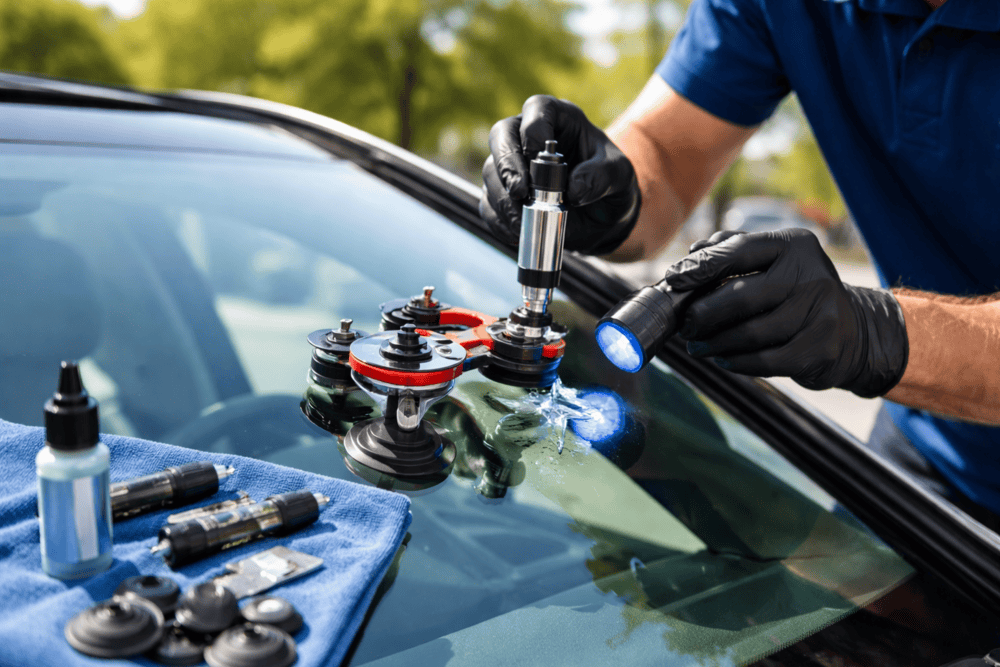
The Resin Injection Repair: Ideally, the damage would be minor enough for repair, not replacement. A transparent, curable glue is injected into the chip during this procedure. The glass’s structural strength and clarity are restored when the air is removed by a vacuum and the resin is hardened by UV radiation.
When can it be repaired? When a chip or crack can be fully covered by a $1 bill, it is usually repairable, according to the “dollar bill rule.” However, location is just as crucial as size.
Most likely, the glass can be repaired if:
The chip has a diameter of around one inch and is smaller than a quarter.
Depending on the shop’s technique, the crack’s length ranges from less than three to six inches.
The damage is not immediately visible to the driver.
The windshield’s edge is undamaged.
The advantages of fixing the glass include maintaining the factory seal around the windshield, which is almost always better than a hand-applied seal. It is also a lot less expensive.
Most insurance companies will waive your deductible because repairing the damage saves them money compared to a complete replacement. Most significantly for owners of newer cars, a simple chip repair almost never necessitates recalibrating your safety cameras.
Complete Replacement
There are instances when the damage is too severe for resin to repair. If the structural integrity of the glass is compromised, the whole windshield must be removed. When a replacement is necessary
You need a new windshield if: The structural connection between the glass and the metal frame is compromised when the fracture reaches the edge of the glass.
The inner layer of the windshield has broken; if you run your fingertip over the interior of the glass and feel a catch, it indicates that the break has reached both layers.
From the driver’s perspective, resin repairs often result in a minor imperfection or distortion. A little distortion in your straight line of sight might be hazardous or distracting.
Complex fractures: Usually too unstable to fix, several cracks spreading from a single point (sometimes referred to as a spider web).
The Unspoken Price and ADAS Adjustment: This is where sticker shock often affects owners of newer vehicles. It’s quite likely that your automobile includes ADAS features if it was manufactured after 2016.
The camera behind the glass is shifted when the windshield is replaced. Even if the new glass is positioned in the same spot, its optical properties could change somewhat.
The system may subsequently miscalculate distances if the camera’s angle changes by even one degree. This might be the result of your lane-keeping assist drifting you into oncoming traffic or your automated braking activating too late. As a result, manufacturers demand calibration after a windshield swap. There are two types:
Static Calibration: This is done in a controlled shop environment. Technicians place accurate target boards at certain angles and distances from the automobile while it is parked on a level surface. To align the cameras, the vehicle’s computer looks for these targets. This procedure calls for specialist equipment and might take an hour or more.
Dynamic Calibration: This process calls for actual driving. A technician drives on designated roads for a certain period of time at a predetermined speed while plugging a portable device into the vehicle’s diagnostic port. The device calibrates itself using the surrounding environment and road lines.
The Cost Implications: ADAS calibration may raise the price by $200 to $800, while a typical windshield repair may cost $300 to $500. It is a safety requirement, not an upsell. When getting quotes, always ask whether calibration is included by the cost.
Do you have a Question?
Get An Auto Glass Replacement Quote Now 866.278.7417
OEM vs Aftermarket Glass and Does It Matter
The quality of the glass is crucial when replacing the windshield on a vehicle with many sensors. OEM (Original Equipment Manufacturer): This glass is made by the same firm as your original windshield and has the manufacturer’s emblem. It is the exact same as what was included with the vehicle.
OEE (Original Equipment Equivalent)/Aftermarket: Third-party businesses manufacture this glass. It may not be as precise as OEM glass, but it is made for your vehicle.
Aftermarket glass is often acceptable for older vehicles. Many automakers advise or mandate OEM glass for newer vehicles equipped with ADAS. Certain sensors are very sensitive to the glass’s curve, thickness, and clarity. Calibration may sometimes be impossible or difficult when using aftermarket glass.
Please review your insurance contract. While some insurers provide an “OEM endorsement” that ensures factory glass, others only cover aftermarket glass unless you pay the difference.
Why DIY Is Not the Answer
For less than $20, you can get a windshield repair kit at any car parts shop. These kits work well for an antique farm vehicle with a little pit in the glass.
DIY is dangerous for a contemporary everyday motorist. If you fail to completely eliminate the air bubbles or cure the resin well, the fracture may widen. An expert often cannot go back in and rectify a failed repair because the glue seals the break. You will bear the cost of a complete replacement.
Damaging a $1,000+ windshield assembly to save a few bucks is usually not worth it, especially because professional repairs are usually reasonably priced (or free with insurance).
Common Questions: Will a little chip really become a crack? It’s quite probable, yes. Changes in temperature cause windshields to expand and compress. Glass may expand or contract at different rates depending on whether you use your defroster on a chilly morning or wash your vehicle on a hot day. Such forces can quickly convert a little chip into a large fracture.
What’s the turnaround time for a replacement? An hour or so is needed for the actual replacement. But before it’s safe to drive, the urethane glue requires time to dry. This additional hour is often referred to as Safe Drive Away Time. If your car requires static calibration, it will take an extra hour or two.
Does insurance cover calibration? Most of the time, yes. Comprehensive insurance coverage often covers the cost of the glass, the labor, and the calibration since the manufacturer requires it for a safe repair.
Safety Must Be the Priority
Having to deal with a damaged windshield may be costly, time-consuming, and irritating. It might be easy to overlook a little break or search for the least expensive replacement glass. But the glass on a contemporary car is doing a lot more than just keeping insects out of your teeth.
It serves as the eyes for your car’s safety systems, supports your roof, and directs your airbag. The decision is obvious when you consider windshield repair from a safety perspective rather than only a cosmetic one. Please ensure your car maintains the same level of safety as when it was purchased by promptly addressing any damage and requesting precise calibration.
The Professional Handbook on Windscreen Damage
Typically, it happens without warning. A truck in the next lane kicks up a bit of gravel while you are driving along the highway, perhaps while enjoying your favorite podcast. Thwack.
The first thing that catches your attention is the windshield. Occasionally, you are fortunate enough to avoid any scratches. On other occasions, you see a “bullseye” chip or a tiny starburst fracture just in front of you. Anger is often the first emotion, followed by the question that every car owner has: Is the repair a temporary solution, or do I need a new windshield?
There is no way to ignore the harm. Temperature fluctuations or vibrations in the road may cause tiny chips to suddenly spiderweb into large fissures, jeopardizing the structural integrity of your car. However, if a simple repair would be enough, it could be unnecessary to hurry to a complete replacement.
This resource offers professional analysis of the repair vs. replace controversy. We will explain the safety concerns associated with broken windshields, the technical constraints of glass repair, and how to choose the most economical course of action for your car.
Why Your Windshield Is More Than Just Glass: It’s critical to comprehend the function of the windshield before choosing a solution. It is an essential safety feature of your car’s structural architecture, not merely a barrier against wind and insects.
Modern windshields are made of laminated glass, which is made up of two layers of glass sandwiched by a layer of vinyl. Because of its design, the glass won’t shatter into sharp fragments when it comes into contact. Furthermore, the windshield contributes up to 60% of the roof’s structural strength in the case of a rollover crash.
If the glass is compromised, the roof is more likely to collapse. The choice to replace or repair is not only a cosmetic one since the stakes are substantial. It has to do with keeping your car’s safety rating high.
The Need for Repair
To repair a windshield, a technician injects a transparent, curable resin into the glass’s outer layer. This glue restores integrity, fills the gap, and joins the glass. It is often faster, less costly, and more environmentally friendly than replacement. Not all damage, however, is a good fit for this process. These are the main elements that often permit a repair.
The extent of the damage is determined by a widely used industry guideline known as the “dollar bill test.” If a chip or crack is completely covered by a six-inch U.S. $1 note, it is often mended.
But because of advancements in technology, some specialty firms can now fix fractures up to 12 or 14 inches long. In order for circular chips, such as bullseyes or stars, to be a good candidate for resin injection, the damage usually has to be less than a quarter (1 inch in diameter).
The depth of the impact: Only if the damage is restricted to the glass’s outer layer can it be repaired. A plastic intermediate layer (PVB), an inner glass layer, and an exterior glass layer make up a windshield.
A fix won’t hold if the rock is struck with enough force to pierce through the inner layer of glass or the plastic. Replacement is the only choice since the structural integrity has been too severely compromised.
Location Is Crucial: The location of the rock’s impact is just as significant as its force. If the damage is in the center of the glass, away from the edges, it is definitely repairable.
Do you have a Question?
Get An Auto Glass Replacement Quote Now 866.278.7417
The Argument in Favor of Replacement
Attempting to preserve the windshield is sometimes futile. In some situations, safety regulations require that the glass be completely removed and replaced.
Even the greatest repairs cannot hide damage in the driver’s line of sight. Although the resin dries clear, it often leaves a faint imperfection that resembles a smudge or dried water stain.
Most technicians would suggest replacement if the damage is directly in the driver’s line of sight, which is about the portion of the steering wheel that extends upward. Dangerous diversions or blinding glares from sunshine and approaching headlights might result from a skewed perspective.
Edge Cracks: The windshield’s edge is where the glass is most stressed. It is adhered to the car’s metal frame, which bends and twists as you drive around curves or over bumps.
If a fracture starts near the edge or extends to within a few inches of the edge, it seriously jeopardizes the structural integrity. If a repair in this “critical zone” fails, the fracture is likely to widen further. Here, replacement is the only safe course of action.
The newest and most costly component in the equation is damaged sensors and ADAS. The majority of automobiles made in 2016 and after include Advanced Driver Assistance Systems (ADAS). These include functions like rain sensors, automated braking, and lane-keeping assistance.
These systems’ cameras and sensors are often installed just behind the windshield. The system may not be able to “see” the road if the glass in front of a camera is broken. Moreover, these cameras often need to be recalibrated when the windshield is replaced, which raises the expense and difficulty of the task.
Recognizing the Variations in Cost
A car owner’s budget is always a consideration. This is the typical breakdown of the financial side.
Costs of Repair: The cost of repairs is much lower. The typical price is between $100 and $150.
The positive news is that a lot of comprehensive insurance plans will cover windshield repairs without charging a deductible. The insurance company often pays for the full cost of repairs since they save money by avoiding replacement, so you pay nothing out of pocket.
The cost of a replacement might range from $300 to over $1,000, depending on the vehicle. Because of the particular glass and calibration needed, luxury automobiles and those with ADAS systems might cost a lot more.
Unless you have a particular zero-deductible glass rider on your insurance, you will normally be responsible for paying your comprehensive deductible, which is usually $500 or $1,000.
Commonly Asked Questions
Will the chip be fully removed after repair? No. The repair will not eliminate the damage, even though it will enhance the look by 80% to 95%. The main objective of restoration is to prevent the break from becoming worse, not to restore the glass’s original appearance.
Can I fix my windshield using a do-it-yourself kit? Auto parts retailers provide do-it-yourself kits, but they are risky. If you inject the glue wrong or don’t remove the air bubbles, the repair will fail. You cannot reverse the resin after it has cured. It is advised to use professional equipment for a long-term safety solution.
How long does a repair take vs a replacement? Repairs typically take between thirty and forty-five minutes. The installation of a replacement typically takes an hour, and there is a “safe drive-away time” of at least an hour to allow the glue to dry. It may take several hours to replace if ADAS calibration is required.
Making the Final Decision: The windshield is an essential component of your car’s safety cage and serves as your window to the road. Time is critical when harm happens. After a single pothole or an afternoon in the scorching sun, a little chip might become an irreparable break.
Choose a repair right away if the damage is small (less than a dollar note), away from the edges, and allows clear vision. It is economical, ecologically friendly, and preserves the original manufacturer seal.
Don’t take shortcuts, however, if the glass is pitted, the crack scrapes the edge, or your driver assistance cameras are blocked. Plan for a full replacement to ensure the safety of both you and your passengers.
Mobile Safe Auto Glass
14241 E Firestone blvd suite 400,
La Mirada, CA 90638
Phone: (562) 608-1154
Toll Free: 1 866 278 7417
Mail: sales@mobilesafeautoglass.com
Get a FREE QUOTE today! You can get a free quote and schedule 24/7 using this free quote wizard.
Mon – Fri 8am – 5pm
Saturday 8am – 1pm
Sunday Closed