Broken Windshield Insurance Rules and Driver Liability
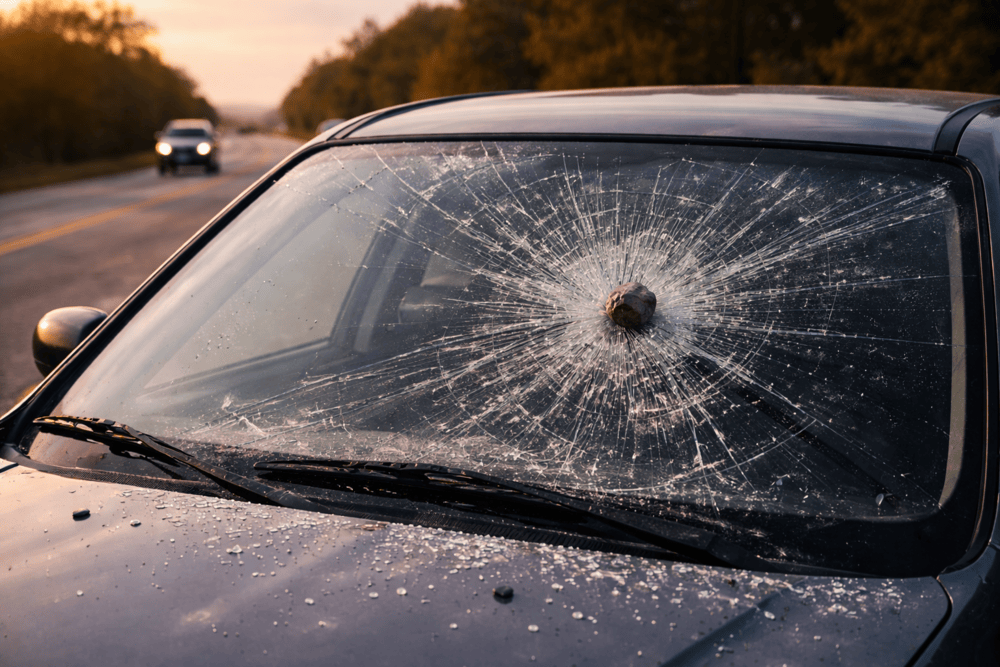
A loud thwack interrupts your journey while you are driving down the highway, maybe humming along to the radio. When you look for the source of the noise, you see that it’s a spiderweb fracture or a star-shaped chip spreading over your windshield. Everyone experiences the first frustration. But as the irritation passes, the practical issues arise. Is this covered by your insurance? Will your rates increase much if you file a claim? Is it less expensive to pay cash? The most frequent insurance claim in the US is for windshield damage, yet many drivers are still unaware of the regulations governing it. Where you reside, who is to blame, and the particulars of your insurance all have a significant impact on the coverage.
Get An Auto Glass Replacement Quote Now 866.278.7417

Windshield Replacement & Repair
Our competitors push you into going to their shop to get your glass fixed-making it cheaper for them. We make it easier for YOU to get back on the road by offering free mobile repairs at your home or work. With our free mobile services servicing the entire Orange County & Los Angeles area, we can often handle your windscreen replacement the same day! So the next time you need a windshield replacement, give us a call.
Talk to a Windshield Replacement Specialist Now 866.278.7417

Calibration
Calibration is the process of returning a vehicle’s ADAS to OEM specifications. Calibration is necessary after a new glass installation, particularly a windshield with a camera mounted to it, to ensure that the ADAS features continue to function properly despite having been moved during installation. If a car’s ADAS is not properly calibrated, the system may not function safely. A misaligned camera could jeopardize the functionality of the system and lead to dangerous driving or accidents, so it is crucial that the cameras are aligned perfectly, which is what windshield calibration ensures.
Talk to a Calibration Specialist Now 866.278.7417

Fleet Auto Glass Repair
We provide expert auto glass repair and windshield replacement services for commercial fleets of all sizes. We are experienced with all manufacturers and machine types of domestic or foreign cars, trucks, vans, or commercial vehicles, including heavy equipment. Our same day mobile auto glass and windshield repair service will enable you to get back on the road faster and start saving you time and money instantly. Give us a call today! We are here to help!
Talk to a Fleet Auto Glass Specialist Now 866.278.7417
Extensive Coverage
Windshield damage is usually included under this category. Damage to your automobile that isn’t brought on by an accident involving another vehicle is covered by comprehensive insurance. Fire, theft, vandalism, falling items (such as tree branches), and—above all—rocks thrown up by other cars are all included in this.
You make a claim under comprehensive coverage if a rock breaks your window after flying off a construction vehicle. Unless you reside in a state with a zero deductible or have a special glass waiver, you will typically be responsible for paying your deductible.
Collision Coverage: This covers shattered windshields caused by rear-ending accidents or collisions with telephone poles. Broken glass is just a portion of the total accident damage in this case. Your collision deductible, which is often more than your comprehensive deductible, will be paid by you.
Liability only: If you drive an older car and just have liability insurance, which covers injuries you cause to other people, you are on your own. Liability insurance will not pay for windshield replacement, regardless of the source of the damage.
The “Free Windshield” states: You may have heard family members or friends assert that there is never a charge for replacing a windshield. Your zip code is the only factor that determines this partial truth. Laws in a number of jurisdictions encourage drivers to promptly repair broken glass in order to uphold safety regulations.
According to state law, insurance companies are required to waive the deductible for windshield repair if you have comprehensive coverage in South Carolina, Kentucky, and Florida. A replacement really feels “free” at the point of service in some states.
You may get separate glass coverage with no deductible in other states, including Arizona, Connecticut, Massachusetts, Minnesota, and New York. Although it is not legally required in the same manner, it is a typical accessory that many drivers in these areas unknowingly own.
You are probably liable for your regular comprehensive deductible if you do not reside in one of these states. If your deductible is $500 and the cost of the windshield repair is $400, your insurance will not pay anything.
The Rule of the Dollar Bill
Repair is preferred over replacement by insurance carriers. Repairs are quicker and far less expensive and preserve the windshield’s original factory seal. Because of this, many insurance companies will entirely waive the deductible if you choose to patch a chip rather than replace the whole glass.
How can you tell whether it’s repairable? The extent of the damage serves as a useful guideline. A specialist can often patch a chip or fracture with resin if it fits under a dollar note. But location is important. Most shops will legally demand a complete replacement if the damage is squarely in the driver’s line of sight since the resin may leave a little blur that makes it difficult to see.
The Myth of Liability: “Not Responsible for Broken Windshields”: We’ve all seen dump trucks traveling down the highway with the placard that reads, “Stay Back 200 Feet. Not Responsible for Broken Windshields.”
These placards are not legal protections; they are intimidation techniques. The trucking business is responsible if a boulder falls from the bed of a truck carrying loose gravel and strikes your vehicle. Negligence occurs when a load is not secured.
It’s difficult to prove, however. A truck driver is usually not at fault when they kick up a rock that was already on the road; this is seen as a driving hazard. In order to successfully sue a transportation firm, you often need:
The rock was seen falling from the vehicle on dashcam video.
The business name and license plate number.
testimonies from witnesses.
It is often your word against theirs in the absence of concrete proof, and you will probably wind up employing your own thorough covering.
Do you have a Question?
Get An Auto Glass Replacement Quote Now 866.278.7417
The Reasons Behind Increasing Prices
Previously, changing a windshield was a straightforward mechanical procedure that cost between $200 and $300. These days, new automobiles are equipped with Advanced Driver Assistance Systems (ADAS).
When the glass is changed, these cameras must be properly recalibrated. Your safety systems might fail to stop in an emergency or cause you to drift out of your lane if they are even a millimeter off.
Calibration calls for specific expertise and costly equipment. It may increase the price of a windshield repair by two or three times, resulting in a charge that is much more than $1,000.
The good news is that the calibration expense is often covered by the insurance provider as part of the glass claim if you have comprehensive coverage. Unfortunately, a $1,000 repair cost increases the likelihood that you may be required to pay your whole deductible.
Will Filing a Glass Claim Increase My Rates? The most frequent query from drivers is this one. Usually, the answer is no, although there are certain exceptions. In general, comprehensive claims are regarded as “not-at-fault” situations. For a single glass claim, most insurance providers won’t raise your premiums. They realize that ill luck, not poor driving, is what a flying rock represents.
Frequency is a warning sign, however. You may be flagged as a high-risk customer by algorithms if you submit three windshield claims in a two-year period. A fee rise or, in the worst situations, the cancellation of your insurance might result from this. Sometimes it makes more financial sense to pay out of pocket to maintain a clean claims history if the cost of the repair is just marginally more than your deductible.
Commonly Asked Questions
Can I choose the repair business I want? Yes. You have the legal right to decide who fixes your car, but insurance companies sometimes have “preferred networks” (like Safelite) that make the billing process easier.
You may choose a specialist over a typical high-volume shop if you own a premium or vintage automobile. If the price at your preferred store is higher than the “prevailing rate,” you may be required to pay the difference.
Is the aftermarket tint covered by my insurance? The glass itself, not the aftermarket tint you subsequently added, is often covered by standard plans. It is possible that the tint will be covered if you have an endorsement for “custom parts and equipment,” however. Since factory tinting (also known as privacy glass) is a component of the original car production process, it is always covered.
What happens if I drive a rented vehicle and the glass breaks? You are protected and may leave if you bought the collision damage waiver (CDW) from the rental company. Your own auto insurance will probably pay for the damage up to your deductible if you are depending on it, but you could also be responsible for “loss of use” costs that the rental company charges while the vehicle is being fixed.
Avoid Breaking the Bank: Although a cracked windshield might be an annoyance, it doesn’t have to be a financial catastrophe. Examining your coverage before the harm occurs is crucial.
Check your comprehensive deductible by logging into your insurance login right now. You are essentially self-insuring your windshield if it is set to $1,000. It often just takes a few dollars per month to purchase a complete glass coverage rider or reduce that particular deductible to $50. Considering the growing price of ADAS-equipped glass, the little premium rise provides substantial financial and safety protection.
Is Your Cracked Windshield Illegal
It begins with the distinct sound of a stray rock hitting against your windshield—a piercing thwack. A small, spiderwebbed chip appears just in front of you, and your heart falls. Many drivers experience annoyance as their first emotion, which is swiftly followed by procrastination. It must be able to wait if it isn’t breaking.
Regretfully, putting off the repair might result in more than simply a bigger fracture. Ignoring windshield damage might land you in legal hot water, jeopardize the structural integrity of your car, and interfere with cutting-edge safety features. The windshield is an advanced piece of safety equipment, even if a little chip could seem to be a cosmetic annoyance.
Every car owner must be aware of the laws and safety requirements pertaining to auto glass. This book includes everything you need to know to keep safe and compliant, whether you’re handling insurance claims or unsure whether you’ll pass your next state inspection.
The Crucial Safety Function of Your Windshield It’s crucial to comprehend the rationale behind the rules before delving into the specifics. Bugs are not the only thing your windshield keeps out of your teeth. It is an essential part of the structural safety system of contemporary automobiles.
Integrity of Structure and Rollovers
Up to 60% of the cabin’s structural integrity is provided by the windshield in the case of a rollover collision. It keeps the roof from collapsing on the inhabitants by serving as a backstop. There is a greater chance that the roof will collapse if the glass is already damaged by a large fracture since it is more likely to break or pop out upon contact.
Airbag Deployment: The windshield is necessary for the passenger-side airbag to function properly. When the airbag deploys, it shoots upward and bounces against the glass to cushion the passenger.
The power of the airbag may blast the windshield off of the frame if the adhesive or the glass itself is fragile because of damage or incorrect installation. The airbag may not deploy properly to save a life without its backboard.
Getting Around the Law: Is it illegal to drive with a damaged windshield? In general, the answer is yes, although the details greatly depend on the extent of the damage and where you reside.
State Laws vs. Federal Regulations: The Department of Transportation (DOT) in the United States has particular rules for commercial vehicles that require windshields to be free of damage or discoloration in the middle of the important viewing region, which is basically the wiper sweep.
Although commercial trucks are the only vehicles covered by these federal regulations, numerous states have added identical wording for passenger cars. Generally, state laws are divided into two groups:
Particular Measurements: Certain jurisdictions stipulate that chips cannot be bigger than a quarter, or about 3/4 of an inch, or that cracks must be longer than a certain length, usually 6 to 11 inches.
The majority of states use more expansive wording that forbids any circumstance that “obstructs the driver’s clear view of the highway.”
There is a great deal of leeway for law enforcement to interpret this expansive phrase. A police officer may issue a penalty if they find that a lengthy fissure or spider crack is distracting or makes it difficult for you to see.
This is a “fix-it” ticket in certain jurisdictions, which means that if you can demonstrate that you fixed the glass within a certain amount of time, the fine is forgiven. It is a straight fine in others.
Inspections of Vehicles
One of the most frequent causes of failure if you reside in a state that mandates yearly or biannual safety inspections is a broken windshield. Inspectors often adhere to stringent rules:
The Wiper Zone: The windshield wipers often fail automatically if there is damage in the region they cover.
Star Cracks: Due to their propensity to spread swiftly, large “star” breaks—chips with cracks spreading outward—are often forbidden in all locations.
Edge Cracks: Cracks that extend to the windshield’s edge weaken the seal and are often the cause of failure.
How to Determine When to Replace a Stone Chip: Not every stone chip requires a full windshield repair. Thanks to substantial advancements in technology, specialists can now fill many chips with resin, restoring structural strength and visibility. But there are boundaries.
The “Dollar Bill” Rule: Auto glass companies sometimes utilize the size of a dollar bill as a general guideline. A crack is usually repairable if it is less than six inches, or the length of a dollar note. If it is longer, the structural integrity of the glass is likely too compromised, necessitating a full replacement.
Do you have a Question?
Get An Auto Glass Replacement Quote Now 866.278.7417
Location Is Important
If a chip is placed incorrectly, even a little one may need to be replaced entirely:
Direct Line of Sight: Repairs often result in a little distortion or imperfection. This is still a safety issue if it is right in front of the driver’s eyes.
The Edge: The glass is adhered to the vehicle’s metal frame at the edge of the windshield. Damage from the automobile frame bending during turns weakens the connection and spreads quickly.
The Sensors: If a chip covers any of the cameras or sensors mounted behind the glass (more on this below), a repair might interfere with their function.
The Hidden Tech: Advanced Driver Assistance Systems (ADAS) Calibration: If you drive a vehicle that was manufactured within the past ten years, replacing the windshield is more complicated than just “pop out the old, glue in the new.”
In order to provide features like adaptive cruise control, automated emergency braking, and lane keep assist, cameras and sensors are often mounted directly to the inside of the windshield. Changing the glass can cause these cameras’ angles to vary, sometimes by a millimeter.
The Need for Calibration
The technology may eventually miscalculate distances by many feet if the camera angle is off by only one degree. Your automobile can stop too late or suddenly veer out of its lane as a result.
As a result, manufacturers mandate that the ADAS systems be recalibrated after a windshield replacement. This procedure may be:
Static: Conducted in a shop with lasers and exact targets.
Dynamic: Completed by operating the car on designated roads at certain speeds.
Dual: A mix of the two.
Make sure the shop has the necessary equipment to complete calibration and that it is included in the pricing when you are obtaining a replacement price. If you skip this step, your safety features won’t work properly.
Perspectives on Insurance: Who Covers? Many drivers put off fixing a fracture because they are afraid of the expense, but your insurance may cover it more thoroughly than you realize.
Comprehensive Coverage: Damage to your windshield usually comes under the “comprehensive” section of your vehicle insurance, which covers things like weather, flying pebbles, and theft that aren’t brought on by an accident.
Paying for a modest repair out of pocket is often less expensive if your deductible is large. However, the deductible is worthwhile since replacements, particularly those that need ADAS calibration, may cost up to $1,000.
Zero-Deductible States: Under the legislation of a number of states, if you have comprehensive insurance, the deductible for windshield replacement or repair is waived. These are often known as “zero-deductible states” in the context of glass.
Complete Replacement Waiver: Insurance companies are required to forego the deductible for windshield replacement in South Carolina, Kentucky, and Florida.
Repair Waiver: In order to save the expense of a complete replacement down the road, several insurance companies throughout the country voluntarily waive the deductible for repairs (chip filling).
Always review the terms of your particular policy. Regardless of state legislation, several insurers provide certain “full glass coverage” add-ons that avoid the deductible.
Selecting the Appropriate Technician
Since your windshield is a safety device, installation quality is just as important as glass quality. Look for AGSC (Auto Glass Safety Council) accreditation when choosing a repair facility. This guarantees that the professionals have received training on how to use and install glue correctly.
The urethane glue used to bind the glass requires time to dry and harden, so you should also inquire about the “safe drive-away time.” Driving too soon might cause the windshield to leak or the seal to fail in an accident. Depending on the glue used, a trustworthy shop will specify how long the vehicle must rest before it is safe to drive, which is often an hour or more.
Don’t Let a Little Chip Turn Into a Big Issue: It’s simple to overlook a cracked windshield, but doing so puts both your safety and your finances at risk. A little chip preserves your factory seal and is a simple, low-cost solution. A lengthy fracture might lead to costly replacements requiring intricate sensor calibrations, legal issues, and inspection failures.
The wisest course of action for every motorist is to take care of damage as soon as it happens. Get that glass repaired, locate a qualified company, and review your insurance coverage. Maintaining a clear vision is important for more reasons than simply following the law; it also helps to make sure your car can keep you safe when it counts most.
Mobile Safe Auto Glass
14241 E Firestone blvd suite 400,
La Mirada, CA 90638
Phone: (562) 608-1154
Toll Free: 1 866 278 7417
Mail: sales@mobilesafeautoglass.com
Get a FREE QUOTE today! You can get a free quote and schedule 24/7 using this free quote wizard.
Mon – Fri 8am – 5pm
Saturday 8am – 1pm
Sunday Closed