Auto Glass Repair Near Me What Quality Shops Do Differently
Every driver dreads that sharp, abrupt crack. A starburst fracture appears just in front of you when a stray pebble kicks up from the car in front of you while you’re driving down the highway. Your first instinct will probably be to pull out your phone and look up “auto glass repair near me.” There will likely be a wide range of options. Large national corporations, independent local businesses, and mobile services that claim to arrive at your driveway will all be visible. The temptation to choose the cheapest quote or the earliest appointment is common when there are so many options. However, not all providers offer auto glass repair and produce the same results. Your car’s windshield plays a vital role in maintaining structural integrity and ensuring that your airbags deploy correctly.
Get An Auto Glass Replacement Quote Now 866.278.7417

Windshield Replacement & Repair
Our competitors push you into going to their shop to get your glass fixed-making it cheaper for them. We make it easier for YOU to get back on the road by offering free mobile repairs at your home or work. With our free mobile services servicing the entire Orange County & Los Angeles area, we can often handle your windscreen replacement the same day! So the next time you need a windshield replacement, give us a call.
Talk to a Windshield Replacement Specialist Now 866.278.7417

Calibration
Calibration is the process of returning a vehicle’s ADAS to OEM specifications. Calibration is necessary after a new glass installation, particularly a windshield with a camera mounted to it, to ensure that the ADAS features continue to function properly despite having been moved during installation. If a car’s ADAS is not properly calibrated, the system may not function safely. A misaligned camera could jeopardize the functionality of the system and lead to dangerous driving or accidents, so it is crucial that the cameras are aligned perfectly, which is what windshield calibration ensures.
Talk to a Calibration Specialist Now 866.278.7417

Fleet Auto Glass Repair
We provide expert auto glass repair and windshield replacement services for commercial fleets of all sizes. We are experienced with all manufacturers and machine types of domestic or foreign cars, trucks, vans, or commercial vehicles, including heavy equipment. Our same day mobile auto glass and windshield repair service will enable you to get back on the road faster and start saving you time and money instantly. Give us a call today! We are here to help!
Talk to a Fleet Auto Glass Specialist Now 866.278.7417
They Put Safety Before Speed
How they see the windshield is the most important distinction between a high-end shop and a “fast and cheap” business. It’s merely a sheet of glass to keep the wind out at a cheap store. It is a structural safety device for a quality shop.
In a modern automobile, the windshield has the capacity to support up to sixty percent of the integrity of the cabin in the event of a rollover catastrophe and up to forty-five percent in the event of a front-end collision. The roof is far more likely to collapse if the glass comes out after a collision due to shoddy installation.
Additionally, the windshield serves as a backstop for the passenger-side airbag. The airbag can deploy improperly and be ineffective if the glass breaks.
Good stores will tell you about these dangers. If the weather (such as rain or extremely cold temperatures) could weaken the adhesive’s bond, they won’t rush a job. They prioritize your safety before moving the bay to create space for the next vehicle.
Reputable Training and Certifications: Just like you wouldn’t let an unlicensed electrician rewire your home, you shouldn’t allow an inexperienced technician to repair your windshield. Despite the car glass industry having specific requirements, not all shops strictly adhere to them.
Check for Auto Glass Safety Council (AGSC) certification when searching for a repair company. The accreditation in question is widely regarded as the standard for the industry. An group that is not-for-profit and works to encourage safe replacement of car glass is called the AGSC. The Auto Glass Replacement Safety Standard (AGRSS) is something that establishments that are registered with the AGSC are obligated to follow.
At reputable companies, technicians go through extensive, continuous training. Their knowledge of the most recent advancements in automobile design and installation techniques is kept up to date regularly. Proceed to the next choice on your list if a shop is unable to clearly respond when you inquire about their credentials.
OEM Versus Aftermarket
Just as important as the installation is the glass itself. Auto glass often falls into three categories, and knowing the differences between them can help you evaluate a shop’s quality.
OEM Dealer Glass: Branded with the logo of the automaker (Honda, Ford, Toyota, etc.), Original Equipment Manufacturer (OEM) glass is produced by the same company that produced the original glass for your vehicle (such as PGW, Pilkington, or Saint-Gobain). It is exactly the same as what was shipped from the factory.
Glass OEE: The same manufacturers produce Original Equipment Equivalent (OEE) glass, although it lacks the manufacturer’s emblem. With the same stringent requirements, it is constructed in conformity with those guidelines.
Glass Aftermarket: This is frequently where low-cost stores make savings. Aftermarket glass is produced by companies that do not supply the manufacture of automobiles. The thickness, clarity, and fit can vary, but it must adhere to the Department of Transportation’s basic safety criteria. Stress cracks, leaks, and wind noise can result from poorly installed glass.
When it comes to the sort of glass that they use, a legitimate store will be forthright and honest. To guarantee a flawless fit and finish, they usually suggest OEM or OEE glass. Inquire as to whether they are utilizing subpar aftermarket glass if a quote appears unusually low.
Do you have a Question?
Get An Auto Glass Replacement Quote Now 866.278.7417
The Value of a Secure Drive-Away Time
A strong urethane glue holds a windshield in place when it is changed. It takes time for this glue to cure and solidify. A pothole or abrupt halt could cause the windshield to shift and break the seal if you drive the vehicle before the glue has had time to dry.
The windshield might come off entirely in the worst-case collision. The name that has been given to this waiting period is the Safe Drive-Away Time, or SDAT for short. The high-modulus urethane adhesives used in high-quality stores heal rapidly, enabling you to drive away safely in as little as 30 to 60 minutes.
Cheap stores frequently utilize less expensive adhesives that may take up to 24 hours to cure completely, but they may still give you the keys right away.
A trustworthy technician will offer you a precise time depending on the temperature and humidity, not just an educated guess. Always ask, “How long until I can drive the car, and what kind of adhesive do you use?”
Information Regarding the Calibration of ADAS: Advanced Driver Assistance Systems (ADAS) are becoming increasingly prevalent in automobiles that have been developed over the course of the last 10 years. Among these characteristics are
Warning of Lane Departure
Emergency Braking Automatically
Cruise control that adapts
Rain-Detecting Wipers
Quite frequently, the cameras and sensors that are a part of these systems are situated just behind the windshield. Any change in the glass will result in a change in the camera angle, even if it is only by a millimeter. The system may miscalculate distances as a result of that small change, which could lead to the lane assist drifting you into traffic or the brakes applying too late.
Good stores are aware that recalibration is required, not optional. They spend money on the costly tools and instruction needed to recalibrate these cameras to manufacturer standards. This can be accomplished statically (using targets in a shop setting) or dynamically (driving the automobile).
A shop is not providing a comprehensive, secure repair service if they tell you that your current automobile doesn’t require calibration following a windshield switch or if they advise you to “take it to the dealer” for handling.
Guarantee and Customer Support
Lastly, have a look at the shop’s commitment to its work. A warranty serves as a safeguard against flaws in the materials or workmanship.
For as long as you own the car, superior auto glass companies provide a nationwide lifetime warranty. This includes problems like mold retention, water leaks, and air leaks. It is possible that they do not have confidence in the longevity of their repair if they just offer a guarantee that is either thirty days or six years.
Indicators of customer service are also instructive. Do they take care of your insurance paperwork? The majority of trustworthy stores offer direct billing connections with major insurance companies, which simplifies the process for you. It is expected that they will be willing to respond to your inquiries without making you feel like an unpleasant bother.
Commonly Asked Questions: Is a windshield better off being repaired or replaced? If the damage is little, repair is always the first option. Chips are typically able to be repaired if they are less than a quarter in size and are found to be out of the driver’s direct line of sight. This maintains the integrity of the manufacturing seal. However, replacement is typically required for structural integrity if the crack is longer than a dollar bill or contacts the glass’s edge.
In the event that I file a claim for my vehicle’s glass, will my insurance premiums see an increase? In most cases, no. Unlike collision claims, which typically impact your premiums, auto glass damage is classified as a comprehensive claim. Many comprehensive policies even offer a zero deductible for glass damage, ensuring you won’t incur any out-of-pocket expenses for repairs or replacements. To be sure, always ask your agent.
Can a mobile service perform on par with a physical store? Yes, as long as the technician adheres to the correct protocols. Although mobile vans are practical, environmental considerations are important.
It is challenging to complete an installation properly outside whether it is raining, snowing, or below freezing. To make sure the adhesive attaches properly in a controlled setting, a reputable company will probably ask you to bring the car in during inclement weather.
Never Sacrifice Safety: You are searching for more than just a temporary solution when you type “auto glass repair near me” into your search box. You want a service that brings the safety features of your car back to their original configuration.
Although price is always a factor to take into account, it shouldn’t be the only factor on your list. Typically, a $50 or $100 difference comes from better glass, better adhesive, and highly skilled technicians who understand how to calibrate your safety systems. Look for the AGSC badge the next time you have a chip or crack, inquire about ADAS calibration, and pick a facility that will give your car the attention it needs.
How to Increase the Life of Auto Glass with the Correct Resin and Curing Technique
More than just a bother, a chipped windshield is a structural weakness that could get worse. The science behind auto glass restoration is surprisingly complicated, although many drivers believe a simple patch job is sufficient. The type of resin chosen and the curing process have a significant impact on a repair’s lifespan and safety.
Handling these factors correctly can determine whether the repair lasts the vehicle’s lifetime or breaks when you hit the next pothole. Understanding the chemistry and physics behind these decisions can help both car owners and professionals better understand the accuracy required for a truly long-lasting repair. This guide examines the crucial processes of resin selection and curing that ensure the strength, clarity, and safety of your car glass.
The Science of Durability: Resins are not all made equal. Professional auto glass specialists really select from various resins according to the type of damage. The objective is always to restore the glass’s structural integrity while matching its refractive index.
Viscosity Is Important
Viscosity, or simply the liquid’s thickness, is the most crucial property of repair glue. Low-viscosity (thin) resins are ideal for tight fractures and star breaks where the damage radiates outward in fine lines. The fluid’s thinness allows it to capillary into even the smallest cracks, filling every little space. A thick resin wouldn’t go deep enough in this case, creating air pockets that might subsequently swell.
High Viscosity (Thick) Resins: These are usually saved for larger bullseye breaks or the impact site (the “pit”) where a sizable portion of glass is crushed or missing. Compared to its thinner competitors, thicker resin functions as a more resilient filler that can tolerate surface impact and environmental deterioration.
Optical Clarity and Tint: In addition to thickness, the resin’s optical qualities are crucial to a repair’s aesthetic success. Although clear resins are the norm, tinted resins—typically green or blue—are occasionally used to improve the windshield’s factory tint or to offset the light-scattering effect of broken glass. The right tint ensures the damage “disappears” from the driver’s line of sight, a crucial safety feature.
Formulations Without Acid: High-quality resins nowadays are frequently acid-free. To improve adhesion, older formulas occasionally included acid to etch the glass; however, this could eventually cause the repair to deteriorate or turn yellow. Acid-free alternatives offer a robust chemical bond without sacrificing the glass’s long-term clarity.
The Curing Procedure
The strength of the glass must be restored by hardening (curing) the resin after it has filled the damaged area. This procedure turns the liquid resin into a solid, long-lasting polymer by causing a chemical reaction using ultraviolet (UV) light.
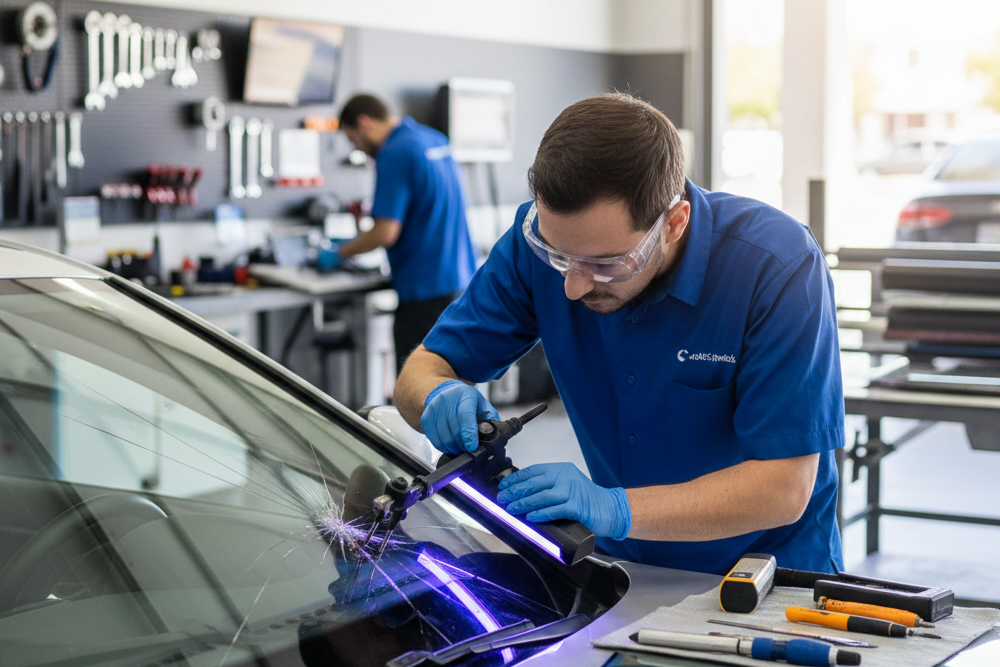
UV Light’s Function: Resin needs a particular UV light wavelength to harden; it won’t do it on its own. Although the sun naturally emits UV rays, it is dangerous to rely solely on sunlight. Uneven curing may result from cloud cover, the time of day, and the sun’s slant. A specialized UV curing lamp is usually used for professional repairs. The resin will cure fully and uniformly in a matter of minutes thanks to these lamps’ steady, intense UV light delivery to the repair area.
Curing Under Stress: Curing is frequently carried out under pressure to get the strongest connection. In the initial curing process, technicians do not remove the injector instrument.
The procedure protects the epoxy from shrinking or separating from the glass walls as it sets by forcing it deep into the crack as it starts to firm. This method is essential to prevent the repair from reopening later due to vibration or thermal expansion.
Completing the Cure: Following the initial hardening, the injector is taken out, and the injection port is sealed by applying a “pit fill” resin—typically one with a higher viscosity—to the surface.
To prevent oxygen from getting to the wet resin, a curing tab—a tiny piece of plastic film—is placed over it. Oxygen can prevent the surface layer from drying, making it sticky. To prepare the surface for polishing and scraping flush, the tab makes sure it cures hard and smooth.
Do you have a Question?
Get An Auto Glass Replacement Quote Now 866.278.7417
Why Glass Life Is Increased by Proper Curing
A partially cured repair is a failed repair in the making. If the resin maintains its softness in the middle, it will experience temperature variations that cause it to expand and contract at a different rate than the glass that is surrounding it. The entire windshield will probably need to be replaced because of the stress that eventually causes the crack to spread.
A monolithic structure is produced by proper curing. The glue restores the windshield’s capacity to serve as a protective barrier by reinforcing the broken glass layers. A properly fixed windshield guarantees the passenger airbag deploys appropriately in an accident and adds to the cabin’s structural rigidity.
Environmental Factors’ Effects: The environment must be considered during the repair process, even with the best resin and curing techniques.
Moisture: A good repair is hampered by water. The bond won’t hold if moisture is trapped inside the crack before the resin is injected. Before commencing, technicians often utilize a moisture evaporator instrument to ensure the brake is completely dry.
Depending on the temperature, glass will expand when it is heated, while it will compress when it is cold. Repairing a blazingly hot windshield might result in immediate damage spreading. On the other hand, cold glass may hinder the proper flow of resin. To make sure the resin flows and cures as planned, technicians will progressively raise the glass’s temperature to a moderate level.
How to Make Sure Your Windshield Lasts
The specifics of the procedure and the level of experience involved determine whether a repair is permanent or just a temporary fix. Skilled technicians may restore a windshield to near-factory strength and optical clarity by using precise, pressure-assisted UV curing techniques, choosing the right resin viscosity and tint, and thoroughly cleaning and prepping the damaged region.
In addition to covering up the damage, a professional repair can provide the glass with additional strength and prevent the fracture from becoming even more severe when it is performed correctly. The lesson for car owners is straightforward: fix chips right away, but choose carefully who does the work.
Instead of choosing a service that views repairs as a quick cosmetic patch, pick one that is knowledgeable about the science underlying glass bonding, curing, and structural integrity.
By prolonging the life of the original windshield, a high-quality repair lowers landfill waste, saves money, and—above all—maintains the safety features intended to keep you safe each and every time you drive.
Mobile Safe Auto Glass
14241 E Firestone blvd suite 400,
La Mirada, CA 90638
Phone: (562) 608-1154
Toll Free: 1 866 278 7417
Mail: sales@mobilesafeautoglass.com
Get a FREE QUOTE today! You can get a free quote and schedule 24/7 using this free quote wizard.
Mon – Fri 8am – 5pm
Saturday 8am – 1pm
Sunday Closed