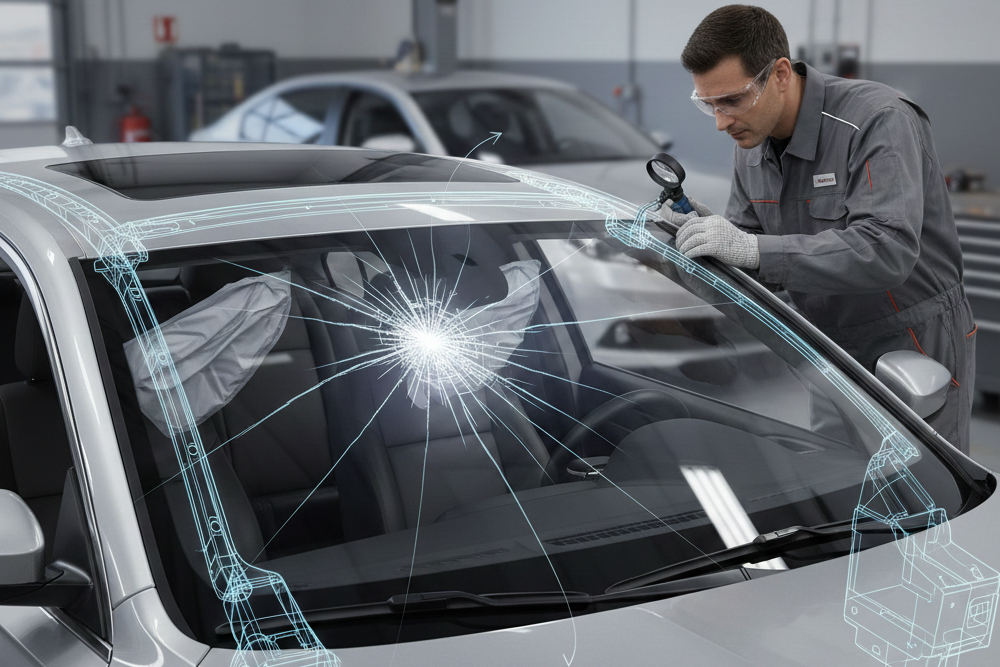
Windshield Crack Repair and Structural Safety Risks
A quick, sharp pop interrupts your playlist as you drive along the interstate. Your window has been hit by a pebble that was kicked up by the truck in front of you. A tiny chip is visible. Your first instinct may be to ignore it or hope it doesn’t spread. You may even tell yourself that you’ll deal with it “someday.” But that minor imperfection is actually a serious weakness in your car. A damaged windshield presents significant structural dangers, even though it is frequently written off as a minor cosmetic inconvenience or a possible cause of a failed inspection. Glass is crucial to modern automotive engineering because it keeps the interior stiff and guarantees that safety features operate as intended. Ignoring the crack jeopardizes everyone’s safety inside the car in addition to making it appear unsightly.
Get An Auto Glass Replacement Quote Now 866.278.7417

Windshield Replacement & Repair
Our competitors push you into going to their shop to get your glass fixed-making it cheaper for them. We make it easier for YOU to get back on the road by offering free mobile repairs at your home or work. With our free mobile services servicing the entire Orange County & Los Angeles area, we can often handle your windscreen replacement the same day! So the next time you need a windshield replacement, give us a call.
Talk to a Windshield Replacement Specialist Now 866.278.7417

Calibration
Calibration is the process of returning a vehicle’s ADAS to OEM specifications. Calibration is necessary after a new glass installation, particularly a windshield with a camera mounted to it, to ensure that the ADAS features continue to function properly despite having been moved during installation. If a car’s ADAS is not properly calibrated, the system may not function safely. A misaligned camera could jeopardize the functionality of the system and lead to dangerous driving or accidents, so it is crucial that the cameras are aligned perfectly, which is what windshield calibration ensures.
Talk to a Calibration Specialist Now 866.278.7417

Fleet Auto Glass Repair
We provide expert auto glass repair and windshield replacement services for commercial fleets of all sizes. We are experienced with all manufacturers and machine types of domestic or foreign cars, trucks, vans, or commercial vehicles, including heavy equipment. Our same day mobile auto glass and windshield repair service will enable you to get back on the road faster and start saving you time and money instantly. Give us a call today! We are here to help!
Talk to a Fleet Auto Glass Specialist Now 866.278.7417
The Windshield As A Critical Structural Component
Windscreens were essentially wind blockers in the early days of automobiles, which were just sheets of glass designed to shield the driver’s face from flying dust, insects, and rushing air.
The windshield served essentially little use other than providing basic comfort, and there was very little safety engineering. However, automobile design has changed significantly in recent years.
The windshield is a load-bearing, precisely designed part of the Safety Restraint System (SRS) of contemporary unibody cars. It works in tandem with airbags, seatbelts, and the vehicle’s chassis to protect passengers in the event of an accident.
The windshield is essentially an element of the vehicle’s safety cage, designed by engineers to work in unison with the body construction of the car. Up to 45% of the cabin’s structural integrity can be provided by the windshield in a head-on collision, which helps keep the passenger compartment’s shape.
In rollover accidents, it plays an even more crucial role, providing up to 60% of the roof’s support and averting collapse. For this structural partnership to function, the glass must remain unbroken and securely attached to the frame.
A crack or large chip compromises the windshield, diminishing its built strength. Its ability to sustain the roof in the event of a severe collision is compromised by the damage, which weakens the bond between the glass and the vehicle’s structure.
A weak windshield may completely collapse in a significant collision, raising the possibility of roof intrusion and severe passenger injuries. Ignoring seemingly insignificant cosmetic deterioration could have detrimental effects on occupant safety.
Interference with the Deployment of Airbags
Most drivers are unaware of the close and critical relationship between your windshield and airbags. Inflating directly toward the occupant is not the intended function of passenger-side front airbags. Instead, the airbags purposefully bounce off the inside of the windshield, settling into place after they launch upward at breakneck speed.
To effectively cushion the passenger’s head and upper torso, the airbag’s explosive energy is redirected and shaped by the windshield, which serves as a hard backstop in this brief moment.
For this meticulously designed interaction to function, the windshield must remain intact and firmly attached to the vehicle’s structure. The glass might not be able to sustain the abrupt force of airbag deployment if it has a large crack, intrinsic weakness, or was fitted incorrectly using subpar adhesives or faulty curing techniques.
When the airbag deploys in these circumstances, the windshield may fracture, partially separate, or even be forced out of the frame completely. The airbag may deploy through the opening or expand in an uncontrollable direction if the windshield fails to function as a backstop.
It might offer minimal restraint instead of a protective cushion, or worse, cause injuries. In the worst situations, faulty airbag deployment brought on by a damaged windshield may result in severe or fatal injuries. A seemingly small glass crack could subtly compromise one of your car’s most crucial safety features.
Do you have a Question?
Get An Auto Glass Replacement Quote Now 866.278.7417
The Risk Of Advanced Driver Assistance System (ADAS) Malfunctions
It’s highly likely that your car has Advanced Driver Assistance Systems (ADAS) if it’s a recent model. These technologies, which typically include features like adaptive cruise control, automated emergency braking, forward collision alarms, lane departure warnings, and traffic sign recognition, are intended to make driving safer and less stressful.
Many of these systems depend on cameras and sensors that are positioned just behind the windshield and are carefully positioned to continuously watch the road ahead to operate as intended.
When a tiny chip or crack breaks the windshield, the cameras lose their clarity. A fracture can subtly bend, refract, or scatter light, especially if it’s in the camera’s field of view. Although the damage might not look like much to the human eye, the distortion could be enough for a car’s computer to misread the state of the road.
Unpredictable or hazardous behavior could ensue, including abruptly stopping for a fictitious obstruction, failing to alert you when you are straying from your lane, or reacting slowly to actual dangers.
A windshield repair or replacement is not usually the end of the process. Many cars need to be recalibrated by a professional to regain accuracy because ADAS systems rely on exact measurements and angles.
If you don’t properly recalibrate the system, it may continue to misinterpret its environment, jeopardizing the safety measures designed to ensure your safety. Maintaining the functionality of these cutting-edge safety features requires that your windshield be intact, installed, and calibrated correctly.
It’s highly likely that your car has Advanced Driver Assistance Systems (ADAS) if it’s a recent model. These technologies, which typically include features like adaptive cruise control, automated emergency braking, forward collision alarms, lane departure warnings, and traffic sign recognition, are intended to make driving safer and less stressful.
Many of these systems depend on cameras and sensors that are positioned just behind the windshield and are carefully positioned to continuously watch the road ahead to operate as intended. When a tiny chip or crack breaks the windshield, the cameras lose their clarity. A fracture can subtly bend, refract, or scatter light, especially if it’s in the camera’s field of view.
Although the damage might not look like much to the human eye, the distortion could be enough for a car’s computer to misread the state of the road. Unpredictable or hazardous behavior could ensue, including abruptly stopping for a fictitious obstruction, failing to alert you when you are straying from your lane, or reacting slowly to actual dangers.
A windshield repair or replacement is not usually the end of the process. Many cars need to be recalibrated by a professional to regain accuracy because ADAS systems rely on exact measurements and angles. If you don’t properly recalibrate, the system may continue to misinterpret its environment, jeopardizing the safety measures intended to ensure your safety. Maintaining the functionality of these cutting-edge safety features requires that your windshield be intact, installed, and calibrated correctly.
Prevention of Ejection
The windshield’s ability to retain passengers inside the car in the event of an accident is one of its most horrifying—and sometimes disregarded—functionalities. The windshield is an essential secondary barrier that helps keep occupants inside the cabin’s protective structure, even if seatbelts are still the major protection against ejection.
Throwing someone from a vehicle significantly increases the risk of serious or fatal injuries in forceful collisions or rollovers, underscoring the importance of this protective role. Laminated safety glass, which is used in modern windshield construction, is made up of two layers of glass joined by a strong polyvinyl butyral (PVB) plastic interlayer.
This design keeps the glass from shattering into harmful pieces and helps it stay fixed in the frame in the case of an impact by allowing it to crack or shatter while mostly remaining intact. When it counts most, the laminated structure is designed to absorb energy and keep a protective barrier in place.
However, the windshield’s capacity to save lives is diminished when its structural integrity is already jeopardized by a huge crack or other serious damage. In a serious crash, a weak windshield has a much higher chance of tearing, separating, or being forced out of the frame.
A robust, well-bonded windshield can make the difference between being brutally ejected from the car and staying inside the safety of the cabin in high-speed collisions or rollover accidents, particularly when seatbelts fail or are not worn.
The Difference Between Repairing and Replacing
The first step in addressing windshield damage is to understand the hazards, but it is just as important to know how to properly repair or replace the glass. Not every rock chip or small crack requires a full windshield replacement, and knowing when a simple repair is sufficient can save time, money, and unnecessary work.
Typically, a repair is possible under certain conditions: the crack or chip is roughly one inch or smaller—less than the length of a quarter; the damage is not directly in the driver’s primary line of sight; and the crack does not extend to the edge of the windshield, which could compromise the seal. Repairs at this stage can restore structural integrity, prevent the crack from spreading, and maintain clear visibility.
A replacement becomes necessary when the damage is more extensive or severe. This includes cracks longer than the length of a dollar bill, damage that penetrates both layers of laminated glass, or cracks that reach the edge of the windshield, which can compromise the seal and allow moisture or debris to enter. Additionally, small divots or pitting in the glass can scatter light, making it difficult to see clearly—especially at night, during sunrise or sunset, or in direct sunlight—creating a potential safety hazard.
Understanding these guidelines helps you make informed decisions about your windshield. Promptly repairing minor chips can preserve the strength and clarity of the glass, while recognizing when a full replacement is necessary ensures that your vehicle’s structural integrity and safety systems remain uncompromised.
Never Sacrifice Road Safety
When a crack in your windshield starts, it doesn’t know when it will stop. The glass swiftly expands and contracts in response to daily temperature changes, such as turning on the air conditioner on a sweltering afternoon or blasting the heater on a freezing morning.
In an instant, frequently at the worst possible time and without notice, that ongoing tension can transform a small, innocuous-looking chip into a gigantic spiderweb crack. Potholes, road vibrations, and even typical driving circumstances only hasten the deterioration.
Simple windshield repairs are typically inexpensive, and many insurance plans pay for them with no deductible at all. In addition to saving money, taking advantage of an early repair maintains the glass’s strength and original manufacturing seal.
Addressing the problem early is a wise and responsible move when weighed against the cost of a complete replacement or, worse, the possible repercussions of a compromised windshield during an accident.
You should not wait to see if a chip or minor crack gets worse. As soon as you can, make an appointment with a qualified auto glass expert. Maintaining the structural shield that helps keep you and your family safe whenever you’re on the road is more important than simply getting your vision back to normal or passing an inspection.
How Your Windshield Is Weakened by Cracks
The truck in front of you kicks up a pebble as you’re traveling down the highway. Hurry up. A small starburst forms close to your windshield’s corner. It’s tiny, inconspicuous, and simple to ignore. It’s out of your direct line of sight; it can wait until you have more time, or it’s just another superficial flaw you’ll get over someday, you convince yourself.
After all, the glass hasn’t shattered all the way yet, and the car still drives smoothly. The majority of drivers consider their windshield to be only a clear barrier that keeps insects, dust, and wind out of the interior. It is actually a load-bearing, perfectly engineered part of your car’s safety system.
To protect passengers in an accident, modern windshields are made to support the roof during rollovers, absorb impact forces, and cooperate with seatbelts and airbags. Even small chips or cracks can weaken this mechanism, reducing its effectiveness when needed.
Stress can accumulate inside the glass if small damage is ignored. Over time, cracks propagate and structural strength deteriorates due to temperature fluctuations, road vibration, and normal driving stresses.
Knowing how auto glass works and how even small flaws weaken it shows why timely repair is more than just putting it back in a pristine state. It’s about protecting an essential safety feature that might one day mean the difference between escaping an accident unscathed and suffering severe injuries.
The Windshield’s Structural Function: You must first comprehend what the windshield accomplishes to comprehend why a crack matters. It is a manufactured safety feature that is essential to the entire structure of the vehicle, not just a window.
Laminated glass is used to make modern windshields. This consists of two glass layers encased in a polyvinyl butyral (PVB) layer. Because of its design, the glass won’t break into jagged pieces when struck. Its function goes beyond containment, though.
Roof Assistance: In the event of a rollover collision, the windshield provides up to 60% of the structural integrity of the vehicle’s roof cabin. It acts as a backstop, preventing the passengers from colliding with the roof. There is a much higher chance of a roof collapse if a crack in the glass compromises its structural integrity.
Deployment of Airbags: The windshield is necessary for the passenger-side airbag to operate properly. The airbag cushions the passenger by shooting upward and bouncing off the windshield when it deploys. If the glass is weak from a fracture, the deploying airbag, which travels at up to 200 mph, might break or push it out. In the absence of that backstop, the airbag can detonate into the road instead of the passenger, making it ineffective.
Do you have a Question?
Get An Auto Glass Replacement Quote Now 866.278.7417
The Crack’s Physics
Glass is a stiff substance that performs poorly under tension but well under compression. Even when the car is parked, the windshield is always under stress. To provide a snug fit on the vehicle’s frame, it is placed under tension.
The glass’s surface tension is disturbed when a chip or crack appears. Imagine a tear in a piece of cloth, where pushing on the fabric is okay until there is a small cut, at which time the fabric comes apart easily with very little power. This interruption provides a “stress raiser.”
Heat-Related Stress: Variations in temperature are detrimental to broken glass. The glass in your automobile stretches and contracts as it warms up in the sun or cools down with air conditioning. The expansion of a clean windshield is consistent. A crack, however, produces a discontinuity. If the glass on one side expands differently than the other, the crack may run. This causes a $50 chip that can be fixed to become a permanent crack that covers the entire windshield.
Vibration of a Machine: Vibrations pass through the vehicle’s frame and into the windshield each time you drive over a speed bump, slam the car door, or hit a pothole. These vibrations are absorbed and dispersed by a solid laminated glass sheet. Because a fractured sheet is unable to disperse energy efficiently, the damage spreads quickly, and the glass’s ability to support the roof in the event of a rollover is significantly diminished.
The Risk Associated with “Wait and See”: Many drivers assume that little chips won’t grow and use a “wait and see” strategy. The chances of winning this wager are decreasing.
The following elements make windshield damage worse: Extreme Weather: Hot summers and frigid winters severely strain the glass. Road Conditions: Construction zones and gravel roads raise the danger of vibration and impact.
Moisture: The fissure may allow water to leak in. The water will expand if it freezes, further widening the split. Moisture can delaminate the glass from the inner PVB layer even in the absence of freezing, giving the structure a foggy look.
When a fracture is larger than around six inches or extends to the glass’s edge, the structural integrity is so damaged that it is no longer safe to fix. Restoring the vehicle’s safety rating requires replacing the complete unit.
The Difference Between Repairing and Replacing: How can you tell if your windshield is salvageable?
Usually, repair is feasible if: It’s not as big as a quarter. The length of the crack is under three inches. The driver cannot see the damage right in front of them. The inner layer of glass has not been affected.
A replacement is required if: A dollar bill is shorter than the crack. The windshield’s edge is affected as well. The glass’s inner layer is fractured. There are numerous fissures, or intricate patterns of destruction.
Avoid Letting A Minor Crack Compromise Your Security
In the truest sense of the word, your windshield is a shield because it is more than simply a piece of glass; it is an essential structural element of your car. It serves as a secure backstop for airbag deployment, supports the roof in the case of a rollover, and is essential in avoiding occupant ejection in the event of an accident. A crack weakens a system that is meant to defend you at the most crucial time by causing a chink in that armor.
Immediate repair of chips and cracks protects the integrity of the vehicle’s safety cage and the windshield’s structural load-bearing capacity. Particularly when subjected to stress from temperature fluctuations, road vibration, and daily driving, minor repairs restore strength and prevent damage from spreading. Early action also saves money because repairs are often covered by insurance with little to no deductible and are less expensive than a complete replacement, saving you both time and money.
Avoid waiting until a crack extends beyond your line of sight or jeopardizes sophisticated safety measures. Please prioritize your safety, protect your investment, and have the damage evaluated by a certified auto glass specialist at your earliest convenience. When it counts most, a fast fix today can have a lasting impact.
Mobile Safe Auto Glass
14241 E Firestone blvd suite 400,
La Mirada, CA 90638
Phone: (562) 608-1154
Toll Free: 1 866 278 7417
Mail: sales@mobilesafeautoglass.com
Get a FREE QUOTE today! You can get a free quote and schedule 24/7 using this free quote wizard.
Mon – Fri 8am – 5pm
Saturday 8am – 1pm
Sunday Closed