Fast At Home Windshield Repair for Newer Cars
People generally fear the abrupt snap sound that occurs when a pebble strikes their windshield. A drive is immediately ruined by this depressing mood. On an earlier automobile, a stone chip was only a visual irritation or a minor structural problem. You could ignore it for a time, or slap some resin on it and call it a day. However, the little chip poses a much more complicated issue for owners of more recent vehicles. Modern automobiles are wonders of technology, and the windshield repair is no longer merely a piece of glass shielding you from the wind. It is a lens for complex safety systems. Your car’s operation is jeopardized when that lens is damaged. The good news is that fixing this damage doesn’t usually necessitate leaving your automobile at a shop for days.
Get An Auto Glass Replacement Quote Now 866.278.7417

Windshield Replacement & Repair
Our competitors push you into going to their shop to get your glass fixed-making it cheaper for them. We make it easier for YOU to get back on the road by offering free mobile repairs at your home or work. With our free mobile services servicing the entire Orange County & Los Angeles area, we can often handle your windscreen replacement the same day! So the next time you need a windshield replacement, give us a call.
Talk to a Windshield Replacement Specialist Now 866.278.7417

Calibration
Calibration is the process of returning a vehicle’s ADAS to OEM specifications. Calibration is necessary after a new glass installation, particularly a windshield with a camera mounted to it, to ensure that the ADAS features continue to function properly despite having been moved during installation. If a car’s ADAS is not properly calibrated, the system may not function safely. A misaligned camera could jeopardize the functionality of the system and lead to dangerous driving or accidents, so it is crucial that the cameras are aligned perfectly, which is what windshield calibration ensures.
Talk to a Calibration Specialist Now 866.278.7417

Fleet Auto Glass Repair
We provide expert auto glass repair and windshield replacement services for commercial fleets of all sizes. We are experienced with all manufacturers and machine types of domestic or foreign cars, trucks, vans, or commercial vehicles, including heavy equipment. Our same day mobile auto glass and windshield repair service will enable you to get back on the road faster and start saving you time and money instantly. Give us a call today! We are here to help!
Talk to a Fleet Auto Glass Specialist Now 866.278.7417
The High Tech Reality of Modern Windshields
To understand why repair is different for a 2024 model than a 2010 model, you have to go behind the glass. Most new automobiles are equipped with Advanced Driver Assistance Systems (ADAS). These systems have attributes such as
Warning of lane departure
Emergency braking that operates automatically
Cruise control that adapts
Rain-detecting wipers
Many of these technologies depend on cameras and sensors positioned directly against the inside of the windshield, generally behind the rearview mirror. The glass must be optically flawless for these cameras to “see” the road markers and obstructions properly.
A stone chip in the incorrect position isn’t just a nuisance; it’s a blindness for your car’s safety computer. If a repair leaves a hazy area or a distortion in the glass immediately in front of a camera, your lane-keeping assist can wander, or your automated braking might fail to function when it needs to. This adds a dimension of accuracy to the repair procedure that wasn’t required a decade ago.
The Mobile Repair Option: Expert Assistance in Your Driveway: In reality, the most often used “at-home” alternative is a service. Mobile windshield repair professionals bring the store to you. This is frequently the safest path for newer automobiles since qualified technicians understand the ramifications of ADAS.
How Mobile Repair Operates
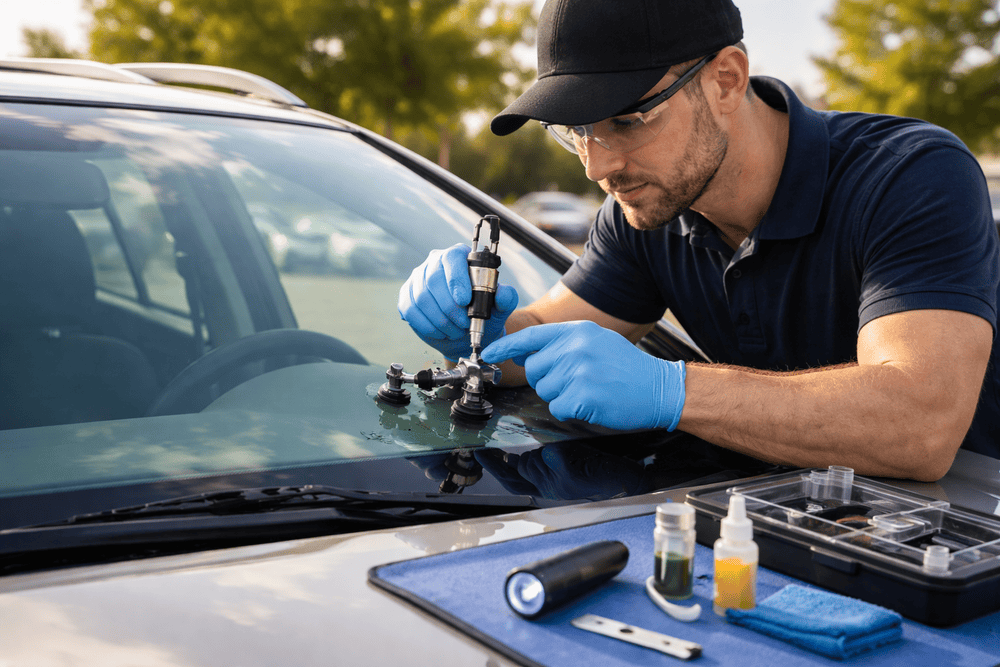
The procedure is very rapid, generally lasting 30 to 45 minutes. A technician comes to your house or workplace with a specific kit. They clean the impact spot, produce a vacuum above the chip to suck out air and moisture, and then inject a clear, high-grade resin. Ultraviolet radiation is used to cure the resin, hardening it to restore the structural integrity of the glass.
Why It Suits Newer Cars: Professional mobile experts can analyze if a chip is too near to a sensor. If the damage is squarely in the line of sight of an ADAS camera, a professional expert will generally advise against repair and urge replacement instead.
A DIY kit won’t offer you that warning. Furthermore, specialists employ resins that match the light-refracting qualities of glass more precisely than over-the-counter kits, lowering the possibility that the repair would fool your car’s sensors.
DIY Kits: Can You Fix a Smart Car Yourself?: If you are handy and the damage is modest, DIY windshield repair kits are available at most auto parts shops. They function on the same premise as professional repairs—injecting glue to connect the glass.
However, proceed with care. While these kits are rapid and inexpensive, they entail concerns for current vehicles:
Resin Quality: Consumer-grade resin may discolor over time or cure with a hazy finish. On a recent automobile, this optical distortion is more than simply unattractive; it might interfere with sensors if the chip is near the top center of the glass.
One Shot Only: Repairing a windshield is a one-time effort. You are unable to scrape the resin off and try again after it has cured. If the repair is mishandled, you may be required to replace the whole windshield.
The “Halo” Effect: A distracting “halo” or glare may result from improperly filled chips. This poses a safety risk if it is in your line of sight or the line of sight of the camera.
Recommendation: Only use DIY kits on recent vehicles if the damage is minimal (smaller than a quarter), not in the driver’s direct line of sight, and—crucially—nowhere near the ADAS camera array behind the rearview mirror.
Do you have a Question?
Get An Auto Glass Replacement Quote Now 866.278.7417
Critical Difference Between Repair and Replacement
Speed is the major reason automobile owners search for at-home maintenance. We want the issue resolved right now. But on contemporary automobiles, you must realize when a rapid repair is difficult and a complete replacement is essential.
If the fracture is longer than a dollar bill, or if a chip has spider-webbed extensively, a resin fill won’t stick. The structural integrity is gone. Replacement makes the “at-home” convenience element more difficult for modern autos.
While mobile specialists can repair windshields in your driveway, newer automobiles typically need calibration once a new windshield is put in. The cameras need to be repositioned to ensure they follow the road accurately.
Dynamic Calibration: Certain vehicles may be calibrated by using them on designated roadways at certain speeds. Mobile tech can frequently achieve this.
Static Calibration: Other vehicles need a controlled setting with level flooring and precisely spaced targets. This normally cannot be done in a driveway.
“Fast at-home service” may not be an option if your damage is significant enough to need a replacement. You may have to go to a store that has calibrating equipment. This is why spotting chips early—when they can still be fixed with resin—is crucial for current automobile owners.
Speed is Safety: Why You Shouldn’t Wait: Procrastination is the enemy of windshields. A tiny chip is a straightforward, 30-minute repair that costs very little (or is free with many insurance plans). A huge fracture is a difficult, costly replacement, including glass prices, labor, and computer calibration.
The primary cause of chips developing fractures is temperature variations. If you blast the defroster on a frosty morning or crank the AC on a hot afternoon, the thermal shock causes the glass to expand and compress. On a contemporary automobile with a laminated acoustic windshield, this force may fracture the glass quickly.
Getting a timely, at-home repair done within 24 to 48 hours of the damage happening limits this spread. It retains the factory seal of your original windshield intact, which is always preferable to an aftermarket replacement.
Frequently Asked Questions: Will my warranty be impacted by a windshield repair? In most cases, a professional repair won’t violate the warranty on your car. However, warranty issues pertaining to the ADAS systems might arise from an incorrect do-it-yourself repair that destroys sensors or necessitates a replacement with non-OEM glass. Always consult your owner’s manual.
How can I tell whether my automobile has ADAS sensors? Examine your windshield externally. If you detect a triangular or trapezoidal cutout in the black blackout band (frit) near the rearview mirror with a lens within, your automobile has sensors. You may also check your car’s settings menu for “Driver Assist” options.
Can I wash my vehicle immediately after a mobile repair? Most professional resins cure nearly immediately with UV light. You may generally drive and wash the vehicle immediately. However, if you use a DIY kit that cures by natural sunshine, you should wait at least an hour or two to ensure the connection is strong.
Is mobile repair more costly than a shop visit? Usually, the pricing is similar. Many glass firms provide mobile service as a regular convenience without a large markup. Since repair is generally completely covered by the comprehensive element of vehicle insurance plans with no deductible, it could not cost you anything out of pocket.
Do Not Let a Chip Become a System Failure
Benefits of owning a modern automobile include smart navigation, heated seats, and safety systems that keep an eye on the road. However, their benefits need upkeep. These days, a windshield chip is more than simply aesthetic damage—it might be a problem with your car’s safety system.
A little rock chip shouldn’t become a significant calibrating headache. Whether you pick a high-quality DIY option for peripheral damage or contact a mobile specialist for a precise repair, the aim is the same: act swiftly. Addressing the damage in your driveway now saves you from the repair shop waiting room later.
Why Local Windshield Calibration Issues May Require Pros: You’re traveling down the interstate, cruise control activated, when a rock kicks up and causes a spiderweb break in your windshield. It’s frustrating, yes, but a short trip to the auto glass shop generally cures it. However, a straightforward glass repair isn’t always the solution for contemporary cars.
If your automobile was produced in the previous decade, there is a significant possibility it is equipped with Advanced Driver Assistance Systems (ADAS). These systems depend on cameras and sensors generally located straight behind your windshield. When that glass is replaced—or even jostled significantly—those sensors might become misaligned.
The outcome can be more than simply a warning light on the dashboard; it might be an automated braking system that activates too late or a lane-keeping aid that causes you to veer into traffic. Windshield calibration is useful in this situation.
While many auto repairs may be done at home, calibration is an exact science that almost always calls for expert assistance. Here is why you shouldn’t cut corners when it comes to your vehicle’s “eyes.”
Comprehending the Windshield Connection and ADAS
To understand why calibration is important, you first need to understand what your windshield is really doing. It is no longer simply a cover against wind and bugs; it is a lens for your car’s computer. Among the characteristics of ADAS are
Lane Departure Warning: Alerts you if you drift without signaling. Adaptive cruise control keeps you a safe distance from the vehicle in front of you.
Collision Avoidance Systems: Automatically brakes to avoid accidents.
Traffic Sign Recognition: Reads speed limits and stop signs.
Most of these systems feature a forward-facing camera affixed to the windshield. That camera’s angle changes when the glass is taken out and put back in.
The camera’s focal point may be shifted many feet along the road by even a single degree. If the camera believes the automobile ahead is 100 feet away when it is only 80 feet away, your safety systems cannot respond in time.
Static vs. Dynamic Calibration: One of the major reasons expert aid is required is the intricacy of the calibration procedure itself. It isn’t a “one size fits all” technique. Depending on your vehicle’s make and model, you will need either static calibration, dynamic calibration, or occasionally both.
Static Adjustment
This occurs in a regulated shop setting. It needs certain targets that are fixed on fixtures at exact heights and distances from the car. The floor must be exactly level, the lighting must be uniform, and there must be no clutter in the backdrop that may confuse the sensors.
Trying to reproduce this climate in a residential garage is practically difficult. Professionals spend thousands of dollars on aiming systems and laser-leveling gear to achieve accuracy down to the millimeter.
Dynamic Calibration: This procedure is carried out while driving. For a certain amount of time, a technician drives at predetermined speeds on well-designated routes while attaching portable equipment to the car’s OBDII port.
While this seems easy, it needs diagnostic software that often isn’t accessible to the common customer. Furthermore, if the procedure fails or is stopped by weather or traffic, it must be resumed.
Do you have a Question?
Get An Auto Glass Replacement Quote Now 866.278.7417
The Risks of Improper Calibration
Ignoring calibration or trying a low-quality correction might lead to “calibration drift.” This is when the sensor is functional, but its data is slightly incorrect. The repercussions vary from bothersome to hazardous.
False Positives: When your automobile sees a shadow or a metal plate on the road as an obstruction, it may apply the brakes forcefully. Unexpected braking at highway speeds causes a huge threat for you and the traffic behind you.
System Failure: In a worst-case situation, the system just won’t function when you need it. If you depend on lane-keep assist and the sensor is misaligned, the vehicle can drive you into the shoulder rather than keeping you centered.
Voided Warranties and Insurance Issues: If you are involved in an accident and it is discovered that your ADAS systems were not correctly calibrated following a windshield repair, your insurance company may complicate your claim. Similarly, car manufacturers typically demand verified calibration to preserve the guarantee on safety equipment.
Why “Local” Doesn’t Always Mean “Pro”: When looking for “windshield calibration near me,” you will likely discover dozens of possibilities. However, not all car glass shops are prepared to perform ADAS calibration.
Some local, smaller businesses could contract out this work to dealerships, which would increase the time and expense of your repair. Others could say they can do it but lack the latest software for newer models. When assessing a local supplier, look for these characteristics of professionalism:
Certification: Have the technicians received specialized training on the systems used by your car manufacturer, or are they certified by the Auto Glass Safety Council (AGSC)?
Equipment: Do they have the appropriate objectives and diagnostic tablets (such as Autel or Bosch systems) visible in the shop?
Documentation: Will they offer a certificate of calibration upon completion? This document is crucial for your records and possible insurance requirements.
The Expense Aspect
The main deterrent for drivers to seek expert calibration is cost. It is an extra expenditure on top of the glass repair, often ranging from $250 to over $500 depending on the intricacy of the system.
Nonetheless, calibration is often covered as part of a windshield claim by comprehensive insurance coverage. Because insurance companies recognize that ADAS dramatically decreases the probability of accidents, they typically encourage (and frequently demand) adequate calibration standards.
Even if you are paying out of pocket, balance the expense versus the benefit of the safety measures. The purpose of these systems is to save lives. Disabling them or allowing them to work wrongly to save a few hundred dollars contradicts the point of driving a modern, safe car.
When to Call the Pros: You should seek expert calibration services if:
The Windshield Cracked or Was Replaced: Any disturbance to the glass necessitates a system reset.
Dashboard Lights Appear: If an ADAS warning light (typically a symbol of a vehicle with waves surrounding it) flashes.
Suspension Changes: The sensor geometry has changed if you have raised or lowered your car.
Wheel Alignment: Significant alterations to wheel alignment may occasionally impact the thrust angle, necessitating sensor recalibration.
Putting Safety Above Convenience
Modern cars are technological wonders, but they need to be maintained. Windshield calibration is an essential maintenance procedure that guarantees your vehicle sees the road properly; it is not a marketing ploy.
While it can be tempting to go for the cheapest local alternative or skip the procedure completely, the safety of you and your passengers depends on those sensors being pinpoint precise. When it comes to ADAS, always hire a licensed expert with the necessary equipment and training to get the job done correctly.
Mobile Safe Auto Glass
14241 E Firestone blvd suite 400,
La Mirada, CA 90638
Phone: (562) 608-1154
Toll Free: 1 866 278 7417
Mail: sales@mobilesafeautoglass.com
Get a FREE QUOTE today! You can get a free quote and schedule 24/7 using this free quote wizard.
Mon – Fri 8am – 5pm
Saturday 8am – 1pm
Sunday Closed