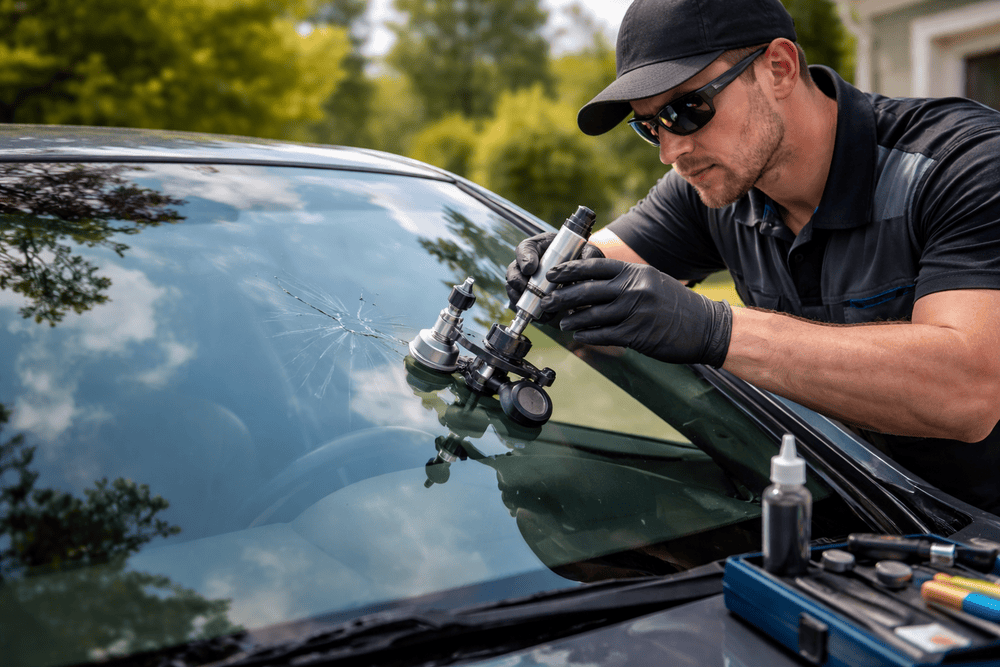
Complete Auto Glass Windshield Repair Guide
Usually, it happens unexpectedly. You are driving down the interstate, enjoying the open road, when a sudden loud pop startles you. A stone thrown up by the vehicle in front of you has found its target, creating a tiny, jagged chip in your windshield. You may decide to disregard it at first. After all, the mark is modest, and you have a hectic schedule. However, dismissing that minor flaw is typically an expensive error. Windshields are under continual stress from wind resistance, chassis bending, and temperature variations. What begins as a little chip may soon spiderweb into a large break that spans the full width of the glass. Your choices radically alter as soon as the harm spreads.
Get An Auto Glass Replacement Quote Now 866.278.7417

Windshield Replacement & Repair
Our competitors push you into going to their shop to get your glass fixed-making it cheaper for them. We make it easier for YOU to get back on the road by offering free mobile repairs at your home or work. With our free mobile services servicing the entire Orange County & Los Angeles area, we can often handle your windscreen replacement the same day! So the next time you need a windshield replacement, give us a call.
Talk to a Windshield Replacement Specialist Now 866.278.7417

Calibration
Calibration is the process of returning a vehicle’s ADAS to OEM specifications. Calibration is necessary after a new glass installation, particularly a windshield with a camera mounted to it, to ensure that the ADAS features continue to function properly despite having been moved during installation. If a car’s ADAS is not properly calibrated, the system may not function safely. A misaligned camera could jeopardize the functionality of the system and lead to dangerous driving or accidents, so it is crucial that the cameras are aligned perfectly, which is what windshield calibration ensures.
Talk to a Calibration Specialist Now 866.278.7417

Fleet Auto Glass Repair
We provide expert auto glass repair and windshield replacement services for commercial fleets of all sizes. We are experienced with all manufacturers and machine types of domestic or foreign cars, trucks, vans, or commercial vehicles, including heavy equipment. Our same day mobile auto glass and windshield repair service will enable you to get back on the road faster and start saving you time and money instantly. Give us a call today! We are here to help!
Talk to a Fleet Auto Glass Specialist Now 866.278.7417
Identifying Different Types of Windshield Damage
Not all glass damage is created equal. Whether a technician can rescue the glass or whether it will end up in the recycling bin depends on the form and depth of the hit. Knowing the lingo helps when you contact for a quotation.
The Bullseye: This is one of the most prevalent forms of impact injury. It appears precisely as its name implies: a black circle with an impact point in the center. Bullseyes are often clean breaks. Because there are no extensive fractures spreading from the core, they are frequently the simplest candidates for restoration.
The Star Break: A star break features a core impact point with small fractures extending outward, like a star. These are repairable if found early. However, since the fractures are already spreading, this sort of damage is very vulnerable to developing if the car hits a pothole or endures significant temperature fluctuations.
The Half Moon: This is akin to a bullseye but isn’t a complete circle. It resembles a half-moon or a semicircle. Like the bullseye, they are often easy to replace since the damage is limited.
The Stress Crack: Unlike the others, a stress crack occurs without an impact item. These occur owing to significant variations in temperature, such as splashing boiling water on an icy windshield or blasting the A/C on a blazing hot day. Stress cracks frequently originate near the border of the windshield and are seldom repairable.
The Big Question
Determining whether you can patch the glass or require a complete new windshield comes down to three primary factors: size, depth, and position.
The Size of the Damage: A popular rule of thumb employed by many car glass companies is the “Dollar Bill Rule.” If the damage can be covered totally by a dollar bill, a repair is generally achievable.
For chips, if the damage is less than a quarter (approximately one inch in diameter), it is nearly always repairable. Once a fracture grows beyond six inches, the structural integrity of the glass is compromised, and replacement becomes the only safe choice.
Laminated glass is used to construct windshields, which are characterized by their depth. This is made up of two layers of glass, with a layer of vinyl (PVB) placed in between the two layers respectively. If the rock strikes hard enough to penetrate through the outer layer and the vinyl, penetrating the inner layer of glass within the cabin, the windshield cannot be fixed. It must be replaced.
The Impact Location: The location of the damage on the glass is just as important as its size.
Line of Sight: Even the greatest restorations leave a tiny imperfection or distortion. If the damage is immediately in the driver’s line of sight (an approximately 8.5 x 11-inch area above the steering wheel), most respectable shops will refuse to fix it for safety concerns.
The Edges: In a rollover accident, up to 60% of the cabin’s structural strength comes from the windshield’s perimeter. If a fracture or chip is within two inches of the edge, it weakens the link between the glass and the metal frame. These frequently need replacing.
Sensor Arrays: Rain sensors and lane-departure cameras are examples of Advanced Driver Assistance Systems (ADAS) installed behind the glass in modern automobiles. Damage directly above these sensors might compromise their performance, typically demanding a replacement to ensure the safety systems operate appropriately.
The Cost Factor: What to Expect The budget is a big worry for automobile owners. Thankfully, there is a big price difference between a repair and a replacement.
Repair Costs: A simple rock chip repair is reasonably inexpensive. You should anticipate spending between $60 and $150 for a skilled repair. Many establishments give a discount if you have many chips treated at the same appointment.
Replacement Costs: Replacing the whole glass is a bigger financial investment. For an older car with no sensors, a replacement may cost between $200 and $400. However, for current automobiles equipped with ADAS technology, the price climbs dramatically.
The glass itself is more costly, and the cameras must be recalibrated after installation. A replacement with recalibration might vary from $700 to over $1,500.
Insurance Coverage: Check your insurance before you pay out of pocket. Many drivers have comprehensive coverage that covers glass.
Under some circumstances, insurance companies are required to waive the deductible for windshield repairs in order to encourage drivers to treat chips in their windshields before they grow into potentially dangerous cracks. For replacements, you will normally have to pay your deductible, while some insurance provides particular “full glass coverage” with a $0 deductible.
Do you have a Question?
Get An Auto Glass Replacement Quote Now 866.278.7417
DIY Repair Kits vs Professional Service
You can get do-it-yourself windshield repair kits for less than $20 at any car parts shop. These kits normally comprise a modest quantity of resin and a plunger device. While they may be useful for extremely tiny, basic surface chips, they involve dangers.
Professional technicians use industrial-grade resins and strong vacuum pumps to remove all air from the break before filling it. If you try a DIY repair and fail to remove all the air, the fracture may continue to expand. Furthermore, once you put resin into a chip, you cannot pull it out.
If a DIY repair fails, a professional cannot correct your error; you will likely have to purchase a new windshield. For most drivers, the minor savings of a DIY kit aren’t worth the danger of destroying the windshield permanently.
Why You Shouldn’t Wait: Auto glass suffers from procrastination. Several circumstances may transform a repairable chip into a complete loss within days or even hours.
If you park a vehicle with a damaged windshield in direct sunshine, the glass warms up, causing the fracture to widen. Instant crack spreading is often caused by quick heating in a concentrated region while using the defroster on a chilly morning.
Dirt and Moisture: A chip leaves the inner layers of the glass exposed. Over time, road filth, windshield wiper fluid, and rain penetrate the crack. The resin may not be able to properly adhere to the glass as a result of this filth. If the damage becomes too unclean, a repair can result in a hazy or milky look, or it might not hold at all.
The Role of ADAS in Windshield Replacement
If you drive a vehicle constructed in the previous several years, your windshield is likely part of a complicated safety web. Advanced Driver Assistance Systems (ADAS) rely on cameras and lasers frequently placed against the glass behind the rearview mirror.
When a windshield is changed, these cameras are repositioned. Even a movement of a single millimeter might throw off the car’s ability to identify lane boundaries or activate emergency brakes.
Therefore, contemporary windshield replacement is a two-step process: replacing the glass and recalibrating the computers. There are two kinds of calibration:
Static: Done in a shop using specialized targets and lasers.
Dynamic: Requires driving the car at particular speeds on defined roads while a computer is hooked into the system.
If your automobile requires a replacement, check that the shop is qualified to handle ADAS calibration. Skipping this step might make your safety features worthless.
Don’t Let a Small Chip Break the Bank: Your windshield is vital to your vehicle’s safety cage and your visibility on the road. While a rock chip is an irritation, dealing with it immediately is the wisest financial move you can make for your automobile.
If you find a chip, cover it with a tiny piece of transparent tape to keep dirt out (this is a temporary solution, not a remedy) and call a glass shop immediately. Whether you need a fast resin fill or a comprehensive replacement with safety sensor calibration, prioritizing your vehicle glass guarantees you get back on the road safely and clearly.
Why Did My Windshield Crack
You park your vehicle in the driveway on a Tuesday evening, and everything seems wonderful. Wednesday morning, you step out with your coffee, ready to start the commute, and there it is—a jagged line running across the glass. No rock struck it overnight. No baseballs were thrown. It appears to have appeared by magic.
For car owners, this situation is annoyingly typical. While flying debris on the roadway is the most apparent cause for glass damage, it is far from the only one. Windshields are vital to your car’s structural safety, engineered to resist great pressure, but they are unexpectedly sensitive to particular climatic and mechanical stresses.
These enigmatic fractures may be frustrating, but they always have a core cause. A break that emerges without a distinct impact point is sometimes referred to as a “stress crack.” The first step in mending your vehicle glass and preventing it from occurring again is figuring out why it failed.
Extreme Temperature Fluctuations: Science informs us that items expand when heated and shrink when cold. Your windshield is no exception. While vehicle glass is tempered and laminated to be robust, it has its limitations, particularly when those temperature fluctuations happen fast.
The Defroster Danger: During winter, a coating of ice typically covers the glass. The inclination is to blast the defroster on the maximum setting or, worse, dump hot water over the outside. This quick application of strong heat to frozen glass generates significant tension. The glass’s surface layer stays constricted due to the cold, while its interior layer quickly expands. A snap is often caused by the ensuing stress.
The Scorcher of Summer
The same idea applies in reverse during the summer. If your automobile has been roasting in direct sunshine, the inside temperature of the glass might skyrocket. Blasting the air conditioning straight into the windshield generates a thermal shock. Abrupt, jagged fractures may result from the inside surface rapidly cooling against the superheated outer surface.
Improper Installation: If you have had your windshield replaced lately, the cause of the fracture can be human error. A windshield depends on proper installation to fit perfectly inside the vehicle’s frame (the pinch weld).
If a technician fails to clean the frame correctly, employs the incorrect sort of urethane glue, or doesn’t repair the rust on the pinch weld, the glass won’t bind firmly. Furthermore, if the glass is fitted into the frame unevenly, it will be under continual mechanical stress.
The car’s body naturally twists as you drive over bumps or make quick curves, applying pressure straight to the glass. Eventually, the glass gives up and splits to release the stress.
Glass Quality Flaws: Not all car glass is made equally. Original Equipment Manufacturer (OEM) glass is created to the precise requirements of your car’s manufacturer. However, many repair businesses employ Original Equipment Equivalent (OEE) or aftermarket glass to economize on expenses.
While many aftermarket choices are safe, lower-quality glass may have tiny flaws. At first, these flaws—such as tiny variations in the thickness or contaminants in the silica—might not be discernible to the unaided eye. Road vibration and wind resistance exacerbate these weak areas over time, causing a sudden fracture.
Do you have a Question?
Get An Auto Glass Replacement Quote Now 866.278.7417
The Unnoticeable Chip
Sometimes, the reason isn’t concealed at all; it’s simply incredibly hard to notice. The perimeter of your windshield has a black ceramic ring called the frit. Its role is to protect the urethane sealant from UV rays and give a rough surface for the adhesive to attach to.
If a little rock touches the fruit, the black backdrop may disguise the damage. You could drive for weeks without knowing there is a chip in the glass. However, as moisture settles into that small chip and freezes, or dirt makes its way in, the harm starts to spread. A little tremor from a pothole may be the last straw that sends a fracture shooting out from the edge of the glass into your field of view.
Structural Integrity Issues: Your windshield contributes up to 45% of the structural integrity of your vehicle’s cabin in a front-end accident and up to 60% in a rollover. Because the glass is a load-bearing component, faults with the car’s body may harm the glass.
Old automobiles or cars that have been in past accidents may suffer from frame warping. If the frame is deformed, it exerts torque on the windshield aperture. Additionally, rust surrounding the window frame is a quiet murderer of glass.
As metal rusts, it expands—a process known as “rust jacking.” The corroding metal pushes against the edge of the glass, generating pressure points that ultimately cause the windshield to crack from the outside in.
Atmospheric Pressure Variations: While less common than temperature or collision damage, dramatic variations in pressure may compromise vehicle glass. This is most typically observed in high-speed driving mixed with heavy wind gusts.
The wind pressure on the outer layer of the glass causes stress. Similarly, sudden changes in elevation might add to the condition.
Sunlight and Aging
Although glass is strong, it is not eternal. Over years of exposure, the persistent UV radiation from the sun may make the glass and the plastic interlayer increasingly brittle. This aging process, sometimes termed solarization, diminishes the windshield’s capacity to bend and absorb stress.
An older windshield is just less durable than a new one. The cumulative impact of thousands of miles of vibration, pitting from road grit, and temperature cycling means that an older windshield can fracture under circumstances that a fresh windshield would easily shrug off.
Frequently Asked Questions: Can I drive with a broken windshield? Legally, this depends on where you reside. If a crack obstructs the driver’s line of sight or interferes with the windshield wipers’ ability to function, driving is prohibited in many areas. Safety-wise, it is not advised. A cracked windshield has impaired structural integrity, which may influence airbag deployment and roof strength in a collision.
Will a stress crack be covered by my insurance? Most comprehensive insurance packages include windshield replacement. If you have glass coverage, many insurers will pay for the fracture with no deductible if it is shown to be a “stress crack” (i.e., there is no point of contact like a rock chip). Standard deductibles could be applicable, however, if the break was caused by a chip you neglected.
How can I distinguish between an impact crack and a stress crack? Grab a ballpoint pen. Run the tip of the pen along the crack. If the pen snags in a divot or pit, it is likely an impact fracture produced by debris. If the pen glides smoothly along the whole length of the fissure without sinking into a chip, it is likely a stress fracture caused by temperature or installation concerns.
Do Not Ignore the Warning Signs
A cracked windshield is more than simply a visual inconvenience; it is a safety threat. Whether the damage happened due to a wayward stone, a chilly morning, or a faulty installation job, the structural strength of your car is jeopardized the instant the glass breaks.
Examine the glass’s edges and take the recent weather into account if a crack suddenly appears. Understanding the reason will help you defend your case for a warranty replacement if faulty installation or damaged glass is to blame. Regardless of the source, rapid intervention is crucial. Small fractures may be patched and sealed, but if they spread, replacement becomes your only choice.
Mobile Safe Auto Glass
14241 E Firestone blvd suite 400,
La Mirada, CA 90638
Phone: (562) 608-1154
Toll Free: 1 866 278 7417
Mail: sales@mobilesafeautoglass.com
Get a FREE QUOTE today! You can get a free quote and schedule 24/7 using this free quote wizard.
Mon – Fri 8am – 5pm
Saturday 8am – 1pm
Sunday Closed