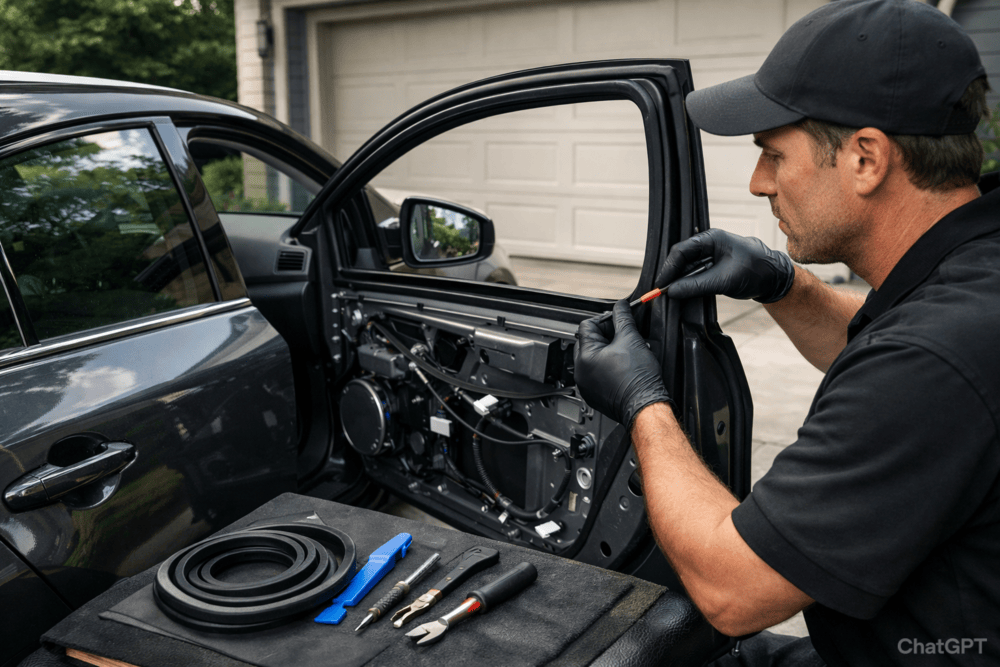
Driver Side Window Replacement Noise Seal Fixes
Hearing a high-pitched whistle next to your ear while driving on a highway is one of the most unpleasant things in the world. You anticipate a peaceful interior and a spotless view after spending money to have your driver-side glass fixed. Instead, a wind leak drowns out your radio, making it difficult to carry on a conversation. This is an annoyingly typical situation. The installation procedure isn’t always flawless, regardless of whether the glass was replaced because of a break-in, an accident, or even a stray pebble. At 60 miles per hour, even a space as little as a sheet of paper may produce a lot of noise. The positive news is that you can fix the problem without requiring hiring a technician or going back to the auto glass shop.
Get An Auto Glass Replacement Quote Now 866.278.7417

Windshield Replacement & Repair
Our competitors push you into going to their shop to get your glass fixed-making it cheaper for them. We make it easier for YOU to get back on the road by offering free mobile repairs at your home or work. With our free mobile services servicing the entire Orange County & Los Angeles area, we can often handle your windscreen replacement the same day! So the next time you need a windshield replacement, give us a call.
Talk to a Windshield Replacement Specialist Now 866.278.7417

Calibration
Calibration is the process of returning a vehicle’s ADAS to OEM specifications. Calibration is necessary after a new glass installation, particularly a windshield with a camera mounted to it, to ensure that the ADAS features continue to function properly despite having been moved during installation. If a car’s ADAS is not properly calibrated, the system may not function safely. A misaligned camera could jeopardize the functionality of the system and lead to dangerous driving or accidents, so it is crucial that the cameras are aligned perfectly, which is what windshield calibration ensures.
Talk to a Calibration Specialist Now 866.278.7417

Fleet Auto Glass Repair
We provide expert auto glass repair and windshield replacement services for commercial fleets of all sizes. We are experienced with all manufacturers and machine types of domestic or foreign cars, trucks, vans, or commercial vehicles, including heavy equipment. Our same day mobile auto glass and windshield repair service will enable you to get back on the road faster and start saving you time and money instantly. Give us a call today! We are here to help!
Talk to a Fleet Auto Glass Specialist Now 866.278.7417
Why New Windows Frequently Leak
Knowing why the noise is occurring might help you get your toolbox ready. An automobile door’s seal mechanism is quite intricate.
It depends on the glass applying a certain amount of pressure to a rubber weatherstrip, also known as a run channel. A window’s replacement affects several variables:
Glass Curvature: The curvature may be a little incorrect if the shop utilized aftermarket glass instead of Original Equipment Manufacturer (OEM) glass. Glass may not seat snugly against the seal if there is a millimeter discrepancy in the curvature.
Regulator Position: The window may have stopped just short of the top due to a possible movement in the regulator, the mechanical arm that raises the glass, during installation.
Deformed Seals: The rubber seal on an older automobile may have developed a “memory” of the original glass. The old, rigid rubber is unable to adjust to the new shape, and the new glass sits differently.
Finding the Leak: Without knowing the precise location of the leak, you cannot remedy it. Wind noise may seem to come from the upper corner, but the gap may be near the mirror.
The Window Reset Process: The computer must know the precise location of the top and bottom of the track, whether your automobile has “auto-up” or “auto-down” windows.
The automobile often loses its memory when a motor is unplugged during replacement or a battery is disconnected. The window might be stopping 1 mm short of the seal. Methods for recalibrating:
Set your ignition to “On” without starting the engine. Depress and hold the window switch. Hold the button down for another 5 to 10 seconds once the window has completely opened.
To shut the window, pull up the switch. Hold the switch up for another 5 to 10 seconds once it is completely closed. Check the window. The window motor is essentially told, “This is the absolute bottom, and this is the absolute top.” This additional force is often sufficient to close the gap.
Rubber Seal Restoration
Rubber’s pliability produces a seal. Heat and UV radiation gradually dry up the weatherstripping, making it brittle and rigid. The stiff rubber does not conform to the new glass when it is placed.
Try to condition the seal before replacing it. Get a high-quality silicone spray lubricant or a bottle of Shin-Etsu grease. Using a cloth and soapy water, thoroughly clean the window channel’s inside to get rid of any dirt or moss. After drying, liberally coat the rubber channel with silicone oil.
After distributing the grease by rolling the window up and down many times, keep it closed for a few hours. As a result, the rubber regains its elasticity and swells somewhat, strengthening its hold on the glass.
The Surgical Tubing Hack: The rubber weatherstripping has simply lost its “spring.” It isn’t pushing back against the glass if the window is calibrated and the seal is clean, but the dollar bill test still reveals a gap. You may fortify the existing seal instead of purchasing a costly new one.
Purchase Tubing: Purchase 10 to 15 feet of vinyl or latex surgical tubing (about 1/4 or 5/16 inch in diameter) from a hardware shop. Use the “foam backer rod” that is located in the insulation aisle as an alternative.
Lubricate: To make the tubing slick, mist it with silicone spray or soapy water.
Insert: Remove the weatherstripping from the door’s metal frame by pulling the edge back; you don’t have to remove it entirely.
Tuck: Slide the tube beneath the rubber weatherstrip’s hollow section. In essence, you are packing the weatherstrip from the rear.
The rubber’s sealing face is forced outward by the additional mass, sealing the space between the seal and your window. For less than $10, you can have a permanent solution that works really well.
A more complex procedure is to adjust the window tracks. The tracks within the door may be misaligned if the glass rattles or feels loose when the door is closed.
You will have to take off the internal door panel to repair this. This generally entails popping the plastic clips around the edge after removing a few screws beneath the armrest and door handle.
After removing the panel, search for the bolts holding the window tracks—the metal rails that the glass slides into. You may often push the track a little inside, into the car’s interior, by removing these nuts and then tightening them again. As a result, the glass must push harder against the seal because of the difference in angle.
Do you have a Question?
Get An Auto Glass Replacement Quote Now 866.278.7417
When to Go Back to the Store
While DIY fixes are satisfying, there are times when the installation is simply botched. You ought to go back to the glass store if:
Examine the space at the top of the window to see that the glass is uneven. The glass is misaligned in the clamps if the left-hand gap is noticeably larger than the right-hand gap.
The Molding Is Loose: A professional must fix or clip the outer trim if it is flapping or peeling up.
The Glass Won’t Close: The regulator may be twisted or broken if the window travels slowly or makes a grinding noise.
You Can Have a Quiet Cabin: Wind noise is more than just an annoyance; it makes long-distance driving exhausting. The mechanics of a vehicle door are sensitive; however, it is disheartening to have problems after a repair. Often, a dry seal or slight misalignment breaks the sound barrier.
First, start with the simplest solutions. Clean the seals and recalibrate the motor. The tubing technique is a mechanic’s secret weapon that fixes the great majority of wind noise problems. If that doesn’t work, You may stop the highway noise and resume enjoying the journey by taking the time to troubleshoot.
Commonly Asked Questions
What is the price of replacing a window weatherstrip? The item itself (the run channel) usually costs between $50 and $150, depending on the vehicle type, if you are unable to repair the seal and must replace it. Since labor may cost an additional $100 to $200, do-it-yourself solutions are a much more appealing first choice.
Can the side mirror be the source of wind noise? Indeed. Sometimes the side mirror must be removed to replace the window. Air would flow through the opening if the mirror was not securely fastened or the foam gasket behind it was broken. To test this, tape off the seam where the door and mirror meet.
Is OEM glass always superior to aftermarket glass? It is sometimes less reliable. Original Equipment Manufacturer (OEM) glass is manufactured in accordance with precise manufacturing requirements.
Glass that is aftermarket is a replica. Even while a lot of aftermarket brands are of excellent quality, some less expensive ones could have small glass waves or the wrong curvature, which makes sealing challenging.
Permanently Fix Wind Leaks Around Your Side Windows
The wind’s high-pitched whistling through your car or house is one of the worst sounds. Although it begins as a faint hiss, the constant airflow eventually becomes a significant cause of pain. A wind leak around a side window is an issue you can’t ignore indefinitely, whether you’re driving down the highway or attempting to keep your house warm during a winter storm.
Wind leaks are an indication of inefficiency in addition to noise. They often point to worn seals in a car that may later allow water to enter and cause mildew or corrosion. Drafty windows in a house waste energy by removing heat from your rooms and increasing your utility costs.
Fortunately, a professional mechanic or contractor isn’t always needed to remedy a wind leak. You may identify the draft’s origin and successfully shut it off with a little perseverance and the appropriate equipment. This book explains the typical reasons why side windows leak and offers practical solutions to put an end to the problem.
Identifying the Draft: What’s Causing Your Window to Leak? You must identify the root of the issue before you can resolve it. Whether in a home or an automobile, there are a few frequent causes of wind leaks.
The Weatherstripping Has Failed The main protection from the weather is weatherstripping and rubber seals. This rubber dries up, cracks, or shrinks over time due to UV exposure, high temperatures, and normal wear and tear. Air may push through the microscopic holes created when the seal loses its elasticity and no longer lies flat against the glass or the frame.
Incorrect Window or Door Alignment
In cars, the door may sag on its hinges, or a side window may not roll all the way up. The seals function properly only if the door shuts firmly against the vehicle’s body. Similarly, window frames in older houses may move slightly out of square due to house settling, leaving gaps that weatherstripping is no longer able to fill.
Degraded Caulking (House Windows): The caulking that connects the window frame to the external siding is an important component of house windows. Wind might enter the frame from behind if the external caulking has split or peeled off. Even though the window sash seems secure, this area is often where drafts start.
How to Locate the Leak Exactly While you may hear the wind, it’s quite another to see it. It takes some detective effort to pinpoint the precise site of the breach.
The Dollar Bill Test is a time-tested technique for windows in homes. On a piece of paper or a crisp dollar note, close your window. Your seal is too loose there if you can simply remove the bill without encountering any resistance. Continue doing your job all the way around the sash.
The Incense/Smoke Test: Light a candle or an incense stick (use caution around open flames) and place it close to the window’s edges on a windy day.
Observe the trail of smoke. You’ve located your leak if the smoke blows horizontally or wavers unpredictably. By having a buddy use a leaf blower or compressed air on the outside of the window while you keep an eye out for airflow inside, you may safely accomplish these tasks with parked automobiles.
The Water Test: Water can typically enter if air can. Find gaps by gently spraying water around the seals with a hose while someone observes from the inside. Your air leak is most likely originating from the area where you observe water seeping in.
Resolving Leaks in Car Windows
Here’s how to handle the repair if your car is the source of the whistling.
Clean and condition the seals: Occasionally, the accumulation of dirt and grime in the window channels makes it difficult for the glass to sit correctly.
After lowering the window, thoroughly wipe the rubber channels with a moist cloth. After cleaning, use dielectric grease or rubber conditioner with a silicone base. By rehydrating the rubber, it becomes more malleable and improves its ability to seal against glass.
Adjust the Strike Plate: The window frame won’t push against the body seal if the door doesn’t close all the way. The “striker”—the metal loop on the automobile body that the door latch latches onto—is often adjustable.
Move the striker inward by a millimeter or two, loosen the bolts a little, and note its initial location with a marker. Please test the door and then tighten it again. It needs to sit closer to the body and shut with a solid thump.
Replace the weatherstripping: Conditioning won’t help if the rubber is brittle, chunky, or damaged. The weatherstripping needs to be replaced. Vehicle-specific seals are available via dealers or online.
Take off the old seal, which is sometimes secured with glue or clips. Gently pull it.
Clean the surface: Use a solvent to get rid of any leftover glue. Make sure the new seal fits completely in the corners of the channel by pressing it firmly into place.
Do you have a Question?
Get An Auto Glass Replacement Quote Now 866.278.7417
Using More Tubing to Patch
You may reinforce the current seal on older automobiles for a simple, low-cost solution. Purchase a length of latex or thin vinyl tubing, similar to aquarium tubing.
Insert this tube into the current weatherstripping’s hollow bulb. This prevents the need for a complete replacement by expanding the existing seal and pushing it outward to improve contact with the door or window.
Repairing Home Window Leaks: The method is a little different for drafts in your bedroom or living room, but the objective is the same: close the opening.
Recaulk the outside: Step outdoors and examine the window frame’s exterior. Use a putty knife to scrape away any broken or missing caulk, then clean the area.
Put a brand-new bead of premium silicone caulk on the outside. This prevents wind from entering the gap between the window unit and the structure of your house.
Install New Weatherstripping: The majority of contemporary windows feature a rubber bulb seal or pile (fuzzy) weatherstripping. Replace them if they are worn down.
The V-Seal (Tension Seal) is excellent for double-hung windows’ sides. To fill in gaps, a V-shaped strip of metal or plastic is folded and then springs open.
Foam tape: A quick and low-cost solution for the sash’s top or bottom. Simply peel and stick; however, be advised that it can need replacement sooner than other varieties.
Insulation for Window Film
Window film is an effective winter remedy if the leak originates from the glass itself (which is typical with single-pane windows) or if you simply cannot identify the precise draft. After taping the large piece of translucent plastic to the window frame, you use a hair dryer to shrink it tightly. By creating a dead air gap, it physically prevents drafts from entering the room and serves as an insulator.
The most often neglected remedy is to check the lock, often known as the sash lock. In addition to providing security, a window’s lock engages the weatherstripping by drawing the two sashes together.
Your window won’t seal correctly if your lock is loose or crooked. To make sure the window closes securely, tighten the screws on the lock mechanism or install a brand-new, sturdy sash lock.
When to Call a Professional: A new rubber strip or a bottle of silicone may fix most leaks, but certain problems call for professional assistance.
Rotten Wood: You have a structural problem if you remove the weatherstripping and discover mushy, decaying wood. Covering rot with a seal will simply retain moisture and hasten the deterioration.
Broken Mechanisms: The hardware has to be changed if the window crank or internal gears are stripped and the window is not closing all the way.
Glass Seal Failure: The glass unit’s seal has failed if fog or moisture appears between the panes of a double-glazed window. This often necessitates replacing the whole sash or the glass unit, although it has a greater impact on insulation than airflow.
Savor the Savings and the Silence: One of the most satisfying do-it-yourself fixes is fixing a wind leak. A more comfortable house or a quieter commute are the instant results. Additionally, the effort is worthwhile.
By preventing unconditioned air from entering, you lessen the strain on your air conditioner or heater and control your energy expenses. The silence is definitely worth the effort, even if it just requires a new caulk bead or a little latch adjustment.
Mobile Safe Auto Glass
14241 E Firestone blvd suite 400,
La Mirada, CA 90638
Phone: (562) 608-1154
Toll Free: 1 866 278 7417
Mail: sales@mobilesafeautoglass.com
Get a FREE QUOTE today! You can get a free quote and schedule 24/7 using this free quote wizard.
Mon – Fri 8am – 5pm
Saturday 8am – 1pm
Sunday Closed