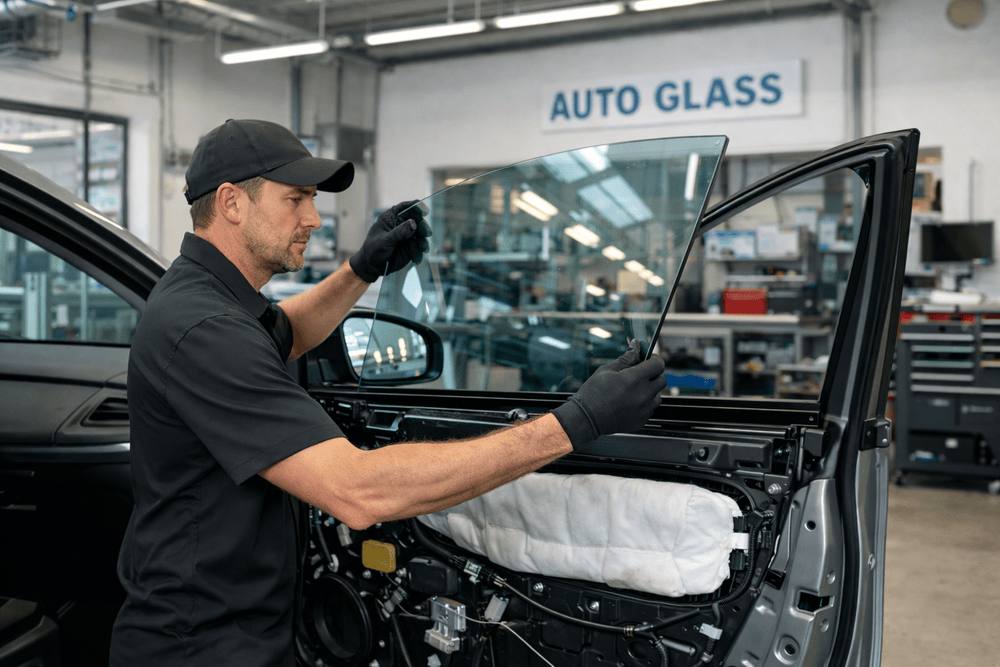
Modern Car Safety Driver Side Window Replacement
A broken window on the driver’s side is an emergency. In addition to making your daily journey inconvenient and loud, it exposes your car to the weather, theft, and bugs. Fixing a damaged side window used to be as simple as a mechanical change. After purchasing a piece of glass, you removed the door panel, vacuumed away the broken pieces, and then inserted the replacement pane. Nonetheless, within the last ten years, automobile engineering has made substantial progress. Your car is now more than just a machine; it’s a sophisticated computer system that works to protect you. Your door’s glass now communicates with sophisticated electronics, materials that reduce noise, and vital safety sensors. Today, fixing a damaged driver-side window involves more than simply fixing a visual problem.
Get An Auto Glass Replacement Quote Now 866.278.7417

Windshield Replacement & Repair
Our competitors push you into going to their shop to get your glass fixed-making it cheaper for them. We make it easier for YOU to get back on the road by offering free mobile repairs at your home or work. With our free mobile services servicing the entire Orange County & Los Angeles area, we can often handle your windscreen replacement the same day! So the next time you need a windshield replacement, give us a call.
Talk to a Windshield Replacement Specialist Now 866.278.7417

Calibration
Calibration is the process of returning a vehicle’s ADAS to OEM specifications. Calibration is necessary after a new glass installation, particularly a windshield with a camera mounted to it, to ensure that the ADAS features continue to function properly despite having been moved during installation. If a car’s ADAS is not properly calibrated, the system may not function safely. A misaligned camera could jeopardize the functionality of the system and lead to dangerous driving or accidents, so it is crucial that the cameras are aligned perfectly, which is what windshield calibration ensures.
Talk to a Calibration Specialist Now 866.278.7417

Fleet Auto Glass Repair
We provide expert auto glass repair and windshield replacement services for commercial fleets of all sizes. We are experienced with all manufacturers and machine types of domestic or foreign cars, trucks, vans, or commercial vehicles, including heavy equipment. Our same day mobile auto glass and windshield repair service will enable you to get back on the road faster and start saving you time and money instantly. Give us a call today! We are here to help!
Talk to a Fleet Auto Glass Specialist Now 866.278.7417
The Development of Auto Glass Technology
We must first examine the glass itself to see why contemporary replacements vary. Tempered glass was the norm for side windows for many years. Tempered glass is designed to break into thousands of tiny, pebble-like fragments when struck. Compared to the sharp shards of ordinary plate glass, these dull cubes are far less likely to result in severe cuts.
Although tempered glass is still widely used, many contemporary manufacturers are using laminated glass, which is the same material used for windshields, on side windows. A vinyl layer is positioned between two layers of glass to create laminated glass.
The Switch to Laminated Glass: Why? This change isn’t random. Laminated glass has many benefits.
Ejection Mitigation: Laminated glass is less likely to break entirely in a rollover collision, keeping passengers within the car.
Sound insulation: It makes the cabin much quieter by drastically lowering road noise.
Security: Laminated glass is significantly more difficult for a burglar to swiftly break through.
If the glass in your automobile is laminated, a replacement has to have the exact weight and thickness specified by the original equipment manufacturer (OEM). Using the incorrect kind of glass may cause water leaks and wind noise by straining the window motor or preventing the window from sealing properly.
The Hidden Role of ADAS Advanced Driver Assistance Systems (ADAS) are the largest innovation in car glass safety. These are the technologies that warn of an approaching accident, keep you in your lane, and notify you when a vehicle is in your blind area.
A common misconception among drivers is that ADAS sensors are only found behind the rearview mirror or in the front bumper. Nonetheless, the door assemblies and side mirrors usually include sensors and cameras. It is necessary to remove the door panel and unhook all electrical cables when replacing a driver-side window.
Calibration is essential because these delicate sensors might sometimes get misaligned when the door assembly is disturbed. At highway speeds, a blind-spot monitor may miss a car if it is off by even a single degree.
Qualified car glass experts now perform a diagnostic scan both before and after the installation. If the repair tampered with the sensors, the system needs recalibration.
This action guarantees that your safety features are “looking” in the appropriate spot when you resume driving. A contemporary window replacement often takes longer and costs more than it did twenty years ago because of this procedure.
The Mechanism of the Power Window
The most often utilized moveable component of the car’s body is the driver’s side window. We reduce it for fresh air, ATMs, and drive-throughs. This continuous use severely strains the window regulator, the mechanical scissor or cable system that raises and lowers the glass.
Glass fragments often fall into the door frame when windows break. If not removed carefully, these shards may get stuck in the motor or regulator gears.
The internal cavity of the door must be thoroughly cleaned as part of a contemporary replacement procedure. To remove each piece of debris, technicians use specialized vacuums and equipment. If this isn’t done, the window may grind every time you use it, or worse, the junk may seize the motor and need a later, more costly repair.
Why Do-It-Yourself Repairs Are Dangerous: It is tempting to attempt to save money by replacing the glass yourself since YouTube videos are accessible for almost every auto repair. The hazards are large for the typical automobile owner, but they are feasible for individuals with substantial mechanical skill.
Airbag Interference: Side-impact airbags or their sensors are often housed in contemporary door panels. Incorrectly disconnecting the door panel or reattaching the wire harness may cause an airbag warning light to illuminate or, in the worst situation, may stop the airbag from deploying in the event of an accident.
Electrical shorts and water damage: An automobile’s door is made to be a “wet” environment. Water flows out the bottom of the door after running down the glass. However, the internal door panel has to remain dry. A plastic layer known as a vapor barrier is placed inside the door to keep moisture out of the complex electronics (door locks, speakers, and window controls).
This vapor barrier is often ripped or opened during do-it-yourself repairs. Water may leak into the cabin if it is not replaced precisely, which might lead to mold growth in the carpets or short out the main window switch.
Do you have a Question?
Get An Auto Glass Replacement Quote Now 866.278.7417
The Process of Replacement
You might feel more at ease knowing what occurs during a professional repair. The typical procedure for a replacement that prioritizes safety is as follows:
Damage Assessment: To determine if the regulator or window frame was bent during the break, the technician examines the damage.
Disassembly: Carefully remove the inside door panel. To prevent damaging the fragile plastic clips holding the panel in place or harming the trim, technicians utilize plastic pry tools.
Removal of Debris: The door cavity is cleaned and vacuumed. Installation involves fastening the new glass to the regulator and inserting it into the door frame.
Testing and Calibration: To guarantee seamless functioning, the window is cycled up and down. The technician makes sure the window won’t shut on a hand or finger by checking the “auto-up/auto-down” pinch-protection features. ADAS systems are lastly examined.
Cleaning: The technician vacuums the car’s interior and cleans the new glass.
Commonly Asked Questions: How much time does it take to repair a driver-side window? The physical replacement usually takes sixty to ninety minutes.
If your car needs ADAS recalibration or has a lot of dirt in the door, it may take longer. After replacing a side window, you may often drive the vehicle right away, unlike windshields, which need time for the glue to cure.
Is side window replacement covered by my insurance? Yes, in many instances. Glass damage is often covered if you have comprehensive coverage. While side windows almost always need to be replaced, some plans include a particular glass deductible, while others may completely eliminate it if the glass can be fixed. It is advisable to review the specifics of your particular insurance.
Can I put a temporary covering on my window and still drive? Heavy-duty tape or transparent crash wrap may temporarily block rain, but these are not long-term fixes. Plastic covers significantly reduce visibility, creating a blind area.
Additionally, they provide no defense against mishaps or theft. Driving with a temporary cover should only be done to transport the car to a repair shop, according to safety regulations.
When I attempt to shut my window, why does it bounce back down? Modern windows contain a safety mechanism that reverses course if they detect an impediment, such as a child’s hand.
This phenomenon is a typical problem known as “bounce-back.” The motor must ‘relearn’ the top and bottom limits after being replaced. These settings may be reset by a professional, often by holding the switch in a certain sequence.
Putting Road Safety First
While replacing a broken window might be a bother, it also gives you the chance to keep your car the safe haven it was intended to be. You can choose the best course of action for your repair if you are aware of the technology behind the glass, from lamination to sensors.
A window replacement should not be thought of as a straightforward replacement of transparent materials. Consider it a system reset for the driver assistance and security features of your car. Choosing a qualified expert who knows these modern issues is an investment in your car’s longevity and the safety of all passengers.
Why Your Car’s Side Windows Are Smarter Than You Think When you think of your car’s electronics, the dashboard is probably the first thing that comes to mind. You may visualize the digital speedometer, the backup camera, or the touchscreen infotainment system.
Perhaps you consider the intricate sensors that track engine performance and fuel economy beneath the hood. You probably don’t consider the glass beside your shoulder.
Side windows remained basic for decades. The tempered glass slabs were able to roll up and down. All they had to do was allow the light in and keep the wind out. However, even the most fundamental parts have changed as cars have become more sophisticated.
These days, the safety and comfort systems in your automobile depend heavily on that piece of glass. Most drivers are unaware of the ways it interacts with sensors, motors, and software until something goes wrong.
It’s not simply mechanics that need to understand these relationships. You can better diagnose problems, comprehend maintenance charges, and appreciate the intricate system you use on a daily basis if you grasp how Windows operates.
The Evolution of the Power Window
We must examine our beginnings to comprehend where we are now. Windows with manual cranks were entirely mechanical. Gears turned as you twisted a handle, and a regulator raised the glass. Sensors, chips, and cables were all absent.
The equation was altered with the advent of power windows. All of a sudden, moving the glass needed an electric motor. This mechanism was comparatively straightforward for a long time: a switch completed a circuit and supplied electricity to the motor.
But contemporary power windows are more complex than simple circuits. The Body Control Module (BCM), a computer responsible for monitoring and controlling various electrical devices within the car, controls them.
When you press the window switch, the motor is not directly powered by you. The BCM receives your signal and determines if moving the window is acceptable and safe. Advanced functionalities become possible as a result of the transition from basic electronics to computer-controlled logic.
Safety sensors and anti-pinch technology: Safety is one of the most important technical interactions. Although “one-touch” or automatic windows are handy, they are dangerous. The motor must know when to stop if a pet’s paw or a child’s hand gets in the path of an automatically closing window.
Anti-pinch technology is useful in this situation. A sensor, usually a Hall effect sensor, is attached to the window motor to track the motor’s electrical current consumption and the window’s movement speed.
The motor must exert more effort if the glass runs into an impediment. This results in either an increase in electrical current or a decrease in the motor’s rotational speed.
The BCM immediately detects this irregularity. According to program logic, the window must instantly stop and reverse orientation if it encounters resistance before it is completely closed. The duration of this exchange is milliseconds.
The actual glass, the rubber seals, the motor, and the computer must all be precisely calibrated. It is often necessary to “re-learn” or recalibrate the system in order for the computer to recognize the precise location of the top and bottom of the frame when a side window is replaced.
Climate Control and Smart Glass
Glass and technology are interacting with the material in ways that go beyond movement. The use of “smart glass” in windows is growing.
Drivers may electrically adjust the tint of their windows using electrochromic glass or Suspended Particle Device (SPD) film. The window becomes darker when a little voltage is applied because the ions in the glass align to block light.
The window clears when the electricity is cut off. This works directly with the car’s temperature control system, so it’s not simply a fun party trick. The car’s sensors track the sun’s intensity and the cabin temperature.
To lessen the strain on the air conditioning system and increase fuel economy (or battery range in electric cars), the system may automatically darken the side windows if the car becomes too hot.
Do you have a Question?
Get An Auto Glass Replacement Quote Now 866.278.7417
Acoustic Dampening and Noise Cancellation
Side windows contribute significantly to the quietness of modern automobiles, which are quieter than ever. But thicker glass isn’t the only solution. It concerns the interaction between audio systems and acoustic engineering.
Laminated side glass, which sandwiches two sheets of glass between a layer of sound-absorbing vinyl, is increasingly common in premium cars. In conjunction with active noise cancellation (ANC) devices, this passive technology operates.
ANC functions similarly to expensive headphones. Inside the cabin, microphones pick up wind turbulence and road noise from the windows. To properly cancel out the undesired noise, the car’s audio system then produces sound waves that are exactly the opposite phase of it.
For this program to function properly, the side window’s acoustic characteristics must be known variables. The ANC system may become miscalibrated if a laminated acoustic window is swapped out for a less expensive, regular tempered glass, which might lead to a noisier ride or even audible feedback loops.
Security Systems and Break-In Detection: The main point of entry for burglars is your side windows. As a result, the glass is extensively integrated with car security systems.
Older alarms would activate their shock sensors if they jostled the vehicle. Systems nowadays are more sophisticated. Some use glass break sensors, which are designed to detect the ultrasonic frequency of glass breaking. Others monitor the air pressure within the cabin.
If a side window breaks, the enclosed compartment’s air pressure rapidly changes. The pressure sensors, often located in the dashboard or overhead console, detect this shift and trigger the alarm. Accordingly, the glass serves as a physical barrier that keeps the atmosphere under pressure so that the security sensors can work.
Windows as Displays in the Future
The side window is ready to be used as a display surface in the future. Concepts for side windows that can provide information to others outside the vehicle, such as ride-share status or battery level, are already being seen.
Inside, passengers may be able to zoom in on far-off things or identify landmarks using augmented reality (AR), which might transform passenger windows into interactive displays. To do this, the glass will need to communicate with internal projectors, transparent OLED screens, cameras, and GPS data.
The side window has transformed into a complex system comprising multiple interconnected components. It is a part of an intricate web of security, comfort, and safety systems. Every action, from the computer that tracks it to the motor that raises it, is planned and managed.
Keep in mind that you are doing more than simply shifting a piece of glass the next time you push the button to roll down your window. You are activating a complex series of electronic checks and balances designed to ensure your security and comfort. As cars get smarter, even their clearest parts are harder to see through.
Mobile Safe Auto Glass
14241 E Firestone blvd suite 400,
La Mirada, CA 90638
Phone: (562) 608-1154
Toll Free: 1 866 278 7417
Mail: sales@mobilesafeautoglass.com
Get a FREE QUOTE today! You can get a free quote and schedule 24/7 using this free quote wizard.
Mon – Fri 8am – 5pm
Saturday 8am – 1pm
Sunday Closed