Glass Types Compared Driver Side Window Replacement
It’s depressing to approach your automobile and see a heap of broken diamonds on the driver’s seat. A damaged driver-side glass is an instant emergency, regardless of the cause—a stray baseball, a break-in, or debris off the road. It makes driving dangerous and exposes your car to weather and theft. Once the initial shock fades, you face a practical dilemma. It is important to find a replacement promptly. You may be shocked to hear that you have options when you contact your insurance company or a car glass repair. Auto glass is not all made equal. You will probably have to choose between aftermarket and OEM (Original Equipment Manufacturer) glass. Additionally, words like “laminated” and “tempered” may be used.
Get An Auto Glass Replacement Quote Now 866.278.7417

Windshield Replacement & Repair
Our competitors push you into going to their shop to get your glass fixed-making it cheaper for them. We make it easier for YOU to get back on the road by offering free mobile repairs at your home or work. With our free mobile services servicing the entire Orange County & Los Angeles area, we can often handle your windscreen replacement the same day! So the next time you need a windshield replacement, give us a call.
Talk to a Windshield Replacement Specialist Now 866.278.7417

Calibration
Calibration is the process of returning a vehicle’s ADAS to OEM specifications. Calibration is necessary after a new glass installation, particularly a windshield with a camera mounted to it, to ensure that the ADAS features continue to function properly despite having been moved during installation. If a car’s ADAS is not properly calibrated, the system may not function safely. A misaligned camera could jeopardize the functionality of the system and lead to dangerous driving or accidents, so it is crucial that the cameras are aligned perfectly, which is what windshield calibration ensures.
Talk to a Calibration Specialist Now 866.278.7417

Fleet Auto Glass Repair
We provide expert auto glass repair and windshield replacement services for commercial fleets of all sizes. We are experienced with all manufacturers and machine types of domestic or foreign cars, trucks, vans, or commercial vehicles, including heavy equipment. Our same day mobile auto glass and windshield repair service will enable you to get back on the road faster and start saving you time and money instantly. Give us a call today! We are here to help!
Talk to a Fleet Auto Glass Specialist Now 866.278.7417
Comprehending the Content
Understanding the actual material used within windows is crucial before learning about brands and manufacturers. In the past, there has been a noticeable distinction between the glass used for your doors and windshield.
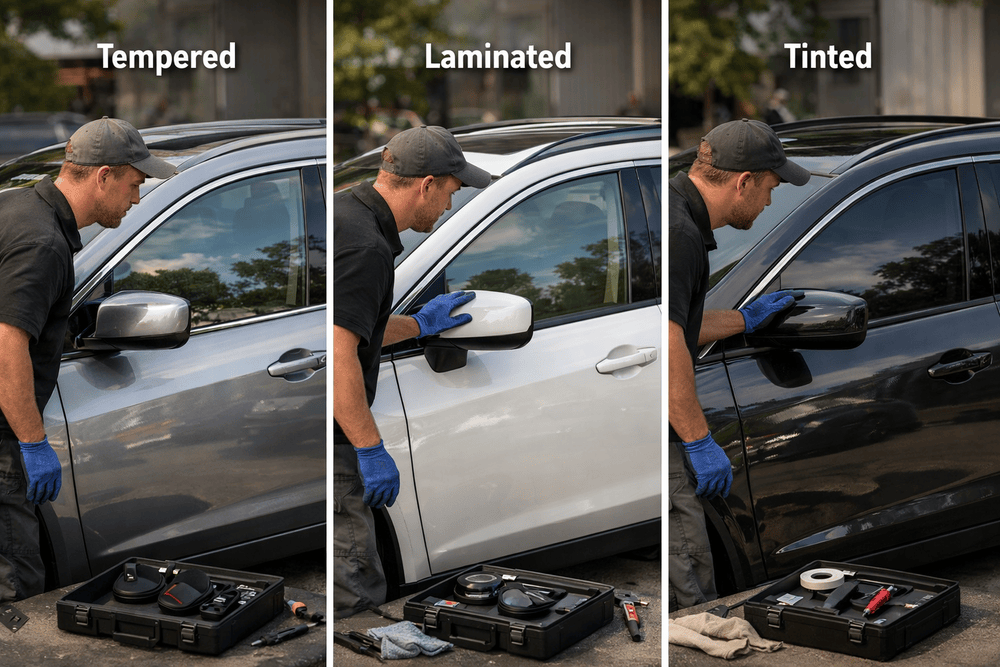
Tempered Glass: Tempered glass has been the industry standard for driver-side windows for many years. Unlike ordinary domestic glass, this glass is heat-treated to make it very robust. Instead of breaking into big, sharp shards, it is made to break into thousands of tiny, dull pebbles.
This is a feature for safety. You don’t want enormous glass guillotines flying across the cabin in the event of an accident. Additionally, tempered glass makes it simpler to escape via the window in the event that the door jams since it entirely crumbles.
Laminated Glass: Your windshield is composed of laminated glass. It has a layer of vinyl (PVB) placed between two layers of glass. The glass sticks to the vinyl layer as it breaks, keeping its form instead of shattering.
Laminated glass has been used by manufacturers for side windows in recent years, especially in premium cars. Among the advantages are: Road noise is greatly reduced by soundproofing.
Security: Because the glass won’t just fall away, it is far more difficult for a criminal to break and seize.
Ejection Prevention: Laminated glass keeps occupants within the car in the case of a rollover.
It is usually necessary to replace windows “like for like.” For example, if your automobile had laminated side windows, you cannot swap to tempered, and vice versa. However, as laminated replacements are much more costly, knowing which one you have helps to explain the cost.
The Big Debate: OEM vs. Aftermarket Glass: The true decision is who creates the glass when you know the substance. The arguments over quality and pricing often take place here.
Glass from the Original Equipment Manufacturer
The OEM glass is the same as the original window. It is often imprinted with the automaker’s emblem (for example, Ford, BMW, or Toyota) and is created by the same manufacturer who made the original glass for the carmaker (for example, Pilkington, Saint-Gobain, or PGW).
The Pros: Perfect Fit: You may be sure that it will fit perfectly since it is manufactured according to the manufacturer’s precise requirements. Water leaks, wind noise, and window regulator problems won’t exist.
Matches Tint: Factory glass often has a certain tint or color. Original equipment manufacturer replacements will precisely fit the passenger-side window.
Resale Value: Original glass with the manufacturer’s mark may preserve the value of expensive luxury or vintage automobiles.
Comfort: You are aware of what you are obtaining.
Cons: Cost: This is the most costly choice. The brand emblem comes with a higher price tag.
Availability: While aftermarket glass is often supplied locally, you may have to wait longer for the dealership to send the precise item.
Original Equipment Equivalent, or OEE, or aftermarket glass is produced by vehicle glass manufacturers who may or may not be the original suppliers. However, trademark regulations prohibit them from imprinting the automobile manufacturer’s emblem on the glass.
Importantly, trustworthy aftermarket glass is often produced in the same facilities as original equipment manufacturers. It is known as Original Equipment Equivalent, or OEE. It is constructed in accordance with the same safety, durability, and thickness requirements as the original.
Do you have a Question?
Get An Auto Glass Replacement Quote Now 866.278.7417
Which Choice Is Best for You
Who is paying the cost, your particular circumstances, and your car will all influence your ultimate choice.
When to Select OEM: You should choose OEM if your car is brand-new (from the current model year). You want to maintain uniformity while the car retains its greatest worth.
OEM is the safest choice to guarantee that cutting-edge technologies like heads-up displays or certain sound-dampening layers that are integrated into the glass of your luxury car operate as intended.
Lastly, review your insurance contract. An “OEM endorsement” on certain insurance ensures that factory parts will be covered. Take advantage of this coverage if you have it.
When to Select Aftermarket: Premium aftermarket glass is the wise option for the vast majority of drivers. The OEM pricing differential is usually not justified if your automobile is older than a few years.
If you choose to pay for aftermarket glass, you can save money without sacrificing safety. Unless there is a particular reason (like safety sensors) that necessitates OEM, the majority of insurance carriers likewise default to paying for aftermarket glass.
Calibration and Safety Systems
These days, driver-side windows are more than simply glass panes. They are often included in the safety ecology of the vehicle. The functioning of the windows in many contemporary cars is controlled by complex regulator systems, sensors, or cameras.
For instance, “pinch protection” features in many automobiles automatically roll down the window if they detect an obstacle, such as a finger. The installation is the most important consideration, whether you go with OEM or aftermarket.
Inadequate installation may interfere with these safety elements or result in the window breaking on its own under stress. When choosing a repair company, find out whether they check the sensors after installation and calibrate the window regulator.
Choosing the Correct Call for Your Vehicle: Although repairing a broken driver-side window might be a pain, it shouldn’t be a risk. A high-quality aftermarket replacement from a reliable manufacturer (such as Pilkington or PGW) will work flawlessly for the majority of everyday drivers. Without the dealership markup, it offers the same functionality and safety as the original glass.
Sticking with OEM glass, however, guarantees that you preserve the vehicle’s unique standards and value whether you drive a brand-new car, a luxury automobile, or a lease. Get rates for both alternatives, review your insurance coverage, and choose the glass that provides you with peace of mind and a clear vision.
How to Make Your Side Window Safer
Airbags, seatbelts, and crumple zones are often the first things that come to mind when you think about automotive safety. Perhaps you think of sophisticated driver-support features like automated braking or lane-keeping assistance. However, how often do you think about the glass located near your head?
Tempered glass has been the norm for side windows for many years. Nonetheless, the design of automobiles is undergoing a silent revolution. Laminated glass, which was formerly almost exclusively used for windshields, is becoming more and more popular among manufacturers for side windows.
This change is essential for passenger safety and goes beyond just lowering cabin noise or enhancing insulation. Understanding the differences between these two materials could potentially prevent ejection or save your life in a rollover accident.
It may also determine how simple it is for you to get out of a car in an emergency. This is all the information you want on the safety glass.
The Two Candidates: Tempered vs. Laminated Glass: We must first comprehend their construction and stress resistance to determine which material is safest.
What is Tempered Glass
For many years, tempered glass has been the industry standard for back and side windows. Glass is heated to very high temperatures and then quickly cooled to form it. Because of the internal strain created by this process, the glass is much stronger than regular annealed glass, such as the kind used in windows in your home.
How it breaks: Tempered glass does not shatter into big, sharp pieces when hit with sufficient power. Rather, it rapidly breaks into thousands of tiny, pebble-like fragments. These parts, which are comparatively dull, are intended to reduce passenger cutting injuries in the event of an accident.
Definition of Laminated Glass: Laminated glass is made in a unique way. It is made up of two glass layers sandwiched by a layer of transparent plastic, often PVB (polyvinyl butyral). Windshields are made using the same technique.
How it breaks: Laminated glass may break or split when struck, but the fragments adhere to the plastic interlayer. Instead of blasting inward or outward, the window acts as a flexible barrier and prefers to stay intact.
The Benefit of Lamination
Ejection mitigation is by far the strongest safety justification for laminated side windows. The forces involved are violent in a severe side-impact accident or rollover crash.
Both unbelted and belted passengers face the risk of ejecting from the car in extreme situations. Being thrown from a car greatly raises the chance of a death, according to National Highway Traffic Safety Administration (NHTSA) statistics.
Tempered glass breaks, leaving a large hole behind. Nothing can prevent a passenger’s head or limb from leaving the car. Glass that is laminated behaves differently.
Even after breaking, the glass stays in the frame because it sticks to the plastic inside. This helps keep people inside the vehicle by forming a sturdy, flexible net.
Federal laws have forced automakers to use this technology. Many manufacturers have been required to use laminated glass for side windows in their most recent models by standards designed to minimize partial and total ejections.
The Emergency Escape Dilemma: Although laminated glass provides better protection in an accident, it creates a problem for situations that may arise after the crash: entrapment.
In the event of an accident, passengers may have to shatter a window to escape if the car is inundated in water or if the doors are blocked. This is easy to do using tempered glass.
The glass may be broken instantaneously with a spring-loaded center punch or a specialty automobile escape hammer, enabling a speedy escape. The purpose of laminated glass is to prevent breakage and disintegration.
The glass of a laminated side window will break if you try to use a regular escape hammer on it, but the aperture will remain unclogged. You would need to either kick the window out completely or forcefully saw through the tough plastic layer, both of which are difficult tasks to accomplish while injured, panicking, or drowning.
Do you have a Question?
Get An Auto Glass Replacement Quote Now 866.278.7417
How to Examine Your Computer
Knowing the kind of glass in your particular car is essential because of this “safety vs. escape” trade-off. Automakers often combine different types of glass, resulting in your car having tempered glass in the back and laminated glass in the front doors.
Examine your side window’s lower corner. A permanent label or stamp needs to be engraved on the glass. Look for the terms “tempered,” “toughened,” or just the letter “T.” Seek out the terms “Laminated” or “Lamisafe.” A quick test to see whether you can locate the stamp is to roll the window down halfway and examine the upper edge.
It is probably tempered if it is smooth and seems to be one single piece. It is laminated if you see a sandwich-like construction with a clear line along the center of the edge.
Security and Theft Prevention: Personal security is just as important to safety as accidents. Laminated glass is the obvious winner in this case.
Thefts known as “smash and grab” depend on speed. A burglar smashes the glass, takes a phone or bag, and flees. With tempered glass, the process takes a few seconds. When you hit a window with laminated glass, the barrier stays intact, but a spiderweb fracture appears.
A burglar would have to repeatedly hit the glass and sever the laminate to get inside. This is a significant deterrent because it takes time and makes a lot of noise. Although no glass is unbreakable, opportunistic burglars find laminated windows to be a much more difficult barrier.
Noise, UV Rays, and Comfort: Although safety is the first priority, the material of your side windows has additional effects on how you drive every day.
Acoustic Insulation
Glass that is laminated is quieter. By acting as a dampener, the plastic interlayer lessens the transmission of high-frequency sounds like tire roar and wind. This results in a more peaceful cabin, which lessens driver tiredness over lengthy journeys—a small but significant safety benefit.
UV Protection: While standard tempered glass lets a lot of UVA rays through, it prevents UVB rays. UVA radiation causes aging and long-term skin damage.
Because of its plastic core, laminated glass may filter up to 99 percent of UV rays. This keeps the inside of the car (dashboard and upholstery) from fading and breaking over time and shields passengers from sun harm. What Is “Safer” About This Material? Depending on how you define safety, the answer will vary.
Laminated glass is unquestionably safer if surviving a high-speed collision or rollover is your top priority. The vehicle’s protective shell protects you inside thanks to its vital structural barrier. This protection is very significant since rollovers have a high mortality rate.
Tempered glass is safer if your main worry is getting out of a burning or drowned car since it breaks readily. It is important to remember, nevertheless, that statistically speaking, collision-based incidents are far more frequent than car submersions.
Modifying Your Safety Strategy
Generally speaking, the manufacturer decides which glass is included with your automobile based on technical and safety regulations; you are not allowed to pick. You may modify your emergency plan, however, if you are aware of what you have.
If the windows on your automobile are laminated: Cheap keychain escape tools often don’t work, so don’t depend on common hammers.
Purchase the appropriate tool: Seek escape tools made especially to cut laminated glass, which often include a saw or cutting edge, rather than just shattering it.
Find an escape by looking at the back windows if your front windows are laminated. If all your side windows are laminated, the windshield may be your only option, even though it’s the hardest glass to remove.
Maintain an accessible breaker tool by mounting it where you can reach it while strapped in, rather than letting it fly away in the glovebox in the event of a rollover.
Wear your seatbelt: Your seatbelt is your sole line of defense against being thrown from the automobile since laminated glass does not provide ejection mitigation.
The Prospects for Automobile Glass: There is no denying the trend: laminated glass is becoming more popular in the automobile sector. Tempered glass may soon become obsolete for side windows as safety regulations tighten and customers want cabins that seem quieter and more upscale.
The “safest” material is the one you understand up to that point. You can make sure you are ready for everything the road may bring by recognizing the glass in your car and arming yourself with the appropriate information and equipment.
Mobile Safe Auto Glass
14241 E Firestone blvd suite 400,
La Mirada, CA 90638
Phone: (562) 608-1154
Toll Free: 1 866 278 7417
Mail: sales@mobilesafeautoglass.com
Get a FREE QUOTE today! You can get a free quote and schedule 24/7 using this free quote wizard.
Mon – Fri 8am – 5pm
Saturday 8am – 1pm
Sunday Closed