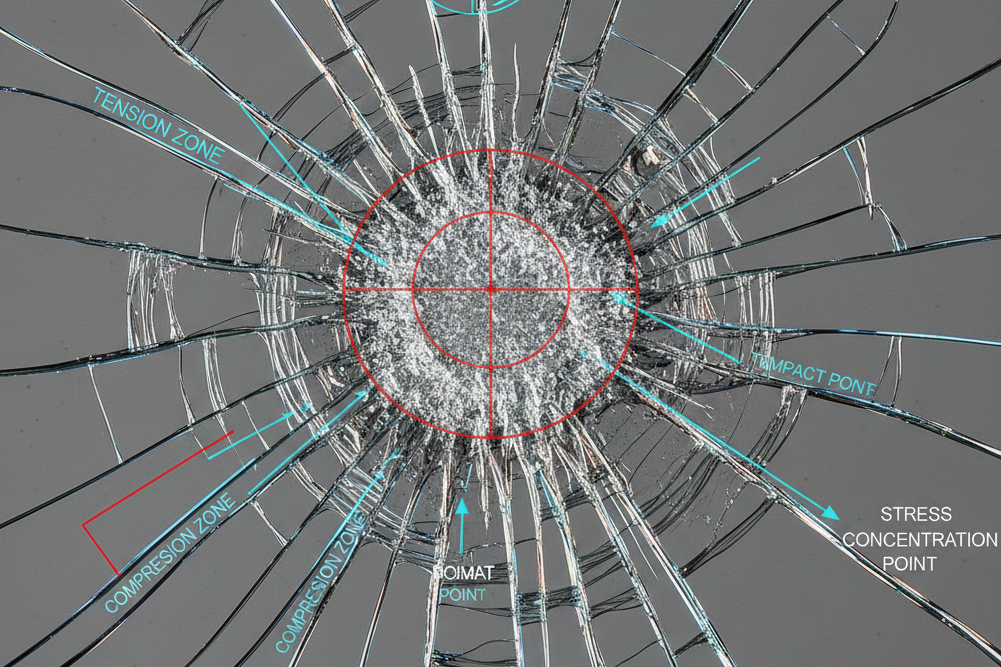
Anatomy of a Crack & The Physics of Failure
The sturdy ground beneath our feet, the steel beams that support our office buildings, and the aluminum skin of the airplanes that we fly in are all things that we have enough faith in. We make the assumption that solidity is a static state. However, there is a limit at which everything, from a porcelain teacup to a gigantic suspension bridge, will eventually fail. It is possible that the outcome will be disastrous once that threshold is reached. The question is, however, what truly takes place when something fails? When viewed with the naked eye, a shatter or a snap appears to occur instantly. Failure, on the other hand, is a complicated process when seen at the microscopic level. A conflict between energy and matter is being fought on a battleground that is significantly smaller than the width of a human hair.
Get An Auto Glass Replacement Quote Now 866.278.7417

Windshield Replacement & Repair
Our competitors push you into going to their shop to get your glass fixed-making it cheaper for them. We make it easier for YOU to get back on the road by offering free mobile repairs at your home or work. With our free mobile services servicing the entire Orange County & Los Angeles area, we can often handle your windscreen replacement the same day! So the next time you need a windshield replacement, give us a call.
Talk to a Windshield Replacement Specialist Now 866.278.7417

Calibration
Calibration is the process of returning a vehicle’s ADAS to OEM specifications. Calibration is necessary after a new glass installation, particularly a windshield with a camera mounted to it, to ensure that the ADAS features continue to function properly despite having been moved during installation. If a car’s ADAS is not properly calibrated, the system may not function safely. A misaligned camera could jeopardize the functionality of the system and lead to dangerous driving or accidents, so it is crucial that the cameras are aligned perfectly, which is what windshield calibration ensures.
Talk to a Calibration Specialist Now 866.278.7417

Fleet Auto Glass Repair
We provide expert auto glass repair and windshield replacement services for commercial fleets of all sizes. We are experienced with all manufacturers and machine types of domestic or foreign cars, trucks, vans, or commercial vehicles, including heavy equipment. Our same day mobile auto glass and windshield repair service will enable you to get back on the road faster and start saving you time and money instantly. Give us a call today! We are here to help!
Talk to a Fleet Auto Glass Specialist Now 866.278.7417
Tug-of-War with Atomic Weapons
Understanding what holds things together is crucial to understanding why they break. Atomic chemical bonds are responsible for the cohesiveness of solids at the atomic level. Atoms are connected by these bonds, which might be thought of as minuscule springs that are quite rigid.
By applying a load to a material, such as by pulling on a rubber band or by weighing down a bridge, you are stretching the atomic springs that are present in that material. This phenomenon is referred to as stress. Strain refers to the amount of stretching or deformation that occurs as a result of the material’s reaction to the stress.
Up to a certain extent, this relationship is linear for the majority of the materials. You can spring the atoms back together by pulling them apart a tiny bit. A term for this phenomenon is “elastic deformation.” On the other hand, the springs will break if you pull them too far. The links are severed. At this point, the material’s strength has reached its intrinsic limit.
In theory, materials ought to have an exceptionally high level of strength. If one were to compute the force that would be necessary to simultaneously break all of the atomic bonds, it is reasonable to assume that steel is 100 times more robust than it is. What causes materials to fail when subjected to loads that are well below their theoretical limit? The explanation can be found in human frailties.
Beginnings of a Crack
In the modern world, there is no flawless substance. Every material, whether it is metal, ceramic, or plastic, has minute imperfections. Among these are voids, which are essentially microscopic air pockets; bond pockets; inclusions, which are foreign particles; particles; and dislocations, which are atoms that are misaligned inside the crystal lattice.
In most cases, a fracture does not just appear; rather, it develops from one of these pre-existing faults through a process commonly referred to as nucleation.
When stress is given to a perfectly homogeneous item, it distributes itself in a manner that is both deep and even. On the other hand, when stress comes into contact with a defect, such as a small hole or a scratch, it is unable to transit through space. On the contrary, the tension should be directed around the defect.
Because of this, the stress tends to congregate along the borders of the defect, which results in the formation of a “stress concentration.”
Consider a river that flows smoothly up until it reaches a massive boulder. As it makes its way around the sides of the rock, the water flows more quickly and with greater force. In the same way, mechanical stress goes through the same process.
A flaw’s tip can have a stress that is several orders of magnitude higher than the stress that is present throughout the rest of the material. It is precisely this focused intensity that causes the initial atomic bonds to break, transforming an innocuous scratch into a crack that can be fatal.
Do you have a Question?
Get An Auto Glass Replacement Quote Now 866.278.7417
Anatomical Structure of a Crack
The Cracking Hint: The point of the crack is the most important component. It is possible, in principle, for the tip of a crack to be indefinitely sharp. An indefinitely acute crack will produce an infinitely high stress concentration. This effect is due to the fact that the stress concentration grows as the radius of the tip decreases.
The result indicates that even a modest amount of external stress can convert into sufficient energy at the split tip to rip apart atomic bonds, widening the crack even further. This self-propagating cycle is one reason why cracks can unzip a large structure at the speed of sound.
In the wake: The wake, consisting of the split surfaces that have already failed, is found behind the tip. Although this region is no longer bearing a load, the roughness of these surfaces might provide forensic engineers with crucial information regarding the failure of the material.
In the Zone of Plastic: The ductile materials steel and aluminum have a defense mechanism that protects them from damage. The tremendous stress leads the atoms to shuffle about rather than break just before the crack point.
This phase occurs just before the crack tip. The sharpness of the fracture tip is smoothed out as a result of this deformation, which consumes energy. The locals refer to this region as the plastic zone.
A sizable plastic zone acts as a blunting agent, making it more difficult for the crack to expand. Because of this, metals tend to flex before they break, but glass, which does not have a plastic zone, has the ability to fracture quickly.
Griffith’s energy balance is the subject of the physics of failure. Around the year 1920, A.A. Griffith, particles; A.A. Griffith, the English aviation engineer, made a significant contribution to the advancement of our understanding of fracture mechanics. He raised a simple question: when does a crack become unstable?
Griffith realized that the creation of a new crack requires energy. The two sides of the fracture are created by breaking chemical bonds, which is necessary to generate two new surfaces. Listed here is the cost of the surface energy.
Nevertheless, the expansion of a crack results in the release of energy. After being stretched under tension, the “springs” (atomic bonds) in the material are eventually able to relax as the split begins to open. The elastic strain energy is released as a result.
According to Griffith’s criterion, a fracture will propagate if the energy released by the material that is relaxing is greater than the energy that is necessary to generate the new crack surfaces.
The crack will go through if the amount of energy released is greater than the expense. In the event that the price is higher, the crack will stop (arrest). This equilibrium is the reason why a minor scratch on your windshield could remain steady for years, only to suddenly rocket across the glass when you hit a pothole on a cold day. Exactly the right amount of energy is added by the external impact to tilt the equilibrium.
The Dying Process of Materials
Failures do not all appear to be the same. The degree to which a material gives you a warning before it fails is the primary factor that engineers use to divide fractures into two main groups.
The Fracture Is Brittle: This is the most devastating kind of failure that can occur. This phenomenon occurs in materials such as glass, ceramics, and certain types of rigid metals. When there is brittle fracture, there is essentially no plastic deformation taking place. Instead of stretching or yielding, the material simply snaps back into place.
All energy is used to grow the crack, not to bend or stretch. Brittle fractures frequently have devastating consequences when they occur at very high speeds.
Fracture of the Ductile: Engineering strongly prefers ductile failure because it provides a warning. The material undergoes a significant amount of deformation before it ultimately fractures. A steel rod may stretch and neck down, which means it will get thinner.
This stretching absorbs a significant amount of energy. You want the steel frame of the vehicle to undergo ductile fracture, also known as crumpling, in the event of a car accident. This technique will allow the frame to absorb the energy of the impact and protect the occupants inside the vehicle.
Fatigue is the killer. Without a Name. Taking names
Fatigue is perhaps the most sneaky and subtly destructive kind of failure. Whenever a material is subjected to cyclic loading, which is defined as stress that is applied, withdrawn, and then applied again and again, this phenomenon takes place.
Consider the motion of bending a paperclip in both directions. Although you are not applying sufficient force to snap it in a single motion, it will eventually break. During each cycle, a minuscule crack moves forward by a tiny amount.
As the fracture gradually expands over thousands or millions of cycles (for example, the vibration of an airplane wing or the rotation of a car axle), it eventually reaches a size that is considered critical. Following that, the component suddenly fails, frequently under a load that it has successfully managed thousands of times in the past.
Examining the De Havilland Comet as a Case Study
The physics of failure is not only a subject of academic study but also etched in history. The de Havilland Comet, which was the world’s first commercial jet airliner, is considered one of the most well-known examples of stress concentration and tiredness.
In the 1950s, comets began to disintegrate while in flight. The investigators eventually identified the square windows as the cause.
The corners of the square windows served as a significant stress concentrator within the room. A significant amount of stress built at the sharp corners of the windows each time the cabin underwent cyclic loading, which consisted of pressurizing and depressurizing the cabin. There were microscopic fatigue cracks that began to form at these corners and continued to grow with each flight. At some point, the cracks stretched out to the point that they caused a catastrophic breakdown of the fuselage.
This lesson altered the history of aviation. Modern airplanes only feature circular or rounded windows. Curves distribute stress more uniformly, preventing the deadly concentrations that led to the Comet’s destruction.
Locating the Weak Links in the System: By gaining an understanding of the anatomy of a fracture, engineers are able to build a world that is safer. By utilizing fracture mechanics, we are now able to determine how long a component will remain functional and when it will need to be replaced.
It is important to avoid sharp corners and sudden changes in shape when designing something to reduce stress concentrations.
Choosing materials that have a high “fracture toughness”—that is, the capacity to resist crack growth—is involved in the material selection process.
The inspection process involves the utilization of ultrasound and X-rays to detect minute defects prior to their reaching the critical Griffith length.
We will not be able to eradicate cracks. In accordance with the laws of thermodynamics, entropy will increase and objects will disintegrate. We are able to foresee failure, manage it, and make certain that when things do break, they do so in a secure manner if we have a solid grasp of the physics of failure.
Questions That Are Frequently Asked
Would it be possible to stop a crack once it has begun? The answer is yes, a crack can be stopped. In most cases, this occurs when the fracture penetrates a section of the material that is more resistant to damage or when the material is subjected to compressive stress, which causes the crack to close.
It is common practice for engineers to drill a “stop hole” at the point where a crack appears in metal components. The round hole eliminates the sharp crack tip, significantly reduces the stress concentration, and halts the fracture’s propagation.
The distinction between stress and strain is precisely what it is. Pressure is the internal force that is applied to the material, and strain is the material’s physical deformation (stretch) in reaction to that force. Stress is the internal force that is applied to the material.
What causes items to shatter more easily when the weather is cold? At temperatures below a certain threshold, a “ductile-to-brittle transition” occurs in various materials, most notably carbon steels.
A decrease in thermal energy causes the atoms to vibrate less and makes it more difficult for them to move around to absorb energy (a process known as plastic deformation). The material loses its toughness and becomes more brittle, making it more likely to shatter throughout the process.
Does there exist a substance that is capable of “self-healing” in a sophisticated manner? Without a doubt, this is an innovative approach to the study of materials. Materials such as concrete, polymers, and coatings that contain microcapsules of therapeutic medicines are currently being developed by researchers.
The rupture of the capsules that occurs when a crack appears causes the agent to be released, which then fills the crack and causes it to harden, so effectively repairing the material.
The Prospects for Fragmentation
Moving forward, we are entering a new era of intelligent materials, which will be distinguished not solely by their passive strength but also by their awareness, flexibility, and resilience. Engineers are now building systems that are able to detect when failure is beginning, respond to it, and in some cases even repair themselves.
This is in contrast to the traditional method of depending on materials that we just hope will not experience fragmentation or failure. This transition has fundamentally altered our thinking about safety, longevity, and maintenance in almost every industry.
In today’s world, sensors that are buried deep within bridges and other important infrastructure are able to detect the subtle acoustic signals of a nucleating crack long before the fracture is evident to the naked eye. These early warning systems are able to send alarms to engineers located miles away, which enables them to take action before a tiny fault develops into a catastrophic collapse.
Researchers are currently developing self-healing polymers, materials that can mend microfractures on their own, in parallel. Researchers are specifically developing these materials for use in harsh environments like space, where repairs are either impractical or impossible.
What we learn about humility is the mechanics of failure. It serves as a reminder that no construction, no matter how advanced it may be, is truly immortal. Because of the accumulation of stress and the aging of materials, even the most robust systems have their limits.
Having an understanding of how and why things happen, however, gives us power. It provides us with the information necessary to anticipate failure, plan around it, and increase the amount of time that the systems on which we rely on a daily basis can be operational.
We are able to avoid giving in to defeat and failure by showing respect for the crack, which includes studying it, monitoring it, and responding to it in an informed manner. It teaches us something. Such behavior allows us to become more proficient in the material and brings us closer to a world that is not only made to withstand but also to adapt, recover, and safeguard what is most important.
The Reasons Why Ignoring a Minor Chip in the Windshield Is a Huge Mistake
Ignoring a chip in your windshield exposes you to a risky situation. What begins as a relatively minor issue in terms of appearance can quickly become a significant risk to public safety and a significant strain on the company’s finances. When it comes to dealing with vehicle glass, having an understanding of why speed is so important can save you not just money but also time and possibly even your life.
Mechanisms underlying automobile glass. It is necessary to have an understanding of the operation of your windshield to comprehend why a chip is hazardous. Unlike your home’s windows, your car’s windshield is made of laminated safety glass.
Alterations in temperature are the adversary. When glass is heated, it tends to expand, and when it is cooled, it tends to compress. These variations are continually being applied to your windshield, and they frequently manifest themselves in severe ways.
Think of a sweltering day in the summer. When you leave your automobile parked in the sun, the windshield begins to warm up. You quickly turn on the air conditioning after entering the building.
An enormous amount of thermal stress is produced as a result of the abrupt drop in temperature on the inside of the glass, while the temperature on the outside stays heated. Should there be a chip, the glass will be unable to withstand the tension in an even manner, causing it to break. The chip explodes out of your dashboard in an instant, leaving a fissure throughout the surface.
During the winter, the same idea is applicable. When a cold windshield is forced to come into contact with a hot defroster, the quick expansion causes the chip, which is the weak point, to fail.
Even minute fluctuations in temperature over the course of a day can gradually transform a small crack into a huge fracture. Delaying repairs is practically the same as waiting for the laws of nature to destroy your windshield. This is because you have no control over the weather.
The expenses associated with contemporary technology are not always immediately obvious. The process of changing a windshield in older vehicles was quite basic and primarily mechanical in nature. After making the payment for the glass and the work, you were able to get back on the road. On the other hand, all modern automobiles are fitted with something called Advanced Driver Assistance Systems (ADAS).
Adaptive cruise control, automatic emergency braking, and lane departure warning are all examples of features that rely on cameras and sensors that are situated right behind the windshield. Simply replacing the windshield with new glass is not sufficient in the event that a chip develops into a crack and you are compelled to repair the entire windshield. In addition, you are required to pay for the recalibration of these delicate
Do you have a Question?
Get An Auto Glass Replacement Quote Now 866.278.7417
Inadequately Protected Safety Features
Although we frequently consider the windshield to be nothing more than a barrier against the wind and insects, it is also an essential safety component that contributes to the structural integrity of your car.
In the event of a rollover accident, the windshield serves as an essential vertical support, preventing the roof from squeezing in on the people within the vehicle. Even a hairline crack significantly weakens the glass. A rollover increases the likelihood of the roof falling if the glass breaks.
In addition, the correctly deployed airbag on the passenger side of your vehicle is dependent on the windshield. The airbag will bounce off the windshield and cover the passenger if it explodes from an outward direction. The force of the airbag could completely shatter the windshield if there is a break in the glass. Such an event would result in the airbag not deploying properly, which would leave your passenger without any protection.
Due to dirt and debris, repair choices are limited. There is a practical reason for hurrying that has nothing to do with the growth of cracks, and that is the fact that clean glass repairs better.
When a windshield is repaired, a specialized clear resin is injected into the chip to make the repair work. Under the influence of ultraviolet light, this resin will cure, thus rebonding the glass and restoring its strength. It is necessary to carefully clean the chip in order for the resin to successfully adhere.
Windshield wipers are responsible for pushing dirt, road filth, wax, and washer fluid into the minuscule crevices of the chip over the course of time. It is possible for this material to become embedded in the fissure. Even a pro may not be able to clear the system if you wait too long. Because of this, the repair will have a foggy appearance, or even worse, it may be impossible to repair the chip at all since the resin will not penetrate the debris. When you wait for a longer period of time, the quality of the final repair will decrease.
Continual driving and vibrations from the road can exacerbate the damage. To transform a chip into a crack, a significant pothole is not required. Normal driving causes continual vibrations. Every bump in the road, every door that slams shut, and every uneven patch of pavement causes shockwaves to travel through the frame of the vehicle and into the glass.
Save Your Glass, Time, and Money
The repair of a chip is one of the quickest and least disruptive automobile services available. In many instances, a professional expert may finish the entire repair in less than thirty minutes, thereby restoring the structural integrity of the glass before the damage has a chance to spread. Because mobile repair services are becoming more widespread, the expert may even come to your house or place of business, enabling you to continue with your day without interruption.
Then, contrast that with the cost of replacing the entire windshield. It is necessary to schedule replacements in advance, spend more time at the shop, and wait for the urethane adhesive to completely cure before it is safe to drive the car. The process becomes even more complicated if your vehicle is fitted with advanced driver assistance systems (ADAS), which frequently necessitate the recalibration of sensors in a precise manner, which adds both time and money to the repair.
The option is unmistakable. Ignoring a small chip exposes you to a risk with slim chances and significant consequences. It puts your safety in jeopardy, it puts your wallet in danger by causing you to incur expenses that are not essential, and it transforms a simple solution into a logistical nightmare.
In the event that you see a chip, you should not wait for it to develop into a fracture. Make an appointment for a repair as soon as possible, and you will be able to drive with the assurance that your vehicle is safe and ready for the road.
Mobile Safe Auto Glass
14241 E Firestone blvd suite 400,
La Mirada, CA 90638
Phone: (562) 608-1154
Toll Free: 1 866 278 7417
Mail: sales@mobilesafeautoglass.com
Get a FREE QUOTE today! You can get a free quote and schedule 24/7 using this free quote wizard.
Mon – Fri 8am – 5pm
Saturday 8am – 1pm
Sunday Closed