Automobile Window Replacement for Modern Car Technology
Fixing a shattered windshield used to be a straightforward process. It would be necessary for you to go to a nearby store, wait for an hour while they replaced the glass, and then drive away with a wallet that was somewhat lighter. An easy mechanical fix, comparable to changing a tire, was involved in this situation. In the past ten years, that procedure has seen significant transformations. In recent years, the modest windshield has evolved from a basic piece of glass into an essential component of the safety ecology of your vehicle. This transformation has occurred as automobiles have gotten more intelligent, safer, and more autonomous.
Get An Auto Glass Replacement Quote Now 866.278.7417

Windshield Replacement & Repair
Our competitors push you into going to their shop to get your glass fixed-making it cheaper for them. We make it easier for YOU to get back on the road by offering free mobile repairs at your home or work. With our free mobile services servicing the entire Orange County & Los Angeles area, we can often handle your windscreen replacement the same day! So the next time you need a windshield replacement, give us a call.
Talk to a Windshield Replacement Specialist Now 866.278.7417

Calibration
Calibration is the process of returning a vehicle’s ADAS to OEM specifications. Calibration is necessary after a new glass installation, particularly a windshield with a camera mounted to it, to ensure that the ADAS features continue to function properly despite having been moved during installation. If a car’s ADAS is not properly calibrated, the system may not function safely. A misaligned camera could jeopardize the functionality of the system and lead to dangerous driving or accidents, so it is crucial that the cameras are aligned perfectly, which is what windshield calibration ensures.
Talk to a Calibration Specialist Now 866.278.7417

Fleet Auto Glass Repair
We provide expert auto glass repair and windshield replacement services for commercial fleets of all sizes. We are experienced with all manufacturers and machine types of domestic or foreign cars, trucks, vans, or commercial vehicles, including heavy equipment. Our same day mobile auto glass and windshield repair service will enable you to get back on the road faster and start saving you time and money instantly. Give us a call today! We are here to help!
Talk to a Fleet Auto Glass Specialist Now 866.278.7417
“Smart” Glass: The Transition from Traditional Glass
Safety has been the major focus of development in auto glass for several decades. In the event of an accident, we switched from using normal plate glass to using tempered and laminated glass, which would not shatter into deadly fragments. In spite of the fact that structural integrity is still quite important—in the event of a front-end collision, the windshield may contribute up to forty-five percent of the cabin’s structural strength—the focus has turned toward digital integration.
For the purpose of supporting Advanced Driver Assistance Systems (ADAS), contemporary windshields are designed with certain optical clarity criteria and specifications. This technology is dependent on cameras, lasers, and radar, the majority of which are installed directly on the windshield behind the rearview mirror. It is possible that you may notice a cutout in the top center of your windshield that is either triangular or trapezoidal in shape and contains lenses that are visible through it. The safety system in your vehicle is controlled by that component.
Gaining an Understanding of the ADAS and Its Connection to Glass
First, you need to have an understanding of what ADAS is in order to comprehend why the process of replacing windshields has gotten so complicated. Automation, adaptation, and enhancement of vehicle systems are the goals of these systems, which are aimed at improving driving safety and performance.
One example of an ADAS function that relies on the windshield is the Lane Departure Warning (LDW) system, which makes use of cameras to monitor the lane markers on the road. You will receive a warning from the system if you wander without signaling. Lane Keep Assist (LKA): This system takes the Lane Departure Warning (LDW) system one step further by gently guiding the vehicle back into the middle of the lane. Known as Forward Collision Alert (FCA), this feature alerts you to an imminent collision by monitoring the distance between your vehicle and the vehicle in front of you.
Automatic Emergency Braking (AEB): If you do not respond to the Forward Collision Alert (FCA), the vehicle will apply the brakes automatically in order to minimize or reduce the collision when it occurs. Adaptive Cruise Control (ACC) is a system that monitors your speed and makes adjustments to ensure that you keep a safe distance from the car in front of you.
Visual data that is accurate is essential to each of these systems. A view of the world is captured by the camera as it peers through the windshield glass. There is a possibility that the angle of the camera will vary by a slight fraction of a millimeter if that glass is replaced. One degree of difference in the camera angle can cause the system to be wrong by many feet in the future, despite the fact that this may not seem like a substantial amount of difference. Due to this mismatch, the vehicle could apply the brakes in response to a phantom obstruction, or it can fail to apply the brakes.
The Importance of Achieving Calibration
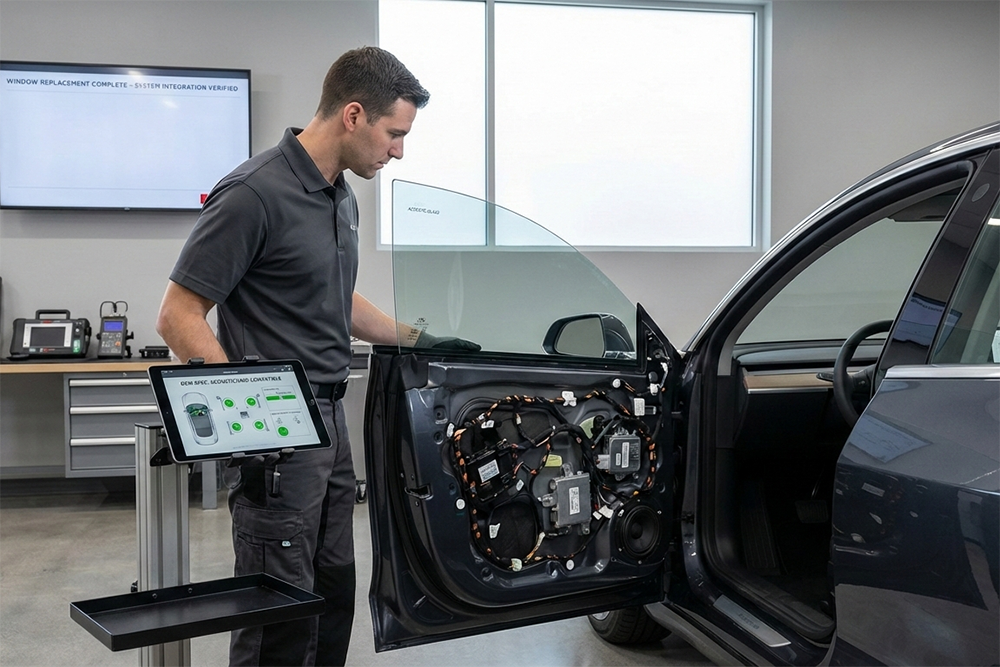
After this point, the replacement procedure undergoes a shift. It is not possible to just glue a new windshield in place and then drive away. The computer in the car has to be informed that the glass has been replaced, and the cameras need to be realigned appropriately. The procedure in question is known as ADAS calibration. Generally speaking, there are two different kinds of calibration, and your vehicle can need either one or both of them:
The process of static calibration is carried out in a shop setting that is under strict control. The technician positions the vehicle on a level surface and then constructs very accurate targets and patterns at certain distances and heights from the vehicle. The technician activates the camera by means of a diagnostic scanner in order to locate these targets and make adjustments to the specifications of the camera. Because it requires a significant amount of room and lighting that can be regulated, mobile van service is frequently not an option for these kinds of repairs.
The procedure of dynamic calibration takes place while the vehicle is in motion. A diagnostic gadget is plugged into the vehicle, and the technician then drives the vehicle at a certain speed on routes that have been clearly designated for a predetermined length of time. In order to “teach” the camera its new position, the system makes use of the road lines and the surroundings that are directly around it.
It is risky to disregard calibration adjustments. Should the system be misaligned, it is possible that your safety systems may not operate when you require them the most, or that they will activate without your knowledge, thus posing a risk to both you and other drivers.
Do you have a Question?
Get An Auto Glass Replacement Quote Now 866.278.7417
Additional Technology That Is Integrated Into Your Glass
Contemporary windshields, in addition to safety cameras, are equipped with a wide range of other convenience features that make the procedure of replacing them more difficult. There are currently a lot of luxury and mid-range automobiles that have Heads-Up Displays (HUD), which are displays that project information such as speed, navigation, and other data straight onto the windshield in the driver’s line of sight.
Because this is not a straightforward projection, the windshield glass needs to have a wedge-shaped interlayer (PVB) installed in order to avoid “ghosting” or duplicate images from occurring. In the event that a shop puts a normal windshield on a vehicle that is mounted with a head-up display (HUD), the display will be hazy and difficult to read.
Rain Sensors: Have you ever noticed that your windshield wipers switch on by themselves when it starts to drizzle? Rain sensors are often situated behind the windshield, next to the rearview mirror, and are responsible for this feature. Infrared light is utilized by these sensors in order to detect wetness. A new gel pad is typically required for the sensor in order for it to properly adhere to the new glass when it is being replaced.
It is possible that the automatic wipers will cease operating or become inconsistent if this is not done correctly. Acoustic Interlayers: In order to make cabins quieter, manufacturers utilize acoustic vinyl layers that are sandwiched between the glass plies. Both wind and traffic noise are reduced as a result of this. Aftermarket glass that is less expensive may not have this characteristic, which may result in a ride that is substantially noisier once it has been replaced.
Compared between Original Equipment Manufacturers (OEM) and Aftermarket Glass
Because of the abundance of technology that is dependent on the windshield, the quality of the glass is more important than it has ever been. This glass is manufactured by the same firm that was responsible for producing the original windshield for the automobile manufacturer. OEM stands for “original equipment manufacturer.” In every respect, it is identical, which guarantees that the lenses of the camera have the precise optical clarity that is necessary.
Original Equipment Equivalent (OEE): This glass is manufactured to the same specifications as conventional glass; however, it may not include the logo of the automobile manufacturer. There is a general lack of risk for ADAS. The aftermarket refers to the production of this glass by independent businesses. The optical quality may vary, despite the fact that it must comply with fundamental safety regulations.
ADAS cameras are susceptible to being confused by even minute distortions that are not visible to the naked eye. To guarantee that all of the systems in modern automobiles are operating properly, it is frequently the safest idea to demand original equipment manufacturer (OEM) or high-quality OEE glass.
What the Effects Are on Time and Money
The process of replacing a windshield has become more expensive as a result of the specific glass, the requirement for calibration, and the highly skilled personnel that are currently required. The cost of a work that used to cost $250 might now range anywhere from $700 to $1,500, depending on the intricacy of the transportation vehicle.
This type of claim is often handled by insurance coverage; nevertheless, it is essential to confirm that your policy includes coverage for calibration. As a result of the fact that insurers are aware that a calibrated safety system does prevent accidents, the majority of complete insurance do.
In addition, time is an issue. It no longer takes forty-five minutes to find a replacement. Because of the installation, the time it takes for the urethane glue to dry, and the calibration procedure, which may take up to an hour or more, you should anticipate that you will be without your car for at least half a day.
Concerning Contemporary Automobile Glass, Frequently Asked Questions
Should I forego the calibration in order to save money? No. It is common practice for respectable car glass companies to decline to repair the windshield if the customer does not consent to the calibration process. There is a problem with liability. In the event that the shop releases a vehicle that has a safety system that is not operating properly and that vehicle is involved in an accident, the shop may be held liable for the accident.
For my ADAS windshield, is it possible for a mobile technician to fix it in my driveway? It is dependent on the automobile. It is feasible that a mobile service might be utilized in the event that your vehicle requires dynamic (on-road) calibration. If, on the other hand, your vehicle has to be statically calibrated, the process must be carried out in a shop that has regulated illumination and floors that are level.
How can I tell if my vehicle is equipped with advanced driver assistance systems (ADAS)? In the upper middle of the windshield, you should look for a cluster of cameras or sensors of some kind. There is also the option of consulting the owner’s handbook of your vehicle or searching for buttons on the dashboard that are associated with lane keeping or collision warnings.
Will the warranty on my vehicle be voided if I change the windshield? Yes, in most cases. As a result of the Magnuson-Moss Warranty Act, consumers are protected from having their warranties void simply because they use parts or services provided by a third party. However, if the ADAS camera or other electronic components are damaged as a result of an incorrect installation, the manufacturer may not be responsible for repair costs associated with that particular repair.
Positioning Safety Above Convenience as a Priority
The development of vehicle technology has resulted in an increase in the safety of our roadways; yet, it has also rendered maintenance more difficult. One of the most prominent examples of this change is the windshield. It is no longer a component that is only a spectator; rather, it is now an active participant in the experience of driving.
A licensed auto glass shop that specializes in ADAS calibration should be your first choice should you find yourself in need of a replacement. Have them answer your questions regarding the equipment they use, the training of their technicians, and the quality of the glass they use. Making sure that your vehicle has a clear view of the road is an investment that is well worth making, even though it may take a little bit more time and cost a little bit more than it did ten years ago. More Than Glass: How the Replacement of Windshields Affects Modern Automobile Safety Technology.
Can you remember the last time you drove a vehicle that was made before the year 2000? In the event of a rollover, the windshield’s primary function was to prevent the roof from collapsing, to keep insects away from your teeth, and to prevent the wind from blowing in. You would replace it with a new sheet of glass in the event that it was damaged by a rock, and then you would get back on the road.
Those days of ease are long gone. The windshield of your modern automobile has evolved from a straightforward clear barrier to a sophisticated optical lens. This is because modern vehicles are effectively supercomputers on wheels. Additionally, it acts as the eyes for the brain of the vehicle.
It is possible that you will only notice a visual flaw if you observe a broken windshield in the present day. That break, however, is a major system interruption for the complex network of cameras, lasers, and sensors that are concealed behind the rearview mirror. The replacement procedure that is required to restore it is also a critical system interruption. For anybody who is concerned about the safety of their vehicle, it is essential to have a solid understanding of the connection that exists between auto glass and automotive electronics.
The Ascent of the ADAS
ADAS, which stands for Advanced Driver Assistance Systems, is the mechanism that is propelling this revolution in technological paradigm. The active safety measures that are now included as standard equipment in a lot of new automobiles are as follows. You will receive a warning if you end up drifting out of your lane, they will automatically apply the brakes if the traffic suddenly stops, and they will modify your speed so that you keep a safe distance from the vehicle in front of you.
Continuous data from the surrounding environment is essential to the operation of ADAS. A portion of this is handled by radar sensors located in the bumper; however, a major percentage of the visual data is obtained by a camera that is placed directly to the inside of the windshield and faces forward.
The following are examples of common systems that rely on this camera: Lane Departure Warning and Lane Keep Assist: These systems scan the lane markers that are located on the road. With the Forward Collision Alert feature, the camera determines the distance between you and the things in front of you as well as their speed. The automobile will automatically come to a stop if the driver does not respond to the collision alarm. This feature is known as automatic emergency braking (AEB).
Identification of Traffic Signs: The camera is able to read speed limits and stop signs, and it displays this information on your dashboard interface. Adaptive Cruise Control is a system that frequently makes use of radar and video data in order to keep up with the flow of traffic. As a result of the fact that these systems are technologies that save lives, they demand absolutely precise accuracy. The road must be captured in its natural state by the camera. At this point, the precision of the installation and the quality of the glass become non-negotiable requirements.
Utilizing the Windshield as a Lens
It is uncomfortable for a human driver to experience a little wave or distortion on the passenger side of the glass, but it will not result in an accident. Optical distortion, on the other hand, is a significant challenge for an ADAS camera. The camera is able to see through the windshield at all times. When the glass is defective, has a varied thickness, or has poor clarity, it will refract light in a different way. The image that the camera captures is altered as a result of this refraction.
If you were to try to catch a baseball while wearing the prescription glasses of another person, what would you do? You would have an inaccurate sense of the depth of the ball, and you would very likely miss it. Now apply that line of reasoning to a vehicle traveling at a speed of seventy miles per hour. In the event that the glass causes the picture to be distorted, the computer in the vehicle may determine that an obstruction is ten feet further away than it actually is. The difference between a near miss and a collision might be attributed to the mathematical mistake that occurs in the event of emergency braking requirements.
HUD stands for heads-up displays. Cameras aren’t the only piece of technology that relies on glass physics. It is currently common for luxury and mid-range automobiles to be equipped with heads-up displays, which are able to show information like speed and navigation instructions onto the windshield, thus eliminating the need for the driver to glance down.
The light that is reflected from the front and rear surfaces of standard auto glass is reflected back. When an image is projected onto normal glass, a phenomenon known as “ghosting” occurs. This phenomenon appears as a double image, which causes the text to become hazy and illegible. Windshields that are built for head-up displays (HUDs) include a layer of plastic (PVB) that is tilted in a certain way and is sandwiched between the layers of glass. A single, clear picture is shown to the driver as a result of the wedge shape’s ability to align the reflections. For a head-up display (HUD)-equipped vehicle, the function is rendered useless if a normal windshield is installed.
Do you have a Question?
Get An Auto Glass Replacement Quote Now 866.278.7417
The Significant Role That Precise Fitting Plays
The quality of the glass is merely one aspect of the overall experience. Equally significant is the exhibition itself in its physical form. When installing a new windshield, a technician is not just affixing a window to the windshield; rather, they are putting a sensor platform in the appropriate location.
Cameras for the ADAS system are installed in a bracket that is affixed to the auto glass. The camera’s viewing angle will shift if the replacement windshield is even a fraction of a millimeter off-center or if the angle of the glass pitch is slightly changed owing to faulty adhesive compression. Both of these situations might cause the camera to function incorrectly.
The answer is in the realm of geometry. A departure of one degree at the lens of the camera might result in a deviation of many feet when gazing down the road one hundred yards ahead. It is possible that the Lane Keep Assist system will believe that you are drifting out of your lane when, in reality, you are perfectly centered. This will cause the steering wheel to pull you toward oncoming traffic if the camera is tilted slightly to the left.
The Final And Most Important Step Is Calibration
Due to the fact that the location of the glass is so important, a physical replacement is rarely sufficient. Therefore, the system has to be recalibrated. This refers to the electrical process of realigning the camera in order to guarantee that it is making accurate communication with the computer in the vehicle. Generally speaking, there are two different kinds of calibration, and your vehicle can need either one or both of them:
The process of static calibration is carried out in a shop setting that is under strict control. Additionally, the tires have been filled to the appropriate level, and the car is parked on a floor that is level. On supports that are carefully positioned at predetermined distances and heights from the vehicle, technicians set up targets or patterns that are extremely exact. The computer of the vehicle is then activated to do a scan of these targets in order to locate its “center” once more. In order for this procedure to function well, the backdrop must be clean of clutter and the illumination must be consistent.
The procedure of dynamic calibration takes place while the vehicle is in motion. The diagnostic port of the vehicle is connected to a portable computer by a technician, who then drives the vehicle at a certain speed on routes that have been designated. Acclimating the camera to the new glass is accomplished by the system by the use of the visible lane markings as well as other environmental data.
Refusing to undergo calibration after having a windshield replaced is a risky endeavor. It is possible that the sensors will not elicit a warning light on the dashboard, which will lead you to assume that the system is functioning properly. The system may, however, fail to deploy in the event of an emergency or deploy in an unpredictable manner.
Where Rain Sensors Come Into Play
Rain sensors are another piece of technology that is directly connected to the process of car glass installation. Conversely, they are not as important for accident safety as ADAS. For the purpose of detecting moisture on the glass, these sensors, which are often situated close to the rearview mirror, make use of infrared light.
When the sensor is activated, light is sent into the windshield at an angle of 45 degrees. A significant portion of the light will be reflected back to the sensor if the glass is dry. The presence of water droplets on the glass causes the light to be scattered, resulting in a lower amount of light returning to the sensor. The automobile recognizes this decrease in brightness as rain and activates the windshield wipers as a result.
The gel pad that is located between the sensor and the glass has to be replaced with a brand new one in order to complete the replacement process. In the event that the gel has air bubbles, dust, or holes, the light will disperse in an improper arrangement. The consequence of this is that the windshield wipers either do not activate when it is raining or engage in a frenetic manner when it is sunny.
Determine Which Service Provider Is Best for You
When it comes to windshields, the “cheapest quote” is rarely the safest option because of the intricacy of contemporary windshields. When searching for replacement vehicle glass, it is important to inquire not just about the cost but also about the technologies involved. Concerning the quality of the glass, inquire as to whether the provider uses OEM (Original Equipment Manufacturer) or OEE (Original Equipment Equivalent) glass material. Because of these criteria, the glass is guaranteed to possess the optical clarity that is necessary for camera systems.
When it comes to ADAS, low-quality aftermarket glass frequently lacks the stringent manufacturing standards that are required. If you inquire about calibration, a business that has a good reputation will inform you right away if your vehicle needs to be calibrated. You should go elsewhere if a service claims that they can replace the glass without calibrating the camera on your behalf. Certification should be checked, and technicians should have training that is primarily focused on ADAS systems. Certification requirements are provided by the Auto Glass Safety Council (AGSC), which also includes teaching on safe installation and calibration processes throughout the certification process.
Service that is Smart and Smart Glass
The car industry is heading toward autonomous driving, which means that the dependence on sensors and cameras will only expand in the next years. We are already seeing windshields that have integrated heating elements to defrost cameras and specific coatings to resist debris. They are becoming increasingly common.
The windshield is no longer a passive component; rather, it is now an active component when it comes to the safety architecture of the car. You are not just mending a window when it breaks; rather, you are repairing a complicated navigation and safety system because of its failure. There is only one way to guarantee that your car will protect you in the manner that it was intended to do, and that is to make sure that the auto glass service you hire is familiar with the physics and electronics that lie behind the glass.
Mobile Safe Auto Glass
14241 E Firestone blvd suite 400,
La Mirada, CA 90638
Phone: (562) 608-1154
Toll Free: 1 866 278 7417
Mail: sales@mobilesafeautoglass.com
Get a FREE QUOTE today! You can get a free quote and schedule 24/7 using this free quote wizard.
Mon – Fri 8am – 5pm
Saturday 8am – 1pm
Sunday Closed