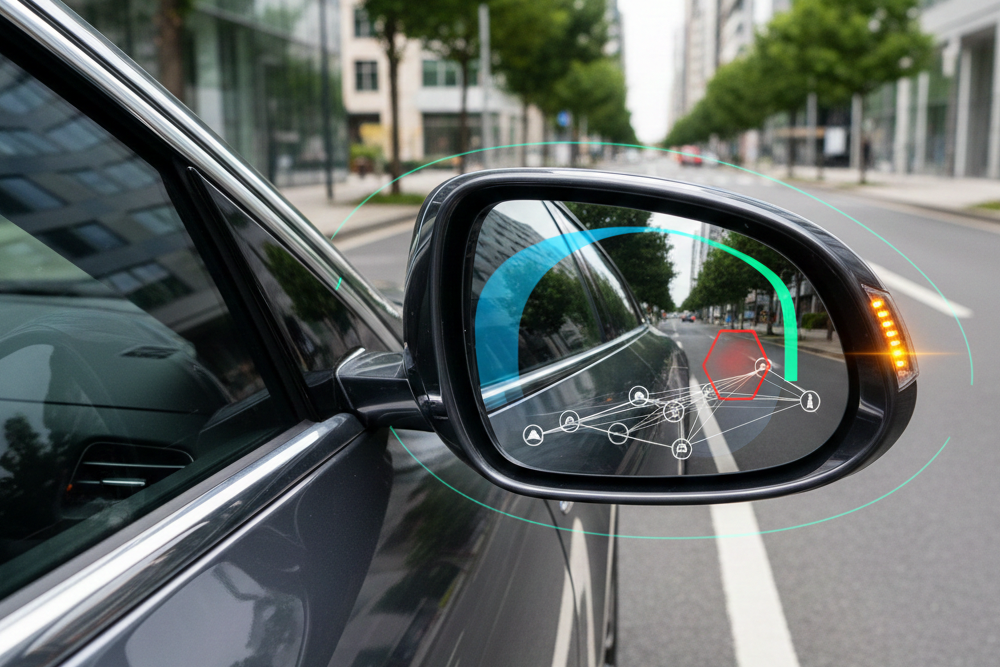
Car Side Mirror Upgrades That Enhance Modern Vehicle Safety
Features like airbags, anti-lock brake systems, and crumple zones are frequently the first things that come to mind when we think about car safety. Even though these are essential for crash protection, preventing accidents is perhaps more crucial. Your side mirrors are one of the most important—and frequently most disregarded—aspects of collision prevention. You rely solely on these tiny reflecting surfaces whenever you change lanes, drive onto a freeway, or pull back into a parking spot. However, older or base-model cars’ stock mirrors frequently have serious drawbacks, particularly when it comes to blind areas and poor vision in inclement weather. Thankfully, automotive technology has developed quickly. Basic glass is no longer your only option. Your side mirrors can be upgraded from basic reflectors to active safety systems with various aftermarket options.
Get An Auto Glass Replacement Quote Now 866.278.7417

Windshield Replacement & Repair
Our competitors push you into going to their shop to get your glass fixed-making it cheaper for them. We make it easier for YOU to get back on the road by offering free mobile repairs at your home or work. With our free mobile services servicing the entire Orange County & Los Angeles area, we can often handle your windscreen replacement the same day! So the next time you need a windshield replacement, give us a call.
Talk to a Windshield Replacement Specialist Now 866.278.7417

Calibration
Calibration is the process of returning a vehicle’s ADAS to OEM specifications. Calibration is necessary after a new glass installation, particularly a windshield with a camera mounted to it, to ensure that the ADAS features continue to function properly despite having been moved during installation. If a car’s ADAS is not properly calibrated, the system may not function safely. A misaligned camera could jeopardize the functionality of the system and lead to dangerous driving or accidents, so it is crucial that the cameras are aligned perfectly, which is what windshield calibration ensures.
Talk to a Calibration Specialist Now 866.278.7417

Fleet Auto Glass Repair
We provide expert auto glass repair and windshield replacement services for commercial fleets of all sizes. We are experienced with all manufacturers and machine types of domestic or foreign cars, trucks, vans, or commercial vehicles, including heavy equipment. Our same day mobile auto glass and windshield repair service will enable you to get back on the road faster and start saving you time and money instantly. Give us a call today! We are here to help!
Talk to a Fleet Auto Glass Specialist Now 866.278.7417
Systems For Detecting Blind Spots
One of the most common driving hazards is the blind spot. Even if you align your mirrors, there’s usually a blind spot next to your car. Every year, this “danger zone” is the cause of hundreds of thousands of sideswipe incidents.
Upgrading to mirrors with integrated Blind Spot Detection (BSD) adds a technological layer of alertness to your driving. These systems commonly use radar or ultrasonic sensors installed on the rear bumper’s corners or inside the mirror housing itself.
The device alerts you when a car enters your blind spot. Typically, a visual indicator, such as a small amber light on the car’s interior A-pillar or mirror glass, accomplishes this. Your turn signal will frequently flash urgently or sound an audio warning if you turn it on when a car is spotted in that area.
Your awareness changes from passive to active with this improvement. Your car is assisting you in your search, not just helping you find automobiles.
Heated Mirror Glass for Visibility in Any Weather: You are familiar with the challenge of blocked mirrors if you reside in an area that experiences severe winters or a lot of rain. In just a few minutes after you start your car, fog, ice, and frost can make side mirrors inoperable. Manually scraping them off is a short-term solution that frequently results in streaks, and as soon as you start moving, the moisture may reappear.
When it comes to visibility in bad weather, heated side mirrors are revolutionary. This upgrade replaces the standard glass with a mirror pane that has heating components underneath it. When it is turned on, the electricity heats the glass, melting snow and ice and quickly evaporating humidity. It is frequently connected to your rear window defroster button.
Here, the safety benefit is instantaneous. Without having to pull down your window to wipe the glass—or worse, driving blind until the air friction clears it—you are able to keep a clear line of sight. This function is now commonplace in many aftermarket mirror assemblies, making it an affordable update for older cars.
Auto-Dimming Electrochromic Technology
There are additional difficulties when driving at night, chief among them being glare. The reflection in your side mirrors can be dazzling when a car behind you has its high beams on or even merely bright LED headlights. This glare either causes eye tiredness that lowers your reaction times or produces a transient blind patch in your vision, which is known as the Troxler effect.
Intelligent chemistry is used in auto-dimming (electrochromic) mirrors to tackle this issue. A gel is positioned between glass layers in these mirrors. The mirror’s sensors measure the amount of light striking the surface in relation to the surrounding light. The gel rapidly darkens when bright light is detected because an electric charge is transmitted through it.
By lowering the strength of the reflection, this darkening protects your eyes from the intense light while preserving your ability to see the car behind you. The mirror becomes clear again after the glare has subsided. Aftermarket replacement mirrors are increasingly offering this technology, previously exclusive to high-end cars.
LED Turn Signals Integrated: Communication is the key to road safety. If other drivers know your plans, they are less likely to take the space you need. Conventional turn signals are found on the front and back corners of the vehicle, but a driver sitting next to you or in your blind spot may find them difficult to see.
This gap is filled with mirrors that have built-in LED turn signals. These improvements install bright LED indicators that only show up when illuminated, either on the outside of the mirror housing or concealed behind the glass.
The signal is positioned such that drivers in neighboring lanes can see it directly. This is especially useful on highways, where rapid communication is crucial due to high speeds, as it acts as a clear warning: “I am moving over.” It successfully increases the signaling’s visibility to a larger area surrounding your vehicle.
Do you have a Question?
Get An Auto Glass Replacement Quote Now 866.278.7417
Aspheric and Wide-Angle Glass
Not every improvement calls for sensors or wiring. The glass’s own geometry can occasionally be improved. Driver-side mirrors in the United States are usually flat, providing a small field of view but an accurate reflection of distance. The “objects in a mirror are closer than they appear” warning is caused by the convexity of passenger-side mirrors, which provide a wider vision but misrepresent distance.
European enthusiasts often add “Aspheric” mirrors to their vehicles to enhance visibility. There are two pieces to these mirrors. The outside edge is sharply curved to force the field of view outward, while the inside section is standard or slightly convex.
This enlarged curve captures the region that would normally be a blind spot. You can track a passing car from your rearview mirror to the side mirror and into your peripheral vision without losing sight of it; however, it requires some adjustment because the image bends slightly at the edge. It is a straightforward, mechanical fix for a challenging issue.
Mirror Systems Based on Cameras (CMS): Right now, we’re seeing a move toward digital solutions. Hybrid upgrades are available, but full video monitoring systems—which completely replace the mirror with a camera stalk—are still encountering legal challenges in some areas.
With these systems, a tiny HD camera is mounted on the side of the car and sends a live video stream to a monitor within the cabin or to the rearview mirror. Compared to glass, cameras have clear advantages. Through the use of software, they can eliminate headlight glare, brighten images at night, and provide a field of view that is significantly larger than any physical glass could without causing significant distortion.
These digital improvements are quite helpful for towing. Although this is the most costly and technically challenging addition on this list, it is the future of vehicle visibility since it enables drivers to see around broad trailers without the need for extendable “towing mirrors.”
Mechanisms for Power Folding: Power-folding mirrors are primarily a convenience feature, but they also protect assets, which is another way they improve safety. The side mirrors are the most exposed area of your car. In crowded city parking lots or on small roadways, passing cars or cyclists have the potential to clip them.
One of the biggest safety hazards is a shattered mirror. Driving with a broken or missing mirror is harmful worldwide and is prohibited in many locations. By upgrading to power-folding mirrors, you can retract them automatically when the car locks or with a single button press. By taking this easy step, you protect the mirror from collisions and guarantee that it will be undamaged and functional when you get back to your car.
Selecting the Best Upgrade for Yourself
Think about your unique needs and the compatibility of your car before making a hasty purchase of new mirrors.
Not every mirror is compatible with every vehicle. Model-specific housing is probably required to make sure the bolt pattern fits your door.
Wiring: Power is needed for features like indicators, dimming, and heating. Should your vehicle lack these characteristics, it may be necessary to install new wiring harnesses through the door panels, which can be a challenging do-it-yourself task.
Rules: Make sure that any modifications to the glass or lights adhere to the rules set forth by the Department of Transportation (DOT) in your area.
Upgrading your side mirrors is rarely purely aesthetic. It is a practical improvement that directly tackles environmental factors and human visual limitations. You may increase road safety for both you and other drivers by implementing improved technologies in your blind spots.
Commonly Asked Questions: Is it possible to add heated mirrors to a car that didn’t have them? Yes, but some electrical repair is needed. In addition to running wire to a power source and a switch (often the rear defroster switch), you will need to buy heated mirror glass or an entire kit. The required wiring harnesses are often included in aftermarket kits.
Are modifications to blind spot monitoring as effective as those seen in factories? Although high-quality aftermarket systems might not integrate as well as factory-installed devices, they can still be quite effective. Compared to less expensive ultrasonic sensors, microwave radar-based systems often provide higher accuracy and fewer false alarms.
Are stick-on convex mirrors indeed effective? Yes, you can see blind spots using the tiny, circular “fisheye” reflectors that you can attach to your existing glass. However, they can occasionally be distracting and occupy valuable space on the primary mirror. A wide-angle pane is typically a cleaner and more efficient option than replacing the entire glass.
Make an Investment in Your Presence
What you cannot perceive, you cannot respond to. Although standard factory mirrors have been a useful tool for drivers for many years, the highways of today are more congested and faster and feature more erratic traffic patterns than ever before.
Using stock mirrors only might result in blind spots and a reduction in situational awareness, which raises the possibility of collisions when changing lanes, merging, or turning.
Every time you drive, upgrading your side mirrors—whether it’s a straightforward wide-angle glass change or a complete computerized blind-spot monitoring suite—offers noticeable safety advantages. By extending your field of vision, wide-angle mirrors make it easier for you to see otherwise hidden objects or cars.
Real-time alerts from electronic systems lower the possibility of human error and provide you peace of mind in congested traffic situations. An enhanced mirror makes the investment worthwhile in terms of protection and peace of mind each time you change lanes securely.
Don’t let a near-miss or close call make you appreciate the importance of a superior vision. Making proactive improvements to your mirrors improves not just your safety but also the safety of other drivers. Ultimately, one of the most straightforward yet efficient improvements you can make to safeguard both you and your passengers is enhanced vision.
Five Technology Features That Increase Accuracy and Clarity
Since the days of basic steering wheels and three pedals, driving has advanced significantly. Rapid technological advancements are turning our cars from simple means of transportation into sentient co-pilots. The advanced sensors, cameras, and software found in modern cars are all intended to improve and increase your safety as a driver.
But it might be challenging to determine which features are truly important amid the marketing language and buzzwords. Are they merely showy gimmicks, or are they actually helpful?
The driving experience is actually being revolutionized by some advanced driver-assistance systems (ADAS). They serve as a guide to keep you exactly where you need to be on the road, an additional pair of eyes, and a quicker reaction time.
The key technologies that are now improving driver clarity and accuracy are broken down in this article. We will examine how these developments function and why they are becoming essential for contemporary drivers, from systems that keep you centered in your lane to displays that place information directly in your line of sight.
HUDs, or heads-up displays: It might be risky to take your eyes off the road for even a brief moment. Heads-Up Displays (HUD) resolve this issue by projecting important information into your field of vision on the windshield.
Originally designed for fighter jets, this technology has found its natural fit in the automotive industry. You can monitor your speed, navigational instructions, and even safety alarms without needing to glance down at the dashboard. HUDs greatly increase situational awareness and reaction times by focusing all of your attention on the immediate surroundings.
HUDs for Augmented Reality
The Augmented Reality (AR) HUD is the most recent version of this technology. Rather than merely displaying floating numbers, AR HUDs superimpose digital images on the actual environment. For instance, you may perceive navigation arrows as seamlessly integrated into the route you need to navigate. Because you don’t have to mentally convert a 2D map on a screen to the 3D road in front of you, this lessens cognitive burden.
ACC, or adaptive cruise control: Conventional cruise control works well on empty roadways but is ineffective in congested areas. Adaptive cruise control enhances this concept by utilizing radar and cameras to monitor the vehicle in front of you.
As usual, you pick the speed you like. To keep a safe following distance, the system will automatically lower your speed as traffic slows down. Your car returns to its predetermined speed as soon as the lane clears. This feature smoothes out the “accordion effect” of stop-and-go traffic and guarantees precise vehicle spacing, which not only lessens driver fatigue on lengthy travels.
The Lane Centering and Lane Keeping Assist (LKA) feature helps prevent accidents caused by drifting out of a lane, which can occur due to inattention or sleepiness.
Drifting out of a lane, often due to inattention or sleepiness, is a significant cause of accidents. Lane Keeping Assist (LKA) uses cameras to identify lane markings. The system will warn you if you start to stray without signaling, usually by beeping or vibrating the steering wheel, and it may gently nudge you back into the lane.
A more sophisticated form of this system is called lane centering. Lane Centering actively guides the car to maintain its position in the middle of the lane rather than simply bouncing you against the lane lines, like in a game of Pong. This makes the driving path smoother and more accurate, especially when navigating highway curves.
Do you have a Question?
Get An Auto Glass Replacement Quote Now 866.278.7417
Monitoring of Blind Spots
A major obstacle to driving precision is being aware of what is invisible. Historically, blind spots have required drivers to physically move their heads, diverting their attention from the road in front of them.
Blind Spot Monitoring systems identify cars in neighboring lanes that are hidden from view in your mirrors by using sensors on the side mirrors or rear bumper. An indicator light, typically on the side mirror itself, may flash and an auditory warning may play if you try to change lanes when a car is identified. To stop you from merging into an occupied lane, some sophisticated systems will even apply a small amount of steering torque or brake pressure.
Systems with 360-degree cameras: A high level of precision is necessary when parking and navigating in confined places. Although they are helpful, traditional rearview cameras only display the area directly behind you.
Often referred to as “bird’s-eye view” monitors, 360-degree video systems combine feeds from several cameras positioned throughout the car, including the front, back, and beneath the side mirrors. This technology produces a virtual top-down image of the vehicle and its surroundings.
This technology eliminates the need for guesswork. You can see how close your bumper is to the garage wall, how far your tires are from the curb, and if there are any obstructions in your blind spots. It simplifies difficult parking tasks into straightforward, stress-free movements.
The Prospects for Accurate Driving
These cutting-edge driver-assistance capabilities are the fundamental components that will eventually enable completely autonomous vehicles as we get closer to autonomous driving. However, these technologies offer improved accuracy, awareness, and clarity that extend beyond fully autonomous vehicles.
Currently available on the market, many of these systems aid drivers in navigating complex routes, monitoring blind spots, maintaining a safe distance, and responding swiftly and confidently to potential hazards. By adopting these technologies now, we’re actively promoting safer highways for commuters, bikers, and pedestrians, in addition to making driving easier.
Prioritizing these features is a wise, progressive decision, regardless of whether you’re looking to buy a new car or are thinking about making aftermarket improvements to your present vehicle.
Human error is one of the main causes of accidents, and lane-keeping assistance, adaptive cruise control, blind-spot monitoring, and collision-avoidance technologies all help lessen it. Purchasing these technologies now signifies a change toward a driving experience where accuracy becomes the norm, confusion is reduced, and reaction speeds are enhanced.
To put it briefly, these technologies are proactive safety measures rather than merely conveniences. They guarantee that your car is ready for the increasingly complicated needs of contemporary traffic, allow drivers to make smarter selections, and lessen tension when driving.
By implementing these technologies, you’re not only enhancing your own driving experience but also contributing to the establishment of new standards for dependability and safety on future roadways.
Mobile Safe Auto Glass
14241 E Firestone blvd suite 400,
La Mirada, CA 90638
Phone: (562) 608-1154
Toll Free: 1 866 278 7417
Mail: sales@mobilesafeautoglass.com
Get a FREE QUOTE today! You can get a free quote and schedule 24/7 using this free quote wizard.
Mon – Fri 8am – 5pm
Saturday 8am – 1pm
Sunday Closed