Car Window Glass Repair Near Me and Weather Exposure
As you continue along the highway, you suddenly hear a pebble being kicked up from the truck that is in front of you. A snap. You notice that your windshield has a very little chip. It appears to be of little significance, around the size of a cent. It’s possible that you believe you can put it off for a few weeks until you have more spare time on your hands. Sadly, nature has other things in store for all of us. Your vehicle’s windshield is continuously being assaulted by the elements. Temperature changes, which can range from sweltering heat waves in the summer to piercing frosts in the winter, place a significant amount of strain on the windows of your car.
Get An Auto Glass Replacement Quote Now 866.278.7417

Windshield Replacement & Repair
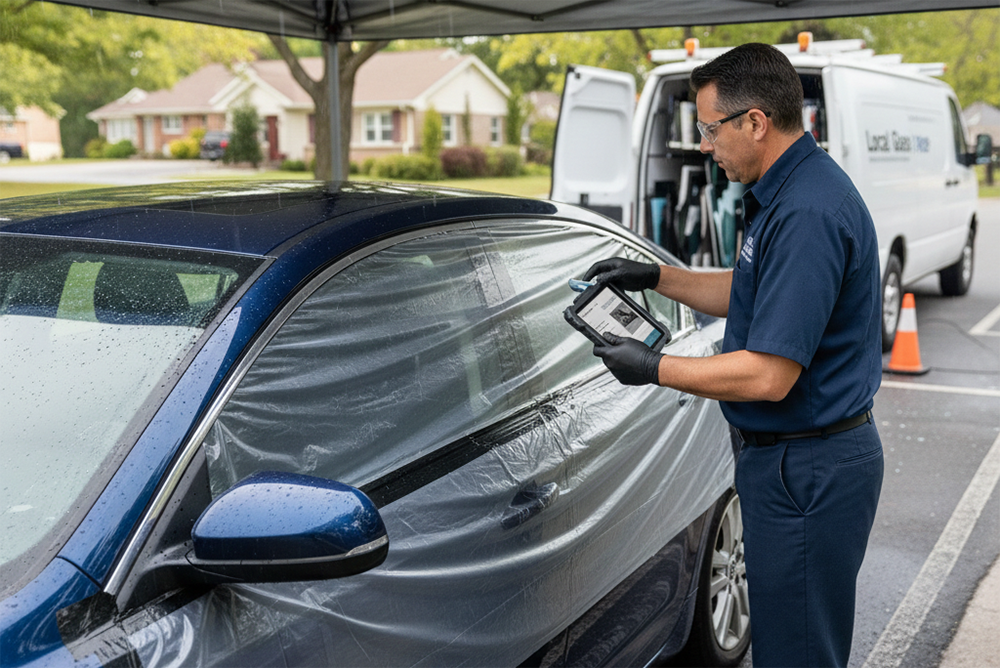
Our competitors push you into going to their shop to get your glass fixed-making it cheaper for them. We make it easier for YOU to get back on the road by offering free mobile repairs at your home or work. With our free mobile services servicing the entire Orange County & Los Angeles area, we can often handle your windscreen replacement the same day! So the next time you need a windshield replacement, give us a call.
Talk to a Windshield Replacement Specialist Now 866.278.7417

Calibration
Calibration is the process of returning a vehicle’s ADAS to OEM specifications. Calibration is necessary after a new glass installation, particularly a windshield with a camera mounted to it, to ensure that the ADAS features continue to function properly despite having been moved during installation. If a car’s ADAS is not properly calibrated, the system may not function safely. A misaligned camera could jeopardize the functionality of the system and lead to dangerous driving or accidents, so it is crucial that the cameras are aligned perfectly, which is what windshield calibration ensures.
Talk to a Calibration Specialist Now 866.278.7417

Fleet Auto Glass Repair
We provide expert auto glass repair and windshield replacement services for commercial fleets of all sizes. We are experienced with all manufacturers and machine types of domestic or foreign cars, trucks, vans, or commercial vehicles, including heavy equipment. Our same day mobile auto glass and windshield repair service will enable you to get back on the road faster and start saving you time and money instantly. Give us a call today! We are here to help!
Talk to a Fleet Auto Glass Specialist Now 866.278.7417
The Study Of The Effects Of Thermal Stress
Despite its appearance of being unmovable and unchanging, vehicle glass is really highly sensitive to changes in temperature. As is the case with the majority of materials, automobile glass expands when it is heated and contracts when it is tempered. In most cases, windshields are constructed out of laminated glass, which consists of two layers of glass with a layer of plastic (polyvinyl butyral) sandwiched in between them. Your vehicle’s metal frame will likewise expand and contract, but it will do so at a pace that is typically different from that of the glass.
Windshields are intended to be able to manage this stress while they are in their original state. It ensures that the stress is distributed uniformly over the surface. The tension, on the other hand, discovers a weak area whenever there is a chip or a fracture in the material. Because of the tension that is concentrated at the location of the injury, the glass is being pulled apart. The process that causes microscopic chips to transform into spiderweb fractures overnight is referred to as stress spreading, and it is the fundamental explanation for this happenstance.
How Windshields Are Destroyed by the Heat of Summer
It is arguable that the summertime is the most hazardous time of year for broken vehicle glass. When heat from the outside is combined with cooling from the inside, the result is a formula for disaster. “The Greenhouse Effect” describes the phenomenon in which the temperature inside of a vehicle rapidly increases while it is parked in the sun. It is possible for the air within to get much hotter than the air outside, which causes the glass to heat up from the inside first. At the same time, the outside of the windshield experiences a baking effect from direct sunshine.
This results in the glass experiencing a substantial expansion. In the event that there is a crack, the expanding glass will put pressure on itself, which will cause the fracture to become longer. It is typically when you get back into the automobile that you are exposed to the most significant risk associated with air conditioning. Quickly after slipping into the driver’s seat, you quickly turn on the air conditioning to bring the temperature down.
As a result, you are experiencing “thermal shock.” This occurs when you contact hot, expanding glass with a blast of frigid air. As a result of the sudden change in temperature, certain regions of the vehicle glass undergo an instantaneous contraction, while the remainder of the glass continues to be heated. It is common for a chipped windshield to reach its breaking point when it experiences this abrupt shift, which causes it to fracture or shatter quickly.
Reasons Why Winter Is Just as Dangerous
The opposite of expansion, which is caused by heat, is constriction in cold weather. At temperatures below freezing, the glass contracts and becomes more compact. The glass has a small curvature that is somewhat different on a microscopic level, which pulls at whatever damage is already there. The trap of the defroster: In the same way that your air conditioner is a source of thermal shock in the summer, your defroster is a hazard in the winter.
In the event that your windshield is coated in frost and you turn the heater up to its highest setting, you will be causing the bottom of the glass to rapidly heat up while the top of the vehicle glass will continue to remain frozen. All of this uneven heating puts a significant amount of strain on the glass. Whenever there is a chip present, the force is frequently sufficient to cause a fracture to run horizontally over the entirety of your line of sight.
Another adversary of winter is water, which may cause freezing temperatures. The microscopic cracks in a windshield chip can allow precipitation such as rain, sleet, or snow that is melting to seep in. During the course of the night, if the temperature falls below freezing, the water will freeze into ice. During the freezing process, water expands. In the process of expanding inside a fracture, it performs the function of a wedge, so physically driving the layers of vehicle glass apart.
During the time that your vehicle is parked in your driveway, this might transform a dent that is repairable into a crack that cannot be repaired. The Ice Scraper: The use of manual pressure is another consideration. When you scrape ice off of your windshield in a hard and forceful manner, you are putting force on a surface that is fragile. If you use the scraper to hit a chip, the impact can easily spread the damage to other areas of the surface.
Do you have a Question?
Get An Auto Glass Replacement Quote Now 866.278.7417
The Importance of Storms and the Pressure in the Atmosphere
In addition to temperature, variations in pressure also play a role in this phenomenon. Even though they are less common than thermal stress, fast variations in air pressure, such as those that occur during severe thunderstorms or when traveling through high altitudes, can have an effect on automobile glass structures. Windshields are responsible for up to thirty percent of the structural strength of a vehicle. Pressure is exerted on the surface of the glass by strong winds. In the event that the structural integrity of the vehicle glass has already been affected by a chip, the glass will have a reduced capacity to withstand the pressure.
What are the reasons for doing a search for “Car Window Glass Repair Near Me”?
As soon as you become aware of a chip, the clock will begin to tick. There is a possibility that the destiny of your windshield may be determined by the weather prediction for the upcoming week. This is the reason why it is essential to locate a local specialist. The need for speed cannot be overstated: if a heatwave or a cold front is on its way, waiting for a weekend or a day off might be detrimental to your safety. It is common for local establishments to provide same-day service.
Many service providers provide mobile glass repair, which means they will come to your location, whether it be your house or your place of business. This eliminates the need for you to drive the car, which results in the addition of road vibration to the list of factors that cause stress on the vehicle glass. Local Knowledge: A technician in your area is familiar with the particular climatic difficulties that are peculiar to your region.
Specific resins that are able to cure properly in high temperatures are utilized by repair shops in Arizona, for instance, because of the tremendous heat and ultraviolet radiation that they are subjected to. On the other hand, a company in Minnesota is able to prepare glass that has been subjected to salt and temperatures below zero degrees.
Savings on Costs: A straightforward chip repair often costs a fraction of what it would cost to replace the chip, and insurance policies typically cover the whole cost of the repair with no deductible. In the event that the weather causes that chip to fracture, you will be required to undergo a complete replacement, which will require you to remove the old glass, reseal it, and calibrate the advanced driver assistance systems (ADAS).
Questions That Are Frequently Asked
After having my windshield repaired, is it all right to wash my car right away? Before putting your vehicle through a high-pressure automatic car wash, it is typically suggested that you wait at least twenty-four hours. Before the resin has had a chance to completely cure, it may be disturbed by the high pressure and harsh chemicals. Washing one’s hands, on the other hand, is often safe to do quickly after the repair.
What kind of impact does rain have on mobile windshield repair? Certainly, rain has the potential to disrupt the curing process of resin. Whenever it is raining, the majority of mobile technicians will require a dry and protected space in order to carry out the repair. It is possible that you may be required to bring the vehicle into the shop if you do not have a garage.
Given that I have a crack in my defroster, is it safe for me to use it? The automobile should be warmed up gently if you are going to use the defroster. A windshield that is frozen should not be subjected to intense heat. In order to gradually raise the temperature of the vehicle glass, begin by turning the heater down to a low setting and allowing the air to go through it.
Avoid Giving in to the Influence of the Weather
The glass in your vehicle is durable, but it is not resistant to damage. At all times, the forces of nature are trying to transform seemingly insignificant chips into significant troubles. It doesn’t matter if it’s the expansion caused by the summer sun or the contraction caused by the winter chill; the environment will ultimately locate the weak area in your windshield.
Proactive maintenance is the most effective form of defense. Waiting for the seasons to change is not a good idea. The search for “car window glass repair near me” should be done right away if you have any damage. Regardless of what the weather prediction may bring, a repair job that takes thirty minutes to complete may save you hundreds of dollars and ensure that you remain safe while driving.
What the Weather Does to the Success of Auto Glass Repairs
It is a sound that every driver dreads hearing: the unmistakable “crack” that occurs when a pebble hits your windshield. The first thing that can come to your mind is to evaluate the size of the chip or to be concerned about the cost of repairing it. On the other hand, there is a factor that is not being taken into account that plays a significant part in determining whether or not that repair is successful: the weather.
The restoration of auto glass is not only a mechanical procedure; rather, it is also a chemical process. The curing process is carried out under UV light, and it is dependent on certain resins attaching to the layers of vehicle glass. Due to the fact that this is a chemical reaction, the quality of the connection is determined by the environment that is surrounding the vehicle.
Variations in temperature and humidity levels have the potential to change a straightforward thirty-minute repair into a permanent visual impairment or, even worse, a fracture that stretches over your whole line of sight. By gaining an understanding of the ways in which environmental elements affect the integrity of the windshield, you can save money and ensure the safety of your car. The scientific principles that underlie heat, moisture, and the structural integrity of your automobile vehicle glass are dissected in this tutorial.
The Chemical Components of a Windshield Injection
In order to know why weather is important, we must first examine the process by which a repair is performed. Glass that is laminated is used to construct modern windshields. This type of glass consists of two layers of glass with a layer of polyvinyl butyral (PVB) plastic sandwiched in between them. A pebble colliding with the windshield will often cause the outer layer of glass to shatter, resulting in the formation of an air pocket.
Injecting a specific acrylic resin into that crack can be done by a specialist or by using a do-it-yourself kit. It is necessary to remove the air and then fill the space with a liquid that has the same refractive index as vehicle glass in order to get the desired result. After the resin has been applied to the crack, it is then subjected to ultraviolet radiation, which causes it to solidify, therefore restoring the structural strength and clarity of the windshield. Although it may appear to be a simple process, resin is notoriously difficult to work with. It is necessary to establish certain circumstances in order for it to flow well, bind successfully, and cure entirely.
The Effects of Heat on Automobile Insulation
One of the most common causes of repair failure is heat, which is especially prevalent during the summer months or in locations that are warmer. The chemical characteristics of the repair resin are altered, as well as the physical condition of the vehicle glass, when it is subjected to significant temperatures. Thermal expansion occurs when glass is heated to a higher temperature. It is possible for the temperature of the windshield to rise to more than 140 degrees if your vehicle has been parked in direct sunshine on a day with a temperature of 90 degrees.
A star break, a bullseye, or a linear crack will become more severe as the glass expands. This is true regardless of the type of damage. The gap becomes too tiny for the resin to flow into the deepest recesses of the break when the fracture increases in size and becomes more extensive. However, despite the fact that the glue may cover the surface, it does leave air gaps below. Those air pockets will remain once the glass ultimately cools and contracts, which will result in the formation of weak areas that may potentially lead to the fracture widening in the future.
Resin Viscosity and Premature Curing: Heat causes the viscosity of the repair resin to decrease, which results in the resin being more runny. Although this may occasionally make it easier for it to flow into tight locations, it also has the potential to cause the resin to seep out of the injection point before it has had a chance to cool and harden. When you are fixing the vehicle glass outside in full sunshine, the ultraviolet radiation from the sun creates a race against time. This is especially true if you are doing the repair outside.
It is possible that the resin will start to firm up (cure) before it has completely filled the chip. In most cases, it is not possible to correct a repair that has already hardened and is only partially filled. Attempting to quickly cool down the glass before a repair by blasting the air conditioning or splashing cold water on the windshield is a typical error that car owners make.
This may result in thermal shock, which is a potentially dangerous condition. As a result of this sudden shift in temperature, thermal shock occurs. When the heated glass suddenly contracts, it places a tremendous amount of stress on the region that has been injured. This tension frequently causes a little chip to “run” into a large break that cannot be repaired.
Do you have a Question?
Get An Auto Glass Replacement Quote Now 866.278.7417
The Reasons Why Moisture Poses a Threat to Repair
The presence of moisture renders the process impossible, whereas heat makes it more difficult. To put it simply, water and auto glass resin are like oil and vinegar; they do not mix together. Interactions That Are Hydrophobic Repair resins are hydrophobic, which means that they do not interact with water. There is a possibility that water molecules will become stuck inside the crack if it is pouring, misting, or even just extremely highly humid.
Due to the fact that water is denser than the air that the resin is attempting to displace, the resin will float on top of the water rather than pushing it out like it would otherwise. There is a possibility that the resin will cure over the water pocket if you attempt to fix a windshield that is moist.
The patch will eventually delaminate (split) from the glass as a result of the retained moisture changing temperature or evaporating over time. “Milky” Appearance: The degree of visual clarity is a significant predictor of whether or not a repair was effective. A foggy, milky white look is frequently observed in the repair when moisture is present during the curing process and causes the resin to get contaminated. As a result of the damage, it does not dissolve; rather, it leaves a permanent, foggy imperfection on your windshield that cannot be cleaned away.
The Freeze-Thaw Cycle: In regions with lower average temperatures, dampness poses a threat to human health. In the event that water is introduced into a chip and the temperature falls below freezing, the water inside the chip will expand and turn into ice. The glass is subjected to a significant amount of pressure as a result of this expansion, which functions as a wedge and causes the fracture to spread further apart. It is not uncommon for a minor chip that is left filled with moisture in the evening to develop into a crack that is one foot long by the morning.
Identifying the Ideal Conditions for Repairing
However, you have the ability to regulate the conditions under which you conduct or schedule a repair. The weather is not something that you can manage. However, having an understanding of these criteria enables car owners to better control their expectations. Professional technicians are aware of how to influence the environment in order to achieve a successful connection. Generally speaking, the “Goldilocks” zone for windshield repair is between 60 degrees Fahrenheit and 90 degrees Fahrenheit (15 degrees Celsius and 32 degrees Celsius).
When the glass is within this range, it is stable, and the resin keeps the appropriate thickness so that it may flow into the break without curing too quickly. In order to exert control over the environment, it is necessary to relocate the car if the weather is going against you. When the temperature is high, you should park the automobile in a garage or in a place that has a lot of shade.
The windows should be rolled down to allow hot air to exit the passenger cabin. Do not use cold water to push the glass to chill; instead, let it cool gently. The car must be dry in the event of rain or humidity. It is necessary to have a garage. When the windshield has been wet, it is common practice for technicians to employ a dry-out cycle, which involves the use of mild heat, in order to guarantee that all moisture has evaporated from the crack before any resin is applied.
Questions That Are Frequently Asked:
If I have a chip, is it possible to use a hair dryer to dry it out before I fix it? You are able to do so, but you must use tremendous caution. When you use a hair dryer with a high heat setting, you run the risk of causing thermal shock, which will further break the glass. In the event that you need to use one, make sure to use a low or medium setting, maintain a consistent motion, and avoid holding it too near to the glass. It is not high heating that is the aim, but rather moderate evaporation.
After it has rained, how long should I wait before I work on repairing my windshield? Wait until the windshield is clearly dry and has had at least an hour of dry weather before attempting to repair the crack in the glass. This will guarantee that any moisture that may have been present in the crack has been removed. In the event that you have access to a garage, you may use a towel to dry the surface and then wait a few hours before attempting to fix it.
Would it be safe to use the defroster on a windshield that has been cracked? Exercise extreme care. During the winter, the fast expansion of the glass is caused by the application of a heated defroster to a windshield that is ice cold. A crack spread can be caused by this, which is one of the most prevalent reasons. The heat should be directed to the floor vents until the cabin begins to gradually warm up.
Safeguarding Your Windshield While It Is Being Repaired
Environmental conditions have a considerable impact on the chemistry and physics involved in the process of repairing vehicle glass. If the temperature or humidity is not taken into consideration, it may result in failing bonding, foggy glass, and cracks that continue to spread. In the event that you find a chip, you should not wait for the ideal time to come to terms with it. Before you can get the damage mended, cover it with a tiny piece of transparent packaging tape and place it on the exterior of the item. This will prevent dirt and moisture from getting inside.
Following this straightforward procedure will ensure that the break is kept clean and dry, which will considerably increase the likelihood of a faultless repair if the weather cooperates or the car is brought into a shop. Regardless of whether you go for a do-it-yourself kit or a professional service, it is imperative that you remain mindful of the science behind glass and resin in order to maintain a clear and secure view of the road.
Mobile Safe Auto Glass
14241 E Firestone blvd suite 400,
La Mirada, CA 90638
Phone: (562) 608-1154
Toll Free: 1 866 278 7417
Mail: sales@mobilesafeautoglass.com
Get a FREE QUOTE today! You can get a free quote and schedule 24/7 using this free quote wizard.
Mon – Fri 8am – 5pm
Saturday 8am – 1pm
Sunday Closed