Windshield Crack Repair vs Replacement Cost Analysis
A pebble suddenly emerges from a truck tire ahead of you as you are leisurely driving down the highway. A star-shaped flaw appears on your glass as soon as you hear that horrible thwack. A financial dilemma soon follows the first frustration: will the outcome be an expensive redesign or an inexpensive fix? Although they are essential to the structural soundness of your car, windshields are extremely delicate. When choosing between a quick repair and a full replacement, there are other factors to take into account besides the size of the crack. You must consider safety regulations, insurance deductibles, and the hidden costs of modern car technology. By dissecting the true expenses of windshield replacement versus repair, this research assists you in making a choice that safeguards your safety and your pocketbook.
Get An Auto Glass Replacement Quote Now 866.278.7417

Windshield Replacement & Repair
Our competitors push you into going to their shop to get your glass fixed-making it cheaper for them. We make it easier for YOU to get back on the road by offering free mobile repairs at your home or work. With our free mobile services servicing the entire Orange County & Los Angeles area, we can often handle your windscreen replacement the same day! So the next time you need a windshield replacement, give us a call.
Talk to a Windshield Replacement Specialist Now 866.278.7417

Calibration
Calibration is the process of returning a vehicle’s ADAS to OEM specifications. Calibration is necessary after a new glass installation, particularly a windshield with a camera mounted to it, to ensure that the ADAS features continue to function properly despite having been moved during installation. If a car’s ADAS is not properly calibrated, the system may not function safely. A misaligned camera could jeopardize the functionality of the system and lead to dangerous driving or accidents, so it is crucial that the cameras are aligned perfectly, which is what windshield calibration ensures.
Talk to a Calibration Specialist Now 866.278.7417

Fleet Auto Glass Repair
We provide expert auto glass repair and windshield replacement services for commercial fleets of all sizes. We are experienced with all manufacturers and machine types of domestic or foreign cars, trucks, vans, or commercial vehicles, including heavy equipment. Our same day mobile auto glass and windshield repair service will enable you to get back on the road faster and start saving you time and money instantly. Give us a call today! We are here to help!
Talk to a Fleet Auto Glass Specialist Now 866.278.7417
The Main Distinction Between Patching and Swapping
It is useful to know what you are truly paying for before getting into the specifics. In order to repair a windshield, a resin that is transparent and can be cured is injected into the outer layer of the glass. After filling the chip or crack, this resin is polished after being exposed to UV radiation.
Restoring structural strength and preventing the crack from expanding are the objectives. Despite the fact that it does not completely remove the damage, it decreases the visibility of the harm significantly.
More intrusive is the process of replacing a windshield than any other procedure. Technicians must remove the molding, the cowl, and the wipers. A new piece of glass is installed after the old urethane seal is cut, the glass is lifted out, and the frame is primed. By doing this, the car returns to its original safety standards.
Cost Analysis: Your bank account will appreciate you if you detect the harm early. The time it takes to complete repairs is typically less than thirty minutes, and they are significantly less expensive than replacements.
Average Prices in the Market: You should budget $50 to $150 for a typical rock chip or a tiny crack (typically less than six inches).
The majority of car glass shops use a tiered pricing structure. If you have a second or third chip on the same glass, they may fix those for an extra $10 to $20 apiece; however, fixing the first chip might cost $70.
The Do-It-Yourself Aspect
Auto parts companies sell do-it-yourself windshield repair kits for as cheap as $10 to $20. The resin-injection technique used in these kits is comparable. Consumer-grade glue is frequently of inferior quality compared to professional-grade glue, and you risk leaving air pockets in the crack if you don’t have the right vacuum equipment. You are typically obliged to upgrade to a complete replacement if a do-it-yourself repair fails.
Repair Insurance Coverage: The greatest news for your pocketbook is that a lot of insurance providers will cover windshield repairs without charging a deductible. The insurance is motivated to pay for the entire cost of the repair to stop the damage from spreading because a $100 repair is significantly less expensive for them than a $1,000 replacement. A competent repair often costs the motorist nothing out of pocket.
Cost Analysis: The cost of resin increases dramatically when the damage is too severe. There is a large amount of variation in the cost of replacing your windshield, depending on the brand and model of your vehicle.
Average Prices in the Market: A replacement usually costs $200 to $500 for an older economy automobile or a car without sensors. However, the cost can reach $1,000 or more for premium cars or new cars with certain technologies.
The type of glass that you choose to replace is a crucial factor in determining the cost of their replacement: OEM stands for “original equipment manufacturer,” which refers to the firm that was responsible for the creation of the windshield that came with your vehicle. It is the same as the glass from the factory. Despite being the most expensive option, we guarantee a flawless fit.
Original Equipment Equivalent (OEE)/Aftermarket: This glass is manufactured by businesses that are not affiliated with the manufacturer. Despite the fact that it may vary slightly in terms of thickness or color, it is required to comply with federal safety rules. Compared to OEM glass, it is often 20% to 40% less expensive.
Do you have a Question?
Get An Auto Glass Replacement Quote Now 866.278.7417
The Unspoken Price
Modern car owners often find themselves unprepared for this. In the event that your vehicle was constructed during the past few years, it is most likely that it is equipped with Advanced Driver Assistance Systems (ADAS). Among these are features like windshield wipers that detect rain, automated emergency braking, and assistance with maintaining lane position.
It is common for the cameras and sensors of these gadgets to look through the windshield. There is only a millimeter of movement in such cameras whenever the glass is replaced. That small change could disrupt the entire safety system.
Therefore, when replacing the glass, the vehicle requires ADAS calibration. This calls for certain tools and instruction. Calibration raises the whole cost by $300 to $600, which frequently causes the replacement to cost more than $1,000.
The Matrix of Decisions: If safety is compromised, you can’t just go with the less expensive choice. Auto glass specialists typically follow certain rules when determining whether to save a windshield.
In the past, there was a rule known as the “dollar bill rule” that claimed a crack might be repaired if it could be filled by a dollar bill. Since then, the size test has been implemented. Some specialists can now fix cracks up to 12 or 14 inches long thanks to advancements in technology. However, the likelihood that the repair would eventually fail increases with the length of the crack.
An examination of the depth of laminated glass reveals that it is made up of two layers of glass that are sandwiched by a layer of vinyl. Repair is impossible if the damage has pierced both layers of glass or if the inner layer is fractured. It needs to be replaced.
Edge Cracks: The structural integrity of the seal is jeopardized if a crack extends to the windshield’s edge. Replacement is required.
Driver’s Line of Sight: Minor distortion or blur is frequently left behind after repairs. Reputable shops will not fix damage that is immediately in the driver’s line of sight, which is an area about the size of a piece of paper just above the steering wheel. A blind spot or dangerous distraction could result from the distortion.
Sensor Area: The resin may obstruct the camera or rain sensor’s capacity to “see,” necessitating a complete replacement if the chip is placed right in front of the sensor.
The Deductible Dilemma in Insurance
The last step in the cost analysis is to navigate your insurance policy. You will probably be responsible for paying your comprehensive deductible if you need a replacement. If the cost of replacement is $450 and your deductible is $500, then filing a claim simply does not make any sense from a financial standpoint. Individually, you are the one who is accountable for paying for it.
However, you save $700 if you pay the $500 deductible, and the price is $1,200 for a contemporary car with ADAS standards.
Insurance companies are required by law in certain areas (such as Florida, Kentucky, and South Carolina) to waive the deductible for windshield repair if you have comprehensive coverage. This is the case in the state of South Carolina. Verify the precise policy specifics and local legislation.
Commonly Asked Questions: Will my insurance premiums increase as a result of a windshield claim? In general, no. Damage to the windshield is typically considered to be a comprehensive claim (rather than a collision), and thus is frequently disregarded as “no-fault.” Nevertheless, a history of claims may eventually affect your risk status or premiums.
I need to wait how long until I can drive once I have a replacement. It takes time for the urethane adhesive to cure. You might have to wait anywhere from one to twenty-four hours before you can drive safely, depending on the humidity and the type of glue used. Driving at an excessively high speed can cause the windshield to shift or leak.
Can a fracture that has been fixed eventually spread? Indeed. The glass is never completely mended, even when mending significantly increases its strength. A mended crack may resurface or spread as a result of extreme temperature fluctuations (such as blasting the defroster on an icy morning) or chassis movement. The majority of trustworthy shops provide a warranty, which credits the repair cost toward a new windshield if it is unsuccessful.
Avoid Waiting for It to Spread
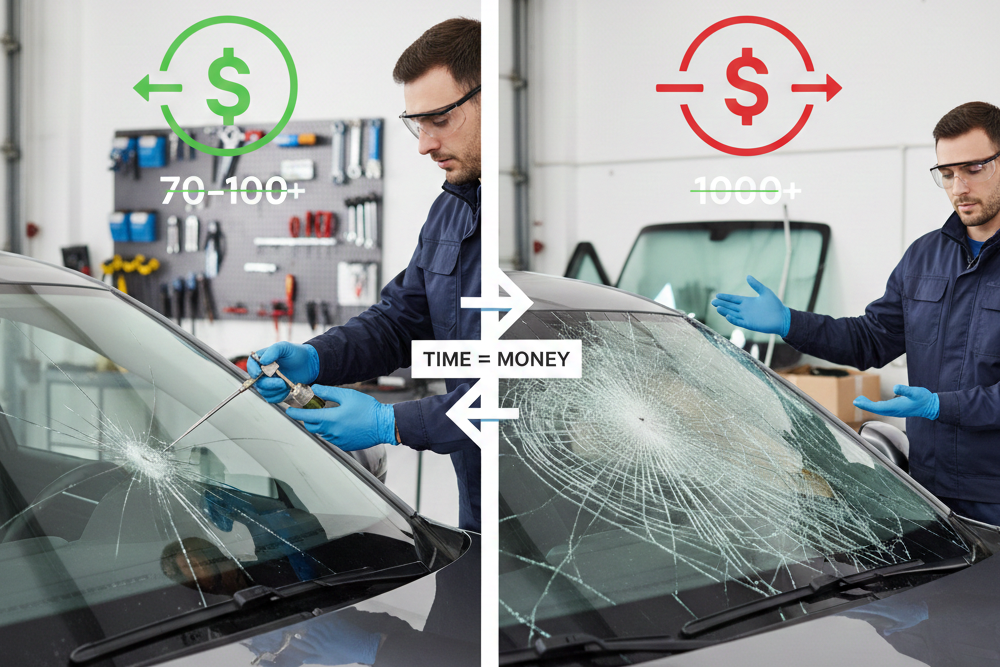
Time is the most important variable in this cost study. If the break spreads across the glass due to a sudden temperature increase, a sharp pothole, or normal road vibrations, a little $70 chip repair can quickly turn into a full $1,000 windshield replacement.
In the event that the damage is ignored, it has the potential to rapidly transform from a relatively minor irritation into a large financial burden. The message is obvious: taking immediate action rather than waiting is considerably more cost-effective when it comes to auto glass.
Repairing chips and small cracks as soon as they appear is almost always the better option financially. In addition to keeping expenses down and generally falling within insurance coverage with little to no deductible, early intervention maintains the integrity of the original glass.
Cutting corners is not an option, though, when the damage is severe or jeopardizes the vehicle’s structural performance, necessitating replacement. In addition to providing a clear barrier, a properly placed windshield preserves the cabin’s structural integrity, supports the roof in the event of a rollover, and guarantees that airbags and other cutting-edge driver-assistance technologies will deploy appropriately in the event of an accident.
Prompt action is essential whether you are replacing a badly damaged windshield or fixing a little chip. Besides assisting you in securing the best deal, promptly addressing the damage guarantees full compliance with safety regulations.
Postponing repairs could save you a few minutes now, but it could cost you hundreds of dollars tomorrow and, more significantly, jeopardize everyone’s safety inside the car. Time is of the essence when it comes to auto glass, and this is true not only for your safety but also for your wallet.
Savings on Vehicles vs. Safety Concerns
Everybody has been there. The smell of rubber and grease fills the air as you stand at the mechanic’s counter and look at an estimate that is double what you anticipated. There is a strong urge to inquire, “Is there a cheaper way to do this?” Consider purchasing used tires rather than brand-new ones, or choosing less expensive brake pads over high-end ceramic ones.
Reducing car maintenance expenses appears to be a prudent financial choice during periods of high inflation and limited spending. It frees up money for savings, rent, or food. On the other hand, a vehicle is a sophisticated mechanism that works quickly and under a lot of stress. The “savings” are frequently a mirage when labor or part quality is compromised.
Car ownership includes the vehicle’s longevity and the safety of its passengers. Let’s examine the trade-offs between having money now and ensuring your car is safe to drive later.
Your tires are the most significant safety aspect on your vehicle, so it is important to choose the right tires. The only thing that comes into contact with them is your two-ton metal box because of the asphalt. In spite of this, car drivers frequently start looking for ways to cut costs on tires.
The Instant Savings: Choosing “budget” tires or purchasing secondhand tires might result in significant upfront cost savings. A high-end set of tires could cost $800, a low-priced set $400, and worn tires even less. It feels satisfying to keep that $400 in your bank account.
The Safety Result: There is science behind the performance differential between high-end and low-cost tires, not just marketing. High-end tires are designed with cutting-edge rubber compounds that improve traction in rainy weather and prevent heat accumulation while traveling on highways.
Longer stopping distances are a common feature of cheaper tires. A cheap tire may take 10 to 20 feet longer to stop than a high-end tire at 60 mph. Those twenty feet can be the difference between a near-miss and a serious collision when emergency brakes is applied to the vehicle. Additionally, there is a greater chance of blowouts at high speeds due to internal structural degradation in used tires that is invisible to the human eye.
The Cost of Stopping Power
Brake rotors and pads are consumables that are meant to deteriorate over time. You will see a wide range of pricing when it’s time to replace them.
The Instant Savings: Brake pads can be bought online for as little as $20, while high-performance or OEM (Original Equipment Manufacturer) pads may cost $60 to $100. Requesting that the mechanic utilize “white box” (generic) parts can reduce the cost by 20% if you are paying them.
The Safety Result: Inexpensive brake pads frequently use semi-metallic compounds, which are harder and noisier. They produce more heat, which can cause “brake fade”—a condition in which the brakes become less effective when stopping for extended periods of time or going downhill.
High-quality brake pads provide reliable friction and heat management. Choosing the least expensive alternative puts you at risk of harming your rotors, which are a considerably more expensive component, and, more significantly, decreasing your stopping power. When you have to replace warped rotors a few months later, the few dollars you saved on pads frequently disappear.
The Silent Killer: Sometimes the savings come from not purchasing a part at all rather than from purchasing a part at a lower cost. You can often achieve short-term cost savings by delaying an oil change, disregarding a “check engine” light, or waiting to fix a rattled suspension.
Do you have a Question?
Get An Auto Glass Replacement Quote Now 866.278.7417
The Instant Savings
You can keep that money in your wallet by forgoing a $100 alignment or a $60 oil change. It seems like a victimless crime if the car is still in motion.
The Safety Result: Your engine’s lifeblood is oil. It becomes sludge as it decomposes, obstructing the motor’s complex channels. Over time, a $60 maintenance expense may escalate to a $5,000 engine replacement expenditure.
Delaying suspension work is much riskier from a safety standpoint. Worn shocks or struts impact your car’s ability to manage bumps and twists. Your automobile may wobble erratically during an evasive move if your suspension is shot, which could result in a loss of control. Tomorrow, a tie rod might snap on the highway if you ignore a rattle today.
OEM vs. Aftermarket Parts: You typically have two options when a repair is required: OEM parts, which are produced by the manufacturer of your vehicle, or aftermarket parts, which are produced by other businesses.
Recognizing the Difference: OEM Parts: These are the exact same parts that were used in the construction of your vehicle. They are rather expensive, but they are assured to fit and work well.
Aftermarket Parts: These might be anything from inexpensive, poorly fitting knockoffs to premium upgrades.
Where to Safely Save: It’s not always necessary to purchase the priciest item. In certain places, aftermarket parts are very affordable and completely safe. Reputable aftermarket brands offer products like floor mats, cabin filters, air filters, and even some exhaust components without sacrificing safety.
Where Compromise Is Not Necessary: Using OEM or premium aftermarket brands is essential for vital systems. This comprises:
Electronics and sensors
Chains and timing belts
Components of suspension
Airbags and bumpers are crash safety components.
Using a generic, low-cost sensor could result in your car stalling in traffic or performing poorly. Should a low-cost timing belt break, it has the potential to result in a catastrophic failure of the engine.
The Economic Facts of “Cheap”: As the expression goes, “I am not rich enough to buy cheap things.” This is especially true of cars. Better parts have a longer lifespan.
You will spend $50 annually if you purchase a car battery that costs $50 and dies after a year. A battery that lasts five years costs $150, which equates to $30 annually. Over time, the pricey option turns out to be less expensive.
The same reasoning applies to resale value. An automobile that has a track record of high-quality maintenance and high-quality parts is worth more. Keeping an automobile together with cheap parts and zip ties will turn off buyers.
Putting Money Into Mental Health
Think differently the next time you encounter a repair fee. This is an investment in safety, dependability, and peace of mind rather than merely fixing a machine. You pay for the guarantee that the car will respond immediately when you hit the brakes, not just to fix a part.
You pay for the assurance that your suspension will cushion the jolts of your daily commute, that your windshield will remain intact in the case of an accident, and that your tires will stay on the road in the event of an unexpected deluge. Because of each repair, the unseen systemic network that ensures the safety of you and your passengers is strengthened.
Saving money in the short term might be alluring, particularly if a less expensive item or postponed maintenance appears to lower the bill at the time. But these “savings” are borrowed from the future; the more shortcuts you take, the more likely you are to face expensive replacements or disasters.
A $50 savings today can become a $500 or even $1,000 payment tomorrow if a crucial part breaks down under pressure. Prioritizing certified installation, high-quality parts, and prompt maintenance protects your health and your pocketbook.
Every well-considered maintenance or replacement is a preventative measure that maintains the reliability of your car’s safety features and keeps your family safe while driving. Paying for quality means knowing that your car is safe and working properly every time you start it. It’s not simply about avoiding future costs.
Mobile Safe Auto Glass
14241 E Firestone blvd suite 400,
La Mirada, CA 90638
Phone: (562) 608-1154
Toll Free: 1 866 278 7417
Mail: sales@mobilesafeautoglass.com
Get a FREE QUOTE today! You can get a free quote and schedule 24/7 using this free quote wizard.
Mon – Fri 8am – 5pm
Saturday 8am – 1pm
Sunday Closed