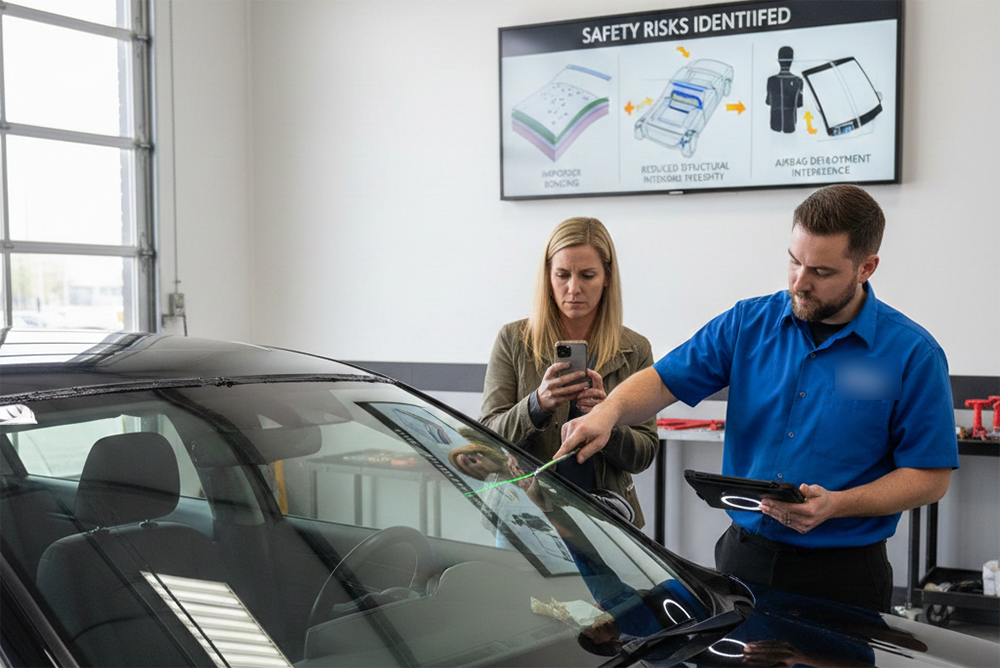
Auto Glass Replacement Errors That Compromise Vehicle Safety
Your initial reaction is probably going to be one of annoyance when a rock hits your windshield while you are driving on the highway. The expense, the insurance claim, and the difficulty of arranging a repair are all things that you are concerned about. On the other hand, the majority of motorists consider replacing their windshield to be a cosmetic fix or a straightforward maintenance chore, comparable to changing a tire or replacing a headlight. However, your windshield serves a far wider purpose than simply protecting you from the wind and insects. It is an essential safety component that is incorporated into the structural construction of your car.
Get An Auto Glass Replacement Quote Now 866.278.7417

Windshield Replacement & Repair
Our competitors push you into going to their shop to get your glass fixed-making it cheaper for them. We make it easier for YOU to get back on the road by offering free mobile repairs at your home or work. With our free mobile services servicing the entire Orange County & Los Angeles area, we can often handle your windscreen replacement the same day! So the next time you need a windshield replacement, give us a call.
Talk to a Windshield Replacement Specialist Now 866.278.7417

Calibration
Calibration is the process of returning a vehicle’s ADAS to OEM specifications. Calibration is necessary after a new glass installation, particularly a windshield with a camera mounted to it, to ensure that the ADAS features continue to function properly despite having been moved during installation. If a car’s ADAS is not properly calibrated, the system may not function safely. A misaligned camera could jeopardize the functionality of the system and lead to dangerous driving or accidents, so it is crucial that the cameras are aligned perfectly, which is what windshield calibration ensures.
Talk to a Calibration Specialist Now 866.278.7417

Fleet Auto Glass Repair
We provide expert auto glass repair and windshield replacement services for commercial fleets of all sizes. We are experienced with all manufacturers and machine types of domestic or foreign cars, trucks, vans, or commercial vehicles, including heavy equipment. Our same day mobile auto glass and windshield repair service will enable you to get back on the road faster and start saving you time and money instantly. Give us a call today! We are here to help!
Talk to a Fleet Auto Glass Specialist Now 866.278.7417
Failure To Adhere To The Safe Drive-Away Times (SDAT) Guideline
Ignoring the Safe Drive-Away Time (SDAT) is one of the most prevalent mistakes done in the business, and it is also one of the most deadly mistakes. In order for the urethane glue to dry and become sufficiently hardened to hold the windshield in place in the event of a collision, this is the particular period of time that is required.
A wide range of adhesives are available. There are certain high-quality urethanes that may cure in as little as thirty minutes, while others may need several hours or even a whole day to properly cure, depending on the humidity and temperature. You are placing yourself in danger if a technician informs you that you may drive immediately after the glass has been set or if they release the vehicle before the time that was specified by the manufacturer.
In the event that the adhesive is not completely cured, driving the car may result in the windshield shifting somewhat. Because of this, the seal is broken, which results in leaks of air and water. However, the most essential thing to note is that this indicates that the bond is not strong enough to survive the force of an airbag deployment.
Mistreatment Of The Pinch Weld In An Improper Manner
A pinch weld is the metal ridge that surrounds the window frame of the vehicle and is where the glass is positioned. During the process of removing the old windshield, sharp instruments are utilized by the specialists in order to cut through the old glue. These tools have a high probability of scratching the paint on the pinch weld, which will result in the exposed metal below being revealed. The creation of rust: If these scratches are not properly coated with a primer, moisture will ultimately reach the bare metal, which will cause rust to spread beneath the glass. Rust formation:
Rust will eventually spread beneath the auto glass. This rust eats away at the metal over time, which has the effect of weakening the connection. Failure of adhesion: The urethane adhesive is intended to bind to paint or primer so that it does not come into contact with bare metal or corrosion. In order to avoid corrosion and guarantee a strong connection, a conscientious technician will carefully examine the pinch weld and add a specialist primer to any scratches that may be present.
Bringing the Bonding Surface into Contamination
Chemicals have a role in the process of adhesion. In order for the urethane to adequately adhere the glass to the frame of the car, both surfaces need to be spotless. When technicians handle the edges of the new glass with their bare hands, they frequently make a mistake that occurs rather frequently.
When applied to auto glass, the natural oils and grease that are found on human skin can act as a barrier, preventing the adhesive from adhering to the surface. It is possible for the seal to be broken by even a minute fingerprint. When handling the glass, professional installers should always use nitrile gloves. Additionally, they should use appropriate cleaning chemicals to prepare the contact surfaces before applying the glue.
Do you have a Question?
Get An Auto Glass Replacement Quote Now 866.278.7417
Recalibration Of The ADAS Was Neglected
ADAS, which stands for advanced driver assistance systems, are standard equipment in modern automobiles. The rain-sensing wipers, automated emergency braking, and lane-keeping assistance are some of the safety features that are included in this category. It is common practice to put the cameras and sensors that are a part of these systems just behind the windshield. Replacement of a windshield results in a change in the location of the glass, which can be as little as one millimeter. This tiny adjustment has the potential to throw off the angle of the camera.
In the event that the system is not recalibrated after the installation, it is possible that your safety features may not function when you require them or that they will occur at the incorrect moment. Skipping this step is a significant breach of safety protocol. If your vehicle possesses these characteristics, you are obligated to make certain that the glass shop has the necessary tools and skills to carry out either a static or dynamic recalibration.
Utilization of Aftermarket Glass of Poor Quality
There is a wide range of quality in auto glass. Glass that was manufactured by the original equipment manufacturer (OEM) is similar to the windshield that was installed on your vehicle when it was first manufactured. The automobile manufacturer’s stringent requirements for thickness, clarity, and durability are satisfied by this product. Some stores try to cut costs by employing aftermarket glass of poor quality, which is sometimes referred to as OEE, which stands for original equipment equivalent.
Although there are some aftermarket glass products that are in pristine condition, there are other cheaper alternatives that may have distortions that hinder visibility (wavy glass). Of much greater significance is the fact that the connection is subjected to stress if the glass does not precisely match the curve of the frame of your car. The tension can cause stress cracks to form several weeks later or prevent the glass from properly sealing against the frame. Both of these outcomes are quite undesirable.
Putting in Place During Unfavorable Weather Conditions
Whether you are employing a mobile windshield replacement service or not, the atmosphere is a significant factor in determining how successfully the installation is completed. In order to ensure that they are applied correctly, urethane adhesives require certain temperature and humidity ranges. Moisture is the enemy of a good seal, and it must be avoided at all costs. There is a possibility that the glue will not adhere if it is pouring or snowing since the pinch weld cannot be kept dry.
In temperatures below freezing, the majority of adhesives become difficult to pump and apply and become difficult to use. There is a possibility that the bond will be broken unless the technician is heating the product or using a specialist recipe specially designed for cold temperatures. In the event that the weather circumstances pose a threat to the quality of the installation, a competent mobile technician will either reschedule the appointment or request that you bring the car into a facility that is climate-controlled.
Warning Signs of a Poorly Installed System
By what means can you determine whether or not your windshield was placed properly? Whooshing sounds: If you hear wind noise, especially coming from the windshield region at highway speeds, it suggests that there is an air leak in the seal. Although you cannot see the chemical bond, there are physical clues that show that the work was not done properly. There is a problem with the seal if your dashboard becomes damp after you have washed your car or if it has been raining heavily.
The rubber trim that surrounds the glass should be flat against the body of the car in order to prevent mold from forming. If it appears to be wavy, loose, or uneven, it is possible that the auto glass is not centered. Cleanliness: If you discover chunks of old glue or shards of old glass left on your dashboard or floor mats, it is a sign that the technician was rushing through the job and may have taken shortcuts in other areas.
Questions That Are Frequently Asked
After having my windshield replaced, is it possible for me to wash my car right away? For at least twenty-four to forty-eight hours following the installation, you should refrain from using high-pressure car washes. During the time when the glue is still curing, the tremendous pressure may cause the glass to shift or cause damage to the seal. In most cases, a light hand wash is okay; nevertheless, it is important to confirm with your installer first.
For what reason do technicians apply tape to the windshield once it has been replaced? During the time that the glue is drying, the retention tape serves to keep the windshield in place and prevents it from slipping down owing to the force of gravity. In most cases, you should leave this tape on for a period of twenty-four hours, or for the duration specified by your specialist.
If I purchase an OEM windshield, would my insurance cover it? This is dependent on the particular policy and insurance company that you go with. Insurers may only pay for aftermarket auto glass if you pay the difference in price, while other insurers may give a rider for original equipment manufacturer (OEM) parts. Before arranging the repair, make sure you check the specifics of your coverage.
But how can I tell whether the ADAS in my automobile needs to be calibrated? In the event that your automobile is equipped with a camera that is situated behind the rearview mirror or functions such as lane departure warning and forward collision alert, it is quite probable that you will want validation. Check the owner’s handbook for your car or ask the glass shop to verify, using your vehicle identification number (VIN), if you are unsure.
Both You And Your Passengers Should Be Protected
Windshield replacement is a technically complex process that calls for qualification, precision, and patience on the part of the individual. When selecting a source of autoglass, it is important to consider more than just the lowest price or the shortest delivery time. Inquire about their accreditation (such as the Agriculture and Food Safety Commission), the type of glue they use, and their policy about safe drive-away times.
You should go elsewhere if a business is unable to explain their method or if they ignore your concerns over the amount of time needed for curing and calibration. In the event of an accident, the vehicle’s safety systems are dependent on the glass staying in its original position. You may ensure that your vehicle will continue to be as risk-free as the day it was constructed by stressing the importance of a high-quality installation.
The Five Installation Errors That Will Destroy The Strength Of Your Adhesive Bond
Adhesives used in structural construction have silently changed the industrial industry. In a variety of industries, including aerospace and automotive assembly, engineers are progressively replacing mechanical fasteners and welds with chemical bonding that has a high level of strength. This change makes it possible to construct vehicles that are lighter, to distribute stress more effectively, and to link materials that are not identical to one another. On the other hand, depending on adhesives brings about a significant variable that mechanical fasteners often avoid: the sensitivity of the installation procedure.
Either a bolt is torqued to the given specification, or it is not. Welds are capable of being visually inspected as well as X-rayed. A chemical reaction that takes place in real time on the production line is what constitutes an adhesive bond, on the other hand. In the event that this response is damaged by human error or environmental conditions, the structural integrity of the entire assembly is put in jeopardy. Within the context of collision safety situations, this margin for mistake is eliminated.
It is possible that a bond that reaches just 80 percent of its target strength will hold during normal operation; yet, when it is subjected to the high-impact energy of a collision, it will break catastrophically under such circumstances. When it comes to achieving optimal crash performance, it is not enough to just choose the appropriate glue; rather, it is necessary to execute an application procedure that is perfect. This article will discuss the most prevalent installation errors that might impair bond strength, as well as the ways in which these errors can be avoided to maintain safety and dependability.
Failure to Perform Appropriate Surface Preparation
Even the most advanced glue in the world is unable to form a bond with a surface that it does not have contact with. Despite the fact that this is self-evident, inadequate surface preparation continues to be the most common reason for adhesive failure. When an adhesive is applied to a component that has not been thoroughly cleaned or abraded, the adhesive adheres to the impurities rather than the substrate itself. This occurs when the technician applies glue to the component.
An invisible barrier created by oils and greases: the settings in which manufacturing takes place are rife with pollutants. Creating a tiny barrier may be accomplished with the use of machining oils, mold release agents, and even the natural oils that are found in a technician’s fingerprints. The adhesive is prevented from “wetting out” by this layer, which means that it does not flow into the tiny peaks and valleys that are present on the surface of the substance. In the absence of wetting out, mechanical interlocking could not be achieved, and the bond strength would be significantly reduced.
When metals oxidize, rust and oxide layers are formed. Although there are structural adhesives that are designed to bite through tiny coatings of oil or oxide, it is not a good idea to rely on this capacity for essential safety components. In situations when the oxide layer is loose, such as when rust is present, the adhesive will adhere to the rust. When the rust is subjected to stress, it will simply peel away from the clean metal that is above it.
However, the substrate surface was the one that failed, not the adhesive. A stringent cleaning procedure should be implemented as the solution. This is often accomplished by first degreasing the surface, then increasing the surface area by mechanical abrasion (such as sanding or grit blasting), and then employing a solvent wipe to remove any remaining dust.
The Mixing Ratios Are Not Correct
A great number of structural adhesives, in particular acrylics and epoxies, are systems that consist of two components. The precise chemical reaction that takes place between a resin (Part A) and a hardener (Part B) is essential to their operation. Stoichiometry, which is simply the computation of reactants and products in chemical processes, is what determines the outcome of this reaction.
When a company guarantees a mix ratio of one to one, they are serious about it. When this ratio is deviated from, even a little, the outcome is a remedy that is only partially effective. The material may continue to be sticky and mushy, lacking the stiffness that is necessary for structural stresses, if there is an excessive amount of resin. The bond may become brittle if there is an excessive amount of hardener, which will cause it to break when subjected to the high-impact shock of a crash test rather than absorbing the energy itself.
This mistake frequently takes place when the mixing process is carried out manually or when the automated dispensing equipment is not calibrated appropriately. It is also possible for this to occur if a static mixing nozzle is reused, if it is partially blocked, or if the “purge” (the initial portion of mixed adhesive) is not removed prior to application.
Ignoring the Control of the Bondline Thickness
There exists a “Goldilocks” zone in terms of the thickness of the glue. There is a possibility that the adhesive will be starved if the bond line is too thin, which will result in inadequate material to endure the stress. In the event that the bond line is excessively thick, the adhesive itself becomes the weak link, which may result in the introduction of flexibility in positions where rigidity is required or the formation of voids during the curing process.
Energy management is essential for peak performance during a crash. For the glue to be functional, it must transfer load between the pieces that are connected together. It is inevitable that the stress distribution would be unequal when the bond gap is varied. It is possible that one part of the joint will bear the brunt of the stress, leading it to break prematurely and producing a “zipper effect” in which the remaining component of the bond collapses in fast succession.
Applying mechanical spacers is the solution. The use of auto glass beads in high-performance structural adhesives is becoming increasingly common. For the purpose of preserving the ideal thickness (which is often somewhere between 0.010 and 0.020 inches), these minuscule beads perform the function of hard stops. They ensure that even if the components are clamped tightly, the glue cannot be pushed out completely.
Lack of Sufficient Conditions for Curing
Once the glue has been applied, the struggle is just half over. During the curing process, the liquid transforms into a solid that has structural integrity. Time and temperature are two factors that have a significant impact on this chemical process. As the temperature rises by 10 degrees Celsius, reaction rates often double. This phenomenon is known as the temperature trap.
On the other hand, the cure time will be greatly extended if the temperature on the factory floor is lower than typical, for example, during the morning shift during the winter. It is possible for the bond to be disrupted if a component is transported to the subsequent stage of assembly before it has reached the “handling strength” level, which is the point at which it is competent to support its own weight. It is expected that the completed product will have micro-fractures that were created during this semi-cured condition.
The tension that is accumulated is caused by these undetectable defects. It is possible that they will not matter under typical loads. In the event of a collision, these fractures serve as the baseline for the collapse of the bond in its entirety. The solution is to keep an eye on the temperature of the water in the bonding region. In order to guarantee that the adhesive reaches its full cross-linked density, it is recommended that important applications make use of hot curing cycles, such as ovens or induction heating.
Do you have a Question?
Get An Auto Glass Replacement Quote Now 866.278.7417
A Poor Design For The Joint In Relation To The Peel Forces
Although this is essentially a design issue, it frequently becomes apparent during the installation process if the components are not aligned properly. Adhesives are exceptionally powerful in shear, which refers to sliding forces, and compression, which refers to pushing pressures. Peeling (pulling apart like a zipper) and cleavage (splitting) are two areas in which they are much less strong.
When an assembly technician presses two warped pieces together, they induce pre-load strains into the connection so that the bond may be strengthened. At this point, the glue is working hard to keep the components together before the automobile has even left the factory. If the design is dependent on the adhesive to conform to the tolerances of the manufacturing process, then the bond has already been established.
When there is a collision, forces are exerted from angles that are not expected. In the event that the bond was left under persistent peel strain as a result of inadequate fit-up during the installation process, the amount of energy that is required to break that bond is significantly decreased.
Questions That Are Frequently Asked
Where can I find out if the surface preparation I’ve done is sufficient? The water break-free test is a straightforward assessment procedure. Apply water that has been distilled to the surface. Beads of water indicate the presence of pollutants in the water. Surface energy is high, and the water is likely clean enough for bonding if it sheets out flat and covers the surface uniformly. This indicates that the water is suitable for bonding. The use of dyne pens allows for the measurement of particular surface energy levels, which is useful for more important applications.
When it comes to bonding, does the surface roughness really matter? Indeed. When the surface is absolutely smooth, there is less surface area for the adhesive to pick up on. Sanding is an example of mechanical abrasion, which serves to expand the surface area, thus providing the adhesive with more “tooth” to mechanically attach to. Nevertheless, the dust that is produced by abrasion needs to be entirely eliminated; else, it will turn into a pollutant in and of itself.
Can you explain the distinction between “work life” and “cure time” specifically? After mixing, the amount of time that you have to apply the glue and arrange the components is referred to as the “work life” or open time. After the allotted amount of time has passed, the glue will start to gel, and it must not be disturbed. “Cure time” refers to the amount of time that must pass before the adhesive reaches its maximum level of structural strength. Failure is caused by moving parts following the expiration of the work life but before the completion of the cure time.
Establish Process as a Priority for Maximum Performance
There are frequently unseen aspects of the production process that are responsible for the difference between a car that is safe to drive and one that has a structural collapse. Unfortunately, high-performance adhesives are not forgiving of shortcuts, despite the fact that they offer enormous possibilities for design and safety.
It is necessary to use a holistic strategy in order to guarantee crash-worthy bond performance. It requires a strict adherence to standard operating procedures, as well as clean substrates, exact chemistry, controlled conditions, and a high level of cleanliness. It is possible for manufacturers to guarantee that their bonds will remain strong when it counts the most if they apply the same level of engineering rigor to the installation procedure as they do to the design of the item itself.
Mobile Safe Auto Glass
14241 E Firestone blvd suite 400,
La Mirada, CA 90638
Phone: (562) 608-1154
Toll Free: 1 866 278 7417
Mail: sales@mobilesafeautoglass.com
Get a FREE QUOTE today! You can get a free quote and schedule 24/7 using this free quote wizard.
Mon – Fri 8am – 5pm
Saturday 8am – 1pm
Sunday Closed