Auto Glass Replacement and Structural Safety Explained
You probably don’t give much mind to the glass in front of you when you get into the driver’s seat of your vehicle. It prevents rain from falling in your lap, pests from getting into your teeth, and wind from getting into your hair. Therefore, as long as you are able to look through it, it is functioning well, right? No, not exactly. Your windshield is much more than a clear protection from the elements now that current vehicle innovation has advanced to the point where it is used. It plays a significant role in the safety restraint system (SRS) that is installed in your car.
Get An Auto Glass Replacement Quote Now 866.278.7417

Windshield Replacement & Repair
Our competitors push you into going to their shop to get your glass fixed-making it cheaper for them. We make it easier for YOU to get back on the road by offering free mobile repairs at your home or work. With our free mobile services servicing the entire Orange County & Los Angeles area, we can often handle your windscreen replacement the same day! So the next time you need a windshield replacement, give us a call.
Talk to a Windshield Replacement Specialist Now 866.278.7417

Calibration
Calibration is the process of returning a vehicle’s ADAS to OEM specifications. Calibration is necessary after a new glass installation, particularly a windshield with a camera mounted to it, to ensure that the ADAS features continue to function properly despite having been moved during installation. If a car’s ADAS is not properly calibrated, the system may not function safely. A misaligned camera could jeopardize the functionality of the system and lead to dangerous driving or accidents, so it is crucial that the cameras are aligned perfectly, which is what windshield calibration ensures.
Talk to a Calibration Specialist Now 866.278.7417

Fleet Auto Glass Repair
We provide expert auto glass repair and windshield replacement services for commercial fleets of all sizes. We are experienced with all manufacturers and machine types of domestic or foreign cars, trucks, vans, or commercial vehicles, including heavy equipment. Our same day mobile auto glass and windshield repair service will enable you to get back on the road faster and start saving you time and money instantly. Give us a call today! We are here to help!
Talk to a Fleet Auto Glass Specialist Now 866.278.7417
In Terms Of Its Structural Function
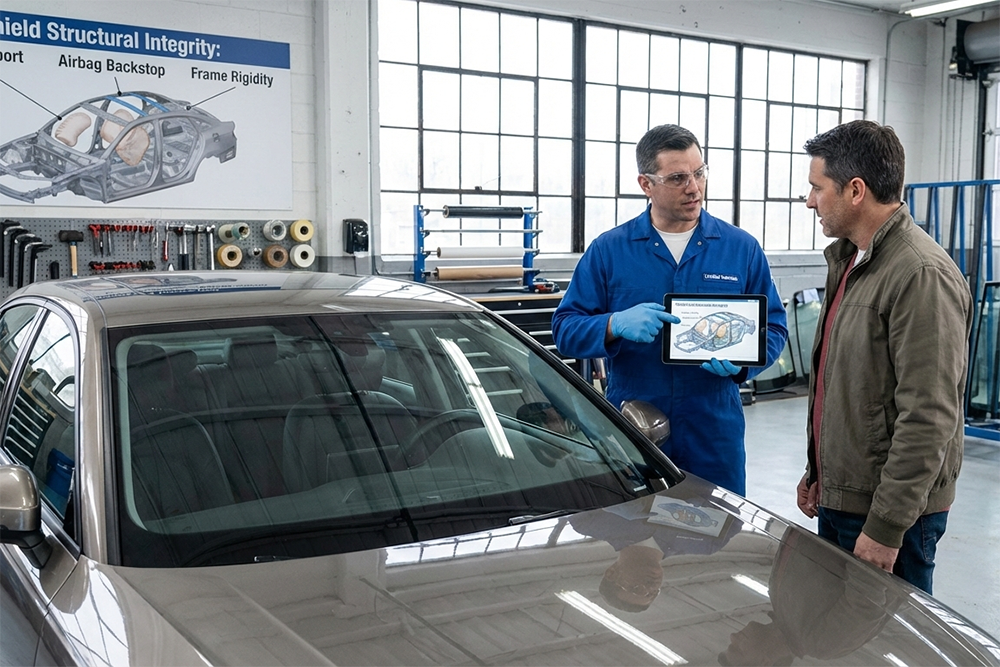
If you drive a car that was manufactured after the year 1990, the windshield is an integral component of the stability of the vehicle. Automotive engineers build the inside of the vehicle, which is sometimes referred to as the “safety cage,” to remain intact in the event of a collision, therefore protecting the people who are within the vehicle. In order to provide support for this cage, the windshield functions as a structural beam.
Roof Crush Protection: The most dramatic example of this support occurs when the vehicle is involved in a rollover accident. During a rollover, the roof of the vehicle is the one that carries the entirety of the vehicle’s weight. In the event that the roof falls, the space available for passengers to survive is immediately reduced.
There is a major percentage of the structural support that is provided by the windshield, which prevents the roof from crushing you. The roof is far more likely to collapse if the glass is able to pop out due to improper installation or if it collapses due to a major fracture that was present in the roof before it was installed.
The Emergency Stop for Your Airbag Although the airbag on the passenger side of the vehicle is a lifeline, it acts with a force that is explosive. Up to 200 miles per hour is the maximum pace at which it may deploy when it is deployed. In order to properly cushion the passenger’s head and chest, it does not just launch itself in the direction of the passenger; rather, it deploys upward and bounces against the windshield in order to place itself in the appropriate position.
It is necessary for the windshield to be robust enough to resist that abrupt and huge impact without being detached from the frame in order for this to be successful. In the event that an inappropriate glue was used during the replacement process or if the frame was not properly prepared, the force released by the airbag has the potential to totally remove the windshield from the vehicle. In the event that the glass becomes broken, the airbag will have nothing to press against, which will render it worthless for the passenger.
Ejection Prevention: In the case of a collision, one of the most perilous outcomes that may occur is for an individual to be ejected from the vehicle from which they are traveling. Despite the fact that seatbelts are the most effective means of protection against this, the windshield operates as the ultimate barrier. When correctly placed, a windshield is intended to maintain its link to the body of the vehicle even in the event of a violent accident, so ensuring that the occupants stay contained within the safety cage.
By utilizing the most recent resin injection technique, specialists are able to properly repair even the smallest chips and cracks. Depending on the size and depth of the crack or chip, it is generally considered a candidate for repair if the chip is less than a quarter or if the crack is shorter than three inches. The technique of repairing the glass requires injecting a transparent resin that can cure into the impact site. This resin then binds the glass back together and restores the viewability of the glass.
In the event that the damage has pierced both the inner and outer layers of the laminated glass, however, it is imperative that a replacement be carried out. Glass that has been laminated is made up of a layer of vinyl that is positioned between two sheets of glass. As soon as the integrity of the inner vinyl layer is damaged, the structure will no longer be intact.
It Is Important to Consider the Location: Even a minor chip might necessitate a complete replacement if it is in the driver’s line of sight. There is frequently a minute deformation left in the glass after repairs. Although this distortion is typically undetectable on the passenger side, it has the potential to divert the attention of a driver or produce glare from headlights and streetlamps, so it creates a potential safety risk in and of itself.
In addition, chips that are close to the circumference of the windshield pose a concern. The adhesion of the glass to the metal frame takes place in this region, which is referred to as the “frit” (the black band that surrounds the edge). Due to the fact that damage in this area reduces the structural relationship, it is possible that the windshield will not be able to withstand the crucial rollover situation.
When It Comes To The Process Of Replacement
When a replacement is required, the procedure and materials used by the technician are often the determining factors in determining whether or not the vehicle is safe to drive or unsafe to drive. It is necessary for urethane to have a clean surface in order for it to adhere properly.
It is possible for the bond to be weak if the technician does not remove the previous glue in the correct manner, or even worse, if they do not prime the metal frame to avoid corrosion. The most dangerous factor to autoglass safety is rust. Additionally, the urethane will peel away from the metal if the metal frame that is underneath the glass rusts. This is typically the result of a damaged paint surface that occurred during a prior replacement.
One of the most frequently neglected parts of windshield repair is the drying period, which is sometimes referred to as the Safe Drive-Away period (SDAT). The urethane material requires a period of time to harden and attain the level of strength necessary to support a roof or to keep an airbag from deploying.
This time frame might range anywhere from thirty minutes to twenty-four hours, depending on the humidity, temperature, and particular type of glue that is being utilized. You can get an accurate estimate of when you will be able to drive your vehicle from a business that has a good reputation. If a technician tells you that you may drive immediately after the glass has been fixed without employing a rapid-cure glue, they are putting your life in danger while acting in this manner. It is possible that the glass will move or come out of the frame if you hit a pothole or get into a fender accident before the adhesive has properly cured.
Do you have a Question?
Get An Auto Glass Replacement Quote Now 866.278.7417
The Cameras and Calibration Feature of the ADAS Factor
As a result of the introduction of Advanced Driver Assistance Systems (ADAS) during the past ten years, the process of replacing windshields has gotten substantially more complicated. In the event that your automobile is equipped with safety technologies such as Lane Departure Warning, Automatic Emergency Braking, or Adaptive Cruise Control, it is most probable that a camera is integrated into the interior of your windshield, specifically behind the rearview mirror. This camera is able to “see” the road markers and obstructions since it is able to gaze through the glass.
When you change the windshield, you are essentially putting a new lens in front of that camera. This has an effect on the optical clarity and geometry of the image. In order to cause confusion inside the system, even a fraction of a millimeter of variance in the glass curvature or a minor fluctuation in the glass clarity can be sufficient.
Because of this, calibration is something that cannot be compromised for current automobiles. Following the installation of the new glass, a technician will need to link a computer to the system of your vehicle and make use of targets, which may be either static boards or dynamic driving tests, in order to instruct the camera on the precise location of the lens. If you miss the calibration process, the camera may incorrectly compute the distance to the vehicle in front of you, which might result in your emergency braking system activating too late or too early.
OEM, or Original Equipment Manufacturer (OEE), Glass
You will hear terminology such as original equipment manufacturer (OEM) while you are arranging a replacement. Being aware of the distinction enables you to make a decision that is well-informed. OEM stands for “Original Equipment Manufacturer,” and it refers to glass that was manufactured by the same company that produced the windshield that was originally installed on your vehicle (such as Pilkington, Saint-Gobain, or PGW). Everything about it, including the thickness, hue, and specs, is exactly the same as what was shipped from the factory. When it comes to safety and comfort, this is the gold standard. Original Equipment Equivalent (OEE) or Aftermarket:
This glass is manufactured by a different company to comply with the specifications of your vehicle. Despite the fact that it must conform to the safety criteria set out by the Department of Transportation (DOT), the thickness or curvature may be somewhat different. In earlier vehicles, OEE is typically not a problem. However, in order to guarantee that the ADAS cameras in vehicles with sensitive sensors function properly, several manufacturers advise adhering to the original equipment manufacturer’s glass.
Questions That Are Frequently Asked
Will the repair of my windshield be covered by my insurance? Autoglass damage is often covered by comprehensive vehicle insurance policies in many instances. In order to encourage drivers to deal with potential safety problems as soon as possible, several jurisdictions have even passed legislation that waives the deductible for windshield repair. Do a check to see whether your particular insurance has “full glass coverage.”
After having my windshield replaced, is it possible to wash my vehicle? Before putting your vehicle through a high-pressure automatic car wash, you should wait around twenty-four to forty-eight hours at the very least. Before the seal has completely dried, the pressure has the potential to displace the glass. It is normally okay to wash your hands after the okay Drive-Away Time has passed, providing that you do not spray water directly at the seals.
The tape is for what purpose? After the installation is complete, it is common practice for technicians to apply blue retention tape strips to the top of the windshield. During the time when the glue is curing, this serves to keep the glass from slipping down owing to gravity. In order to guarantee that the seal secures itself in the appropriate location, you should leave this tape on for a full day.
But how can I tell whether a store has a good reputation? An accreditation from the Auto Glass Safety Council (AGSC) is something you should look for. Technical technicians who have obtained the AGSC accreditation have been educated on the appropriate installation standards, the right use of adhesive, and the safety regulations.
Putting Safety Ahead of Speed of Priority
The discomfort of having a cracked windshield is significant, and the desire to obtain the most affordable and expedient estimate is tremendous. On the other hand, taking shortcuts in this particular location is risky because of the heavy lifting that your windshield undertakes in the event of an accident. Autoglass is a quiet guardian that serves a variety of purposes, including but not limited to providing support for the roof in the event of a rollover, ensuring that your airbags deploy correctly, and enabling your emergency braking system to view the road.
The moment it breaks, you should treat it with the same level of haste and attention that you would give to a tire that is flat or defective brakes. Make certain that you select a certified technician who ensures that the appropriate primers and adhesives are used, that the cure time is respected, and that the necessary calibrations are performed. Your life might very well be in jeopardy if you disregard this.
The Reasons Why Your Windshield Is More Than Just Glass: A Guide to the Strength of Your Roof
What comes to mind when you think of the safety measures that are installed in your vehicle? What about airbags? Do you have a seatbelt? Is it anti-lock brakes? On the other hand, relatively few drivers would cite the wide pane of glass that is directly in front of their face. The majority of drivers would name these essential components.
Many times, we think of the windshield as nothing more than a window that allows us to view the road and protects us from the wind, rain, and insects. However, in the field of contemporary automobile engineering, it encompasses a great deal more. Your windshield is a structural component of the car, and it plays a very important part in preserving the form of the cabin in the event of an accident and ensuring that other safety systems function as they were designed to.
A damaged windshield is not only a nuisance from a purely aesthetic standpoint; it is also a possible safety threat that might impair the structural integrity of your vehicle at a time when you require it the most. It is possible that your perspective on that little rock chip may shift after you have a better understanding of how this glass protects passengers and supports your roof.
The Modern Windshield’s Role in the Structure of the Vehicle
Windshields were essentially little more than wind deflectors in the early days of automobiles. These were sheets of glass that were flat and supplied very little protection and did not provide any structural support. On the other hand, as the design of vehicles progressed, engineers came to the realization that the windshield had the potential to make a major contribution to the total rigidity of the automobile body.
In modern times, high-strength urethane adhesives are utilized in order to secure the windshield to the frame of the car. Consequently, this results in the formation of a unified unit in which the glass and the metal frame collaborate. Because this relationship is so strong, the windshield actually stiffens the body of the automobile, which reduces the amount of bending and flexing that occurs when the vehicle is being driven. Nevertheless, its most important function takes place in the event of an accident.
Reducing the Risk of Roof Crush in Rollover Accidents Rollover accidents are among the most horrifying types of accidents that may occur. When a vehicle flips over, the weight of the vehicle is supported by the roof supports, also known as A-pillars. They are not, however, doing it by themselves. To comply with automotive safety regulations, roofs must be able to bear forces that are far larger than the weight of the car itself. The windshield is responsible for providing a sizeable percentage of this vertical support.
As a matter of fact, the windshield is responsible for up to forty-five percent of the structural integrity of the cabin in many contemporary automobiles in the event of a front-end collision and up to sixty percent in the event of a rollover. It is possible that the windshield will not be able to withstand the load of the roof if it is cracked, chipped, or placed in an unsuitable manner. A malfunction in this area can result in the roof collapsing into the passenger compartment, which would significantly reduce the amount of room available for survival and significantly increase the likelihood of serious head and neck injuries.
Providing Support for Airbag Deployment: The airbag on the passenger side of your vehicle does not just launch itself directly at the passenger. As a result of its deployment upward, it makes contact with the windshield, and then it deflects outward to provide the passenger with cushioning. Within milliseconds, this process takes place with a tremendous amount of force. It is necessary for the windshield to be sturdy enough to serve as a backstop in order for the airbag to perform its intended purpose.
It is possible that the power of the airbag might lift the windshield out of its frame if the glass is damaged in some way, such as by cracking, or if the adhesive bond breaks. The absence of such a backstop makes it possible for the airbag to deploy in the incorrect position or to fail to provide the requisite cushioning, leaving the passenger susceptible to collision with the dashboard.
The Ways in Which Damage Displaces Integrity
Glass is a substance that is exclusive. When it is compressed, it is extremely strong, but when it is tensioned, it becomes fragile. Laminated glass contains two layers of glass with a layer of polyvinyl butyral (PVB) plastic sandwiched in between them. This type of glass is used to construct modern windshields. During a collision, this design serves to safeguard passengers inside the car by preventing the glass from shattering into sharp fragments and preventing the collision from occurring. Surface tension, on the other hand, is what gives this system its incredible strength.
What Causes a Crack in a Windscreen: When a rock strikes your windshield, it causes a fault in the surface of the windshield. The function of this little chip is to act as a stress concentrator. There is a buildup of tension at that weak place when your vehicle goes over potholes, deals with temperature fluctuations, or flexes during turns. At some point, the chip will develop into a fracture. The structural tension of the glass is disrupted as soon as a fracture begins to extend throughout its length.
When this happens, the windshield loses its capacity to transport energy over its surface in an effective manner. Cracked windshields have a substantially higher risk of buckling or detachment in the event of a rollover accident compared to windshields that are not cracked. Not only does structural integrity depend on fractures, but it also depends on how the structure is installed. Improper replacement poses risks. For those who require a new windshield, the quality of the work performed is of the utmost importance.
Additionally, the urethane glue must be placed properly and allowed sufficient time to dry in order for the windshield to be able to hold the roof. If a technician does not use the appropriate primer, contacts the glass with their bare hands (which leaves oils that hinder bonding), or releases the vehicle before the glue has had a chance to dry, the windshield will effectively become a loose sheet of glass. In the event of an accident, it has the potential to fly out completely, stripping the roof of all of its structural support.
Do you have a Question?
Get An Auto Glass Replacement Quote Now 866.278.7417
In addition to Windshield Clarity
When it comes to the “eyes” of your vehicle, the integrity of the windshield is more important than its physical strength. A significant number of contemporary automobiles are already fitted with Advanced Driver Assistance Systems (ADAS). The cameras and sensors that are used for these systems are often situated directly behind the windshield, typically in close proximity to the rearview mirror. Some of the functions that are included in these systems include lane departure warning, automatic emergency braking, adaptive cruise control, and rain-sensing wipers. It is necessary for them to have a vision of the road that is completely unobstructed.
Confusion can be caused by a variety of factors, including a fracture, a chip, or even the distortion that is present in low-quality aftermarket glass. It is possible that the vehicle will brake abruptly or drift out of its lane if the camera “sees” a crack and perceives it as a lane marker or an impediment rather than a crack. Additionally, anytime a windshield is changed, these cameras need to be recalibrated to ensure that they are aiming at the precise angle that is required. If this step is skipped, the active safety measures that were meant to prevent accidents from occurring in the first place would be compromised.
Maintenance Procedures That Are Considered to Be the Best
Making sure that your vehicle’s glass is properly maintained is the first step in preserving the vehicle’s structural integrity. The following are some things that you can do to ensure that your windshield continues to be a benefit to your safety rather than a liability. Get Chips Fixed Right Away: Do not wait for a chip to develop into a crack before repairing it. Small chips, often less than a quarter, may frequently be mended by injecting a specific resin that joins the glass and restores its strength. This is a common method of maintenance. This is a considerably more cost-effective alternative than installing a replacement, and it preserves the original manufacturing seal.
Keep an eye on the temperature: glass will expand when it is hot and will contract when it is cold. Using the defroster on a frigid morning or the air conditioner on a hot afternoon can produce thermal shock, which can rapidly convert a little chip into a big break. If you have a chip, however, you should avoid doing either of these things. Choose Certified Technicians: If replacement is required, be sure that the shop utilizes high-quality glass (OEM or OEE) and adheres to the guidelines set out by the Auto Glass Safety Council (AGSC).
Inquire about the “safe drive-away time,” which refers to the period of time that the vehicle must not move in order for the adhesive to dry. You should look for another business if they tell you that you may drive immediately after the installation. ADAS should be recalibrated: If your vehicle is equipped with safety cameras, you should require that they be recalibrated following that. In order for the safety systems to function properly, it is not a required choice; rather, it is a must.
Putting Emphasis on Safety Instead of Aesthetics
When you see a crack in the windshield, it is simple to put off replacing it because of the expense or the difficulty it would give other people. It is common for us to excuse it by stating, “I can still see the road just fine.” However, vision is only a small part of the tale. As the quiet protector of the vehicle’s structural shell, the windshield is an essential component. It prevents the roof from falling in the event of a rollover, it provides support for the airbags in the event of a collision, and it makes it possible for technology to keep us in our lanes.
For the sake of passenger safety, it is imperative that any damage to the windshield be addressed as a structural problem rather than a cosmetic one. The next time a pebble hits your glass, you should take immediate action to fix it. When you take care to preserve the integrity of your windshield, you are also taking care to preserve the integrity of the protective cage that surrounds you and the people you care about.
Mobile Safe Auto Glass
14241 E Firestone blvd suite 400,
La Mirada, CA 90638
Phone: (562) 608-1154
Toll Free: 1 866 278 7417
Mail: sales@mobilesafeautoglass.com
Get a FREE QUOTE today! You can get a free quote and schedule 24/7 using this free quote wizard.
Mon – Fri 8am – 5pm
Saturday 8am – 1pm
Sunday Closed