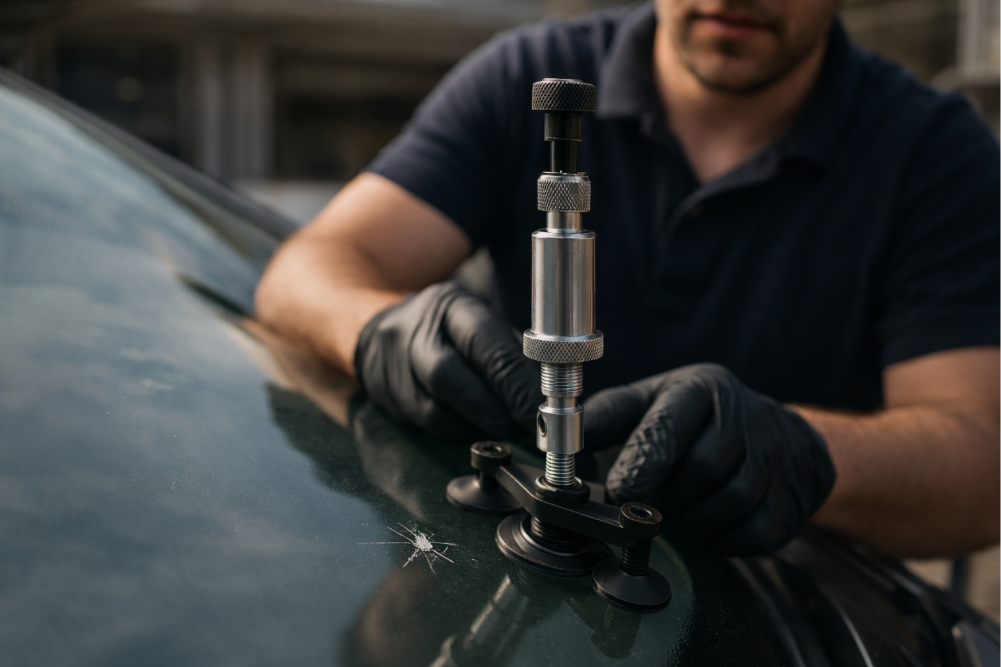
Why Windshield Repair Prices Vary for Small Chips
You were listening to your favorite podcast while driving down the interstate when all of a sudden—snap! A pebble kicks up from the semi-truck ahead and smacks your windshield. You inspect the glass and find a small chip. It’s annoying, but you figure it will be a cheap fix. You call a few auto glass shops and get quotes ranging from $50 to over $150. Why such a wide variation for what seems like the same service? The price of repairing a small windshield chip isn’t arbitrary. It varies according to a number of variables, such as the extent of the damage, the repair shop’s technology, your location, and even your insurance coverage.
Get An Auto Glass Replacement Quote Now 866.278.7417

Windshield Replacement & Repair
Our competitors push you into going to their shop to get your glass fixed-making it cheaper for them. We make it easier for YOU to get back on the road by offering free mobile repairs at your home or work. With our free mobile services servicing the entire Orange County & Los Angeles area, we can often handle your windscreen replacement the same day! So the next time you need a windshield replacement, give us a call.
Talk to a Windshield Replacement Specialist Now 866.278.7417

Calibration
Calibration is the process of returning a vehicle’s ADAS to OEM specifications. Calibration is necessary after a new glass installation, particularly a windshield with a camera mounted to it, to ensure that the ADAS features continue to function properly despite having been moved during installation. If a car’s ADAS is not properly calibrated, the system may not function safely. A misaligned camera could jeopardize the functionality of the system and lead to dangerous driving or accidents, so it is crucial that the cameras are aligned perfectly, which is what windshield calibration ensures.
Talk to a Calibration Specialist Now 866.278.7417

Fleet Auto Glass Repair
We provide expert auto glass repair and windshield replacement services for commercial fleets of all sizes. We are experienced with all manufacturers and machine types of domestic or foreign cars, trucks, vans, or commercial vehicles, including heavy equipment. Our same day mobile auto glass and windshield repair service will enable you to get back on the road faster and start saving you time and money instantly. Give us a call today! We are here to help!
Talk to a Fleet Auto Glass Specialist Now 866.278.7417
The Type and Severity of the Chip
All chips are not made equal in every way. The extent of the damage is one of the most important factors that determines the total cost. Compared to a complicated break that has begun to spiderweb, a simple, surface-level nick can be fixed much more quickly and easily. Chips are divided into many categories by technicians, including
Bullseye: A circular fracture with a clear point of impact. These are often easy to fill. A chip with tiny fissures spreading outward is called a star break. These require more care to ensure the resin fills every fissure.
Combination Break: A blend of a bullseye and star break, sometimes needing extra time and resin.
If the chip is deep or has intricate cracks extending from the center, the technician needs more time and skill to ensure the resin penetrates fully. This labor intensity drives up the price. Furthermore, if you have multiple chips, most shops will charge a base rate for the first chip and a discounted rate for each additional one.
Technology and Materials Used: When it comes to vehicle glass repair, the adage “you get what you pay for” is mostly true. The quality of the resin and the tools used can significantly impact the price tag.
High-Quality Resin vs. DIY Kits: Professional shops use high-grade, UV-curable resins designed to mimic the optical properties of glass. These resins are strong, resistant to yellowing over time, and bond aggressively to the glass layers.
Cheaper services might use lower-quality resins that discolor or shrink, potentially leading to the chip reopening later. High-quality materials cost more, which is reflected in the service price.
Advanced Equipment
Top-tier repair facilities employ vacuum-pressure equipment to inject glue into the chip. This equipment cycles between a vacuum (to suck air out of the break) and pressure (to force resin in). This ensures a solid, bubble-free fill.
Budget providers might use simpler, manual injection tools that don’t achieve the same level of penetration. If a shop has invested in state-of-the-art repair bridges and curing lights, their overhead is higher, but the result is usually a repair that restores the windshield’s structural integrity more effectively.
Mobile Service vs. In-Shop Repair: Convenience comes at a cost. Mobile services are offered by a number of vehicle glass firms, which means that they will come to your house or place of business to complete the repair.
In-Shop: Taking your automobile to the shop is often the most economical choice. The technicians have all their tools ready, a controlled environment, and zero travel time.
Mobile Service: The cost may include a trip fee or a marginally higher service rate to cover fuel and travel time if a technician must drive to you.
While mobile repair is incredibly convenient, weather conditions can also complicate things. A repair needs to be done on dry glass and ideally out of direct, scorching sunlight or freezing temperatures. The logistical cost increases if a mobile technician must use drying equipment or set up a canopy due to environmental conditions.
Insurance Coverage and Deductibles: For many drivers, the “price” of a chip repair is actually zero. This is because many insurance policies cover windshield repairs (not just replacements) with no deductible. Insurance companies prefer to pay $70 to fix a chip now rather than $500+ to replace a cracked windshield later.
On the other hand, you will be responsible for paying it out of your own cash if you do not have comprehensive coverage or if your insurance company handles glass claims in a different manner. When you get a quote, the shop might ask if you are going through insurance.
Insurance Rates: Shops have pre-negotiated rates with major insurance carriers. These are often standardized.
Cash/Retail Rates: If you are paying out of pocket, the shop has more flexibility. To attract clients without insurance, several stores offer competitive “cash prices” that are less than what they charge insurance companies.
Do you have a Question?
Get An Auto Glass Replacement Quote Now 866.278.7417
Your Location and Local Competition
Similar to housing and groceries, labor costs for auto repairs differ by region. A repair business in downtown San Francisco or New York City has much greater rent and labor expenses than a firm in a rural Midwest town. These overhead expenditures are passed on to the customer.
Additionally, local competition plays a role. Ten auto glass stores in a five-mile radius are likely to maintain competitive prices in order to gain your business. If there is only one shop in town, they have a monopoly on the market and can charge a premium.
The Technician’s Experience: Windshield repair is an artistic endeavor. It requires a steady hand, patience, and an understanding of how glass reacts to pressure and temperature.
Master Technicians: Experienced techs know exactly how much pressure to apply without spreading the crack further. They know how to heat the glass safely to make resin flow. Their competence attracts a greater hourly cost.
Entry-Level Techs: Cheaper shops may employ less experienced staff. While they can handle basic repairs, they might struggle with complex breaks or leave air pockets in the repair, leaving the glass vulnerable. The peace of mind that comes from having a skilled team work on your car is frequently what you pay for when you pay a premium.
Windshield Technology (ADAS Calibration): This element is primarily significant to replacements, although it is beginning to effect repairs too. Modern cars are equipped with Advanced Driver Assistance Systems (ADAS)—cameras and sensors often mounted behind the windshield.
The location of the chip matters, even though recalibrating these sensors is typically not necessary for a straightforward chip repair. Some stores may refuse to fix a chip that is right in front of a camera or sensor because the resin might warp the sensor’s “vision.”
In these cases, they might recommend a full replacement, which drastically changes the price conversation. However, if they do proceed with a repair in a sensitive zone, they may charge more for the extra care and testing required to ensure the ADAS system isn’t obstructed.
How to Get the Best Value
How do you make sure you’re not overpaying when prices vary?
Check Your Policy: Give your insurance agent a call first. The cost is unimportant if your policy covers free repairs.
Get Multiple Quotes: Call three local shops. Ask them about their “cash price” vs. “insurance price.”
Ask About Warranty: Reputable shops offer a lifetime warranty on the repair. If the chip cracks out further from the repaired spot, they should credit the cost of the repair toward a new windshield.
Don’t Wait: The longer you leave a chip, the more dirt enters the crack and the more likely it is to spread. A dirty or spread crack is more expensive (or impossible) to fix.
Frequently Asked Questions: Can a windshield chip repair be invisible? No repair is 100% invisible. The goal is to restore structural integrity and prevent the crack from spreading. However, a high-quality repair with good resin can reduce the visibility of the blemish by 75% to 90%.
Is it worth fixing a small chip? Of course. Just striking a pothole or using the defroster on a chilly morning can cause a tiny chip to grow into a huge crack. A $70 repair is much better than a $400 replacement.
Can I use a DIY windshield repair kit? You can, and they are very cheap (usually $10–$15). They typically don’t have the vacuum pressure equipment used by experts, though. If you mess up a DIY repair, a professional usually cannot fix it afterward because the crack is already filled with cured, low-quality resin.
Safeguarding Your View and Budget: Labor, materials, location, and the severity of the damage are the main factors that affect the cost of fixing a windshield chip. While it could be tempting to look for the very lowest price or try a DIY patch, remember that your windshield supplies up to 30% of your vehicle’s structural strength in a catastrophe.
Spending a little extra for a seasoned technician using high-grade resin is an investment in safety. Don’t let a small chip turn into a big headache—assess the damage, check your insurance, and choose a shop that values quality as much as you do.
A Guide to Windshield Damage
Driving down the highway, you hear that dreaded thwack of a rock hitting your glass. Your heart sinks. You see a small chip. Is this a significant issue? Do you have to go to an auto shop right away, or can you ignore it?
Damage to a windshield is not only an attractive annoyance; rather, it poses a substantial threat to the safety of the vehicle. In the event of a rollover, your windshield serves to give structural support for the roof of your car and ensures that your airbags deploy in the appropriate manner. Additionally, your safety is jeopardized if the integrity of the glass is compromised.
Determining whether you can merely fix the glass or whether you need a complete replacement relies on three essential factors: size, location, and time. You can drive safely and save money by being aware of these.
Does Size Matter?: The physical dimensions of the damage are generally the first thing a specialist will analyze. Generally, minor damage is simpler to mend, but bigger fractures weaken the structural integrity of the glass too much to be properly repaired.
Chips and Bullseyes: Chips smaller than a quarter (roughly one inch in diameter) are easily fixed by the majority of repair shops. These circular breaks, often called “bullseyes” or “star breaks,” are common. If the damage fits under a coin, you are likely a good candidate for a quick repair job.
Cracks: These are a little more difficult. Historically, the rule of thumb was that any crack longer than a dollar bill (about 6 inches) required a replacement. However, technology has improved.
Some specialized shops can now repair cracks up to 12 or even 14 inches long, provided they aren’t deep or branching out extensively. If the crack is longer than 14 inches, or if there are multiple cracks radiating from a single impact point, the glass is too weak. The only safe option in these circumstances is to do a complete replacement.
Depth of Damage: Depth is just as important as surface area. A windshield consists of two layers of glass with a layer of plastic (PVB) placed in between. A repair won’t last if the damage pierces through the inner plastic layer or both layers of glass. The structural bond is broken, necessitating a new windshield.
Location, Location, Location: Where the damage lays on your windshield is just as crucial as how large it is. Even a tiny chip can require a full replacement if it lands in the “danger zone.”
The Driver Line of Sight
The most critical area is the driver’s direct line of vision. Repairs, while effective, often leave a slight distortion in the glass. It might look like a small smudge or water spot. In the corner of the passenger side, this is negligible. But directly in front of the driver’s eyes? It can be a dangerous distraction.
If the damage is right in front of the steering wheel—roughly the width of a standard piece of paper—most technicians will recommend replacement to ensure the driver has a perfectly clear view of the road.
The Edges of the Glass: The perimeter of your windshield is where the structural tension is highest. Here, the glass is fused to the car’s metal frame. Damage located within a few inches of the edge significantly weakens the bond and the glass itself.
Cracks or chips here are prone to spreading rapidly due to vehicle vibration and stress. Furthermore, the vehicle’s roof-crush protection standards may be compromised by damage close to the edge. For safety considerations, damage near the edge nearly always calls for a replacement.
Sensors and Cameras: Present-day automobiles are outfitted with Advanced Driver Assistance Systems (ADAS), which include functions such as automated braking, rain sensors, and lane departure alerts. Sensors and cameras are often installed behind the windshield in order to make advantage of these safety systems.
These safety systems may fail if a chip or fracture obstructs a camera or sensor. Even a successful repair might leave enough distortion to confuse the sensors. Manufacturers often need a replacement and a recalibration of the safety systems in these situations.
Do you have a Question?
Get An Auto Glass Replacement Quote Now 866.278.7417
Timing is Everything
The last consideration is the duration of the injury. Unfortunately, windshield damage does not heal; instead, it becomes worse. Many drivers make the mistake of ignoring a minor chip, believing they will “get to it later.”
Environmental Stressors: There is continuous stress on your windshield. Temperature fluctuations are the biggest enemy of damaged glass. Glass expands and contracts in the winter due to the heater blasting inside and the cold air outside, which can quickly transform a tiny chip into a huge crack.
The same happens in summer with the hot sun and air conditioning. Even driving over a pothole or slamming a car door can create enough vibration to spread a crack.
Debris & Dirt: Over the course of time, debris such as dirt, dust, and washer fluid will seep into the crack or chip. The area may become discolored by this debris.
Furthermore, it hinders the repair resin from properly attaching to the glass, which is of considerable importance. If you wait more than necessary, the harm will become “contaminated.” Once a crack is filled with dirt, a repair could not be feasible, or the outcome would be foggy and weak.
The “Sticker Shock” of Waiting: Repairing a chip is usually inexpensive. As a matter of fact, many insurance companies allow the deductible to be waived for repairs since doing so saves them the expense of having to replace the whole vehicle.
If you wait until the crack spreads, you are looking at a replacement cost that can run anywhere from a few hundred to over a thousand dollars, especially if ADAS recalibration is needed. Addressing damage immediately—often within a few days—gives you the best chance of a successful, low-cost repair.
Check Your Glass Today
An essential part of the safety architecture of your car is your windshield. Don’t ignore that small rock chip. By evaluating the size, location, and timing of the damage, you can make an informed decision.
If the damage is small, out of your direct line of sight, and fresh, a repair is likely your best bet. If it’s long, near the edge, or blocking a sensor, prepare for a replacement. When in doubt, consult a professional auto glass technician immediately.
Mobile Safe Auto Glass
14241 E Firestone blvd suite 400,
La Mirada, CA 90638
Phone: (562) 608-1154
Toll Free: 1 866 278 7417
Mail: sales@mobilesafeautoglass.com
Get a FREE QUOTE today! You can get a free quote and schedule 24/7 using this free quote wizard.
Mon – Fri 8am – 5pm
Saturday 8am – 1pm
Sunday Closed