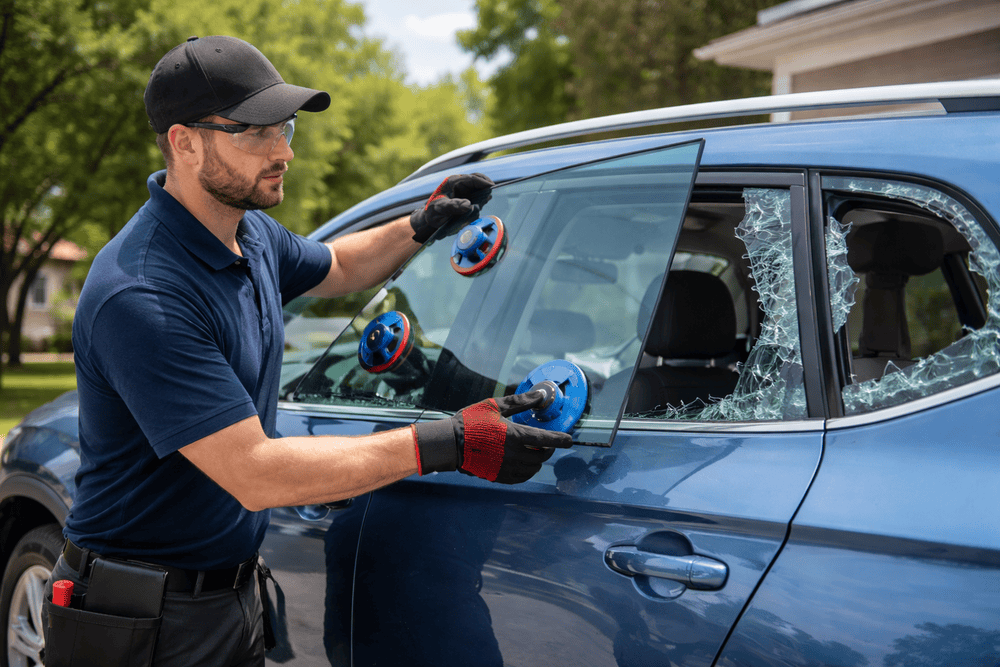
Tips for Car Side Window Replacement Costs
It is depressing to approach your car and discover a heap of broken glass on the sidewalk. A damaged side window exposes your car to weather and theft, regardless of whether it was the result of a break-in, a wayward baseball, or road debris. Your first thought is probably one of annoyance, which is followed immediately by the urgent query, “How much will this job cost me?” A side window nearly always needs to be replaced entirely, in contrast to a windshield, which may frequently be fixed if the damage is modest. This repair project is special because of the door’s mechanics, the kind of glass utilized, and the amount of work required.
Get An Auto Glass Replacement Quote Now 866.278.7417

Windshield Replacement & Repair
Our competitors push you into going to their shop to get your glass fixed-making it cheaper for them. We make it easier for YOU to get back on the road by offering free mobile repairs at your home or work. With our free mobile services servicing the entire Orange County & Los Angeles area, we can often handle your windscreen replacement the same day! So the next time you need a windshield replacement, give us a call.
Talk to a Windshield Replacement Specialist Now 866.278.7417

Calibration
Calibration is the process of returning a vehicle’s ADAS to OEM specifications. Calibration is necessary after a new glass installation, particularly a windshield with a camera mounted to it, to ensure that the ADAS features continue to function properly despite having been moved during installation. If a car’s ADAS is not properly calibrated, the system may not function safely. A misaligned camera could jeopardize the functionality of the system and lead to dangerous driving or accidents, so it is crucial that the cameras are aligned perfectly, which is what windshield calibration ensures.
Talk to a Calibration Specialist Now 866.278.7417

Fleet Auto Glass Repair
We provide expert auto glass repair and windshield replacement services for commercial fleets of all sizes. We are experienced with all manufacturers and machine types of domestic or foreign cars, trucks, vans, or commercial vehicles, including heavy equipment. Our same day mobile auto glass and windshield repair service will enable you to get back on the road faster and start saving you time and money instantly. Give us a call today! We are here to help!
Talk to a Fleet Auto Glass Specialist Now 866.278.7417
The Mean Replacement Cost
Let’s start by discussing the numbers. A replacement for a car side window typically costs $200 to $500. Usually, this cost covers both the glass and the work.
But the $200 range is merely a starting point. The cost may easily reach $800 or more if you own a rare luxury car with specific sensors in the glass. On the other hand, you might be able to get away with spending more like $150 if you drive an older, more popular sedan and get a good price on aftermarket glass.
You must comprehend the several aspects that influence price fluctuations to comprehend the quote you obtain from an auto glass business.
Important Elements That Affect the Cost: The glass pane isn’t the only item on the final bill. A vehicle glass expert determines your quote based on several factors.
The largest variable is your car’s make and model. For a Toyota Corolla, a side window is generally accessible and reasonably simple to install. Finding a window for a luxury Mercedes or an old classic car is more difficult and involves more complex work.
Another contemporary issue with newer autos is electronics. These days, many cars include windows with built-in security sensors, heat-reducing tints, or laminates that block noise. These high-tech windows need to be replaced with calibrated glass, which is far more costly than regular tempered glass.
The Glass Type: Laminated vs. Tempered Tempered glass constitutes the majority of side windows. To prevent harm, this glass is made to break into thousands of dull, microscopic cubes upon impact. It is typically inexpensive and the standard for the majority of cars.
Nonetheless, some high-end cars and more recent models have side windows made of laminated glass. Laminated glass is made up of two layers of glass with a plastic layer in between, much like a windshield. Although it is pricier to replace than tempered glass, it is also quieter and more difficult to break in.
The Mechanism of the Window Regulator
To raise and lower the window, a motor powers a mechanical track called a regulator that holds the glass. Broken glass frequently falls within the door panel when a window breaks.
The repair becomes more difficult if the debris affects the motor or the regulator. The door panel must be disassembled, the debris must be vacuumed out, and the mechanical components may need to be replaced. The final invoice now includes labor time and parts.
Which Is Better, OEM or Aftermarket Glass Technology? Selecting between OEM and aftermarket glass is one of the simplest methods to keep the expense of your repair under control.
The same company that produced the glass for your vehicle when it was brand-new produces Original Equipment Manufacturer (OEM) glass. Its durability, hue, and thickness are all the same. It also carries the brand’s logo. Due to its certification, OEM glass is the most expensive option.
Third-party firms make aftermarket glass. Although it doesn’t include the carmaker’s logo, it is made to suit your car precisely and adhere to safety regulations. Some drivers opt for an OEM front windshield because safety sensors (ADAS) need to be calibrated precisely.
However, aftermarket glass is typically a fantastic option for a side window. Although it works exactly the same way, you can save a lot of money—up to 40% less than OEM rates, in some cases. Aftermarket is typically a more cost-effective option unless you are leasing the vehicle and the agreement calls for OEM parts.
Do you have a Question?
Get An Auto Glass Replacement Quote Now 866.278.7417
When to Get Insurance and When Not to
Many drivers believe that since they have “full coverage,” they ought to submit a claim for a shattered window on their own. This isn’t always the optimal approach.
You should verify your deductible. Filing a claim won’t help you if the cost to replace the window is only $350 and your comprehensive insurance deductible is $500. To cover the deductible, you will ultimately have to pay the entire $350 out of pocket.
But look for a “full glass coverage” recommendation in your policy. Glass replacement is permitted under certain policies (and state legislation) with no deductible. The replacement should be free if you have this particular coverage.
Prior to contacting your agent, always do the math. It might not be worth the chance of your premiums going up the next year to file a claim for a meager settlement.
In-Shop Replacement vs. Mobile Service: Typically, you have two choices for getting the service done: having a mobile technician come to you or taking the car to a shop.
Mobile service is really practical. The specialist comes to your house or place of business, fixes the glass in the parking lot, and departs. Some businesses, however, impose a “convenience fee” for this service.
You must either arrange for a ride or drive to the site and wait for in-shop service. The technicians work in a controlled area, and you save mobile fees. The interior of the door panel must remain dry; thus, mobile replacement may not be feasible in inclement weather (rain or snow).
If cost is your top priority, give the store a call and inquire about any price differences between in-store and mobile services. You might save between $30 and $50 if you bring the car to them.
Why Repair Isn’t an Option: When it comes to side windows, drivers frequently wonder, “Can’t you just patch it like a windshield chip?” The answer is nearly always no.
Side windows, which are typically composed of tempered glass, shatter entirely rather than just chip or split. The entire pane crumbles if the structural integrity is violated.
Side windows experience a lot of movement and vibration from slamming doors and rolling up and down, even if the glass is laminated and slightly cracked. That kind of stress is too much for a repair to withstand. There is no other secure and long-term answer but replacement.
Ways to Reduce the Cost of Your Replacement
If you are covering the expenses yourself, use these tips to cut costs.
Get Quotes: National businesses and small, neighborhood auto glass shops might have completely unique prices. Make at least three separate phone calls. You may discover that a nearby store is eager to attract customers and is prepared to provide a lower price than a rival.
Request a Cash Discount: Businesses lose money due to credit card processing fees. If you pay with cash, some independent stores will give you a little discount, typically about 5%. Asking never hurts.
Your Own Cleaning: Labor expenses are based on time. You are footing the bill if the technician needs to spend thirty minutes sweeping glass fragments from your seats and carpet.
You may be able to negotiate a lower labor charge if you safely vacuum the car’s interior before bringing it in. Note: Leave the glass within the door panel to the experts.
Think About Used Auto Glass
This is the best way to save money. Cars that have been totaled in front or rear incidents but have fully intact side windows can be found in salvage yards, also known as junkyards.
A salvage yard frequently sells used OEM side windows for a fraction of the cost of a new one. Although they won’t extend a warranty on the part itself, some auto glass businesses will even install used glass if you supply it.
Tape It Up (Temporarily): Cover the interior if you can’t afford the repair right now. Don’t just let it hang there. To close the aperture, use tape and heavy-duty plastic or crash wrap. By doing this, you can avoid having your upholstery or electrical door switches damaged by rain, which would result in a much higher repair price down the road.
Frequently Asked Questions: How much time does it take to repair a side window? An hour or so is often needed for the actual installation.
The technician must, however, make sure the glue sets properly and clean up any broken glass inside the door panel. The appointment should take roughly two hours.
Will my other windows be compatible with the new one? Indeed, ordinary auto glass includes a specific tint level that mimics the factory look. You will have to hire a different business to put film on the new window so that it matches the rest of the car if you have aftermarket dark tint (limo tint) on the other windows.
When a side window is smashed, is it safe to drive? It is not advised. Driving at highway speeds with a window (or a plastic sheet) open can be distracting owing to the noise, in addition to the potential of theft. In the event of a rollover, the window also gives the roof structural support.
Regain the Security of Your Vehicle
Although a shattered side window might be very inconvenient, it doesn’t have to be expensive. You may efficiently control the cost by being aware of the distinctions between OEM and aftermarket glass, examining your insurance deductibles, and obtaining several quotations.
Don’t put off fixing it too long. A sealed, functional window is essential to your car’s security and interior protection. Spend a few minutes today comparing your alternatives, making some calls, and restoring the safety and security of your car.
Why Vehicle Year and Location Affect Automobile Shipping Costs: When moving an automobile across the nation, you may think there is a set price per mile. Given that the distance doesn’t fluctuate and gasoline prices are comparatively constant, it makes sense.
You’ll soon discover, nonetheless, that the final price tag is dependent on a lot more factors than just the mileage number if you ask auto shipping providers for bids. How old the automobile is ( year) and where you are shipping it to and from (location) are two of the main elements affecting your price.
The price can change by hundreds of dollars depending on these factors. You may improve your budget and possibly even save money on your next shipment if you understand why these variations occur. This is an explanation of why vehicle age and location have such a significant impact on auto transport expenses.
Locations Effect on Shipping Prices
The location of the truck is more important than the distance it must go. Logistics firms operate with efficiency, which in turn determines the price.
Carriers prefer densely populated areas and main roadways over rural routes. Transporting a vehicle from Los Angeles to New York City is known as the “golden route.”
Drivers can pick up a full load of cars in these high-traffic lanes, drive straight on an expressway, and drop them off swiftly. Prices are still competitive because there is a large supply and demand for trucks.
On the other hand, the cost will increase if you need to move a car to a mountain lodge in Colorado or a rural hamlet in North Dakota. To get to you, the driver must take a detour off the main interstate, use more fuel, and maybe go several miles without a full load. The cost of driving with an empty trailer, also known as “deadhead” mileage, transfers to you.
Door-to-door versus Terminal-to-Terminal: The locations of your pickup and delivery are also important.
Door-to-door: This method is the most practical but also the most costly alternative, particularly in residential neighborhoods with little streets that are difficult for big transport trucks to navigate.
Terminal-to-terminal: Because it makes the carrier’s job easier, dropping off your vehicle at a regional hub—typically close to a big city—is frequently less expensive.
Do you have a Question?
Get An Auto Glass Replacement Quote Now 866.278.7417
Regional Weather and Seasonality
The calendar is linked to locations as well. Because “snowbirds” (retirees) are relocating their cars north for the summer, shipping a car out of Florida in the spring is costly. Both demand and prices are surging. Similarly, because of the possibility of snow and ice delaying the shipment, shipping routes through northern states in January may be pricier.
Why is Vehicle Year Important? You may believe that a car is just a car, no matter when it was manufactured. However, a 2024 Honda Civic and a 1965 Mustang are completely unique types of goods for a carrier.
Variations in Size and Weight: Older cars are frequently heavier. Modern automobiles use lighter materials like carbon fiber composites, aluminum, and plastics, while sedans from the 1970s were made of hefty steel. The Department of Transportation enforces stringent weight restrictions on auto transport trucks.
A carrier may need to carry fewer vehicles overall to be legal if they load too many hefty vintage autos. They charge more for the larger, older car to make up for the “lost” place on the trailer.
Operational Status: When it comes to vehicle age, the previous owner is the most important factor. A brand-new vehicle steers, stops, and starts flawlessly. A 1950s “barn find” might not run at all.
The carrier cannot just drive an unusable vehicle onto the trailer. To load and unload it, they need to utilize a winch and additional work.
The process takes a lot longer and requires specialized equipment. In logistics, time is money; thus, transporting an older automobile that isn’t working will always cost more.
Liability and Value
Insurance coverage for classic or historic autos is frequently pricier. Standard liability coverage might not be adequate if you are delivering a rare artifact from the 1960s. To shield the car from road debris, carriers might need to modify their insurance or adopt additional safety measures.
Many owners of vintage cars opt for enclosed transportation rather than an open carrier. Although enclosed transit is 30% to 50% pricier than open travel, it shields the car from the elements and pebbles. You can place a 2024 Camry in an enclosed trailer, but older, more expensive cars typically require this more expensive service.
Advice for Reducing Your Quote: Here are some strategies to perhaps reduce your expenses now that you are aware of the factors:
Be Flexible with Locations: Offer to meet the driver at a sizable parking lot close to the closest interstate highway if you live in a remote location.
Ship Off-Peak Seasons: If at all feasible, steer clear of the summer rush and the spring and fall snowbird seasons.
Make Sure the Vehicle Is Operating..
If you are purchasing or selling an older car, you can avoid the “inoperable vehicle” tax by getting it in working order before shipping.
Plan Ahead: Last-minute reservations are nearly always pricier. Thorough planning enables brokers to locate a carrier that is already working with you.
The first step is to understand the quote: the cost of shipping an automobile reflects the time, risk, and effort put out by the carrier. An older, heavier, or unusable car adds labor and risk; a remote site adds time. You can prevent sticker shock when the final quotation arrives and have a more open discussion with your transport provider if you are aware of these factors.
Mobile Safe Auto Glass
14241 E Firestone blvd suite 400,
La Mirada, CA 90638
Phone: (562) 608-1154
Toll Free: 1 866 278 7417
Mail: sales@mobilesafeautoglass.com
Get a FREE QUOTE today! You can get a free quote and schedule 24/7 using this free quote wizard.
Mon – Fri 8am – 5pm
Saturday 8am – 1pm
Sunday Closed