Automobile Window Replacement After Collision Damage
No driver ever wants to hear the sound of an accident. After an accident, your adrenaline rushes and your attention instantly shifts to safety. After the dust settles and you start evaluating the damage, you may see the crumpled hood or the evident dents in the bumper. However, your car’s glass is one of the most crucial components that often shatters in an accident. Glass damage is more than just a visual problem, whether it takes the form of a spiderweb crack across the windshield or a side window that is totally broken. It jeopardizes the structural integrity of your car and poses a serious safety risk. Navigating the repair process can be quite challenging when you are already managing mechanic quotes and insurance claims.
Get An Auto Glass Replacement Quote Now 866.278.7417

Windshield Replacement & Repair
Our competitors push you into going to their shop to get your glass fixed-making it cheaper for them. We make it easier for YOU to get back on the road by offering free mobile repairs at your home or work. With our free mobile services servicing the entire Orange County & Los Angeles area, we can often handle your windscreen replacement the same day! So the next time you need a windshield replacement, give us a call.
Talk to a Windshield Replacement Specialist Now 866.278.7417

Calibration
Calibration is the process of returning a vehicle’s ADAS to OEM specifications. Calibration is necessary after a new glass installation, particularly a windshield with a camera mounted to it, to ensure that the ADAS features continue to function properly despite having been moved during installation. If a car’s ADAS is not properly calibrated, the system may not function safely. A misaligned camera could jeopardize the functionality of the system and lead to dangerous driving or accidents, so it is crucial that the cameras are aligned perfectly, which is what windshield calibration ensures.
Talk to a Calibration Specialist Now 866.278.7417

Fleet Auto Glass Repair
We provide expert auto glass repair and windshield replacement services for commercial fleets of all sizes. We are experienced with all manufacturers and machine types of domestic or foreign cars, trucks, vans, or commercial vehicles, including heavy equipment. Our same day mobile auto glass and windshield repair service will enable you to get back on the road faster and start saving you time and money instantly. Give us a call today! We are here to help!
Talk to a Fleet Auto Glass Specialist Now 866.278.7417
Why the Glass in Your Car Is a Safety Device
Many motorists consider their windows to be nothing more than wind and rain protection. In actuality, the glass in your car is a crucial component of the safety restraint system (SRS).
In a rollover, the windshield can contribute up to sixty percent of the structural integrity of the cabin, and in a front-end collision, it can contribute up to forty-five percent. Poor placement or prior damage can compromise the glass, increasing the likelihood of the roof falling in a rollover accident.
Additionally, your windshield serves as the passenger-side airbag’s backstop. The force with which the airbag deploys is explosive. By rebounding off the windshield, it ensures that the passenger is protected. The windshield may separate, making the airbag ineffective and causing passengers to be ejected from the car if the adhesive is inadequate or the glass is damaged.
Understanding the Two Types of Auto Glass: It’s helpful to know that not all of the glass in your car is created equal when evaluating collision damage. Manufacturers use two different kinds of glass, each with a specialized function.
The windshield is made of laminated glass, which is also known as glass lamination. Within the framework of this construction, two sheets of glass are wrapped within a layer of polyvinyl butyral (PVB) plastic sheeting.
Glass may shatter in a crash or when a stone strikes your windshield, but the plastic covering keeps the fragments together. This guarantees that passengers stay within the car in the case of a serious collision and keeps fragments from flying into the driver’s face.
Glass That Has Been Tempered Tempered glass is typically utilized for the rear windshields and side windows of automobiles. The fact that this auto glass has been subjected to heat treatment makes it far more durable than regular glass.
Tempered glass’s key safety feature is the manner in which it breaks when it is broken. It is made to break into thousands of tiny, dull, pebble-like bits rather than into sharp, jagged shards. In the event of an accident, this reduces the possibility of significant cuts if an occupant comes into touch with broken glass.
The Replacement Procedure
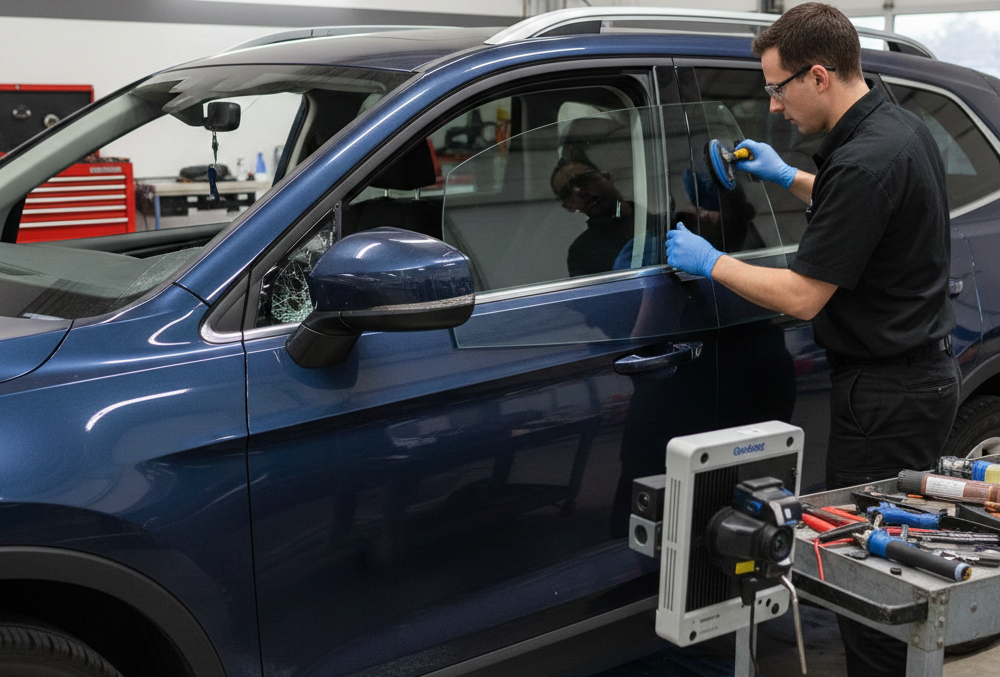
After a collision, replacing a window requires more than simply removing the damaged pane and adhering to a new one. It calls for accuracy and rigorous respect for safety regulations.
Evaluation and Elimination: A technician starts by evaluating the damage to the car’s body and glass. The pinch weld, which is the metal frame that holds the glass in place, is commonly broken or distorted as a result of unpredictable circumstances. This metal needs to be fixed before new glass can be put in, or the glass won’t seal properly.
The technician takes out the broken glass after confirming that the frame is sound. In this phase, the old urethane seal is carefully cut, and any broken glass inside the car and inside the door panels is vacuumed out.
Getting Ready and Priming: The pinch weld needs to be clear of any old glue or rust. The technician primes the new glass and the car frame using a specific primer. In addition to preventing rust, this primer gets the surfaces ready for a strong urethane adhesive bond.
Setting Up and Curing: The glass or the car frame is coated with a premium urethane adhesive. After that, the replacement glass is carefully lowered into position. This process is an exacting task; even a small misalignment in the glass might result in wind noise, water leaks, or catastrophic failure in the event of a future catastrophe.
Curing the adhesive is a process that takes some time. A phrase that describes this is the Safe Drive-Away Time, or SDAT for short. According to the temperature, humidity, and type of glue that is being utilized, the duration of this process might range anywhere from thirty minutes to twenty-four hours. You run the risk of dying if you drive the car before the adhesive has dried.
Do you have a Question?
Get An Auto Glass Replacement Quote Now 866.278.7417
The Significance of ADAS Adjustment
If your automobile was manufactured during the past 10 years, there is a good chance that it is equipped with Advanced Driver Assistance Systems (ADAS). Among these characteristics are:
Warning of Lane Departure
Emergency Braking Automatically
Cruise control that adapts
Rain-Detecting Wipers
Quite frequently, the cameras and sensors that are a part of these systems are situated just behind the windshield. The angle of these cameras gradually shifts when the windshield is replaced. The system may miscalculate distances if there is even a one-degree variation in the camera’s focus.
Following a collision repair, your car has to have its ADAS calibrated. Your safety features will function precisely as the manufacturer intended thanks to this procedure, which realigns the cameras using specialist targets and computers. If a shop offers to replace your windshield but is unable to calibrate it, you might need to go right away to a dealership or other specialized facility.
OEM or Aftermarket Glass Technology: You will probably have to choose between OEM and aftermarket glass when approving repairs.
OEM (Original Equipment Manufacturer) glass is produced by the same company that was responsible for producing the original glass manufactured for your automobile manufacturer. Its thickness, hue, and form are all the same as those of the manufacturing glass. Usually, the carmaker’s logo is on it.
Reputable businesses produce aftermarket (OEE, or Original Equipment Equivalent) glass, which does not have the manufacturer’s name. It must comply with the same safety criteria as glass that was manufactured by the original equipment manufacturer.
Which is superior? Aftermarket glass is a secure and affordable option for the majority of cars. However, original equipment manufacturer (OEM) glass is commonly recommended (and even required) for premium automobiles or automobiles that have advanced ADAS systems in order to ensure that the sensors function appropriately. Verify your insurance policy because some companies pay for aftermarket glass only when you pay the difference.
Handling Costs and Insurance
The “collision” section of your auto insurance policy, rather than the “comprehensive” section (which covers things like falling branches or vandalism), usually covers collision damage to glass.
You will need to calculate the deductible because collision claims typically have one. The cost of replacing your car could be less than your deductible if the only damage is a broken side window. Paying cash in this situation keeps a claim off your record.
An insurance claim is the sensible course of action, though, as the expenses might easily surpass $1,000 if the damage includes the windshield, ADAS calibration, and paintwork. To find out if your policy has a special “full glass” endorsement that could eliminate the deductible for glass repair, always ask your insurance agent.
Commonly Asked Questions: After the glass is restored, can I go back behind the wheel of my automobile right away? No. The adhesive needs time to cure. Depending on the type of glue used, the technician will give a precise safe drive-away time. Ignoring this precaution could result in an accident when the windshield slips or separates.
Will my other windows match the replaced glass? Yes, trustworthy glass shops match your new glass’s tint and color to the rest of the car. In the event if you have bespoke aftermarket tint, it is quite likely that you will be required to have the replacement window retinted separately after the installation has been completed.
What happens if, weeks later, I discover glass fragments in my car? Tempered glass bursts into thousands of fragments that can conceal themselves inside door panels, under seats, and in air vents. Over time, even with thorough vacuuming, a few particles may eventually find their way out. If you hear rattling in your door, return to the store; they may need to remove the door panel to clear debris.
Putting Safety First When Making Repairs
After a car accident, dealing with the aftermath can be difficult, upsetting, and draining. Fixing the glass can seem like just another task on an already lengthy to-do list, especially when you have to deal with insurance claims, repair quotes, and getting your daily schedule back on track.
However, you should never compromise on auto glass repair or replacement due to the crucial role your windows play in maintaining the structural integrity and safety systems of your car. The strength of your roof, the correct deployment of airbags, and the precise operation of contemporary safety technology are all influenced by your windshield and glass.
Selecting a professional auto glass specialist who uses premium materials, adheres to manufacturer-approved installation protocols, and recognizes the significance of accurate calibration for sophisticated driver-assistance systems is crucial.
The artistry and accuracy of the installation are ultimately what safeguard you and your passengers, regardless of whether you choose OEM or premium aftermarket glass. Don’t wait or think the glass problem can be fixed later if your car has been in an accident.
Prompt inspection and expert service can restore your car’s protective systems to factory standards and prevent hidden safety hazards. To evaluate the damage and make sure your car is genuinely road-ready and safe to drive again, get in touch with a reputable auto glass specialist right away.
The True Justification for Windshield Replacement
It is a bright, beautiful day as you travel down the highway. It is not possible to spot any gravel trucks, and the road is in a smooth condition. Abruptly, the cabin reverberates with a thunderous crack. A long, thin line snakes its way from the glass’s edge toward your line of sight as you search the glass, hoping to spot a starburst pattern from a stray rock.
Drivers frequently find this behavior puzzling. It seems as though the injury happened suddenly because there is no obvious point of impact. That crack is actually a sign of unseen forces operating on your car. The cause of it is hidden frame tension.
A minor rock chip may seem bothersome but fixable, but a stress crack indicates that something more serious is occurring between the body of your car and its glass. since of this dynamic, the topic goes from a cosmetic fix to a severe safety problem, and it is vital to understand this dynamic since it shifts the focus of the discussion. The structural tension that initially weakened the glass is typically more important in determining whether to replace a windshield than visibility.
An example of a structural component is the windshield. We must first examine the construction of contemporary vehicles in order to comprehend why frame tension is harmful. Windshields used to be little more than wind blockers secured in place with rubber gaskets. It wasn’t ideal if they popped out in a collision, but the metal frame of the automobile carried the weight.
The engineering philosophy has undergone a radical transformation. In modern automobiles, the safety restraint system (SRS) consists of the windshield, which is a vital component. High-strength urethane glue is used to adhere it directly to the frame. Because of this link, the glass becomes a structural beam that connects the car’s pillars.
Automotive engineers use the windshield to give the cabin structural strength. In certain models, the windshield, which helps prevent the roof from folding inward in the event of a rollover crash, protects up to sixty percent of the structural strength of the vehicle. When a stress crack compromises that glass, it degrades the entire cabin’s structural integrity.
What Leads to Stress in Hidden Frames? Metal is slightly flexible, while glass is rigid. The chassis of your automobile flexes and twists a little while you drive in reaction to potholes, bumps, and cornering forces. The windshield and the adhesive bond can tolerate this movement under typical conditions. Nonetheless, several things can raise the glass’s strain to the point of breaking.
Issues with Manufacturing and Body Alignment
Occasionally, a car’s pinch weld, or the groove where the glass rests, has minor flaws as it leaves the manufacturer. The metal frame applies unequal, continuous pressure to the auto glass if it is not precisely aligned. This continuous tugging and squeezing eventually develops a weak spot. Even when parked, the glass is essentially under load.
Changes in Temperature: When heated, materials expand, and when cooled, they contract. Metal and glass expand differently. The metal frame may shrink more quickly than the glass if you reside in a region that experiences drastic temperature fluctuations, such as chilly nights followed by sunny mornings.
Extreme pressure is produced along the windshield’s edges by this imbalance. If the glass is already under tension from the frame, an abrupt shift in temperature often triggers the formation of a stress crack.
Inadequate Prior Installation: One of the main causes of frame tension if you’ve had your windshield changed in the past is incorrect installation. Glass that was placed into the frame unevenly or that the technician failed to clean the old urethane adequately will have “high spots.” These high points serve as fulcrums, concentrating all of the chassis flex at one point on the glass until it cracks.
Do you have a Question?
Get An Auto Glass Replacement Quote Now 866.278.7417
The Significance of Stress Cracks as Time Bombs
An impact break is not the same as a stress crack. Localized damage is known as an impact break. Tension is released by a stress crack. It usually continues as the tension subsides. For three main reasons, this makes replacement much more important.
Unpredictable Dispersal: If detected early, impact chips can frequently be contained with resin. Because the forces that cause stress cracks are still there, they are infamously tough to fix. If the frame continues to apply uneven pressure, even after you have repaired the crack, the glass will probably crack again, usually from the same location or creating a new fissure close by.
These fissures have the potential to expand quickly. Just by turning on the defroster or running over a speed bump, a tiny 2-inch crack at the edge can grow into a 12-inch crack across your field of vision. Due to the fact that it is unexpected, the car is one that should be driven with caution.
Failure of the Airbag: The integrity of your passenger-side airbag is dependent on the windshield for its correct operation. The airbag deflects outward to cushion the passenger after shooting upward and colliding with the windshield. This reaction occurs with explosive force in milliseconds.
If a significant stress crack compromises the windshield, the airbag may not be able to sustain its deploying force. The glass may break or completely separate from the frame. The airbag will inflate through the opening instead of toward the passenger if the glass gives way, making the safety device ineffective.
Rain sensors, automated emergency braking, and lane departure warning are some of the ADAS technologies that are present in the majority of modern automobiles. However, there are some compromises that are associated with Advanced Driver Assistance Systems (ADAS). These systems typically install their cameras behind the windshield.
Cameras are set up to focus on a particular angle through the glass. A stress crack distorts the light traveling through the windshield. Even if the crack isn’t in front of the lens, the glass’s structural displacement may misalign the camera. Due to visual distortion, your car may perform risky steering corrections if it believes the lane sign is three feet to the left. Not only is it required to replace the glass, but it is also important to recalibrate these delicate safety mechanisms.
How to Spot a Stress Crack: How do you tell whether you have a dangerous stress crack or a simple rock chip? A ballpoint pen can be used for a straightforward test.
Move the pen’s tip along the crevice. You most likely have an impact break from debris if the pen dips slightly into a pit or a divot at any point along the line. If the crack starts from the very edge of the molding and the pen moves smoothly over it without catching on a noticeable impact point, you are looking at a stress crack.
The edge of the windshield, where the glass meets the metal frame, is nearly invariably where stress cracks begin. Instead of the starburst pattern that characterizes stone hits, they may extend in a straight line or a meandering “S” curve.
Put Your Safety First While Driving
Ignoring a stress crack puts your car’s structural integrity at risk. The dangers of frame stress extend beyond a broken windshield ticket, despite the temptation to put off repairs to save money or time. Your safety system is hacked and could malfunction just when you need it most.
The wisest move is to arrange for a replacement right away if you notice any indications of a stress crack. To return your car to its original safety standards, a qualified technician can remove the cracked glass, check the frame for any rust or deformities that may have contributed to the stress, and install a new windshield.
Commonly Asked Questions: Is it possible to fix a stress crack? Usually not. Stress cracks weaken the windshield’s structural integrity too much for a resin injection to repair since they begin at the glass’s edge and spread into the viewing area. The crack typically reopens due to the underlying stress from the frame. The usual remedy is replacement.
Are stress cracks covered by insurance? Regardless of the reason, comprehensive insurance coverage often covers windshield damage. A stress crack is handled similarly to an impact break if there is glass covering. To determine whether it makes financial sense to file a claim, however, check the deductible for your particular policy.
Is using a stress crack while driving against the law? Cracks that block the driver’s view or interfere with the wipers are illegal in most states and countries. Furthermore, a police officer may decide that a car is hazardous to drive because stress cracks degrade the vehicle’s structure.
To what extent does the process of repairing a windshield take time? The replacement process typically takes one hour. To ensure that the urethane adhesive has had the time to thoroughly dry, the vehicle must typically be left to wait for an additional one to two hours before it can be driven safely. The visit can take longer if your car needs its ADAS camera recalibrated.
Mobile Safe Auto Glass
14241 E Firestone blvd suite 400,
La Mirada, CA 90638
Phone: (562) 608-1154
Toll Free: 1 866 278 7417
Mail: sales@mobilesafeautoglass.com
Get a FREE QUOTE today! You can get a free quote and schedule 24/7 using this free quote wizard.
Mon – Fri 8am – 5pm
Saturday 8am – 1pm
Sunday Closed