Auto Glass Replacement for Vehicles With ADAS Systems
Have you ever noticed that your vehicle seems to be able to tell when you are drifting out of your lane or when you are going too near to the vehicle that is in front of you during a driving situation? Technology, not magic, is what’s at play here. To be more specific, it is a collection of safety features that are collectively referred to as Advanced Driver Assistance Systems (ADAS). Because of these devices, car safety has been revolutionized, which has resulted in fewer accidents and saved lives. The replacement of your windshield, which was formerly a straightforward repair, has been made more difficult by the addition of a new layer of complexity.
Get An Auto Glass Replacement Quote Now 866.278.7417

Windshield Replacement & Repair
Our competitors push you into going to their shop to get your glass fixed-making it cheaper for them. We make it easier for YOU to get back on the road by offering free mobile repairs at your home or work. With our free mobile services servicing the entire Orange County & Los Angeles area, we can often handle your windscreen replacement the same day! So the next time you need a windshield replacement, give us a call.
Talk to a Windshield Replacement Specialist Now 866.278.7417

Calibration
Calibration is the process of returning a vehicle’s ADAS to OEM specifications. Calibration is necessary after a new glass installation, particularly a windshield with a camera mounted to it, to ensure that the ADAS features continue to function properly despite having been moved during installation. If a car’s ADAS is not properly calibrated, the system may not function safely. A misaligned camera could jeopardize the functionality of the system and lead to dangerous driving or accidents, so it is crucial that the cameras are aligned perfectly, which is what windshield calibration ensures.
Talk to a Calibration Specialist Now 866.278.7417

Fleet Auto Glass Repair
We provide expert auto glass repair and windshield replacement services for commercial fleets of all sizes. We are experienced with all manufacturers and machine types of domestic or foreign cars, trucks, vans, or commercial vehicles, including heavy equipment. Our same day mobile auto glass and windshield repair service will enable you to get back on the road faster and start saving you time and money instantly. Give us a call today! We are here to help!
Talk to a Fleet Auto Glass Specialist Now 866.278.7417
Can You Explain What ADAS Is and How It Operates
Electronic systems in a car that make use of modern technology to provide assistance to the driver are referred to as modern Driver Assistance Systems, or ADAS for short. For the purpose of gaining an understanding of the environment surrounding the vehicle, they make use of a variety of sensors, cameras, radar, and lidar.
The majority of these sensors are located right behind the windshield, typically in close proximity to the rearview mirror. Although they can be found in bumpers, grilles, and side mirrors, the majority of them are on the windshield itself. As a result of this positioning, the cameras are able to view the road from a perspective that is comparable to that of the driver.
Common Advanced Driver Assistance System (ADAS) functions: You may utilize these functions on a daily basis without even understanding that they are connected to your windshield. Lane Departure Warning (LDW): When you drift over lane markers without signaling, this feature will alert you. The Lane Keep Assist (LKA) feature is responsible for actively guiding the vehicle back into the middle of the lane. Warning of an approaching accident with a vehicle or obstruction in front of the vehicle is what the Forward Collision Alert (FCA) system does. Automatic Emergency Braking (AEB) is a system that applies the brakes automatically in order to avoid or reduce the severity of an accident.
Adaptive Cruise Control (ACC) is a feature that automatically adjusts your speed while maintaining a certain distance from the vehicle in front of you. This feature reads the speed limit and other road signs and shows them on your dashboard. It is considered traffic sign recognition. When a windshield is replaced, the lens that these cameras view through is physically moved. This is because the windshield is covered. The computations of the system can be severely thrown off if even a slight deviation of a few millimeters occurs in the future.
The Crucial Connection Between Windshields and Physical Protection
At first glance, a windshield appears to be nothing more than a piece of glass that prevents insects from getting into your mouth. In point of fact, it is a structural component of the vehicle and an essential component of the ecosystem consisting of safety measures. In order to achieve a particular position, the camera that is installed behind the glass is calibrated. It anticipates that the glass will possess a particular degree of transparency, curvature, and refractive index. It is certain that the camera may be jostled or somewhat shifted when the old glass is removed and a new one is fitted.
Even if the camera is wrong by just one degree, the region that it focuses on might be off by several feet if it is positioned further down the road. This mismatch can have potentially hazardous effects, including late braking, in which the vehicle may not detect an impediment until it is too late to come to a responsible stop. In the event of a false alarm, the system may apply the brakes in response to a “ghost” barrier that is not actually present.
The automobile may believe that it is centered in the lane while, in reality, it is drifting into the lane of traffic that is approaching from the other direction. For this reason, when replacing the glass on an ADAS-equipped car, it is not just about the seal and the quality of the glass; it is also about restoring the safety systems of the vehicle to the criteria that were specified by the manufacturer.
Do you have a Question?
Get An Auto Glass Replacement Quote Now 866.278.7417
Detailed Explanation of the Calibration Process
The process of calibrating and testing the ADAS cameras and sensors to ensure that they are functioning appropriately and to guarantee that they are aligned exactly is referred to as calibration. During this stage, the difference between a regular glass job and a contemporary safety repair is demonstrated. Static calibration and dynamic calibration are the two primary methods of calibration. You can require either one or both of these, depending on the make and type of your car.
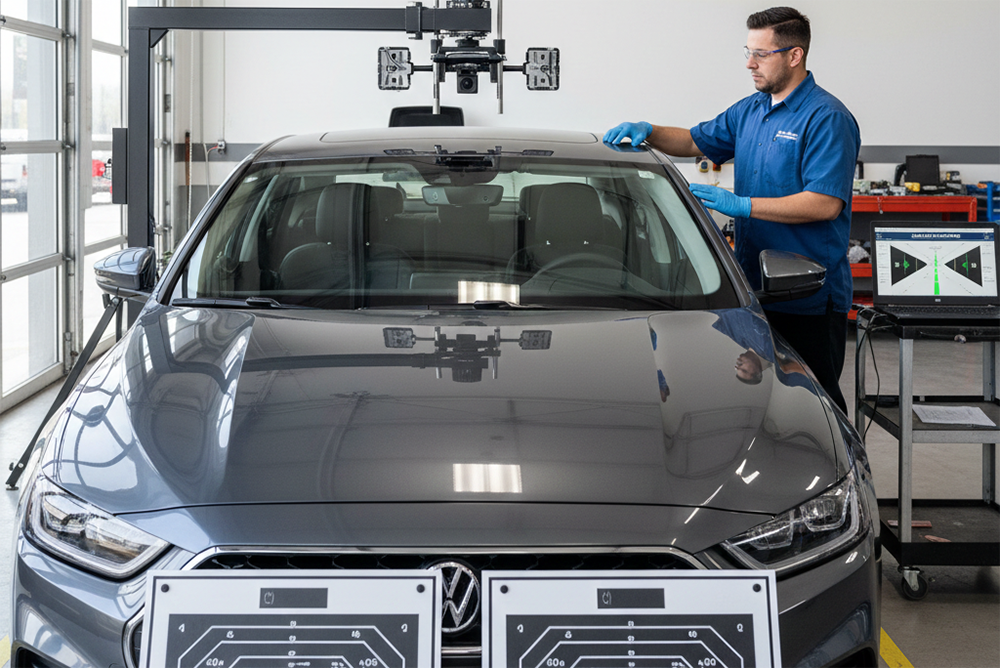
The process of static calibration is carried out in a shop setting that is under strict control. Floor that is completely level: the floor on which the car is parked is perfectly level. Mounted on fixtures at specific distances and heights from the vehicle are specialized patterns that are referred to as targets. The illumination must be uniform and free of shadows and glare, as these elements have the potential to cause the sensors to get confused. During the scanning process, a technician will utilize a computer tablet that is attached to the OBDII port of the vehicle in order to instruct the camera to locate the targets and then recalibrate itself.
It is possible that mobile windshield replacement services will not be able to conduct this approach in your driveway since it demands a significant amount of space and specialized equipment because of its accuracy. This process takes place on the open road and is referred to as dynamic calibration. The calibration tool is connected to the car by the technician who is performing the connection.
When driving, the vehicle is driven at a predetermined speed on roads that are clearly designated for a predetermined period of time. To “relearn” its position and concentration, the system makes use of the road markers and other cars in order to acquire new information. This may appear to be a straightforward process; yet, it necessitates favorable weather conditions (no precipitation, including rain or snow) and lane markers that are easily discernible.
Why You Should Opt for Original Equipment Manufacturer Glass
Whenever a windshield is being replaced on a vehicle that is equipped with modern safety measures, the quality of the glass is more important than it has ever been. OEE/Aftermarket, which stands for Original Equipment Equivalent, and OEM, which stands for Original Equipment Manufacturer, are the two options that you will often have. The firm that produced the original glass for the automobile manufacturer is the same one that produces OEM glass. The glass that was included with your vehicle when it first rolled off the production line is exactly the same as this one.
Glass that is sold aftermarket is manufactured by independent businesses. However, it is possible for it to have tiny differences in curvature, thickness, or clarity, even though it must comply with federal safety regulations. When it comes to ADAS systems, OEM glass is recommended by a large number of companies and specialists.
Due to the fact that the cameras are so sensitive, even minute defects or waves in aftermarket glass can cause the picture that the camera sees to be distorted, which makes calibration extremely challenging or perhaps impossible. OEM glass may even be required under certain car warranties in order to ensure that the safety systems continue to be protected.
Expenses and Their Coverage by Insurance
When compared to the cost of replacing a windshield on an earlier vehicle, the cost of replacing a windshield on an ADAS-equipped vehicle is much higher. This is due to the additional complexity and the calibration equipment that is required. The price of a job that used to be $300 may easily range anywhere from $700 to $1,500 currently, depending on the car they are working on. The replacement of windshields is typically covered by comprehensive insurance policies, which is a positive development.
Due to the fact that ADAS is a safety feature, insurance companies typically pay for the cost of calibration alongside the feature itself. They have an understanding that a windshield that has not been calibrated is a liability. On the other hand, before arranging the work, it is usually a good idea to verify with your provider. You should inquire particularly about whether or not they will cover the expenses of calibration and whether or not you have authorization to use OEM glass if your manufacturer advises it.
How to Determine Which Auto Glass Shop Is Right for You
Auto glass stores are not all made equal in the same way. In situations when your safety is at stake, you need a specialist that is not just familiar with the adhesive but also with the technology overall. When you are looking for a price, here are some things you should ask: “Do you perform calibration in-house?” Some shops outsource this task to dealerships, which can add additional time to the repair process. In response to the question, “Are your technicians certified?” look for credentials issued by the Auto Glass Safety Council (AGSC).
Documentation demonstrating that the systems were tested and passed should be provided to you in response to the question, “Do you provide a calibration certificate?” “Are you able to perform static calibration?” If your vehicle needs static calibration, a technician who only works on mobile devices will not be able to perform the task correctly in your driveway.
Questions That Are Frequently Asked
Even if the camera wasn’t disconnected, is it possible for me to avoid the calibration? No. The process of physically removing and reinstalling the glass causes a change in the angle and position of the lens (the windshield) in relation to the sensor. This occurs even if the camera is left hooked in. The system must undergo recalibration in order for it to operate in a secure manner.
When it comes to the replacement and calibration, how long does it take? An hour is required for a basic replacement, but the calibration process adds additional time. When compared to dynamic calibration, which is dependent on traffic and road conditions, static calibration might take anywhere from sixty to ninety minutes. In order to ensure that the adhesive has sufficient time to dry away safely, you should plan to remain without your car for a total of three to four hours.
In the event that my calibration is incorrect, would a warning light on the dashboard ding? It is not always the case. So now comes the terrifying part. In the event that the system is irreparably damaged, a light could turn on. If, on the other hand, the system is only slightly misaligned, it might not cause a warning light to illuminate, but it would still not operate properly in the event of an emergency. It is for this reason that expert calibration is an absolute need.
Does ADAS take into account window tint? It is able to. When applying a tint strip across the top of the windshield, which is sometimes referred to as a “brow,” you need to make sure that it does not cover the region where the camera lens is located. Films with a dark tint or a metallic tint have the potential to obstruct the views or signals captured by the camera.
Safety Should Take Precedence Over Convenience
The maintenance of automobiles is becoming more accurate as they grow more intelligent. When it comes to current automobile owners, the days of being able to replace a windshield in thirty minutes for cash are becoming less common. Despite the fact that the higher expense and time necessary for ADAS windshield repair may be bothersome, it is a minor price to pay for the superior protection that these systems provide.
It is not enough to just hunt for the lowest possible price when the pebble hits your glass. You should look for a business that is able to comprehend the complicated computer that is located behind your rearview mirror. The capacity of your vehicle to safeguard you and your loved ones is contingent upon it.
What Makes Precision More Important Than Price When It Comes to Windshield Replacement
Unmistakable is the sound that is produced when a rock strikes your windshield. Your stomach will immediately feel as though it is sinking as a result of the harsh snap that you just heard. While you are observing the spiderweb crack spread over the glass, your thought is probably the first thing that comes to mind: how much money will this be going to cost?
Over the course of several decades, replacing a windshield was a basic and generally affordable repair. An hour after you phoned a shop, they provided you with a pricing estimate for the glass as well as the work, and you were able to go back on the road. As a matter of course, motorists have been conditioned to look for the most affordable rate.
Despite this, the automobile sector has been subjected to a significant transformation. A wind blocker is no longer the only function that the piece of glass in front of you serves. It functions as a sophisticated lens for a network of safety systems that is extremely complicated. In the process of replacing anything, if you put the lowest possible price ahead of technical precision, you are not just putting yourself at danger of a leaking seal. The safety features that are intended to save your life might be compromised as a result of your actions.
By gaining an understanding of the reasons why recalibration accuracy is the most important component of windshield replacement, you may avoid making mistakes that are not only expensive but also possibly hazardous in the future. It is the era of “smart” windshields. It is necessary to have a look at what is going on behind the scenes in order to comprehend the reason why the cost of replacement has increased, as well as the reason why the understanding of the technician is more important than it has ever been.
The majority of automobiles that were produced after the year 2016 come standard with Advanced Driver Assistance Systems, which are more generally referred to as ADAS. These systems are able to “see” the road since they are equipped with cameras, lasers, and radar sensors. The camera that faces forward is nearly always fixed directly to the windshield, despite the fact that certain sensors are located in the bumper or grille.
This camera is responsible for controlling essential safety systems, such as the Lane Departure Warning (LDW) system, which notifies you if you make a sudden departure from your lane without signaling. Lane keep assist, often known as LKA, is a feature that automatically guides the car back into the lane. The Forward Collision Alert (FCA) sends out a warning when a collision with a vehicle or item in front of you is about to occur. Automatic Emergency Braking (AEB) is a system that automatically applies the brakes in order to avoid getting into an accident.
Maintains a predetermined distance from the vehicle in front of you, which is referred to as adaptive cruise control (ACC). In the event that your windshield is being replaced, the technician will need to take this camera off and then reconnect it to the new glass. Microscopically small variations in the glass curvature or the positioning of the bracket might cause the camera’s angle to shift, even if the new windshield seems to be similar to the old one.
There Is A Difference Of One Degree
Possibly, you are wondering how much of a difference a little change in the camera actually makes. The solution may be found in geometry. You are staring hundreds of feet down the road with the camera that is mounted on your windshield. In the event that the camera is improperly oriented by even a single degree, the mistake will be considerably amplified across that distance.
It is possible that your Automatic Emergency Braking system will not engage at all or will engage too late if you have a one-degree downward pitch. This is because it will incorrectly compute the distance to the vehicle in front of you. On the other hand, it might lead the vehicle to “phantom brake,” so that it comes to a sudden and abrupt halt for an obstruction that does not actually exist.
Your Lane Keep Assist system can become confused if there is a lateral (side-to-side) misalignment. While the automobile is genuinely drifting into oncoming traffic, it may believe that it is centered in the lane while it is actually drifting. “Close enough” is not an acceptable term in the current field of vehicle glass repair because of this reason. It is imperative that the calibration be accurate and precise in accordance with the manufacturer’s specs. It is common for a low-cost glass estimate to omit the cost of this crucial phase, or even worse, to rely on workers who lack knowledge and speed through the operation.
Dissecting the Recalibration Procedure in Detail
Recalibration is the process of electrically directing the camera in such a way that the computer system of the vehicle is aware of the precise location of the camera in relation to the road. There are two basic approaches to solving this problem, and depending on the car you have, you could require either one or both of them.
This technique is known as dynamic recalibration, and it entails driving the car at a certain speed on roads that are clearly designated. It is the technician’s responsibility to connect a portable device to the OBDII diagnostic port of the vehicle. During the course of their journey, the system makes use of the road lines to determine the position of the camera and then adjusts the software accordingly.
This may appear to be a straightforward operation; nevertheless, in order to guarantee that the “learning” process is carried out effectively, it is necessary to have suitable weather conditions, clear lane markers, and a technician who is aware of exactly what to look for.
Static Recalibration: This technique is being carried out in a shop setting that is under strict control. There is a level floor on which the car is parked. In front of the vehicle, the technician positions very accurate targets or patterns on a fixture at a particular distance and height from the vehicle.
It is as if the computer in the vehicle “stares” at these targets in order to properly position the camera. In order to do this, specialized, high-priced equipment and an atmosphere devoid of distractions are required. In order to complete an accurate static calibration, a shop that is cluttered or has flooring that is uneven is not recommended.
Why Low-Cost Glass May Be a Choice That Comes With a High Risk
Whenever you come across a windshield replacement estimate that is much lower than the average price in the market, it is typically due to the fact that concessions are being made. When it comes to ADAS systems, here is where the cheap option frequently fails to deliver. Glass with Optical Clarity Original Equipment Manufacturer (OEM) glass is manufactured in accordance with the stringent criteria set out by the automobile manufacturer. There is a possibility that aftermarket glass (OEE) is of good quality, although “economy” glass frequently experiences distortion.
With the naked eye, the glass seems to be transparent. On the other hand, waves or ripples in inexpensive glass behave in the same way as a prescription lens that is slightly off when viewed via a computer camera. Due to the fact that the camera is unable to focus accurately on the road, the calibration process is either impossible or inaccurate.
Skipping the Pre-Scan: Before handling the vehicle, a qualified technician will run a diagnostic pre-scan to determine whether or not any of the vehicle’s safety systems already have fault codes. In an effort to save time, budget stores frequently omit this step. If there is already a problem with the system, upgrading to a new windshield won’t repair it, and you can feel as though you have a false feeling of security as you drive away.
Recalibration is a technical process, yet there is a lack of proper training. Training and certification are both necessary for it. There is a possibility that discount suppliers will hire personnel who are skilled in the physical installation of glass but do not have the technological skills necessary to manage ADAS. It is possible that your safety features will be compromised if they fail to successfully conduct the calibration drive cycle or if they install the camera bracket in an incorrect manner.
Do you have a Question?
Get An Auto Glass Replacement Quote Now 866.278.7417
Questions to Ask Prior to Making a Reservation for a Replacement
Asking the appropriate questions is the first step in being able to protect yourself. It is important to look beyond the total dollar amount when you are collecting quotations from different companies. To answer the question, “Does your quote include ADAS recalibration?” some stores will charge you for the glass alone, and then they will surprise you with the calibration fee later on. It’s possible that other people will tell you that you don’t require it, which is a rather unusual occurrence for contemporary automobiles.
Alternatively, they could urge you to go to the dealership to get that item fixed, which would leave you with an additional errand and a different expense. “What kind of glass do you use?” Inquire as to whether or not the glass satisfies the criteria set out by the original equipment manufacturer for ADAS systems. If they are unable to verify this, you should search elsewhere.
In response to the question, “Can you provide a calibration certificate?” a respectable company will submit documentation after the service has been completed. This report provides evidence that the calibration was successful and that the camera is providing accurate readings. In addition to being important for your records, this also establishes accountability for the shop.
The question is, “Do you have the equipment to do static calibration in-house?” If your vehicle has to be statically calibrated, the shop needs to have the room and the targets to perform the calibration. In the event that they attempt to do a static calibration in a parking lot, they are not adhering to the appropriate measures for safety.
The Insurance Consideration
One piece of encouraging news is that the majority of comprehensive insurance policies acknowledge the need for recalibration requirements. In most cases, insurance companies are prepared to pay for the necessary procedures to maintain ADAS systems operational since they are aware of the fact that these systems lower the number of accidents that occur.
If you have glass coverage, you should not feel compelled to select the most affordable shop in order to “save the insurance company money.” You have the right to select a facility that places a priority on safety standards. Your deductible will typically stay the same regardless of the total amount that the shop bills you, so it is in your best interest to select the service that is of the greatest possible quality.
Positioning Safety on the Road as a Priority
The sticker shock that comes with replacing a contemporary windshield is all too real. When you pay hundreds of dollars, or even more than a thousand dollars, for a repair that was formerly considered to be quite simple, it may be very aggravating. In spite of this, we need to reframe our understanding of what it is that we are truly paying for.
A sheet of laminated glass is not the only thing that you are purchasing. The repair of a complicated safety system is something that you are paying for. The payment you make for a licensed technician ensures that your vehicle will respond promptly and properly in the event that it is required to apply the brakes for you in an emergency situation.
Accuracy is not a bonus when it comes to the sensors that are responsible for protecting you and your family; rather, it is an absolute must. The next time a rock chips your view, search for a business that prioritizes safety standards and calibration over pricing. This will help you avoid any more discomfort. It is well worth the price to have your peace of mind.
Questions That Are Frequently Asked:
How can I determine whether or not my vehicle is equipped with ADAS? Take a look at your windshield. You most likely have a camera that is pointing forward if you see a cutout that is either triangular or trapezoidal and contains a lens inside of it near the mount for the rearview mirror. Additionally, you may consult the owner’s handbook of your vehicle to learn about features such as Lane Keep Assist or Forward Collision Warning.
Does the recalibration process allow me to drive my vehicle right away? After the recalibration has been completed successfully, the systems will be operational and ready to go. Nevertheless, you must continue to adhere to the prescribed waiting intervals in order for the urethane (glue) to take effect, which is responsible for holding the windshield in place. You will receive guidance from the technician on the safe drive-away time, which is typically one hour following the installation.
What will occur if I do not readjust my settings? It is possible that warning indications would appear on your dashboard, which would be the desirable outcome. A situation in which the lights remain out but the systems fail to perform properly, such as braking when they shouldn’t or failing to brake when they should, is the worst possible scenario.
Does it have to be the case that replacement and recalibration take place at the same time? In a perfect world, absolutely. Driving with a camera that is not properly oriented is dangerous. In order to guarantee that the vehicle is risk-free before it is released from their care, the majority of expert shops will do the calibration and replacement together at the same appointment.
Mobile Safe Auto Glass
14241 E Firestone blvd suite 400,
La Mirada, CA 90638
Phone: (562) 608-1154
Toll Free: 1 866 278 7417
Mail: sales@mobilesafeautoglass.com
Get a FREE QUOTE today! You can get a free quote and schedule 24/7 using this free quote wizard.
Mon – Fri 8am – 5pm
Saturday 8am – 1pm
Sunday Closed