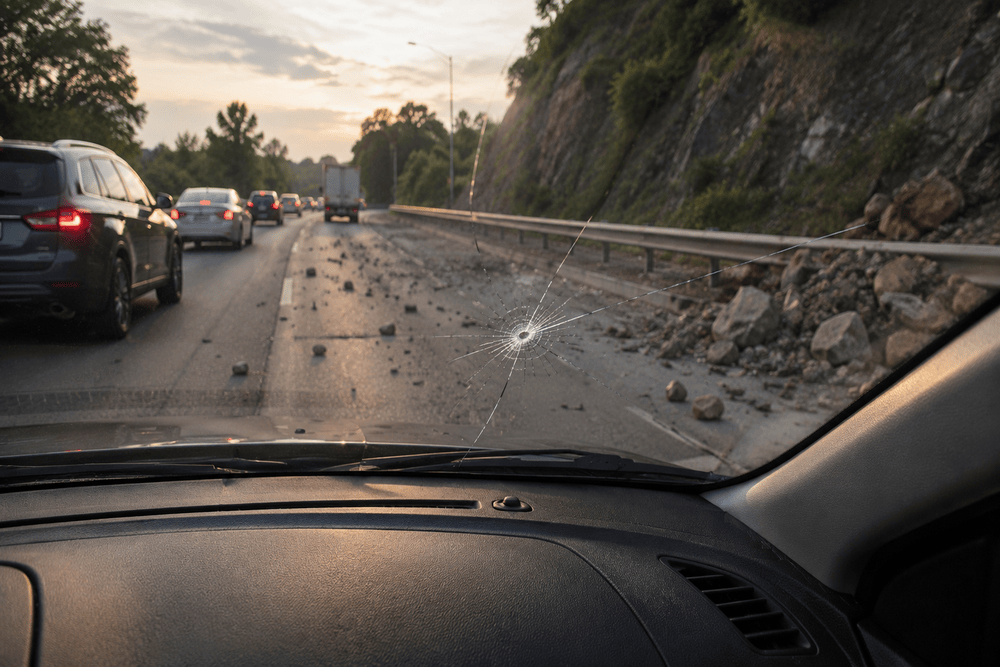
Road Hazards That Make You Fix Cracked Windshield Sooner
A little windshield fracture may become a serious safety problem due to certain road dangers, such as gravel, potholes, temperature changes, and huge vehicle debris. While a complete windshield replacement costs $200–$400 or more, fixing a tiny fracture early usually costs $50–$150. You can safeguard your safety as well as your pocketbook by acting quickly. A few weeks ago, you noticed the crack. Perhaps you struck a pothole at an incorrect angle or a pebble kicked up on the roadway. You convinced yourself you would deal with it later since it seemed to be little. It’s spreading now, and the danger increases with each journey. A damaged windshield may result in improper airbag deployment and break more readily upon impact. Therefore, that “minor” fracture is far more important than it seems.
Get An Auto Glass Replacement Quote Now 866.278.7417

Windshield Replacement & Repair
Our competitors push you into going to their shop to get your glass fixed-making it cheaper for them. We make it easier for YOU to get back on the road by offering free mobile repairs at your home or work. With our free mobile services servicing the entire Orange County & Los Angeles area, we can often handle your windscreen replacement the same day! So the next time you need a windshield replacement, give us a call.
Talk to a Windshield Replacement Specialist Now 866.278.7417

Calibration
Calibration is the process of returning a vehicle’s ADAS to OEM specifications. Calibration is necessary after a new glass installation, particularly a windshield with a camera mounted to it, to ensure that the ADAS features continue to function properly despite having been moved during installation. If a car’s ADAS is not properly calibrated, the system may not function safely. A misaligned camera could jeopardize the functionality of the system and lead to dangerous driving or accidents, so it is crucial that the cameras are aligned perfectly, which is what windshield calibration ensures.
Talk to a Calibration Specialist Now 866.278.7417

Fleet Auto Glass Repair
We provide expert auto glass repair and windshield replacement services for commercial fleets of all sizes. We are experienced with all manufacturers and machine types of domestic or foreign cars, trucks, vans, or commercial vehicles, including heavy equipment. Our same day mobile auto glass and windshield repair service will enable you to get back on the road faster and start saving you time and money instantly. Give us a call today! We are here to help!
Talk to a Fleet Auto Glass Specialist Now 866.278.7417
Why Do Road Cracks Spread So Fast
Understanding the mechanics is helpful before delving into particular risks. Laminated safety glass, which consists of two glass layers joined to a plastic interlayer (usually polyvinyl butyral, or PVB), is used to make windshields.
When anything hits the surface, the inner layer keeps the glass in place while the outer layer absorbs the stress and may break. The outer glass layer’s structural integrity deteriorates once a fracture appears.
Every bump, temperature shift, or strong wind gust puts more strain on an already vulnerable area. After a single difficult trip, a tiny chip may snake across a whole windshield because cracks spread along the route of least resistance.
Road Hazards That Worsen a Cracked Windshield: Gravel Roads and Loose Debris One of the most frequent sources of new chips and exacerbating pre-existing cracks is loose gravel.
Stones are thrown from the tires of moving cars at a high speed. A pebble hitting a pre-cracked windshield may significantly increase the damage, even at low speeds.
A chip that could ordinarily remain stable in city traffic might turn into a growing fracture in a matter of days if you often travel on unpaved or gravel-heavy roads. On these surfaces, maintain a safe following distance from other cars, particularly trucks.
Rough Road Surfaces & Potholes: Potholes are detrimental to windshields in two ways. First, the whole vehicle structure experiences a shockwave from the abrupt jolt. Second, that force causes your windshield to flex slightly, which is sufficient to widen an already-existing fracture.
Roads with crumbling asphalt or frequent bumps provide a continuous vibration cycle that gradually expands damage. This is especially important in late winter and early spring, when roads are covered with fresh potholes due to freeze-thaw cycles.
Temperature Extremes and Quick Changes: When you park in the sun on a 100°F day and then turn on the air conditioning, the inside surface of the windshield experiences a quick thermal contraction. Temperature affects how quickly glass expands and contracts, and the stress sites where this movement concentrated are called cracks.
The same phenomenon happens in reverse when warm water is poured over a frozen windshield, a popular wintertime shortcut. The glass expands unevenly due to the abrupt temperature shock. In only a few minutes, a chip that has remained dormant all winter may spider outward.
Commercial Vehicles and Large Trucks
The chance of debris hits is significantly increased while following construction vehicles, dump trucks, or semis. At highway speeds, these trucks often transport loose items that might fall or be thrown backward, such as boulders, sand, timber, or building supplies.
Large vehicles cause a lot of road disturbance in addition to trash. Even in the absence of a direct hit, a broken windshield may flex due to the air pressure difference produced when a big vehicle passes at high speed.
Hail and Severe Weather: A hailstorm striking a windshield that is still intact is dangerous enough. It may be disastrous on one that already has a crack. When hailstones strike near an existing fracture, many additional stress sites are simultaneously created. A previously steady fissure may suddenly branch outward in several directions due to even little hail, quarter-sized or smaller.
It’s also important to drive on damaged roads after a lot of rain. In addition to wiper blade vibration at the border of the fracture, standing water striking the glass at highway speeds causes constant tension that gradually expands the damage.
Highway Speeds and Wind Pressure: Wind pressure on the windshield greatly rises at speeds above 60 mph. This is not a problem for an undamaged windshield since it is designed to withstand aerodynamic force. In the case of a broken one, the prolonged pressure functions like a gradual wedge pushed into the opening.
Driving long distances on the highway might be unexpectedly harmful. After an hour on the highway, a crack that seems steady during a quick city journey might visibly widen. It’s highly recommended to fix a crack before a lengthy road trip.
Do you have a Question?
Get An Auto Glass Replacement Quote Now 866.278.7417
When a Crack Is Too Deep to Fix
The majority of vehicle glass experts adhere to a clear rule: resin injection can usually fix fractures less than three inches and chips smaller than a quarter. Larger vehicles often need to have their whole windshield replaced. Additional elements that cause a crack to enter “replacement” region include:
Location: Since restored glass may somewhat affect vision, cracks in the driver’s direct line of sight are often irreparable.
Depth: Repair is impossible if the break has pierced both laminated glass layers.
Edge cracks: The seal and the structural bond are compromised by cracks that begin within two inches of the windshield’s edge, necessitating replacement. A simple repair, as opposed to a complete replacement, is more likely to be successful the earlier you treat a crack.
How Much Does Windshield Repair Really Cost? Reputable auto glass shops usually charge between $50 and $150 for a common chip or minor crack repair, and many comprehensive vehicle insurance plans cover this with no deductible.
For most ordinary cars, a complete windshield replacement costs between $200 and $400. However, cars with advanced driver-assistance systems (ADAS), which need recalibrating cameras and sensors installed on the windshield after replacement, may cost up to $500.
It is not optional to recalibrate. Cameras installed on or close to the windshield are necessary for ADAS features including lane-keep assistance, collision alerts, and automated emergency braking. The accuracy of such systems may be compromised if the glass is replaced without first recalibrating them.
Do Not wait for the Crack to Decide for you
It is impossible to avoid road risks. The speed at which you react to harm is something you can manage. A single hard drive, a hailstorm, or a blast of the defroster in the frigid morning may turn a minor chip today into a complete replacement tomorrow.
Before winter arrives, before the next long journey, and before you come across a section of road that transforms a minor chip into a safety hazard, have the repair done. Make an appointment as soon as possible, find a trained car glass expert in your region, and find out whether the repair is covered by your insurance. Acting immediately is almost always less expensive than waiting.
Common Questions: Is it possible to operate a vehicle with a damaged windshield? Depending on your state or nation, driving with a small crack may be permitted, but it is not advised.
Cracks reduce visibility, weaken the structure, and spread swiftly when the road is stressed. A crack in the driver’s line of sight is considered a ticketable vehicle defect in several countries.
How quickly can a break in the windshield spread? Under the correct circumstances, a fracture may spread in a matter of hours. A crack may grow several inches in a single journey due to abrupt temperature fluctuations, potholes, or highway speeds. When a fracture will cease expanding on its own is impossible to anticipate with any degree of accuracy.
Is windshield repair covered by auto insurance? Windshield repair is often covered by comprehensive auto insurance coverage, frequently with no deductible. Certain insurers give free complete chip repairs, such as Safelite’s alliances with major suppliers. Before making an out-of-pocket payment, get in touch with your insurance.
Is a windshield repair long-lasting? Under typical driving circumstances, resin-based chip and crack restorations are intended to be permanent. Although the glass’s structural integrity has been restored, the mended region may still be somewhat visible. Although repairs won’t be apparent, they successfully prevent cracks from spreading.
When a chip or crack emerges, what should I do right away? Avoid using pressure while cleaning the windshield; instead, gently clean the damaged area. To keep moisture and debris out, temporarily cover the chip with transparent tape. Make an appointment for a repair as soon as you can; the longer you wait, the more probable it is that the damage will worsen.
Little Crack Now Might Cost You A Lot Tomorrow
More than just an aesthetic problem, a cracked windshield jeopardizes both your safety and the structural integrity of your vehicle. Small chips may often be fixed for less than $100, but if a crack extends more than 6 inches, a complete windshield replacement (usually costing $200–$400+) is required.
In most cases, taking quick action is the safer and less expensive option. Your windshield’s little chip? Ignoring it is simple.
You convince yourself that it’s really a little imperfection that is innocuous and hardly noticed. However, fissures don’t remain little. Road vibrations, temperature fluctuations, and regular driving pressure all work together to transform that little chip into a full-length fracture, at which point your alternatives become much more costly.
The good news is that most windshield damage can be repaired quickly and affordably if discovered early. This tutorial explains all you need to know, including how to evaluate the damage, when to replace rather than repair, what do-it-yourself choices are available, and how to stop the crack from expanding while you figure out a long-term solution.
Why a Cracked Windshield Is More Dangerous Than It Appears: Your windshield is much more than just a wind barrier. The Auto Glass Safety Council (AGSC) estimates that it accounts for up to 30% of the structural stiffness of your car.
A damaged windshield is far less successful in avoiding roof collapse during a rollover collision. Additionally, it facilitates the deployment of airbags; the passenger-side airbag uses the windshield as a backstop as it inflates, directing the bag toward the person.
All of this is weakened by a crack. The laminated glass layers may be compromised by even a tiny scratch, which would lessen the windshield’s capacity to absorb impact.
Beyond safety, a cracked windshield may cause visual problems, particularly when sunshine or headlights strike the affected region at certain angles. Driving with a cracked windshield in the driver’s direct line of sight is prohibited in several U.S. states and may result in a traffic penalty.
Crack Repairable or Need a Complete Replacement
Not all cracks are made equally. Three elements determine whether your windshield has to be completely replaced or repaired: depth, location, and size.
Size: The 6-Inch Rule: The majority of vehicle glass repair specialists adhere to the general rule that cracks shorter than six inches and chips smaller than a quarter may usually be fixed.
Larger damage often necessitates a complete replacement. Although some more recent repair solutions go above this limit, 6 inches is still the industry standard.
Location: Where the Crack Sits Matters: Even a well-executed repair may result in slight optical distortions, making it more difficult to fix cracks that are in the driver’s line of sight.
Because edge fractures weaken the barrier between the glass and the automobile frame and tend to spread more quickly, damage along the windshield’s edge is also more difficult to repair. Replacement is often advised in both situations.
Depth: Does It Pass Through Both Layers? Laminated windshield glass consists of two glass layers joined by a plastic interlayer called polyvinyl butyral, or PVB. Repair is not feasible if the break reaches both the interlayer and the glass layers. A visual examination allows a technician to swiftly evaluate this.
What Takes Place When Repairing a Windshield? The simple procedure of professional windshield repair usually takes 30 to 60 minutes. A specialist uses a suction instrument to remove air from the damaged region before injecting a transparent resin into the chip or fracture.
After the resin fills the gap and is UV-cured, the surface is smoothed out. Although the outcome won’t be entirely noticeable, it will prevent the fracture from growing and restore the glass’s structural integrity.
Depending on the extent of the damage and where you live, a professional chip repair in the US typically costs between $50 and $150. Windshield repairs are often covered by vehicle insurance plans with no deductible, so it’s a good idea to check before making an out-of-pocket payment.
Do you have a Question?
Get An Auto Glass Replacement Quote Now 866.278.7417
Should You Use a Do It Yourself Windshield Repair Kit
Auto parts retailers provide DIY windshield repair kits, which range in price from $10 to $35. They use inferior materials and less accuracy, but they employ the same fundamental technique as expert repair—injecting glue into the fracture.
For tiny bullseye chips (the circular fractures created by a single point of contact), do-it-yourself kits function rather well. The findings are less accurate for intricate star-shaped fractures or longer cracks. When resin is applied incorrectly, air bubbles may be trapped or it may not adhere completely, making future professional repairs more difficult.
If the damage is minor, you need a temporary fix, and professional repair isn’t readily accessible, use a do-it-yourself kit. Go immediately to a professional instead of using the kit for anything bigger than a quarter or for damage that is in your line of sight or close to the edge.
How to Prevent a Crack from Spreading Right Now: Take the following actions to prevent a crack from spreading if you are unable to get your windshield fixed right away:
Cover the crack with transparent tape. This prevents moisture, dirt, and debris from entering the injured region, which may hasten spreading and result in poor resin bonding during repair.
Steer clear of drastic temperature swings. In summer heat, avoid turning on the air conditioner or blasting hot air on a cool windshield. Glass expands and contracts in response to sudden temperature changes, widening fissures.
Take caution while driving. Cracked glass is stressed by vibration caused by driving over uneven terrain or hitting potholes.
Park in the shade. Damaged parts of the glass are compressed by the uneven heating caused by direct sunlight. These solutions just give you time; they don’t solve the issue. It is best to get the damage evaluated as soon as possible.
How Much Does Replacing a Windshield Cost
Replacement is the next course of action when repair is not an option. The kind of glass, the brand and model of your car, and whether or not it features advanced driver assistance systems (ADAS) like lane departure warning or automated emergency braking all have a big impact on the price.
The average cost of replacing a windshield is between $200 and $400. After replacement, cars with ADAS cameras installed on the windshield need to be recalibrated, which may increase the final cost by $150 to $300 or more. Specialty and luxury cars might be much more expensive.
Although you will often have to pay your deductible, windshield replacement is typically covered by comprehensive vehicle insurance. There are “zero deductible” windshield replacement rules in several jurisdictions, including Florida, Kentucky, and South Carolina, which require insurance to pay the whole cost without imposing a deductible.
What’s the Best Course of Action Right Now? This math is easy. A $400 replacement next month is outweighed by a $75 fix today. Tiny fissures spread. One chilly night or a rough road may turn what begins as a chip from a rock on the roadway into a complete fracture.
As quickly as possible, get the damage evaluated. Mobile repair providers will visit your house or place of business, and the majority of vehicle glass firms provide free examinations.
The cost to you is almost $0 if your insurance pays for repairs without a deductible. There isn’t an ideal moment to deal with it, so don’t wait. Until you do, the crack will continue to widen.
Common Questions Regarding Windshield Cracks
Can I operate a vehicle with a cracked windshield? The size and position of the fracture will determine whether or not you can. In several U.S. states, it is prohibited to have a crack in the driver’s line of sight, and it may result in penalties. Before driving, any fracture that reduces vision or jeopardizes structural integrity should be fixed.
How quickly does a break in the windshield spread? If certain circumstances are met, such as severe temperatures, vibrations from uneven roads, or moisture seeping into the crack, a crack may expand within hours. The fastest-spreading fissures are usually seen around the edges.
Is windshield replacement or repair covered by auto insurance? Replacement and repair are usually covered by comprehensive vehicle insurance. The deductible for repairs is often waived by insurance. Complete windshield replacement is legally covered in several areas without a deductible.
How much time does it take to fix a windshield? The majority of expert fixes need 30 to 60 minutes. Before the car can be driven, a full replacement takes 60 to 90 minutes, plus a further 30 to 60 minutes for curing.
If the crack is visible to me, is windshield repair covered? The technician’s evaluation will determine this. Many stores advise replacement when repairs are made in the driver’s direct line of sight since they may cause slight optical distortions.
Mobile Safe Auto Glass
14241 E Firestone blvd suite 400,
La Mirada, CA 90638
Phone: (562) 608-1154
Toll Free: 1 866 278 7417
Mail: sales@mobilesafeautoglass.com
Get a FREE QUOTE today! You can get a free quote and schedule 24/7 using this free quote wizard.
Mon – Fri 8am – 5pm
Saturday 8am – 1pm
Sunday Closed