Professional Tips to Fix Cracked Windshield the Right Way
If the damage is less than a dollar note and out of the driver’s line of sight, a broken windshield may often be fixed. Larger or more intricate cracks are usually needed for complete replacement. Quick action keeps the cost of repair low and stops the fracture from expanding. You saw that little chip this morning? It won’t remain little for very long. Cracks in windshields have a tendency to widen. A little chip may become a crack that covers your whole field of vision due to temperature changes, road vibrations, or even a vehicle door slamming shut. A few days of delay may rapidly turn a $50 repair into a $400 replacement.
Get An Auto Glass Replacement Quote Now 866.278.7417

Windshield Replacement & Repair
Our competitors push you into going to their shop to get your glass fixed-making it cheaper for them. We make it easier for YOU to get back on the road by offering free mobile repairs at your home or work. With our free mobile services servicing the entire Orange County & Los Angeles area, we can often handle your windscreen replacement the same day! So the next time you need a windshield replacement, give us a call.
Talk to a Windshield Replacement Specialist Now 866.278.7417

Calibration
Calibration is the process of returning a vehicle’s ADAS to OEM specifications. Calibration is necessary after a new glass installation, particularly a windshield with a camera mounted to it, to ensure that the ADAS features continue to function properly despite having been moved during installation. If a car’s ADAS is not properly calibrated, the system may not function safely. A misaligned camera could jeopardize the functionality of the system and lead to dangerous driving or accidents, so it is crucial that the cameras are aligned perfectly, which is what windshield calibration ensures.
Talk to a Calibration Specialist Now 866.278.7417

Fleet Auto Glass Repair
We provide expert auto glass repair and windshield replacement services for commercial fleets of all sizes. We are experienced with all manufacturers and machine types of domestic or foreign cars, trucks, vans, or commercial vehicles, including heavy equipment. Our same day mobile auto glass and windshield repair service will enable you to get back on the road faster and start saving you time and money instantly. Give us a call today! We are here to help!
Talk to a Fleet Auto Glass Specialist Now 866.278.7417
How Serious the Damage Is
Examine the crack first. The size, depth, nature, and position of the break determine the best course of action since not all windshield damage is created equal.
Which kinds of fractures in windshields can be fixed? Expert vehicle glass specialists often adhere to a simple guideline: if the damage is less than a dollar bill, or around 6 inches, it may probably be fixed. Typical damage types that may be repaired include:
Bullseyes and incomplete bullseyes: Circular chips brought on by debris or pebbles. Star breaks are tiny fissures that radiate from the center of an impact.
Surface pits: Small fragments that haven’t broken through the glass’s two layers
Any damage that extends beyond the driver’s main sightline, such as cracks longer than six inches, almost invariably need a complete replacement. Because they jeopardize the glass’s structural integrity, edge cracks—those that extend to the windshield’s edge—are also usually irreparable.
When is replacing the windshield the only safe course of action? When should the windshield be replaced?
The fissure is more than six inches long.
The damage is just in front of the driver.
The laminated glass’s inner layer has been pierced by the break.
The damage is seen close to advanced driving assistance systems (ADAS), cameras, or sensors.
Windshields now are more complicated than they were in the past. Rain sensors, forward-facing cameras, and heads-up display components are now found in many. Precise recalibration is necessary for replacements on these cars, but unskilled technicians sometimes neglect this process, which might turn off safety systems.
What the Procedure Actually Entails
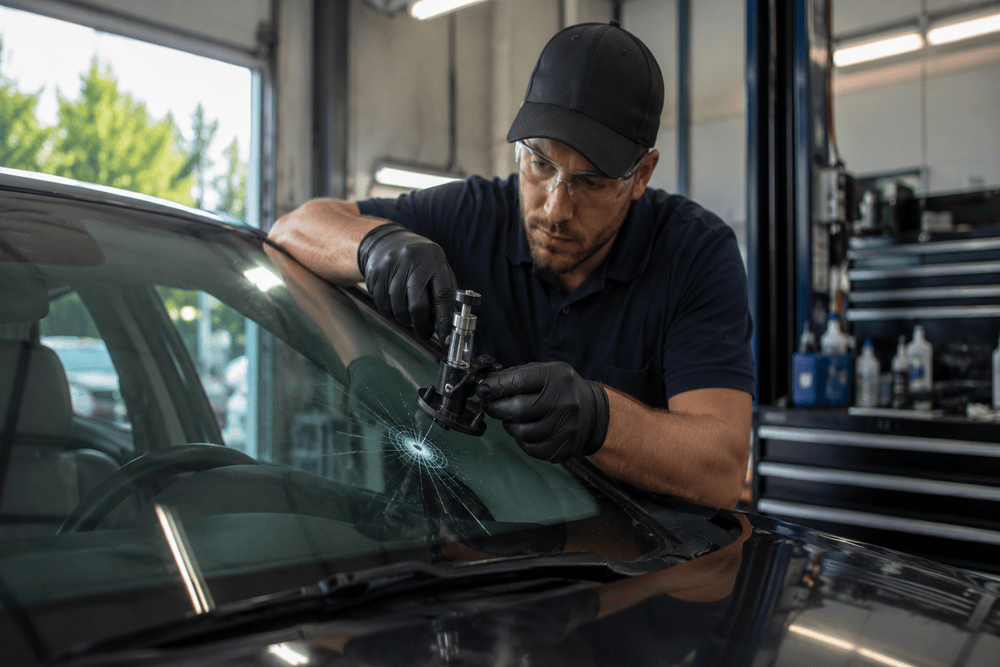
There are kits for do-it-yourself repairs, but they are somewhat limited. In order to fully heal the fracture and restore optical clarity, professional-grade restoration employs injected resin under vacuum pressure. What a competent technician performs is as follows:
Clean and prepare the injured area: Using a specialized drill or probe, the technician cleans the chip and removes any stray glass particles. This preparation step is more important than most people believe since moisture and dirt within the crack will prevent the resin from bonding properly.
Use a resin injector to create a bridge over the injured region while applying vacuum pressure. After using a vacuum to extract air from the crack, the technician fills it with UV-curable resin. Instead of the resin resting on the surface, the vacuum guarantees that it penetrates completely.
Cure and polish: The technician uses UV light to cure and solidify the resin once it has filled the crack. After that, the repaired region is polished to a smooth, optically clean surface.
The National Windshield Repair Association (NWRA) states that a high-quality repair recovers between 85 and 90 percent of the windshield’s original strength. For a single chip, the complete procedure usually takes 30 to 45 minutes.
Do you have a Question?
Get An Auto Glass Replacement Quote Now 866.278.7417
Advice on How to Correctly Handle a Cracked Windshield
These pointers can assist you in managing the issue appropriately, whether you’re waiting for your appointment or attempting to prevent more harm.
Take action within 24 hours since a crack is more likely to widen the longer it is exposed. Temperature fluctuations, moisture, and dirt all work against you. Cover the fracture with transparent tape to prevent debris out if you are unable to see a shop right away; however, this should only be used temporarily.
Steer clear of abrupt temperature swings, such as blasting your defroster or dousing a frozen windshield with hot water. Glass expands and contracts unevenly due to rapid temperature fluctuations, which may transform a chip that can be repaired into an irreversible break. Warm your automobile gradually while it’s freezing outside.
When you can, park in the shade since direct sunlight causes uneven heating of your windshield. Parking in a garage or under shade delays the spread of pre-existing damage and extends the period before a repair turns into a replacement.
Avoid pressure washing the windshield because the resin bonding process during restoration is compromised by high-pressure water forcing moisture deep into the fracture. If you need to clean the automobile, wash your hands around the damaged area.
Before making an out-of-pocket payment, check your insurance. Windshield repair is often covered by comprehensive vehicle insurance coverage with no deductible.
Insurance companies are required by law to pay for windshield repairs at no cost to the policyholder in a number of US states, including Florida, Kentucky, and South Carolina. Prior to making a payment, always give your insurance a call.
Inquire about ADAS recalibration if your vehicle has it: If replacing your windshield requires relocating or reinstalling cameras or sensors, ask the technician directly whether recalibration is included. Automatic emergency braking, lane departure alerts, and other vital safety features might be disabled if this step is skipped.
What Occurs When You Drive with a Broken Windshield
There is more to a cracked windshield than meets the eye. According to the Auto Glass Safety Council (AGSC), the windshield may account for as much as 60% of a car’s structural strength in a rollover accident. This protection is greatly diminished with a damaged windshield.
Beyond safety, most US states may issue a traffic penalty for driving with a broken windshield, especially if the damage blocks the driver’s vision. During car inspections, several states additionally mandate that windshields adhere to minimal requirements.
Selecting the Best Auto Glass Technician: The quality of auto glass repairs varies. When choosing a technician, consider:
AGSC certification: Industry standards for installation and maintenance are established by the Auto Glass Safety Council. These rules are taught to certified technicians.
Reputable stores provide a minimum 12-month guarantee for their repairs. OEM glass options: Find out whether your car is using OEM or aftermarket glass and what that entails.
Any contemporary car with driver-assistance technology must have the capacity to recalibrate its ADAS. For small chips, mobile repair services are convenient and generally accessible. An in-shop procedure with appropriate calibration equipment is the safest option for complete replacements, particularly on cars with ADAS.
Prevent a Minor Crack from Growing Into a Serious Issue: Although a broken windshield is seldom an emergency, it still has to be fixed right away. It usually just takes a few days to go from a $75 fix to a $700 replacement.
Get a qualified expert to evaluate the damage as soon as possible if it is minor and recent. You may not owe a dime if you first check your insurance coverage.
Invest in high-quality glass if replacement is required, and before you leave, make sure that any safety systems have been adjusted. Beyond just keeping out the wind, your windshield accomplishes more. Be mindful of it.
Common Questions
Can I operate a vehicle with a cracked windshield? In theory, the answer is yes, however it depends on the crack’s size and placement. In the majority of US jurisdictions, damage in the driver’s line of sight is both a safety risk and a legal concern. Additionally, a structural defect lessens the windshield’s capacity to shelter passengers in an accident.
How much time does it take to fix a windshield? The majority of expert chip or crack repairs take 30 to 45 minutes. It usually takes 60 to 90 minutes to replace the whole windshield, plus extra time for any necessary ADAS recalibration.
Will windshield repair be covered by my insurance? Windshield repair is often covered at no cost to the policyholder by comprehensive vehicle insurance coverage. Certain US states, such as Florida, Kentucky, and South Carolina, mandate that insurance pay for repairs without charging a deductible.
Does a windshield that has been fixed appear the same? Although a skilled repair greatly improves clarity and recovers around 85–90% of the windshield’s original strength, a faint mark may still be apparent in certain lighting situations. The only method to return the windshield to like-new condition is to replace it completely.
Does replacing a windshield with OEM glass make sense? When it comes to cars with built-in cameras, sensors, or heads-up displays, OEM glass is made to the precise specs of your original windshield. High-quality aftermarket glass is sometimes a more affordable option for older cars lacking these systems.
What distinguishes a fracture from a chip? A chip is a tiny fragment of glass that is missing from the surface and is often brought on by road debris. A line that radiates outward from the impact site is called a crack. Cracks are assessed according to their length, depth, and position; chips are simpler to fix.
How Professionals Repair a Broken Windshield
At first glance, a little chip on your windshield may seem innocuous. However, if you don’t do anything about it for a few weeks, that chip becomes a crack that covers your whole field of view. You might save hundreds of dollars and maintain your safety while driving if you know when and how professionals can repair damaged windshields.
This tutorial explains how expert car glass technicians evaluate and fix windshield damage, what equipment and supplies they use, and when a repair is insufficient and a complete replacement is required. By the time it’s all over, you’ll know what to anticipate if you take your vehicle in for windshield repair and what warning signals to look out for until your next visit.
What Determines Whether a Windshield Crack Can Be Repaired: Not all cracks are the same, and not all cracks can be repaired in the same manner. A professional uses a set of established criteria to evaluate the damage before touching your windshield.
The first consideration is size. The majority of expert repair businesses can fix fractures up to 30 cm long and chips up to 40 mm in diameter. Generally, anything larger than those dimensions requires a complete replacement.
Location is equally important. Repairing cracks that are in the driver’s direct line of sight is more difficult since even a well-filled fracture may cause some optical distortion that poses a safety concern. Because edge damage jeopardizes the glass’s structural integrity, cracks that extend to the windshield’s edge are likewise troublesome.
The third variable is depth. The two glass layers that make up a windshield are joined by a plastic interlayer known as PVB (polyvinyl butyral). Repair becomes much more difficult if the break reaches both layers, and replacement is often the safest option.
How Experts Repair a Cracked Windshield
Before doing a repair, how do specialists prepare the glass? The technician meticulously cleans the affected region before any resin approaches the fracture. A poor or hazy repair will result from the resin’s inability to properly adhere due to moisture, dirt, and debris trapped within the crack.
To achieve a clean surface, experts may add a little bit of isopropyl alcohol to the region after using vacuum equipment or specialized probes to remove impurities. In order to assist evaporate any moisture concealed deep inside the fracture, the technician may initially use a curing light to gently warm the region if the chip or crack has been exposed to rain or car wash water.
Which resin is used by experts to seal cracks in windshields? The resin injection is the foundation of every expert windshield repair. In order to make the repair almost undetectable, technicians use optically matched UV-curable resin, a transparent liquid substance that is intended to connect with the glass and solidify to a comparable refractive index.
By physically covering the damaged region, a bridge injector tool generates a vacuum that extracts air from the fracture. The injector reverses course and applies regulated pressure to force resin into the void once the air has been eliminated. This two-step procedure, which involves vacuuming and then applying pressure, guarantees that the resin fills the whole fracture, including any hairline extensions that aren’t often apparent to the unaided eye.
How are repairs cured and completed by experts? The technician uses a UV curing lamp to expose the resin to ultraviolet light once it has been properly injected. This locks the resin in place by hardening it in a matter of minutes.
Following the curing process, the technician takes out the injector tool and uses a razor blade to remove any extra resin, leaving the surface flat with the surrounding glass. Polishing is the last stage.
To restore clarity and smooth the mended surface, a little bit of curing film and polish are applied. A good repair should be almost undetectable and, more importantly, structurally sound.
Repair vs. Replacement: How Experts Make the Decision: Safety, not personal taste, is the deciding factor between repair and replacement. As a structural element of your car, the windshield gives passenger-side airbags the proper deployment angle and supports the roof in a rollover. Both of those tasks are jeopardized by a damaged windshield.
Do you have a Question?
Get An Auto Glass Replacement Quote Now 866.278.7417
When a Professional Windscreen Replacement Is Performed
Technicians switch to a complete replacement when repair is not feasible. The procedure entails cutting through the urethane glue that holds the broken windshield to the car frame in order to remove it completely.
The pinch weld—the metal frame around the windshield opening—is preserved by using either powered cut-out tools or cold knife techniques. After the old glass is taken out, the frame is cleaned and fresh urethane glue is put on.
Before being placed into the adhesive, the new windshield is precisely adjusted and secured in place using suction cup handles. Although complete cure may take up to 24 hours, most stores demand a safe drive-away time of one hour to enable the urethane to dry enough to keep the glass in place.
After a windshield replacement, modern cars with Advanced Driver Assistance Systems (ADAS), such as lane departure alerts and automated emergency braking, also need to have their cameras and sensors recalibrated. If this step is skipped, such safety measures may malfunction or cease to function completely.
Is There a True Difference Between Professional Repair and Do-It-Yourself Kits? There are consumer windshield repair kits, and some of them function rather well for extremely small chips. In contrast to professional service, there are significant constraints.
Because DIY kits lack a vacuum-pressure bridge injector, resin could not reach the whole depth of the fracture. Additionally, the results are less optically clear and the resins in consumer kits are of lesser quality than those in professional formulas.
Professional repair is the safest and more dependable option for anything bigger than a little surface damage. The most prevalent reason consumers choose a DIY kit is cost.
Depending on the car and kind of glass, a complete windshield replacement may cost anywhere from $200 to over $1,000, although a skilled chip repair usually costs between $50 and $150. Before making any out-of-pocket expenditures, it is advisable to confirm that many vehicle insurance plans cover windshield replacement at no cost to the driver under a comprehensive claim.
Prevent a Crack from Spreading Before Repairing It
A few steps may limit the growth of a crack if you are unable to see a repair business right away: Steer clear of significant temperature swings. Avoid parking in bright sunlight in the summer and don’t blow hot air on a freezing windshield in the winter.
Cover the crack with transparent packing tape. It will keep moisture and filth out, which make restoration more difficult, but it won’t stop the fracture from expanding. Steer clear of vehicle washes. Automated vehicle washes’ mechanical brushes and high-pressure water may push dirt further into cracks and hasten their development.
When Is a Cracked Windshield Serious? In all honesty, the answer is right now. Road vibration, temperature changes, or even a second tiny collision nearby might cause a chip or fracture that seems small today to expand quickly. More significantly, several states have laws that prohibit driving a car with a crack in the driver’s line of sight, therefore it could be against the law to drive with a damaged windshield.
In most stores, it costs nothing to have a crack evaluated by a specialist. In less than five minutes, the examination will determine if you need a replacement or a minor repair.
You May Be Surprised at What Your Windshield Can Do
Keeping the wind out is just one aspect of the windshield’s function. It serves as a safety mechanism, a load-bearing device, and the lens through which you see the road.
It is not worth the risk to treat a crack as a cosmetic problem. Fortunately, expert windshield repair has greatly improved.
The majority of chips and small cracks may be repaired for less than half an hour at a little cost, restoring clarity and strength. You’ll nearly always have the simpler, less expensive choice if you get it evaluated early.
Mobile Safe Auto Glass
14241 E Firestone blvd suite 400,
La Mirada, CA 90638
Phone: (562) 608-1154
Toll Free: 1 866 278 7417
Mail: sales@mobilesafeautoglass.com
Get a FREE QUOTE today! You can get a free quote and schedule 24/7 using this free quote wizard.
Mon – Fri 8am – 5pm
Saturday 8am – 1pm
Sunday Closed